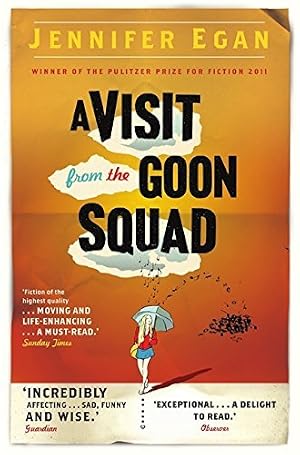
I had heard a lot about this book, and it hadn’t registered with me that it was written in 2010, which in these days of deluge of new titles is an eon ago. I don’t know why I didn’t read it at the time- it must not have appealed to me- and I’m not sure that it appeals to me now, sixteen years later. The title evoked a mafia, true-crime book, and the blurbs crowed with praise without actually denoting what the book was. I’m not sure that I even know what the book is, either.
The book starts with the two characters who are the linchpins of the book. The first is Sasha, personal assistant to a record producer who ‘picks up’ two things in the first chapter: a younger man called Alex whom she takes home for sex, and a wallet stolen from the handbag of another woman while she was in the toilet. The second is Bennie Salazar, Sasha’s former employer, who founded Sow’s Ear records and is still immersed in the music of the 1970s. These two characters are the linchpin, but only because the other characters have or have had a tangential relationship with them in the forty-odd years covered by this book. It’s like a book of six-degrees-of-separation, or a form of narrative doodling, where the author creates a character and then plays with them. The thirteen chapters each have a different character as their focus, slipping backwards and forwards in time, occasionally voiced in the first person, or in the format of a Powerpoint presentation. There are a lot of characters, and as you’re reading you’re not quite sure whether you’ve met them before. There are two musicians, washed up by the 1990s: Scotty, a semi-derelict who goes back to Bennie the record producer and launches a last open-air concert, hyped by influencers, and Bosco, a member of the Conduits, the bank that launched Bennie’s career who wants to commit suicide on stage but ends up recovering from cancer. There’s Dolly the publicist who holds a disastrous party and ends up in jail for negligence, who becomes a publicist for a dictator. There’s Rob, Sasha’s ‘pretend boyfriend’ at college, who dies in a drug-fuelled swim in the East River. There’s Lou, the hedonistic record producer, thrice married and the father of six children.
The ‘goon squad’ of the title is not a bunch of mafia thugs, as I suspected, but instead is time. ‘Time’s a goon, right? You gonna let that goon push you around?’ Two of the characters- Scotty and Bosco- both question how they started off at one place and ended up at another. When Scotty, disheveled and disturbed turns up in Bennie’s plush office he says
…I came for this reason: I want to know what happened between A and B…A is when we were both in the band, chasing the same girl. B is now. (p. 107)
Bosco wants to produce a new record ‘A to B’
The album’s called A to B, right? And that’s the question I want to hit straight on: How did I go from being a rock star to being a fat fuck no one cares about? Let’s not pretend it didn’t happen…Time’s a goon, right? Isn’t that the expression? (p. 134)
This question lies at the heart of the book- and indeed, in the heart of anyone over the age of, say, fifty who can look back at their life and wonder how they got there. What are the hinge-points; what are the inevitabilities? What if…what if.. It’s a big question but I don’t know if this multi-layered, tangled story is the best way to address it. There is a discipline to the book, and an overarching structure, but you have to work very hard to find it.
This book was discussed at the recent Ivanhoe Reading Circle meeting (which I missed) and both the presenter there, and several blogs I’ve read (including Louise at A Strong Belief in Wicker) felt that the book definitely deserved a second reading. Indeed some people have spent an inordinate amount of time reconstructing the timelines of the characters of the stories. I can see, just by flipping through the first chapter, that a second reading would yield a tapestry of threads that I hadn’t noticed on the first reading. But for me, a first reading should bring its own rewards, rather than needing a second reading to make it intelligible. As it is, each chapter is self-contained, and reads almost as a short story in its own right (indeed, several were published in the New Yorker as stand-alones). In a world drowning in new publications, I don’t know if any author has the right to demand two readings of any book to make it coherent: a second reading should be a joyful choice, not a post-requisite.
My rating: 7/10
Sourced from: purchased second hand from Brotherhood Books
Read because: Ivanhoe Reading Circle August 2026 selection.