
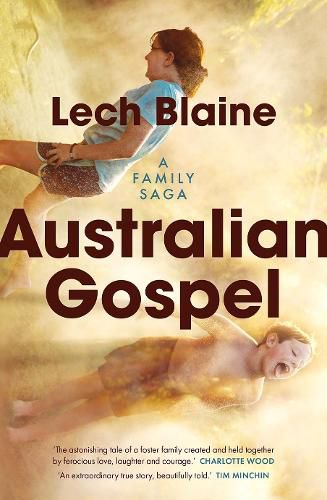
Sometimes a memoir says more by what it doesn’t say. The subtitle of this book is ‘A Family Saga’, and saga it certainly is, as it tells the long, drawn-out struggle between birth parents and Christian fundamentalist fanatics Michael and Mary Shelley and the foster parents of their three of their children, Tom and Lenore Blaine. It came as a rather guilty relief when Michael and Mary finally die by the end of the book, and you can let go of the breath that you have been holding and think “well, thank God that’s over”.
This is not a straight generation-to-generation family saga. The book starts in 1983 when Michael Shelley, accompanied by a 19 year old hitchhiker Glen, burst into the house of Fran and Neil Williams, the foster parents of Michael’s three year old son Elijah. To the background theme song of Play School, Michael and Glen literally snatched Elijah in front of his foster sisters, Debbie, Linda and Cindy, and took him back to join Mary Shelley as they continued on their peripatetic life proclaiming God’s providence and sponging on everyone they met. We don’t meet this event again until about a third of the way through the book, after we have learned of the family tree, history and relationships of the four main protagonists- the brilliant, egotistical Michael Shelley; his psychotic and dependent wife Carole Newgrosh who changes her name to Mary Shelley on her husband’s instructions; rough-and-tumble, overweight and raucous Tom Blaine; and his wife the conscientious Lenore Meurant who suffers miscarriage after miscarriage and whose love for children can encompass an ever-increasing number of children as foster carer
As Blaine notes in the preface, he wasn’t around for much of the action of this story, which had hardened into deep ruts of suspicion and wariness by the time he was born as Michael and Lenore’s only biological child. . The youngest child in the family, he is more observer than participant as Michael and Mary Shelley continue to confront the Blaine family demanding the return of their children, causing multiple shifts of residence as Tom buys up one hotel after another, a successful publican who builds up failing hotels into successful concerns.
Michael and Mary have multiple court appearance for harassment and stalking, not just of the Blaines but also of Queensland politicians who they hoped would take up their case- a strange way of trying to win support. Within the strict tunnel vision of their religion, they are quick to label women lesbians and men pedophiles. When they do manage to make contact with their children separately, they soon alienate them by their bitterness against the Blaines and their messianic fundamentalism.
Class is not directly addressed in this memoir, but it pervades it throughout. Both Michael and Mary Shelley had enjoyed privileged upbringings in Sydney, beautiful Mary appearing in the women’s magazines as the wife of singer Lionel Long, before meeting Michael Shelley. Tom and his hotels, with the Rugby trophies on the walls, the alcohol and the pokies are everything that Michael Shelley abhors, seeing it not only as evil but also working-class and demeaning. Certainly, contraception seems to be completely unknown throughout, as the Blaine/Shelley children grow up into adulthood with unplanned pregnancies catapulting them into responsibilities that they treat with varying degrees of maturity and avoidance. As their adult personalities emerge, so too does mental illness and addiction, but who can tell if it’s “in the blood” or a result of the constant evasion and escape prompted by yet another arrival of the Shelleys on their doorstep.
There is no grand plot twist at the end- or even a plot at all, for that matter- and the book is more observation than analysis. The book moves chronologically, focussing on one character and then another, with a number of small sub-chapters, each with its own subheading subsumed into larger chapters, which are in turn organized into three parts. The author withholds judgement, trying to present the perspective of each of his characters, and leaving the reader to pose the questions: what is a family? whose rights are paramount? what does it mean to be a parent? how well has the child protection system worked here? are we doomed to repeat the destructive patterns of our parents? can trauma ever be shaken off? is ‘alternative’ parenting abuse or just a choice?
What comes over most strongly is love – as a form of obsession and persistence, in the case of the Shelleys, or as a glowing coal of acceptance and protection, in the case of the Blaines. Although the author has withheld judgment, he hasn’t withheld his own gratitude and love for what Tom and Lenore Blaine gave to all of their children, himself included.
My rating: 9/10
Sourced from: Purchased from Ladyhawke Books, Ivanhoe
Read because: Ivanhoe Reading Circle selection.

