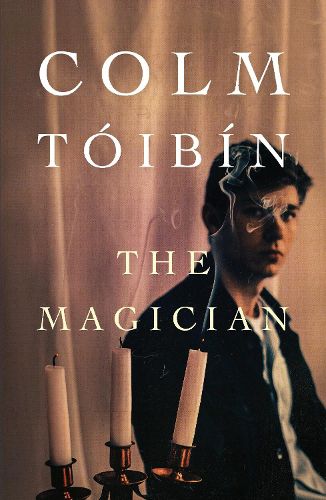
When I saw the Book Group selection for this month, I was a bit disappointed because I thought that I had read it before. However, I had confused Tóibín’s The Master (about Henry James) with The Magician, although looking at my pre-blog Reading Journal for The Master, my comments for the two book could be interchangeable.
Both of these books by Tóibín deal with a writer and his repressed/hinted at homosexuality in ‘fictionalized biography’ form. The Magician is a fictionalized biography of Thomas Mann, who was much spoken-of in my undergraduate English studies back in the 1970s but the only work of his that I have read is Death in Venice. I am a bit uneasy about fictionalized biography- which bits are fiction? which bits are biography?- and so I decided to read the Wikipedia entry for him before embarking on the book, and I’m glad that I did. I would have been able to follow it without any pre-reading, but I felt on more secure ground while reading it.
The book starts in Lübeck in 1891, when Thomas is a schoolboy in a wealthy provincial family. His father was a senator and Protestant businessman who had, rather out of character, married the impetuous Julia da Silva-Bruhns from Brazil. Thomas was one of five children, with his older brother Heinrich, sisters Lula and Carla and younger brother Viktor. When his father died, the will required the sale of the family firm, and Thomas’ mother and children moved to Munich. Thomas was sent to be an office clerk at a Fire Insurance Company even though, like his older brother Heinrich, he had aspirations to be a writer. Always attracted to young men, he married Katia Pringsheim in 1905, who came from a wealthy, secular Jewish industrialist family. They had six children, but she was always aware of his homosexual yearnings, and even facilitated them. His two eldest children Erika and Klaus were also homosexual and thoroughly embroiled in the Weimar Republic nightclub and intellectual scene. Another son came out later in life. His first novel Buddenbrooks was published in 1901, a thinly disguised history of his own family, and it launched his literary career which culminated in the Nobel Prize for Literature in 1929. It was the money from his publications, especially the American dollars from the translations of his work, which shielded him from the economic madness of Weimar Germany and enabled him to build several houses and live a comfortable lifestyle. His books, while not autobiographical, reflected his own interests: the decline of the old Hanseatic bourgeoisie, the attraction between an older man and young boys, music, and a conservative, anti-modernist politics that championed German intellectual literature.
Although there is much about his writing (very little of which I have read), what interested me particularly, in today’s political world, was the gradual encroachment of Nazism, which Thomas at first discounted as an aberration that would pass. However, after being encouraged to go to Switzerland as the political climate hardened:
Thomas began to lose hope that the regime might fail in Germany. The Nazis, he realized, were not like the poets of the Munich Revolution. They were street fighters who had taken power without losing their sway over the streets. They managed to be both government and opposition. They thrived on the idea of enemies, including enemies within. They did not fear bad publicity- rather, they actually wanted the worst of their actions to become widely known, all the better to make everyone, even those loyal to them, afraid (p. 200)
His brother Heinrich and children Erika and Klaus were more politically vocal than he was, and unable to believe that Hitler could usurp the strong German intellectualism that Mann so prized, and paralysed by fear for Katia’s Jewish parents (and perhaps conscious of his book sales) he took a long time to actually voice his opposition to Nazism, even though he had been on the National-Socialists’ radar for some time. It was only once he had managed to get to the United States- in itself a close-run thing, in spite of his contacts in high places- that he felt confident to openly express his anti-Nazi sentiments. However, he found that his status as a Nobel Prize winning author became a tool to be wielded by governments for their own purposes. The United States government wanted him to publicly warn of the dangers of Nazism, but remain silent on America’s own involvement in the war. After the war, the US government pressured him not to go to East Germany, which as a believer in the unity of the German spirit, he wanted to do. The FBI questioned him several times about the Communist leanings of his friends, and expressed their dissatisfaction with his East German visit. In the end, he left America and moved to Switzerland, where he died.
Much of this book is about Mann’s relationship with his family, which is certainly a strange one. The narrative perspective is entirely Thomas’, and he is probably the least interesting of them all. The whole basis of his marriage to Katia was off-kilter from the start, and it is hard to know what she made of his infatuations and constant appraisals of the men he met. Three of his children were homosexual: I don’t know quite what that says. He was in a constant intellectual competition with his older brother, who at times seemed to hate him, and his children were all rude to him- and he to them, in spite of supporting them financially. His demand for silent working time in his office set him apart from his family, and dominated family life. His two daughters committed suicide; a son died of an overdose. As is often the case with parents with a fraught relationship with their children, he gained more pleasure from his grandchildren than he ever did from his own children. His son Michael wrote:
I am sure the world is grateful to you for the undivided attention you have given to your books, but we, your children, do not feel any gratitude to you, or indeed to our mother, who sat by your side…It hardly bothers you, most likely, that these feelings of adulation are not shared by any of your children. (p.394)
Not a letter that any parent would want to receive from their child.
Running alongside this ‘respectable’ family man is his lifelong attraction to men, particularly young men. Age does not seem to weary him: right into his 70s he is still attracted to, and flirts with, young men. He wrote about his desires, including those involving his own son, in diaries which he feared falling into the wrong hands (well, any hands really) after he had to flee Germany.
There were two men that he did not become and he might make a book from them if he could conjure up their spirits properly. One was himself without his talent, without his ambition, but with the same sensibility. Someone fully at ease in a German democracy. A man who liked chamber music, lyric poetry, domestic quietness, gradual reform. A man, all conscience, who would have stayed in Germany even as Germany became barbaric, living a fearful life as an internal exile.
The other man who someone who did not know caution, whose imagination was as fiery and uncompromising as his sexual appetite, a man who destroyed those who loved him, who sought to make an art that was austere and contemptuous of all tradition, an art as dangerous as the world coming into shape. A man who had been brushed by demons, whose talent was the result of a pact with demons. (p. 332)
Then, interwoven with all this, is the presence of many other public figures: W. H. Auden (who married his daughter in a marriage of convenience as a cover for their homosexuality), Christopher Isherwood, Stefan Zweig, the Rooseveldts, Arthur Schoenberg, Mahler and the Washington Post owners, Agnes and Eugene Meyer.
Tóibín captures both these elements in this book. I found myself wondering what having it as a ‘fictionalized biography’ added to the book. The invented conversation and inner dialogue of fiction allowed him to flesh out these two aspects of his personality beyond a mere recitation of events, but the biographical aspect and the need to confine himself within actual events constrain the author from exploring his character as fully as he could have. Toibin’s Thomas Mann remains a rather bloodless man, and the members of his family even more so. With no footnotes, I had to just trust him as a biographer, and I don’t know whether my trust is justified or not. Mann remains an enigmatic and not particularly likeable character, but I suspect that Tóibín intended that from the start.
My rating: 7.5
Read because: Rosanna Readers selection
Sourced from: Yarra Plenty Regional Library Bookgroups program.