
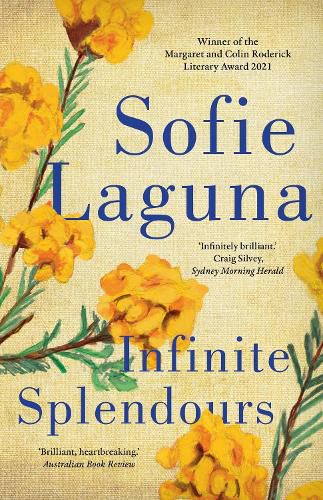
SPOILERS AND DISTURBING MATERIAL AHEAD
I don’t know why I read Sofie Laguna’s books: I feel restless and anxious the whole way through them. But actually, I do know why I read her- she is masterful in entering into a vulnerable child’s mind and putting the pain and precariousness of the situation onto you, as a reader. But they’re not easy reading.
Ten-year-old Lawrence and his brother Paul live with their mother on a large block at the foot of the Grampians in Western Victoria. Their father had died as a pilot during WW2 and their mother has her own childhood traumas. The book starts in 1953 and Laguna spends nearly 100 pages establishing the rural simplicity of the brothers and their innocence in their small country house with the mountains of the Grampians- especially the large Mt Wallis that dominated the chain of mountains – a constant presence against the sky. Lawrence is a bright boy and a good artist; his brother Paul less so. Their mother is strict in the way of 1950s parents, and she works as a bookkeeper at the nearby dairy. Their closest neighbour is Mrs Barry next door, who sees the boys in the backyard as she tends her vegetable garden.
Their lives have been changed, though, by the arrival of their Uncle Reginald, their mother’s brother, who had been absent for many years. Their mother and Reginald had had a disrupted childhood, and their mother had always credited Reginald with her survival- although her survival from what she never says. Reginald and his mother are like two rather creepily affectionate teenagers, dancing to the record player in the lounge room, drinking Teachers whisky at night. Reginald encourages her to go out dancing, offering to mind the boys. Paul is wary of Uncle from the start, and wants him to leave. Lawrence is flattered by Uncle’s interest in him and his art, and Uncle starts giving Lawrence little gifts, “as our secret”.
You know where this heading, and it does. After 130 pages, Lawrence’s life ruptures.
He is a changed boy. He begins to stammer, he falls ill and unable to put into words what has happened, he lashes out as his brother Paul, whom he wanted to protect from Uncle. Uncle is long gone. He takes off, despite his sister’s pleadings to stay, and she is left crushed by his disappearance. Years pass, and instead of the bright future that beckoned, he takes up a job at the dairy where his mother works, where he is mocked by the other works for his stammer.
It is at the dairy that, as a 24 year old, he encounters ten-year old Colin, the son of one of the workers. With the same sense of sickening inevitability that you felt when reading of Uncle’s increasing attention to Lawrence, you see him repeating the same pattern with Colin. Laguna snatches her characters from danger at the last minute, although Lawrence goes on to become a recluse, holed up in his childhood home now that his mother has died, dependent on his brother Paul to negotiate with the world that has no patience for his stammer. He is isolated in the countryside now that his neighbour Mrs Barry has died, with only his love of painting to sustain him. He paints obsessively, painting Mt Wallis over and over, and filling the house with canvases.
More years elapse, and we meet him again in 1994, now in his sixties, dirty, disturbed and isolated. When a new family moves into what was Mrs Barry’s house next door, he is furious at the intrusion of other people into his life. The mother, Rachel, is friendly but wary of their strange neighbour, and her adolescent daughter Tanya is mocking and derisive. Ten year old David, however, is drawn to Lawrence and once again as a reader you know what is going to happen.
As in her other books, Laguna pulls the story away from absolute despair at the end, although possibly less so in this book. As with the other books, it is told in the child’s voice and this stunted, damaged voice is maintained even though Lawrence is now over sixty years old. It’s strange: Sofie Laguna spoke at a recent Ivanhoe Reading Circle, and her bubbly rather dramatic persona belies the vulnerable and hurt children that she writes about. Alongside fellow Australian author Sonia Hartnett, who also writes about children growing up in brutal worlds, I wish that both these talented, lyrical writers could break out of this child-misery genre and write a completely different book. Perhaps I am more critical of this book because I only recently read Laguna’s The Choke (my review here) and the two books are too similar.
It is risky for a writer to write from the point of view of a child abuser, even though she sympathetically depicts Lawrence as a damaged, tortured soul. Nonetheless, as a reader you come to fear for any child that comes into his orbit, despite your knowledge of Lawrence’s background which has caused him to be this way. I started to feel a bit as if Laguna was manipulating her readers: she holds the tension for a long time about Uncle’s intentions for Lawrence, and having not one but two ten-year-old boys come into Lawrence’s orbit is a form of ratcheting up the tension, only to release it, then repeat. I know that Lawrence’s painting was a form of displacement, but Laguna’s descriptions of his works was laboured and overdone.
I don’t know what to think about this book. It is beautifully written: it is a sensitive topic written with insight and sympathy (too much sympathy??). But I think that the author played too much with the reader’s emotions and attention, and I don’t know if I want to read another of her books if it is like this one. Not for a long while, anyway.
My rating: 7/10
Read because: Rosanna Readers Book Group
Sourced from: Yarra Plenty Regional Library Book Group Program.

