
SPOILERS
When I think of ‘historical fiction’, I summon up women in richly brocaded gowns, like Anne Boleyn , or perhaps thin, grey-streaked victims of the industrial revolution stepping from the pages of a Zola or Dickens. I don’t really think of the 1960s as being ‘historical’ because I was there. But historical the 1960s certainly are, and that sense of a past that is somehow separate from us pervades this book.
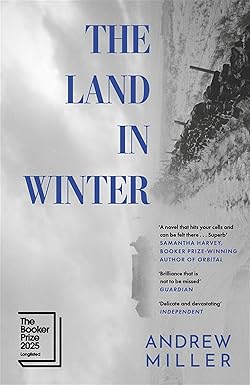
The winter of 1962-3 was an intensely bitter one, with England plunged into freezing conditions between Boxing Day 1962 until the spring of 1963. Juliet Nicolson’s Frostquake (read my review here) describes the time perfectly, and made me even keener to read this Booker Prize 2025 nominated book. It’s strange that I have read so many books set in a future beset by a climate emergency, but here is one set in the past- and what a difference that makes.
The book revolves around two couples in a small rural English village. Dr Eric Parry is one of the two local doctors in the village . His late father had started work on the railways early, and he had worked his way up to superintendent of the Birmingham New Street railway. He is married to Irene, whose family are of a higher social status and whose sister Veronica lives in America. Despite Dr Parry’s surface respectability, he is involved in an affair with Alison, who lives nearby, with her wealthy but thuggish husband and son.
Across the fields is the second couple: Bill and Rita. Bill’s father was a post-war refugee, probably Jewish, who had made money under suspicious circumstances, including as a slum landlord. Despite his city upbringing and his private school education and largely as a way of distancing himself from his family, Bill had purchased a small, barely-productive dairy farm. He was joined there by Rita, who had worked as a dancer in a bar. She had her own complex background: working in a bar where the line between ‘hostess’ and prostitute was faint. A tawdry and circumscribed relation with the bar owner Eugene culminated in an abortion in a nondescript house where none of the women looked or spoke with each other. We meet her father, Martin, one of the patients at the nearby asylum, and we learn that he had been one of the photographers who had documentated the liberation of the Belsen concentration camp. He was the patient who found the body of Stephen Storey, a 19 year old man due for release, who had committed suicide using the medication prescribed by Dr. Parry, the event with which the book starts.
The war is not far distant in 1962. Buildings are still bombed out, there are still Anderson shelters in people’s backyards, and conditions are still straitened. This is not at all the Britain of Carnaby Street or the Beatles which lay just ahead. Belsen and WWII had shaken not only Martin Lee in the asylum, but the influx of refugees, like Bill’s father, and the presence of people with numbers tattooed on their arms reminded everyone of what they had just lived through, even if they had not fought themselves. In the same way that the snow falls on the countryside, muffling everything and making it shapeless, so too the knowledge – spoken and unspoken- of the evil that had been exposed is silenced, made secret and not spoken of.
The action of the novel takes place over a short period of time, starting on 7 December 1962 and finishing on 12 January 1963, with an undated epilogue. The focus of attention shifts from one character to another of the quartet – Eric Parry, Irene Parry, Bill Simmons and Rita Simmons (nee Lee)- and it did take me a little while to realize which character was central in each unnumbered, short chapter. In essence: the two women, both pregnant at the same time and neighbours, form a friendship, despite the difference in their backgrounds and social standing; Bill decides to approach his father for money to establish an automated mega-dairy to replace the family-bound nature of the small farm; Irene finds out about her husband’s affair and Rita returns to her old haunts and friends in the nightclub district.
These small, crystalline domestic dramas are overlaid by the historical detail of the times and a specific weather phenomenon. Miller has really done his homework here (aided, I wonder by Nicholson’s book?) and he captures perfectly the social practices (heavy smoking and drinking, even among pregnant women), the domestic decor of houses, the clothes, the entertainments and to a lesser degree the political climate of 1962/3. The quiet shutting down of transport, power and trains, evoking for present-day readers the COVID shutdown, is a historically accurate depiction of a climate disaster, without the theatrics.
I loved the combination of this minute detail alongside characters who are fleshed out, conflicted and flawed. I really enjoyed this book, and I’m looking forward to reading Flesh which pipped it for the Booker Prize in 2025. I think that, set in a time which is not often written about – that grey, straitened England of the early 1960s- this book is likely to stand the test of time. It’s a very quiet book, and all the more powerful for its restraint.
My rating: 9.5/10
Sourced from: Yarra Plenty Regional Library. It has taken about six months for the loan to become available.
Read because: I knew it was a Booker Prize shortlisted book from 2025, and I very much enjoyed Juliet Nicholson’s Frostquake.

