
Tag Archives: historical-fiction

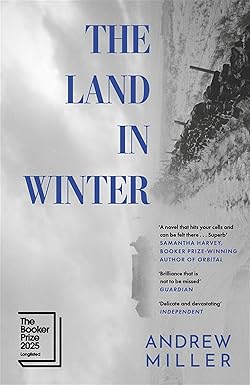
‘The Land in Winter’ by Andrew Miller

2024, 371p.

SPOILERS

When I think of ‘historical fiction’, I summon up women in richly brocaded gowns, like Anne Boleyn , or perhaps thin, grey-streaked victims of the industrial revolution stepping from the pages of a Zola or Dickens. I don’t really think of the 1960s as being ‘historical’ because I was there. But historical the 1960s certainly are, and that sense of a past that is somehow separate from us pervades this book.

The winter of 1962-3 was an intensely bitter one, with England plunged into freezing conditions between Boxing Day 1962 until the spring of 1963. Juliet Nicolson’s Frostquake (read my review here) describes the time perfectly, and made me even keener to read this Booker Prize 2025 nominated book. It’s strange that I have read so many books set in a future beset by a climate emergency, but here is one set in the past- and what a difference that makes.

The book revolves around two couples in a small rural English village. Dr Eric Parry is one of the two local doctors in the village . His late father had started work on the railways early, and he had worked his way up to superintendent of the Birmingham New Street railway. He is married to Irene, whose family are of a higher social status and whose sister Veronica lives in America. Despite Dr Parry’s surface respectability, he is involved in an affair with Alison, who lives nearby, with her wealthy but thuggish husband and son.

Across the fields is the second couple: Bill and Rita. Bill’s father was a post-war refugee, probably Jewish, who had made money under suspicious circumstances, including as a slum landlord. Despite his city upbringing and his private school education and largely as a way of distancing himself from his family, Bill had purchased a small, barely-productive dairy farm. He was joined there by Rita, who had worked as a dancer in a bar. She had her own complex background: working in a bar where the line between ‘hostess’ and prostitute was faint. A tawdry and circumscribed relation with the bar owner Eugene culminated in an abortion in a nondescript house where none of the women looked or spoke with each other. We meet her father, Martin, one of the patients at the nearby asylum, and we learn that he had been one of the photographers who had documentated the liberation of the Belsen concentration camp. He was the patient who found the body of Stephen Storey, a 19 year old man due for release, who had committed suicide using the medication prescribed by Dr. Parry, the event with which the book starts.

The war is not far distant in 1962. Buildings are still bombed out, there are still Anderson shelters in people’s backyards, and conditions are still straitened. This is not at all the Britain of Carnaby Street or the Beatles which lay just ahead. Belsen and WWII had shaken not only Martin Lee in the asylum, but the influx of refugees, like Bill’s father, and the presence of people with numbers tattooed on their arms reminded everyone of what they had just lived through, even if they had not fought themselves. In the same way that the snow falls on the countryside, muffling everything and making it shapeless, so too the knowledge – spoken and unspoken- of the evil that had been exposed is silenced, made secret and not spoken of.

The action of the novel takes place over a short period of time, starting on 7 December 1962 and finishing on 12 January 1963, with an undated epilogue. The focus of attention shifts from one character to another of the quartet – Eric Parry, Irene Parry, Bill Simmons and Rita Simmons (nee Lee)- and it did take me a little while to realize which character was central in each unnumbered, short chapter. In essence: the two women, both pregnant at the same time and neighbours, form a friendship, despite the difference in their backgrounds and social standing; Bill decides to approach his father for money to establish an automated mega-dairy to replace the family-bound nature of the small farm; Irene finds out about her husband’s affair and Rita returns to her old haunts and friends in the nightclub district.

These small, crystalline domestic dramas are overlaid by the historical detail of the times and a specific weather phenomenon. Miller has really done his homework here (aided, I wonder by Nicholson’s book?) and he captures perfectly the social practices (heavy smoking and drinking, even among pregnant women), the domestic decor of houses, the clothes, the entertainments and to a lesser degree the political climate of 1962/3. The quiet shutting down of transport, power and trains, evoking for present-day readers the COVID shutdown, is a historically accurate depiction of a climate disaster, without the theatrics.

I loved the combination of this minute detail alongside characters who are fleshed out, conflicted and flawed. I really enjoyed this book, and I’m looking forward to reading Flesh which pipped it for the Booker Prize in 2025. I think that, set in a time which is not often written about – that grey, straitened England of the early 1960s- this book is likely to stand the test of time. It’s a very quiet book, and all the more powerful for its restraint.

My rating: 9.5/10

Sourced from: Yarra Plenty Regional Library. It has taken about six months for the loan to become available.

Read because: I knew it was a Booker Prize shortlisted book from 2025, and I very much enjoyed Juliet Nicholson’s Frostquake.
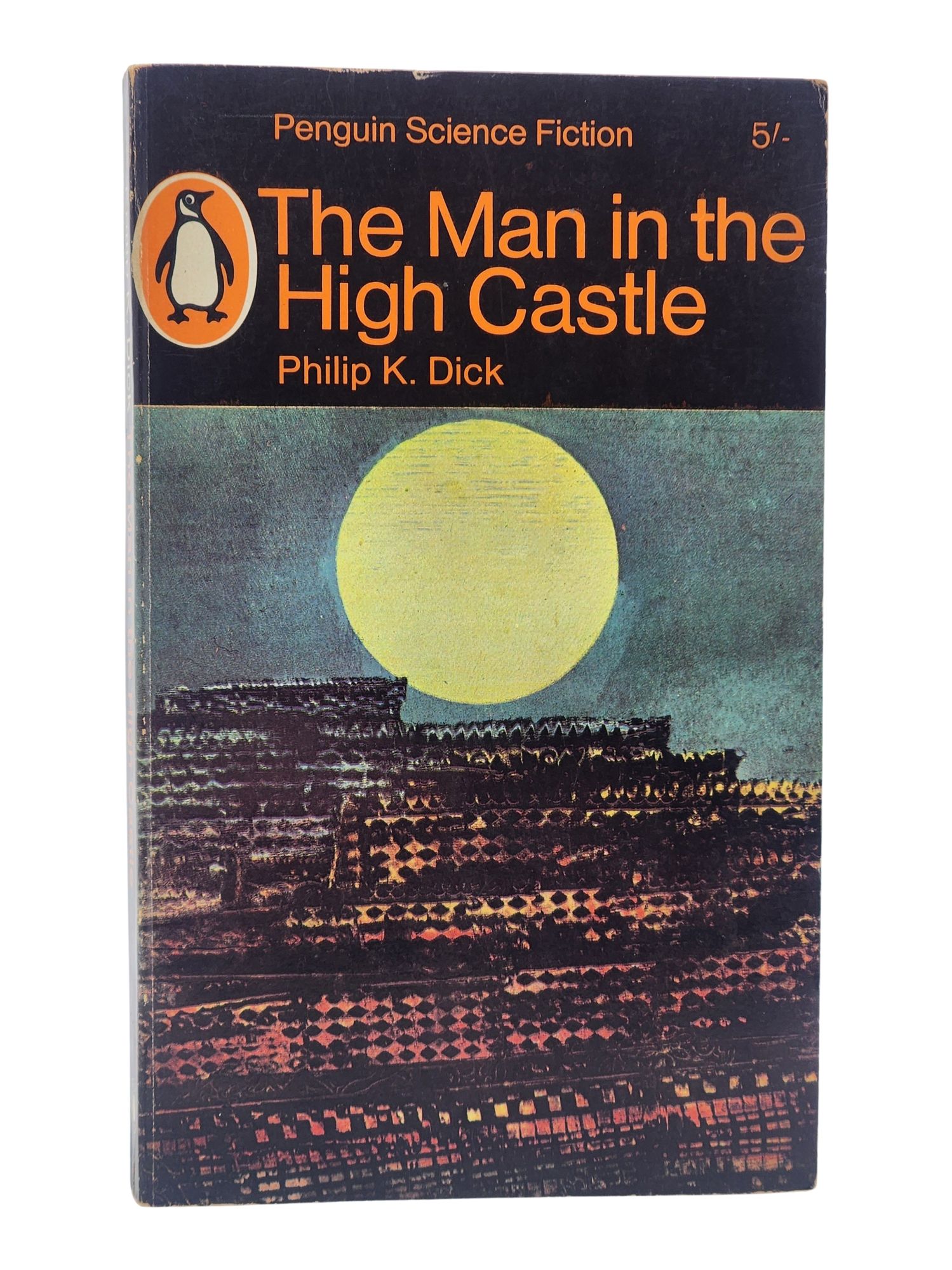
‘The Man in the High Castle’ by Philip K. Dick

1965 (1962) 236 p.

It’s interesting that my copy of The Man in the High Castle should be issued under the Penguin Science Fiction impress, because it doesn’t seem particularly science-fiction-y to me. It was first published in 1962 and envisaged a world in which Germany and Japan had triumphed during WW2, with the action occurring taking place in 1962- i.e. contemporaneously. To my mind it was more an alternative history or counterfactual than science fiction.

The narrative traces through several characters who live in an America partitioned into three. Nazi Germany controls the East Coast, as well as Russia and Western Europe. The east coast itself is divided in two: the remnant United States of America up to the Canadian border, and ‘The South’, both ruled by puppet regimes under Nazi control. The West Coast had been annexed by the Japanese as the Pacific States of America. Between the two regimes is the buffer Rocky Mountain states, where American citizens continue a depressed, oppressed existence.

The novel starts in the Pacific States of America, where businessmen Robert Childan runs a business selling pre-invasion Americana, most of which is counterfeit and manufactured by the Wyndam-Matson Corporation. Childan is contacted by Japanese trade official Nobusuke Tagomi, who seeks a gift to impress a Swedish industrialist named Baynes, who is coming to visit. Baynes, however, is really a Nazi defector who is coming to warn of the incipient activation of Operation Dandelion, a plan for Germany to attack Japan and attain world domination. Meanwhile, there is a banned publication, The Grasshopper Lies Heavy which is circulating surreptitiously, which posits that in fact, the Allies did win. Ostensibly the book is written by Hawthorne Abendsen, the eponymous ‘Man in the High Castle’. Juliana, the ex-wife of secret Jew Frank Frinke, is fascinated by the book, and travels unwittingly with an under-cover Nazi to meet the author, unaware that her companion Joe Cinnadella, has been sent by the Germans to execute Abendsen. It is a repressive and violent society, which has reverted to almost-magical times, with the I-Ching, a book of Chinese divination, guiding the actions of many of the characters, both Japanese and American.

The scenario is fascinating, but unfortunately the characters are not. I confess to losing track of who was who, and I am still bemused by the authorship of The Grasshopper Lies Heavy, although I think that the author intended this ambiguity. The characters are rather mechanical, and it is difficult to feel any connection with any of them. The end of the book becomes bogged down with a fairly metaphysical exploration of the I-Ching.

However, the book does form the political and ‘historical’ background to the excellent Prime four-season series, which managed in its first episode to evoke more sympathy and coherence to the characters than the whole book did. Interestingly, they turned The Grasshopper Lies Heavy into a film, instead of a book, which in a way made the whole scenario more implausible- who has a film projector hanging around in their apartment? Surely a book would be more portable and thus more dangerous. To eke four seasons of the TV series out of a fairly slim volume, obviously it was taken far beyond the original book, but to my mind so far, with far more success in character development than the book. So, for me, The Man in the High Castle is a book with a really fascinating premise which didn’t quite manage to develop its characters, or integrate its metaphysical aspects.

My rating: 6/10

Sourced from: My husband’s bookshelves. I had heard about the book, but never read it or seen a copy.

I hear with my little ear: Podcasts 1-7 January 2026

Journey Through Time Episode 26 The Failed Nazi Coup (Episode 1) The Munich Beer Hall Putsch was the time when Hitler could have, and should have been stopped. In 1923 there were dozens of far right parties with paramilitary wings. The Treaty of Versailles had demanded the loss of lands still in German hands (much as Russia is demanding of Ukraine now). Particularly in conservative Bavaria, the German defeat was blamed on the ‘stab in the back’ from progressives and Jews. Knowing the importance of visual images, and inspired by the Italian fascists’ March on Rome, on 8 November 1923 Hitler and approximately 600 supporters marched on the beer hall Bürgerbräukeller, where Gustav Ritter von Kahr—the Minister-President of Bavaria was speaking. They surrounded the hall, and held von Kahr and other speakers at gunpoint in an adjoining room until they declared their support for the uprising . Although Hitler had the crowd in the hall eating out of his hand, the expected crowds outside did not materialize and the whole thing collapsed in farce.

In Our Time Another one from the archives. Little Women features Bridget Bennett Professor of American Literature and Culture at the University of Leeds; Erin Forbes Senior Lecturer in African American and U.S. Literature at the University of Bristol and Tom Wright Reader in Rhetoric and Head of the Department of English Literature at the University of Sussex. The podcast starts of with Louise May Alcott’s lifestory, emphasizing her parents’ eccentricity for the time and the influence of the Transcendentalists. Alcott herself was a prolific writer, although much of it was ‘sensation literature’, mainly written under the pseudonym A. M. Barnard. She did not particularly want to write for a teenaged girl market (not that there was a concept of ‘teenager’ at that time), but she was manipulated into writing it by her publisher who promised to publish her father’s book in return. Little Women was published in two parts. The first part was modelled on Pilgrim’s Progress, with the four girls each trying to overcome their personal flaws. Part 2 follows their adult lives. She didn’t want to write this one either, so she intentionally married Jo off to the Professor, who was not likely to appeal to many readers. The panellists then go on to talk about the film depictions of Little Women over time, and the way that increasingly there has been a conflation between Jo and Alcott herself, particularly in the most recent Greta Gerwig version.

The Documentary (BBC) When Christian Nationalists Came To Town The small Tennessee town of Gainesboro population 900, overwhelmingly Trump voters (80%), is disconcerted when a large parcel of land is bought up by a conservative developer with the aim of forging an “aligned” community based on shared values like “faith, family, and freedom“. It attracts young men, looking for a traditional family life and holding a particular view of the role of the church in society, and the locals don’t like it.

The Rest is Classified Ep.98 Putin’s Secret Army: The Rise of Prigozhin (Ep.1) Even though Prigozhin was known as ‘Putin’s chef’, he was never actually a cook: instead, he was a restaurateur, among many other things. He was born in 1961 in St Petersburg (the old Leningrad) to a middle class family, but he left school early and fell into bad company. From petty crime he escalated to a robbery with violence at the age of 18 and was sentenced to 13 years in a penal colony. He was released in 1990, as the old Soviet Union was collapsing. He started off by selling hot dogs, then moved into grocery stores, casinos, clubs and restaurants. At the same time, Putin was working his own way up in the thuggish capitalism of the 1990s. Prigozhin became Putin’s catering man, and President Putin brought the Japanese Prime Minister and G. W. Bush to Prigozhin’s restaurants when they visited. In 2011 Putin became Prime Minister, then moved back to being President. When protests broke out (and Putin hates protests), Putin turned to Prigozhin.

I hear with my little ear: Podcasts 1-7 July 2025

The Rest is History Episode 555: 1066 Slaughter at Stamford Bridge This was in effect the last battle between the Vikings and the Saxons, with two doomed characters each representative of their cultures. Harald Hardrada was 56 years old, and although he hadn’t previously been interested in invading England, he was now because of the need for money, the desire to be the next Cnut and because he was psychologically restless and warlike. He landed with 300 longships and possibly 10,000 men north of Yorkshire, where there were many Danish connections. There he joined forces with Harold Godwinson’s own brother Tostig (boo, hiss) at the Humber. It was a hot day, and it is possible that the Norse left their armour off, because they were unaware that Godwinson had rushed from London with his army, picking up men as he went. Harald was killed at Stamford Bridge, but glowing with success, Harold Godwinson did allow his treacherous brother Tostig to return to Norway. Then blow me down, who should arrive by William of Normanby, ready for a fight!

History Extra Podcast Owain Glyndŵr:Life of the Week The blurb on the website says “Famed for his dramatic and determined revolt against English rule in the early 15th century, as well as his bold vision for an independent Wales, Owain Glyndŵr has gone down in history as a symbol of Welsh resistance and a national hero.” Well, I’d never heard of him. To be honest, I didn’t like this episode much- it assumed too much knowledge of Welsh/English history. I’m not sure if I have this right, and I don’t have enough interest to check. As Wales was a colonized region, the rich and well-connected Owain served in the English armies, then went home for about 10 years. During 1400 rebellion broke out in Wales, taking advantage of the intra-English rebellion. His lands were confiscated, then an outbreak of violence saw a Welsh victory in 1402. The first native Welsh Parliament in 100 years was held in 1404 and in 1406 Owain wrote a long treatise on the Welsh State. The Welsh had French support at first, but when the French support split, the war reverted to a Peasants Rebellion. Owain never accepted a pardon from the English for his role in the resistance, and we don’t know what happened to him.

I hear with my little ear: Podcasts 8-15 June 2025

Background Briefing (ABC) Agents of Influence Ep. 2 The Billionaire’s New Sport I’d never heard of Len Blavatnik, but apparently he’s the new head of Foxtel and the owner of Warner Music. Is he the person I have to blame for taking AFL off free-to-air on Saturday night? He is one of the oligarchs (although he does not like that term) who made his money through the carve up of Russian state enterprises after the fall of Communism, and somehow he seems to have escaped Western sanctions. He has since distanced himself from Russia, and is strongly pro-Israel and pro-Netanyahu. Yuck.

The Rest is History Episode 554: 1066 The Shadows of War After our little excursion with Harald Hardrader, we head back to 1066 again with three warlords: the Viking Harald, the French Duke of Normanby and the Anglo-Saxon Harold Godwinson. Edward the Confessor died on 5 January 1066 and the Bishops met to choose the next king (which surprised me because I thought that the English crown was hereditary, but it wasn’t. Although family had a good head start). There were quite a few contenders to choose from: 1 Harald Hardrada who had a slight claim, and no one wanted the Vikings 2. Sven, who was King Knut (Canute)’s nephew. Another Viking. 3. William the Duke of Normanby who had been promised the throne of England 4. another descendant of Alfred the Great 5. Edward the Exile in Hungary who arrived back in England in 1057. 5. Thirteen-year old Edgar. 6. Harold Godwinson. The Bishops went for Harold Godwinson, well aware that this would prompt an invasion, and so they crowned him the very next day. Meanwhile Tostig, Harold’s brother was stewing away in exile and he invaded but was not successful. Thanks to feudalism, Harold could command 90% of English men, but he was facing Norman technology and confidence, sharpened by religious reform under hardline Catholic reformer Hildebrand (who was later to become Pope Gregory VII). When bad winds arrived, threatening to delay William of Normanby’s troops, Harold decided to stand down his army which was a big mistake because who should arrive but brother Tostig and Harald Hardrada!

Half Life BBC Episode 7 The City Forgets Happy to distance himself from his great-grandfather’s half-truths, Joe turns to his great-grandfather Siegfried’s sister Elizabeth who redeemed the family somewhat by establishing a nursery and orphanage for Jewish children in Munich. Once the Nazis came to power, Elizabeth herself escaped to Tel Aviv, and there she read about the gradual deportation, in several tranches, of all the children in her orphanage. In the concentration camps they were gassed by the same chemicals that Joe’s great-grandfather had produced. Episode 8 A Fracture Joe returns to Germany, where eventually a memorial to the Dersim massacre is unveiled, something that would not be possible in Turkey, where all mention of the massacre is suppressed. Kurdish activists are trying to get the German government to take responsibility because the chemicals were manufactured there (which is a bit of a long stretch, I reckon, and they’re probably only pursuing it because the Turkish government won’t admit it). I’m getting a bit sick of Joe making it all about him. It’s about time this series finished.

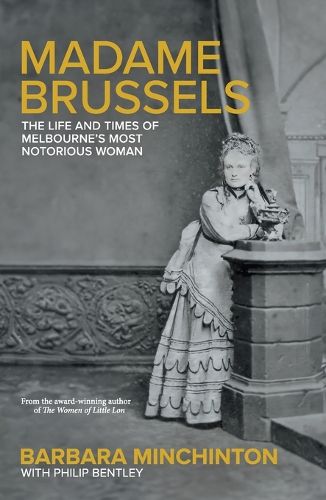
‘Madame Brussels: The Life and Times of Melbourne’s Most Notorious Woman’ by Barbara Michinton

With Philip Bentley, 2024, 254 p. with notes

This book is both companion and expansion of Barbara Minchinton’s The Women of Little Lon (my review here) which looked at the sex work industry in nineteenth century Melbourne. Madame Brussels is one of the brothel keepers that Minchin described in the earlier book as part of the ecology and economy of Melbourne’s brothel precinct, but here she deals with Madame Brussels as biography, rather than one name among others.

Madame Brussels is probably the best known of Melbourne’s ‘flash madams’, now immortalized with her own lane and roof-top bar. She was certainly well known in the late 19th century, too, through her political and policing contacts that largely shielded her from prosecution, court appearances and notoriety. Caroline Hodgson nee Lohmar was born in Germany, married in UK and arrived in Melbourne with her husband ‘Stud’ Hodgson in 1871, shortly after her marriage. She rode the exhilaration of the ‘Marvellous Melbourne’ land boom, suffered the 1890s recession, and was increasingly hemmed in by the ever-tightening moral strictures of the early 20th century.

Soon after her arrival in Melbourne her husband left her to work as a policeman ‘up-country’, returning twenty years later in the depth of the 1890s depression in poor health. Left in a strange city as a deserted wife, she opened a boarding house in Lonsdale Street and gradually began accumulating property adjoining her original purchase, later purchasing property in South Melbourne, Middle Park and Beaconsfield Parade in St Kilda. She presided over her brothels, but there is no evidence that she worked as a sex worker herself. Her brothel attracted politicians and magistrates and there were rumours that Alfred Plumpton, then music critic for The Age and composer, was her lover. Although she appeared in court several times, she was always well represented and almost magically the magistrate’s bench filled up with worthy JPs who were not otherwise active in the courts (but may well have been active in her brothel). She remarried after her first husband’s death, but this marriage to fellow-German Jacob Pohl was no more successful than her first, as he soon left her to live in South Africa for several years. After a couple of years’ absence from the brothel scene, she started up again but times and politics had changed.

In the years preceding the turn of the century she became increasingly name-checked by moral reformers, particularly Henry Varley, and became a regular object of scandal in John Norton’s Truth newspaper (which had plenty of the former, and little of the latter, despite the name). In April 1907, after appearing in court charged under new laws with “owing and operating a disorderly house”, she closed her brothel in Lonsdale Street, and died soon after in 1908. Despite an extravagant funeral, she had little to show for the wealth which had passed through her hands.

As might be expected of a notorious entrepreneur, the sources for her life are skewed by real estate transaction documents and court appearances reported breathlessly by the newspapers. There is a genealogical record, although it is patchy: for example, it is not clear whether her ‘adopted’ daughter Irene was actually her own daughter. There are the annual ‘in memoriam’ notices that she placed in the newspapers after her first husband’s death, as was the practice in the early 20th century. But in terms of letters, diaries etc, there is nothing.

In an afterword Phillip Bentley, who is credited as co-author writes:

…we have remained resolute our desire for all conjecture to have a basis in fact and so have resisted the temptation to speculate on how she overcame her early education towards ‘moral earnestness, humility, self-sacrifice and obedience to authority’ in order to become Melbourne’s most famous brothel madam of the nineteenth century (p. 253)

I’m not absolutely convinced that the authors fulfilled this resolution. There are many times that they raise questions which they leave hanging in the absence of evidence, but the questions are raised nonetheless, couched in “may” and “could” statements. The chapter ‘A Curious Gentlemen’s Club’ I found particularly unconvincing, where the question of flagellation is raised, largely on the basis of her first husband’s uncle’s involvement in the ‘Cannibal Club’ and the presence in Melbourne of journalist George Augustus Sala, who was said to have coined the phrase ‘Marvellous Melbourne’ as well as being the anonymous author of flagellation pornography. As the final paragraph of the ten-page chapter says:

In all the records and writings and newspaper reports examined to date there is no suggestion that Caroline’s establishments offered anything other than ordinary common-or-garden variety male-female sex. There are no wild rumours, no snide passing remarks from journalists or parliamentarians under privilege, in fact no hints at all of anything alone the lines of the ‘fladge brothels’ in London. That does not mean it was not happening of course: it means that if it was, we simply can’t see it. (p. 82)

Likewise the chapter where they raise the question of whether her first husband Stud was homosexual raises the question but then admits “There is no way we can know for certain whether Stud was gay” (p.140). I’m not sure that raising questions, identifying parallels and possible networks is sufficiently rigorous, although surely a temptation when writing a life of such notoriety which provided relatively barren and biassed documentary evidence.

This book stands on its own two feet, but I think that I appreciated it more for having previously read The Women of Little Lon, a book which has firmer evidentiary foundations than this one. But I guess that’s part of the challenge of biography: finding the individual person while confronting the dearth of evidence. Even Phillip Bentley admits that perhaps they have not unpacked her personality as much as they would have liked (p. 253), but certainly the authors have succeeded in bringing out the person behind the name now adopted by popular culture with such glee.

My rating: 7.5/10

Sourced from: Review copy from Black Inc.