
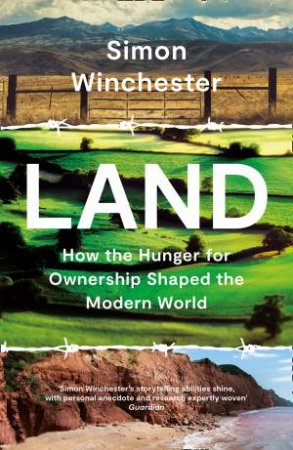
Prolific and popular historian Simon Winchester is always a good read, and I was interested in this book which promised a general history of land rather than a history of a particular geographical place. I expected that he would move from country to country in his analysis, and I was pleasantly surprised to find that he took a more thematic approach.
He starts with a fairly lengthy prologue of six chapters which mainly deals with his own purchase of 123 acres of forested and rocky mountainside in Amenia, in the state of New York- the first time that he had owned land anywhere. As with landscapes everywhere, his own little block had its own story to tell, going back to when it was part of the ancient continent of Laurentia, which was itself created about a billion years ago when a gigantic supercontinent split into Gondwana and Luarentia. It was peopled by homo sapiens, members of the Mohican tribe, who were felled by illnesses like smallpox, measles and influenza, and expelled from their lands and possessions. A subordinate tribe of the Mohicans, the Schaghticoke lived on for a bit longer, until many of them were turned off as well, with a few clinging on it the hope that treaties would be honoured. They weren’t. Their land was subdivided and, eventually, ended up owned by Simon Winchester after it had passed through several hands.
The book proper starts with Part I ‘Borderlines’ which traces the shift from hunter-gatherer society to a settled agricultural society where the concept of animal husbandry arises. Both agriculture and husbandry require boundaries, and the land is manipulated through ploughing and the use of animals to pull those ploughs. Surveying arose as a science, and the land was mapped. Borders could be between neighbouring plots of land, or between countries and later nations. He spends some time on the borders between India and Pakistan, and the mapping anomaly of the Lake of the Woods that straddles the 49th parallel between United States and Canada. (Don’t tell Trump; he’ll start a war over it).
Part II ‘The Annals of Acquisition’ looks at the phenomenon of obtaining land. He starts with man-made land and reclamation of land from wetlands, as in the Netherlands. He then turns to the British acquisition of land in North America, the Louisiana Purchase, and the great land rush in South Dakota which led to the expulsion of the Native American tribes, as the deluge of settlers continued on inexorably. The following chapter turns to landholding in England by the gentry, with a backwards look at the concept of ownership including the Domesday Book and the presence of the Romans in England.
Part III deals with ‘Stewardship’ picking up from the previous chapter and looking at the ‘Tragedies of Improvement’ through enclosure, and the expulsion of people from their lands in rural Scotland. He then turns to the huge landowners, looking at mine-owner Gina Rinehart in Australia, and huge American landowners like the founder of Cable News Network, Ted Turner, and his competitor John Malone, an engineering billionaire who also made his fortune through cable, and the Wilks brothers who have bought up a huge forest and rangeland empire in Idaho, Montana and down the Rockies to Texas. The Wilks have been dubbed ‘conservation evangelicals’ because they have been extreme in preventing people approaching their land by hiring security guards, dug anti-vehicle ditches and strung barbed-wire fences across public roads. He turns his attention to the concept of ‘trespass’ and fencing, then moves on to re-wilding, both unintentional (e.g. in the Demilitarized Zone between North and South Korea) and intentional (e.g. the Dutch polder in Flevoland, or Charles Burrell and Isabella Tree whose 3500 acre estate at Knepp in southern England has been a centrepiece of the rewilding movement). He returns his attention to Australia where, in counterpoint to Gina Rinehart’s mining activities, indigenous knowledge of the land presents a different form of stewardship. The public spaces of cities via parks and maidans are an acknowledgement and substitute for the loss of pastures and forests as they are replaced by asphalt and concrete. But in some places pollution and contamination (think plutonium, Chernobyl and Fukushima) have forced people from settled land permanently.
Part IV ‘Battlefields’ looks at conflicts over land, expressed by concepts of rule, possession and sovereignty, legal systems. This section is largely historical, although the three events who looks at are still all controversial (indeed two of them are active military conflicts). There is, of course, the creation of Israel, which he treats historically from the collapse of the Ottoman empire, and Stalin’s collectivization of Ukrainian agriculture- again, treated historically. He then turns to the appropriation of the land of Japanese farmers in the United States during World War 2.
Part V ‘Annals of Restoration’ looks at different movements worldwide to re-assert ownership of land. As this book was published in 2021, his chapter ‘Maori in Arcady’ may, I fear, be outdated because of recent moves to minimize the role of the Treaty of Waitangi in New Zealand His chapter on ‘Bringing Africa Home’ looks at land reform, which has had a chequered history with Robert Mugabe, Nelson Mandela, and the continuation of the ‘Happy Valley’ set in Kenya. He returns to Native American dispossession in America, and the Yosemite Land Grant where about 150 Miwok of the central Sierra live today and run the Black Oak Casino. He looks at land trusts in America, but saves up his venom for the island of Eigg in the Hebrides, where the community has taken over ownership after a succession of colourful private owners. He is sceptical of the politics surrounding these changes, which he sees as a form of social engineering, and he rather uncharacteristically steps out of his role as historian to become more of a commentator- and a critical one at that.
In his epilogue ‘Yet Now the Land is Drowning’ he rejects the idea that “land is the only thing on this earth that lasts” in the face of climate change. He picks up Leo Tolstoy’s question ‘How Much Land Does a Man Need?’ and ends with the observation that the protagonist in the story, Pakhom, eventually is buried in a hole six feet long and three feet wide.
As you can see, this is a wide-ranging book where he can indulge his story-lines of interest drawn from examples all over the world. It does have a bit of a “smooth the dying pillow” feel when he writes about indigenous cultures, and I don’t know if he explored ideas of modernity and the psychology of ownership as well as he could have. For the parts that I do know about- namely the Australian and New Zealand examples- he is basically accurate, if a little outdated, but that is inevitable as the world has swung to the right politically, cementing the place of elites who tend to hold, or seek, land. It’s eminently readable and interesting, and I’m pleased that he chose to take a thematic approach which lends itself better to digression and rabbit-holes.
My rating: 8/10
Sourced from: Yarra Plenty Regional Library.

