
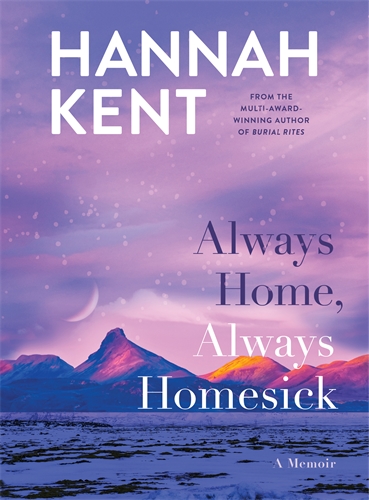
I was well-primed to enjoy this book, having read all three of Hannah Kent’s published books: Burial Rites (review here) The Good People which I thought even better than Burial Rites (review here) and Devotion (my review here). It’s probably a bit ageist of me to express my skepticism when a ‘young’ person (i.e. anyone under 60!) writes a memoir, but in this case the term ‘memoir’ is a bit of a misnomer. The first part of the book is about her experience as an exchange student in Iceland as a 17 year old in 2003, and the second part is about the draw of Iceland that led to her writing her first book Burial Rites, the story of the last woman hanged in Iceland.
The book starts in Australia in 2020, with Hannah the mother to two children aged two years and three months. It is lockdown, and as with other Australian families she is enclosed within the circle of immediate family with her children and her wife Heidi. Inspired by a birthday video compiled by her friends in Iceland, she delves into a box of childhood memorabilia that her mother had brought around. She is mentally taken back to 2003 when, at the end of her formal schooling, and unsure of what she wanted to do with her life other than “be a writer” she had decided to go on a Rotary Exchange visit.
In that moment I know that this is for me. I know it. I know it in my bones, with a surety that runs through my body and makes me sit up as though I have been prodded in the back by life itself. This is what I need to do. This is the thing that will lead me further into life, that will allow me to breathe lung-deep of it. My certitude feels miraculous. (p. 28)
She is asked to nominate five countries, and having never seen snow before, she chooses Sweden, Norway, Finland, Switzerland and Canada- and hopes that the selection committee gets the gist. They do: and although they don’t send her to any of the countries she named, they do send her to Iceland. She would be one of only two Australian exchange students sent to Iceland that year.
The first half of the book deals with her experience in Iceland. Her first host family is quiet and reserved, although they probably fulfill their obligations in taking her to places and encouraging her to join a theatrical group. However, she cannot speak the language and is probably encased by the silent period that second-language learners often experience. It is only when she goes to a second family with four young children ( a family which was not intended to be her host family, but which saw her struggling) that her language begins to blossom and she begins to feel ‘at home’. But what her first foster family did do was to introduce her to the story of Agnes Magnusdottir, the last woman executed in Iceland and she finds herself drawn, at a deep psychological and even psychic level, to Agnes’ story. When she returns to Australia, excited at her acceptance into a Creative Writing course, she fears that she will forget the experience, forget her hard-won Icelandic fluency and lose Iceland itself “Iceland, I don’t know how to let you go” (p. 159)
Writing what became Burial Rites was how she kept her connection with Iceland. The second half of the book follows her research process over several years as she follows the archival sources, visits places and wrestles with the silences in the history. She eventually follows the ‘speculative biography’ methodology that Margaret Attwood utilized in Alias Grace, an approach of finding and writing ‘fictional likelihoods’. I enjoyed this part because I enjoyed the end product, but I do wonder if someone who hadn’t read Burial Rites would get much from it. After all, most historians (and novelists) have their own war-stories, which are probably of more interest to them and fellow historians and novelists than the general public.
Burial Rites was published in 2013 after an intense bidding war, and was instantly acclaimed both in Australia and internationally. I found myself wondering how Icelanders felt about an ‘outsider’ taking ‘their’ story- I can remember feeling a mixture of admiration and grudging resentment when English author Sarah Murgatroyd wrote the Burke and Wills story so well in ‘The Dig Tree’- but it seems that the book was well received. In fact, quotes from the book were integrated into a tourist trail that was constructed around Agnes Magnusdottir sites. It was important in her publicity for the book in Iceland that she spoke Icelandic, as part of confirming her credentials.
She captures well the ‘in-between’ status of a person who loves more than one home. When she is in one ‘home’, she misses the other. This ‘in-between’ness recurs when she has her second child, which is how she starts the book, which ends up being the memoir you are holding in your hand. In a way, this book would have been an ‘easy’ write, compared with her three other historical fiction books which required historical research, and it is an ‘easy’ read because her narrative voice is warm and engaging. If you had told me that this book was a ‘what I did on my exchange visit’ mixed with ‘how I wrote my first book’, I would have decided not to read it, but she is such a beautiful writer that she makes even these things compelling. Her descriptions of landscape are poetic, and the book has a human pull to it.
My rating: 8/10
Sourced from: purchased from Ladyhawke Books, Ivanhoe
Read because: Ivanhoe Reading Circle selection.

