
Tag Archives: literature

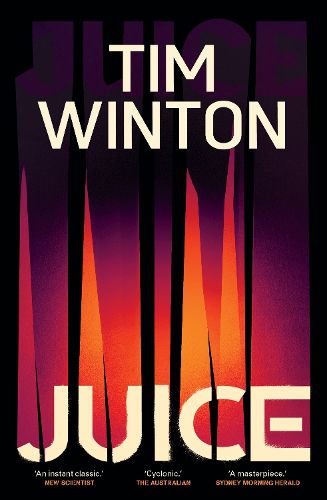
‘Juice’ by Tim Winton

2025, 528p.

An unnamed man and a young girl are driving in a truck through a blighted stony landscape, surrounded by ash. When they draw into an abandoned mine site a man armed with a crossbow forces them from the truck cab and into a deep hole. The unnamed man does not trust the intentions of their captor towards the girl, and Scheherazade-like he tells his story to ‘the bowman’ both as a way of staying awake to protect the child and to gain the co-operation of his captor.

Set at some time in the future, the world has endured a horrific ratcheting-up of climate change and political breakdown. Temperatures regularly breach fifty degrees, and summer is spent underground in dark, stifling conditions, waiting out the months until winter, when it is finally safe to venture out into the open. Society seems to have broken down into small hamlets, scattered homesteads or gated armed communities. There does not appear to be any government, no religion, no music, no civic life. Cities like Perth and Sydney still exist, protected by walls, but they are fetid and dangerous.

As our unnamed narrator tells us (and the bowman), his father disappeared in a maritime accident when he was young and he was brought up by his ‘staunch’ mother – likewise unnamed- in the outback, growing vegetables in irrigated greenhouses in winter when the weather conditions are more benign. As he reaches adolescence he works salvaging parts from deserted infrastructure and taking their produce to ‘market’ where he barters for the things they need from other desperate, edgy people. It is at this market that he is approached to join the Service, a shadowy organization, that ruptures his world view completely. Brought up in an a-historical world, he learns about the phases of history that have brought the world to this point: ‘The Hundred Years of Light’, followed by the ‘Dirty World’, then the ‘Terror’. There were political choices that could have been made in the past (our present) that could have avoided this complete breakdown, and the wealthy descendants of the fossil-fuel executives, financiers and the lobby groups still shelter in enclaves surrounded by a luxury completely foreign to the depleted populations scrabbling to survive ‘outside’. The Service is committed to ‘acquittals’ – a euphemism for the assassination of whole families, including children- as vengeance for this climate collapse.

And so our narrator lives in two worlds: the spartan existence on the blighted landscape and the other world of secret missions, danger and bloodshed. He partners with Sun, and has a daughter, Esther, but spends months away, ostensibly scavenging, leaving his family on the homestead with his mother while he is called upon to embark on this campaign of murder and retribution that takes him to Utah, the Persian Gulf, and to Asia- all just ‘overseas’ places in this world without nations. The killing does not sit well with him, and each time he returns more and more disturbed, only to find that his wife and daughter have left. The Service keeps all of its operatives ignorant of each other and of the scope of their mission, and it is only as time goes on that our narrator learns that his whole life has been much more touched by the Service than he realized.

He tells all this to the Bowman, who he later learns has also been a Service man. Despite their common experiences, they are not the same. Our narrator’s life was saved by ‘sims’, hybrid simulacra who can withstand the heat and deprivation, but the Bowman believes that all sims should have been annihilated while they could be. Our narrator distrusts the Bowman with good reason, and even when I reached the last sentence of the book, I wasn’t sure quite what it meant.

Juice is similar to Cormac McCarthy’s The Road but the Scheherazade structure of the novel, alternating between the telling of the story at the bottom of a tunnel, and the story itself, means that it does not have the same grim relentlessness of McCarthy’s book. As a committed environmentalist, Winton does not pull his punches, naming the present-day fossil-fuel companies that the Service holds responsible for the climate collapse. In just one part of the novel, his religious faith and love of nature surfaces as well, when our narrator meets with one of the operatives who initially trained him. In what our narrator later says was the most interesting conversation of his life – just one- the operative says:

My mother used to tell me that when Nature dies, God dies along with Her… I guess what my mother meant is that without clean, wild, healthy things that can regenerate and renew themselves, the idea of God is impossible to imagine. (p. 346)

Does it matter if fiction is the vehicle for a political treatise? Not for me, as long as there’s enough depth to the characters to make them something more than mere mouthpieces. I don’t know whether Winton completely succeeded in this, but I wonder if his choice to keep his main characters nameless is not a way of intentionally distancing us as readers. I’m not sure that the introduction of the sims half-way through the book worked either, although it does raise questions about the sentience of artificially-created simulacra, and whether humanity’s only hope is co-existence with them, with the nature of the relation between human and sim left unexplored. There is much that he does not explain but to do so would detract from the earnest howl of despair at our present obtuseness that underpins the novel. He does not explain history, or the remnant technology, but this sparseness reflects the blighted nature of this world where there is no past and no future, just the survival of the season.

My rating: 8/10

Read because: Rosanna Readers Bookgroup selection

Sourced from: Yarra Plenty Regional Library

I hear with my little ear: Podcasts 1-7 January 2026

Journey Through Time Episode 26 The Failed Nazi Coup (Episode 1) The Munich Beer Hall Putsch was the time when Hitler could have, and should have been stopped. In 1923 there were dozens of far right parties with paramilitary wings. The Treaty of Versailles had demanded the loss of lands still in German hands (much as Russia is demanding of Ukraine now). Particularly in conservative Bavaria, the German defeat was blamed on the ‘stab in the back’ from progressives and Jews. Knowing the importance of visual images, and inspired by the Italian fascists’ March on Rome, on 8 November 1923 Hitler and approximately 600 supporters marched on the beer hall Bürgerbräukeller, where Gustav Ritter von Kahr—the Minister-President of Bavaria was speaking. They surrounded the hall, and held von Kahr and other speakers at gunpoint in an adjoining room until they declared their support for the uprising . Although Hitler had the crowd in the hall eating out of his hand, the expected crowds outside did not materialize and the whole thing collapsed in farce.

In Our Time Another one from the archives. Little Women features Bridget Bennett Professor of American Literature and Culture at the University of Leeds; Erin Forbes Senior Lecturer in African American and U.S. Literature at the University of Bristol and Tom Wright Reader in Rhetoric and Head of the Department of English Literature at the University of Sussex. The podcast starts of with Louise May Alcott’s lifestory, emphasizing her parents’ eccentricity for the time and the influence of the Transcendentalists. Alcott herself was a prolific writer, although much of it was ‘sensation literature’, mainly written under the pseudonym A. M. Barnard. She did not particularly want to write for a teenaged girl market (not that there was a concept of ‘teenager’ at that time), but she was manipulated into writing it by her publisher who promised to publish her father’s book in return. Little Women was published in two parts. The first part was modelled on Pilgrim’s Progress, with the four girls each trying to overcome their personal flaws. Part 2 follows their adult lives. She didn’t want to write this one either, so she intentionally married Jo off to the Professor, who was not likely to appeal to many readers. The panellists then go on to talk about the film depictions of Little Women over time, and the way that increasingly there has been a conflation between Jo and Alcott herself, particularly in the most recent Greta Gerwig version.

The Documentary (BBC) When Christian Nationalists Came To Town The small Tennessee town of Gainesboro population 900, overwhelmingly Trump voters (80%), is disconcerted when a large parcel of land is bought up by a conservative developer with the aim of forging an “aligned” community based on shared values like “faith, family, and freedom“. It attracts young men, looking for a traditional family life and holding a particular view of the role of the church in society, and the locals don’t like it.

The Rest is Classified Ep.98 Putin’s Secret Army: The Rise of Prigozhin (Ep.1) Even though Prigozhin was known as ‘Putin’s chef’, he was never actually a cook: instead, he was a restaurateur, among many other things. He was born in 1961 in St Petersburg (the old Leningrad) to a middle class family, but he left school early and fell into bad company. From petty crime he escalated to a robbery with violence at the age of 18 and was sentenced to 13 years in a penal colony. He was released in 1990, as the old Soviet Union was collapsing. He started off by selling hot dogs, then moved into grocery stores, casinos, clubs and restaurants. At the same time, Putin was working his own way up in the thuggish capitalism of the 1990s. Prigozhin became Putin’s catering man, and President Putin brought the Japanese Prime Minister and G. W. Bush to Prigozhin’s restaurants when they visited. In 2011 Putin became Prime Minister, then moved back to being President. When protests broke out (and Putin hates protests), Putin turned to Prigozhin.

I hear with my little ear: Podcasts 8-15 December

The Global Story (BBC) The Death of Reading This episode was based on a recent essay by James Marriott ‘The Dawn of the Post-Literate Society’ which can be found on his Substack here. Both the essay and this discussion go back to the mid- 1700s when the spread of reading beyond the elites meant that power no longer had to be performed visually, but could be disseminated and reinforced by the written word. Marriott draws on Neil Postmans work ‘Amusing Ourselves to Death’, and argues that beyond the concern about the decline of reading in the 1990s, the spread of the smart phone from 2010 onward has led to a steep drop in educational standards. With the rise of TikTok and Instagram, we are returning to the primacy of visual display – a sort of counter-revolution in thinking and perception.

Journey Through Time Episode 48: The Paris Commune: Can the City of Light Govern Itself? After the uprising over the cannons on Montmatre, the radicals took over, but with no leader, they split almost immediately. Auguste Blanqui would have been the leader, but he was in prison (as indeed he was for whole decades of his life). Supplies were allowed in, but Paris was still lunder siege. Napoleon III’s column was pulled down, although it was later re-erected. Elections were held with 4 days to give the leaders legitimacy with the result that there was an anti-nationalist government but otherwise, the movement splintered. The new government started issuing executive orders (and don’t we know about THEM!) to separate church and state, provide rent relief and soldier pensions, provide free secular and compulsory co-education, cap salaries, and give workshops to co-ops. So far, all normal socialist fare, but also they imposed decimal time (10 day weeks, 10 hour days etc), banned night baking as a labour market reform for bakers, and banned croissants (can’t remember why). They treated legitimate and illegitimate children equally and had same and equal pay for teachers. The army was a citizen’s militia, and army discipline broke down almost immediately. 150,000 people per day fled Paris, where there was constant violence but no terror as such (in Revolutionary terms). From afar, Marx was interested but because he didn’t support the French International, he waited a while before writing about it. Women were influential in organizing, but they were not inspired by feminist or suffragist ideals. To get Auguste Blanqui released from prison, they took hostages which backfired on them. There were small mini-communes in the rural towns, but essentially Paris was on its own.