
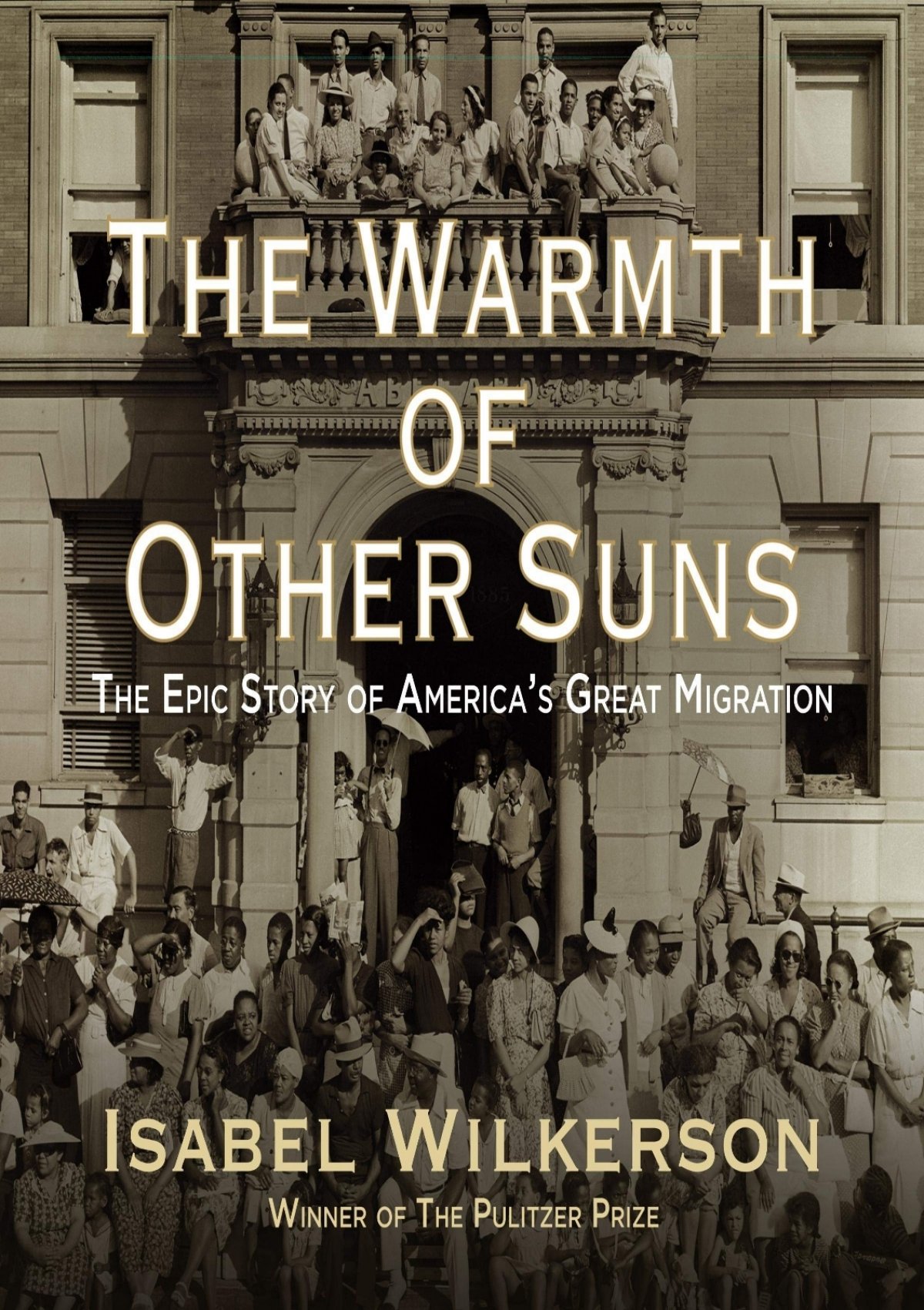
With my embarrassingly shaky sense of the geography of the United States, it hadn’t really occurred me to wonder, when I saw Black Lives Matter riots throughout America, why there were so many African-Americans in northern states. Neither, it would seem, do many Americans.
Starting during the First World war and over the course of six decades, a wave of some six million black southerners left the south and fanned out across the country, transforming urban America and recasting the social and political fabric of every city it touched. By the 1970s, nearly half of all black Americans -some 47%- would be living outside the South, compared with 10% when the migration began (p.10)
Historians would come to call it the Great Migration. It would become perhaps the biggest under-reported story of the twentieth century. It was vast. It was leaderless. It crept along so many thousands of currents over so long a stretch of time as to be difficult for the press truly to capture it while it was under way….Yet for all its influence, the Migration was so vast that, throughout history, it has most often been consigned to the landscape, rarely the foreground…. This book addresses that omission. (p.9, 13)
This is a very long book – 538 pages of very small font- but it is very easy to read. The author interviewed more than twelve hundred people (!!) in New York, Chicago, Los Angeles, Milwaukee and Oakland, all of whom had journeyed from the South during the Great Migration. To interweave 1200 stories would be impossible, and so she focuses on just three main characters, Ida Mae Brandon Gladney, George Swanson Starling and Robert Joseph Pershing Foster. Other people appear too, fleetingly, but she signals from the start that Ida, George and Robert are going to be the main protagonists.
They each set off in a different decade. Ida Mae Brandon Gladney was the first, leaving a sharecropping form in Chickasaw County, Mississippi in 1937 with her husband George for Chicago, after the family was threatened by a lynch mob that came in search of her husband’s cousin over the loss of some turkeys- which, as it happened, had just wandered away.
George Swanson Starling was a fruit picker from Florida who fled to Harlem in 1945 when his union activities brought him into the sights of vigilantes. He had hoped to go to college, but when he sensed that his father was blocking his ambitions, he married Inez, a girl his father did not approve of, just to spite him. The marriage was always unhappy, and George spent years working on the railways, charged with ushering Black passengers through the nuances of policies governing who could sit where.
Robert Joseph Pershing Foster, objectively the most ‘successful’ of the three, was a doctor from Louisiana who moved to Los Angeles in 1953. Despite working as an army medic, he always struggled break through the barriers which, although (purposefully?) invisible to white doctors, kept him sidelined from the career he could have had. Having married the daughter of a prominent Black educationalist, he was always insecure about his status in the eyes of his in-laws, and he threw himself into gambling while maintaining a large practice amongst the Black immigrant community.
She moves from one character to the other, often interspersed with chapters which give the context in each of the three locations (Chicago, Harlem and Los Angeles) that mark the destinations of Black immigrants as they fanned across the north. The book moves chronologically, and she gave much-appreciated ‘plot summaries’ when she picked up one of her three characters again.
She juxtaposes the truly appalling stories of lynchings and cruelty against the smaller injustices that burned strongly enough to compel these three people to move north, under varying degrees of danger. Your heart is in your mouth as Ida and her husband George tell Mr Edd, who owns their sharecropping farm, that they are leaving, unsure whether he is going to allow them to go. You sit rigidly with George Starling as he catches the train north, a train that he will spend years of his life working on. A wave of exhaustion sweeps over you, too, when Robert Foster drives his big flash car to Los Angeles, turned away from one hotel after another even though he has ostensibly left the Jim Crow South.
The North is not the escape that they thought it would be. There are no Jim Crow laws, but there is a thicket of unwritten standards and practices that limit work opportunities and, as a result, their life chances. We see ‘white flight’ in action, as suburbs change and gangs and crimes take over, affecting Black neighbours as much -more- than the white population.
By the end of the book, which takes us right up to the 21st century, you have sat with these three storytellers and you feel a real sadness as they die one by one, as they must, because this history and not fiction. It’s beautifully written history, well-researched, compassionate and human. Well worth every one of its 500-odd pages.
My rating: 10/10
Read because: a friend told me about it
Sourced from: Yarra Plenty Library- I had it reserved for over six months.

