
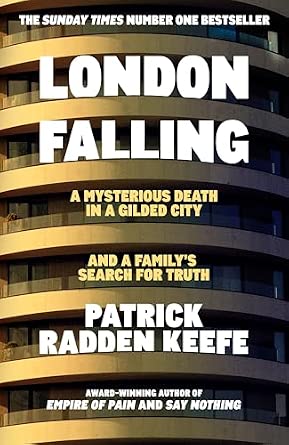
It seems that every TV report of a shooting or murder in a suburban area has a neighbour standing on the nature strip, shaking their head and saying “But it’s such a quiet area. Nothing like this ever happens here” (although clearly, it has.). That’s very much the feeling that Matthew and Rachelle Brettler felt when their 19 year old son’s body was found in the mudflats of the Thames, overlooked by a luxury high-rise apartment building. The CCTV footage of his last night showed him on the balcony moving from one end to the other, before launching off from the middle, catching his hip on the embankment wall on the way down. Was it suicide or a failed attempt to jump out and reach the water because he was in fear of his life? And what was he doing in that apartment anyway?
All of this was bewildering to his parents, both the children of Holocaust survivors, who lived a middle-class existence in an apartment in Maida Vale. His mother was a journalist and his father was a financial services manager. Zac had been their second son, who had felt second-rate when he failed to get into University College School, the academic private school that his older brother Joe attended. Instead, he attended Mill Hill School, a private school with less exacting academic standards where he mixed with the scions of wealthy expatriates, especially those of post-Soviet Russia and the Middle East. Here he was free to reinvent himself, lying about his parents’ jobs and covering his chest with fake Russian mafia tattoos. After school, he boasted of Kazakh and Nigerian business contacts, began wearing a sharp suit and became involved in cryptocurrency and other dubious business enterprises. He reinvented Zac Brettler as “Zac Ismailov”, affected a slight Russian accent,and concocted a backstory of a immense wealth from his Russian oligarch father who was looking for investment opportunities. He was drawn into the social circle of Akbar Shamji, an older, wealthy businessman whose wife was a fashion designer, and through him to Verinder Sharma, an underworld enforcer known also as Indian Dave. It was at Sharma’s apartment that he met his death, although both Sharma and Shamji denied involvement in his so-called ‘suicide’.
No-one is who they say they are here- except Matthew and Rachelle, who are bewildered by this whole other world so separate from the middle-class lives that they lived. People have multiple names, multiple identities. Sharma had several names, and disappeared regularly to Europe when things got too ‘hot’ in London. Akbar Shamji’s father had insinuated himself into the circle surrounding Margaret Thatcher purporting to be a wealthy oligarch, but his fortune was built on unsecured loans. But, as the Brettlers learn, invented lives and secrets are part of many families. Rachelle’s own father, a much-loved Rabbi, had lied about attending Cambridge University and fathered a secret child with a woman in his congregation.
I’ve only just recently finished watching the Netflix series of ‘Say Nothing’, based on Keefe’s book of the same name about the IRA. He brings his same journalistic and investigative skills to this book as well, drawing on interviews predominantly with Rachelle and Matthew Brettler over a two-year period. There are other interviews as well, both on and off the record, and he draws on the work of other journalists and investigators have been investigating Zac’s death and international crime in London .
This is a family story, of parents struggling to find out what happened to their son, who had become embroiled in a fantasy life in a milieu completely foreign to them. But it’s also the story of London, and its slide into its own mudflats of sleaze and oligarchical money, abetted by successive governments which wanted to attract and capture the easy money from disreputable men from disreputable regimes. Reading of the easy acquiescence of police and coroners in attributing highly suspicious deaths as suicides, especially among people with Russian connections, suggests that the corruption has spread throughout police and political realms, which have their own reasons for moving into the ‘Grey Zone’ of multinational crime and politics. It’s this juxtaposition of the familial and intimate everyday life of a middle-class family, and the monied ruthlessness of international crime and corruption that gives this book its power.
My rating: 9/10
Sourced from: Yarra Plenty Regional Library
Read because: I was impressed with the ‘Say Nothing’ series on Netflix.

