
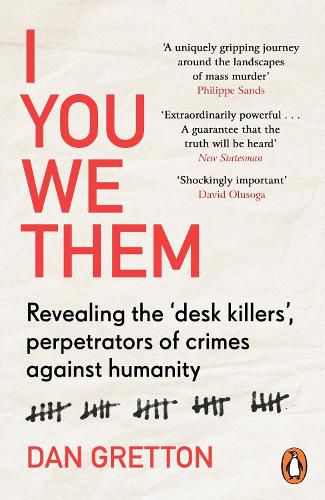
Has anyone ever complained so much about reading a book? At 1.6kg, I found it too heavy to hold up while reading it in bed and having recently sprained my knee, I was not keen on ‘tenting’ my knees to lean the book against. At over 1000 pages long, it took two renewals at the library to complete, and even now as I write this review, it is overdue.
So why did I so willingly heft it off the floor each night, to keep reading? Quite simply, because I enjoyed the company of the author and once I gave up any idea of following an argument, I just floated along on his observations – a little bit like reading Proust, really.
The lengthy subtitle of the book is “Journeys Beyond Evil: The Desk Killers in History and Today” and this is the overall theme of the book, but it is intermingled with reminiscence, nostalgia, regret and curiosity as he travels around Europe researching his topic. It could just as easily be a travel book. Attracted to maps from childhood, he maps out the sites of concentration camps of Europe and their accompanying industrial infrastructure, he follows forced marches and places himself in massacre sites, forming his own mental and physical maps. And it could just as easily be an ecological/environmental diary of landscape. For him, the environment in which he holes up to immerse himself in his writing – the Suffolk Coast for Book One in winter; Pembrokeshire in spring in Book Two- becomes part of the narrative as well, particularly when he writes about a hurricane that buffets the cottage in which he is sheltering when the power goes out in the house he has rented.
Gretton himself is an activist as well as author and teacher. In 1983 he co-founded the political arts organization Platform, which describes itself on its website as bringing together workers and communities “to create new, liberatory systems that tackle injustice and climate breakdown”. In particular, it confronts the power of transnational corporations. You can see this emphasis coming through in this book in its focus on corporations; especially that of the German manufacturing, banking and insurance companies that still exist powerfully today, which had flourished in Nazi Germany through its contacts and contracts with the government. He also targets Shell and its influence in Nigeria that looked the other way during the execution of Ken Saro-Wiwa, the activist who died trying to save his land and people from the destruction of Shell’s oil conglomerate. The “desk killers’ that he focuses on here are the managing directors of wealthy, multinational corporations, many of whom he interviewed after they have retired, and the often invisible bureaucrats and office workers who followed the procedures and timetables and the accountants in charge of the financial accounts that made genocide an anonymized, abstraction. There are no innocents here.
Although his focus is on corporations, he also hones in on individuals – most particularly Albert Speer, Hitler’s architect, whose own biography and the work of Gitta Sereny has thrown up so many questions about culpability and redemption. He also spends quite a bit of time on the Wannsee Conference of 20th January 1942, which pulled together as many agencies as possible to discuss the implementation of ‘the Final Solution of the Jewish question’. Of the 15 attendees (there were actually 16, counting the unnamed stenographer), seven held PhDs in law. We only know this because just one copy survived of the thirty copies made at the time. He parallels this with a discussion of the two Washington lawyers, who prepared memos for the Bush administration discussing the legalities and grey areas of torture and ‘enhanced interrogation techniques’.
Then there are the individuals who survived: Primo Levi, Jan Karski, Elie Wiesel. Some of the testimony in these books kept me awake at night, after turning off the light.
He concentrates predominantly on Nazi Germany, and on Nigeria to a lesser degree. But he also turns back to history to take up Gunther Grass’ question about how young people grow up in Britain and know so little about the long history of crimes during the colonial period. He looks at the East India Company and the Opium Wars, the slave trade, the Irish Famine, and what he claims as “the genocide” and the “extermination” of the Tasmanian Aboriginals (a contested question here in Australia, where there is a continuing Tasmanian First Peoples community today)[As an aside, if you’re looking a desk killers, I would have focused more on later bureaucrats and Protectors in the late 19th-early 20th century Australia whose arbitrary and desk-bound decisions did just as much as outright massacres to distort indigenous families and expunge language and culture]. He spends quite a bit of time on Namibia (former German South West Africa) where the systematic killing, detention and forced labour of the Nama and Herero people was a forerunner to actions undertaken by the Nazi government. He looks at the French massacre of between 120 and 200 Algerian demonstrators by the French government on 17 October 1961.
All of which would be pretty grim, continuing for over 1000 pages, if this were all that this book contains. But it’s not. There’s beautiful writing about his father and a wistful recounting of his own torrid, passionate affair with a younger man. There’s information dumps at time, as if you’re reading someone’s research notes. Interwoven are his own childhood memories, his political stances, travel-journey type entries.
It’s big; it’s untidy; it’s completely indulgent but it’s also thought-provoking and very easy to read. My complaints about weight and heft not withstanding, I missed hearing Dan Gretton’s voice when I finished. But perhaps there’s more: apparently this 1000+ pager is just Volume 1 of a two-volume publication. Hopefully the next volume will have an index, which I really missed in a book of this size. Will I read Volume II when it comes out: most probably, if I still have the strength to hold a 1.6 kg book!
My rating: Hard to say. 9?
Read because: I read or heard someone raving about it- can’t remember who.

