
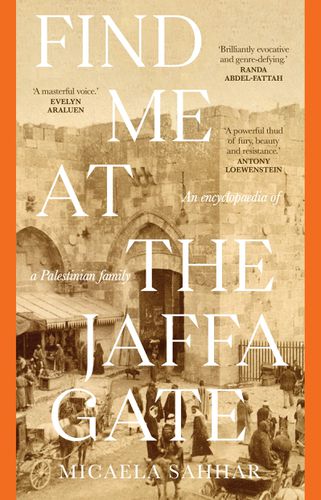
2025, 265 p. & notes etc.
I feel a bit naive. As part of the standard Christmas schlock, there’s usually a TV report from Bethlehem where brief mention is made of the Christian congregations that celebrate Christmas, often supplemented by Christian pilgrims from other countries, most particularly the United States. It has never occurred to me to think about the status of Christian Palestinians who continue to live there beyond Christmas, and how the Israeli/Palestinian conflict affects them. I have become so accustomed to linking Palestinian with Muslim, that I’ve forgotten that Palestinians can be of any religion.
And so ‘Find Me at the Jaffa Gate’ is a brisk corrective to this ignorance. The author, Micaela Sahhar, comes from a Christian family: at first an Orthodox family, then later some family members were born again into a more evangelical brand of Christianity. Following the Nakba her extended family has splinters: some come to Australia and settle in Newport and Williamstown, many others emigrate to America, and some stay. Michaela herself was born in Australia, and does not subscribe to any particular faith. Her father is Palestinian but was born in Jordan, because he was born within days of his family fleeing Jerusalem in the wake of the bombing of the Semiaris Hotel by Jewish terrorists, the Haganah, as part of the ‘de-Arabization’ of West Jerusalem. Just as important in this book are her grandparents, particular Pa and Ellen, who emigrated to Australia as part of the family shift. She has grown up with the stories of her grandparents, aunts and uncles, and great-grandparents, and the photos that testify that – yes- the family lived in Jerusalem, no matter how much their presence and identity as Christian Palestinians has been denied.
This book is a piecing together of the stories of the different generations of her family, with stories and photographs interwoven. She travels to America to meet branches of the family, and returns to Jerusalem and Jaffa to locate the places where they lived, and to find that her family is still remembered by the people who stayed. Palestinians- Christian and Muslim- face the same appropriation (theft) of land and livelihood, and they are subjected to the same surveillance and humiliation by the Israeli military forces. This is a personal, family pilgrimage, but it also part of her academic identity, explored through a Ph D, and so bolstered by subtly placed quotations of historians and activists. I particularly enjoyed the chapter on ‘Mr Settler Colonialism’ where she writes about her friendship with the late Patrick Wolfe, who I also knew, and who died far too young but whose influence is still powerful- if anything, with the destruction of Gaza it is even more plangent.
There’s a beautiful piece of writing at the close of the book where she dreams of returning to Jerusalem, standing in her Pa’s garden and speak to her grandparents:
I would like to say to my Pa and to Ellen that nothing is truly gone if you know how to look, to say, look here, I have built our beautiful home out of words, a house Pa built twice in his life already, first in Jerusalem and then with the shape of his key in the eye of his mind. One day I will…[shout] I am I. And I am here. And when I do, I know that Ellen and Pa will be with me too.
I will shout this at the intersection of Mamillah, and on the balcony of the house my Pa built, and I will give what voice I have to the most joyous euphonia of the Palestinians returning to our once and future home, with the dead on our shoulders and the living in our arms. We will burst through the gates of the Old City and roam the New Jerusalem from the Greek Colony to Talbiyeh, from Qatamon to Baq’a, sweeping south to Gaza and north to the Galilee, and to all the places we are indivisibly from and that are ours. And as I cross the threshold of my grandfather’s house, I will lay my burden down.
And if it should not be me, then it will be another, when I will be an ancestor and those that I have loved will all be stars. (p. 263)
But this really strong, affecting and ultimately defiant and hopeful ending is not enough to overcome my other qualms with the book. The subtitle of the book is ‘An Encyclopedia of a Palestinian Family’, and it does reflect the fragmentary, all-embracing nature of an encyclopedia. But few of us would read an encyclopedia by choice, and this does not have the genre-structure of an encyclopedia: it is not alphabetical, there is no index. There are 48 chapters, between 5-10 pages in length. The chronology and setting skip about, and right up to the end of the book I found myself having to refer to the family tree at the back of the book to work out who this person was because there were just so many, and only a few were fleshed out to be instantly recognizable.
I know that I’ve been complaining about these short, almost kaleidescopic mosaic books that seem to be so popular at the moment, and here I am doing so again. Any one of these chapters, except the last one, could have been placed anywhere, and with each one it felt like a carefully polished piece of discrete writing, almost more like a journal article or the product of a writing workshop rather than of an overarching structure. Perhaps I’m showing my age, but it all feels so filmic and the product and fodder of a short attention span. Perhaps I’m too old for all this and need something more 19th or 20th century in structure, staying well away from anything that has ‘fragmentary’ ‘gaps’ or ‘blank spaces’ in its description.
My rating:7.5/10
Sourced from: Yarra Plenty Regional Library
Read because: I saw that it won the non-fiction category of the Victorian Premiers Literary Awards.

