
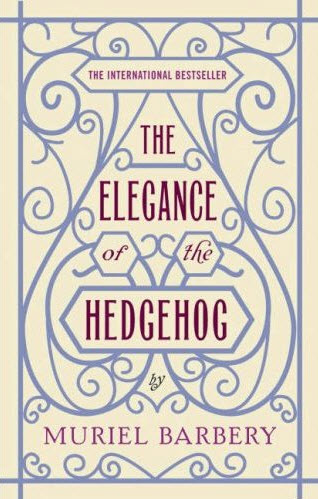
Translated from the French by Alison Anderson
I know that this book was on the best seller list for ages several years ago, but somehow or other I missed out on reading it. I think that I had it mixed up with Edmund de Waal’s The Hare with Amber Eyes -both European animals, I guess- and I was surprised to find that it wasn’t a WW2 Jewish family story at all. Instead it is set at some undetermined time -1990s?- in a luxurious Parisian apartment block. Reneé Michel is the concierge there, a job that she she took over from her late husband Lucien after his death.
SPOILERS AHEAD
Outwardly Reneé appears to be a working class menial worker, largely invisible to the residents of the apartment block who see her as little more than one of the amenities of the building, like the elevator. But she is much more than this. A precocious child from a poor family, who was forced to leave school early and marry young, she has a thirst for knowledge of the most esoteric and philosophical kind but she hides her abilities from everyone. Her best and only friend is Manuela, who works as a cleaner in the building. Manuela does not share Reneé’s interests at all, but she is quick, observant, generous with her limited resources and a loyal friend. She also provides cover for Reneé, giving the appearance of two equally humble and uneducated women friends- which of course we know Reneé is not. An equally precocious child lives several floors up, twelve year old Paloma Josse who is a mixture of intellectual superciliousness, ennui and determination to subvert the bourgeois future that awaits her by planning to commit suicide on her thirteenth birthday.
The book is told alternately from the first person perspective of Reneé and Paloma. The author distinguishes the two voices through different fonts, but the narrative voice is strong enough in both of them that there is no need for the visual cues. Both of them are exploring big philosophical questions- Reneé at a more abstract level; Paloma by observing the behaviour of people around her and gradually distancing herself from her avowed intention to set fire to the apartment buildings and kill herself at the same time.
I’ll confess that I found some of the philosophical chapters rather tedious- a long chapter about phenomenology, for example- and until halfway through the book I was wondering whether it was going to go anywhere. But then one of the residents of the apartment block died, and his apartment was purchased and renovated by the wealthy Japanese Kakuro Ozu. A man of refined and simple tastes, and an observer of beauty, he recognizes through small clues that both Reneé and Paloma are intelligent, philosophical women, both hiding their intelligence behind a surface of gruffness and ignorance, in Reneés case or adolescent moodiness and self-centredness in the case of Paloma. Manuela, Reneé, Paloma and Kakuro form a bond to which the apartment residents are completely oblivious.
Kakuro asks Reneé on a date, and with endearing awkwardness she procures a dress through Manuela’s help and goes to the hairdresser for the first time in many years. But she is increasingly uncomfortable at his attention, telling herself that such a cultured and wealthy man could not be interested in a lowly concierge. This, however, is all a defence mechanism, and we learn from her family story that her sister Lisette had died after giving birth to the child of the wealthy employer she had left home for. Shaken by her sister’s death, “Don’t fraternize with rich people if you don’t want to die” had become her watchword, but it was countered by Kakuro’s response “You are not your sister, we can be friends”. Indeed, possibly even more than friends.
I won’t divulge the ending, but it came quickly and out of left field. All of my reservations about the lack of movement and philosophical pretension in the first half of the book were dispelled. It left me in tears, wishing that I could stop the ending and just hold on to the characters for a bit longer.
I am rather mystified by the title though. Paloma watches Reneé and observes:
Madame Michel has the elegance of the hedgehog: on the outside, she’s covered with quills, a real fortress, but my gut feeling is that on the inside, she has the same simple refinement as the hedgehog: a deceptively indolent little creature, fiercely solitary- and terribly elegant. (p.139)
I’m no expert on hedgehogs: indeed, I don’t know if I’ve ever seen one. I must say, though, that ‘elegant’ is not a word I would readily associate with them. Certainly Madame Michele is prickly, solitary, combative and self-contained but elegant?
My rating: 8/10
Read because: Rosanna Readers bookgroup (i.e. ex-CAE) selection through YPRL.

