‘Australia’s Second Chance’ by George Megalogenis

megalogenis

‘Australia’s Second Chance: What our history tells us about our future’

2016, 292

When I did HSC Australian History back in 1973, one of the books we had to purchase was A.G.L. Shaw’s The Economic Development of Australia. With its mud-coloured front cover, it was not an enticing book and it remained resolutely unopened the whole year.  Despite my admiration for A.G.L. Shaw’s work on Port Phillip, I’ve never been tempted to dig it out again.

Generally, economic history does not have a lot of prominence within Australian historiography, especially in recent years.  This struck me particularly when I was looking at Upper Canadian history, where economic explanations of development seem to abound. I wondered if, perhaps the difference lay in the fact that Upper Canada was settled overtly as a capitalist, entrepreneurial venture, compared with Australia’s more ambivalent beginnings as a penal colony in NSW, Tasmania and Moreton Bay, or as a Wakefieldian experiment in South Australia combining economic and social/moral aims.

However, in Australia’s Second Chance George Megalogenis has written a history of Australia  from an economic perspective that starts with the First Fleet and goes right through to 2015. Megalogenis writes more as a journalist more than historian and political commentator and in this survey-history he relies mainly on secondary sources.

The thesis of the book is that with the Gold Rush, Australia had a windfall that opened us up to the  rest of the world and made us, during the 1870s, the most prosperous country in the world. However, by the end of the 1880s we were too rich for our own good, and insecure that we could lose it all and thus grasped at the White Australia policy as a way of keeping people and goods out in order to preserve our standard of living.  This insular, frightened stance locked Australia into low growth and a sluggish economy until post-war migration, in its various guises, reinjected diversity back into Australian society and again stoked the furnaces of economic growth. In the closing chapters of the book, written while Abbott was Prime Minister, he warns that income inequality and fear of competition could lead us to squander our ‘second chance’- the minerals boom and Hawke/Keating open economy- and condemn us again to mediocrity. Continue reading

This Week in Port Phillip in 1841: 15-22 October 1841

Hot air in winter!

presbyterian-school-house-melbourne-elevation-also-known-as-scots-school-house

Presbyterian School House (Scots School House) by Joseph Burns. It was erected at the north-west corner of Collins and Russell Street by December 1839 and used for services until Scots Church was built. It was for some time the only building available for public meetings, like this first meeting of the Debating Society.  It was demolished in 1870. Source: State Library of Victoria


On 13 October a meeting was held in the Scots School House to discuss the transformation of the Debating Society, which had previously been meeting in private homes, into a larger and  more substantial organization. In Sydney, the Debating Society was a branch of the Mechanics’ Institute, and had use of their lecture room and library.  Although there was a nascent Mechanics’ Institute in Melbourne,”their temporary committee room is too circumscribed to afford accommodation for the debates being held therein; the use of the books in the library is the utmost that could be offered, and this, no doubt, would be cheerfully conceded.” (PPG  13/10/41)  As a result, the Melbourne Debating Society decided to open itself up to the public as an independent organization.

Mr John Stephen was called to the chair, and the rules were discussed. There was some controversy over the rule which prohibited reference to scripture in the elucidation of argument, but Mr Darling, who proposed the original rule was sticking by it.  Then Rev James Forbes, the Presbyterian minister (in whose rooms they were meeting, after all) said that religious controversy should always be avoided in a Debating Society, but that he didn’t disapprove of referring to scripture in support or confirmation of an historical fact. He then proposed an amendment that quotations from scripture should be excluded in the debate (i.e. reference was allowable, but quotation was not). His motion was carried. A great number of people enrolled their names as members.(PPG 16/10/41)

On 20 October the first public debate was held, again at the Scots School House.  There were twenty members present, plus visitors. The question for debate was  “Did the motives which incited Brutus and his associates in the assassination of Julius Caesar originate in patriotic desire or personal feeling”? Quite frankly, I wouldn’t know where to start. Neither, it seems did the good men of Port Phillip, in the opinion of the writer from the Port Phillip Gazette:

One thing was evident; that neither of the parties, pro or con had sufficiently studied the question, as to bring the points which most materially bore upon the subject in aid for its elucidation. This system should not be permitted to obtain, if the society is to prosper. [PPG 23/10/41]

Oh well, better luck next Wednesday, when the topic was: “Whether America or any other nation is likely ultimately to supplant Great Britain”?

I’ve written more about the Debating Society here.

It’s ball time again

You might remember the fuss about the Private Assembly Ball back in June. Well, another Private Subscription Ball was planned for October and, according to the Port Phillip Gazette, it all went very well:

PRIVATE ASSEMBLIES. The first ball of the season took place last night at the Freemasons’ Lodge-Room in the Exchange Hotel.  The attendance was numerous, considering the unsettled state of the weather, and the arrangements made reflected the greatest praise upon the stewards of the evening. The ball room was most tastefully decorated, under the supervision of Mr Buckingham. The refreshments were of the first-rate description. Quadrilles, waltzes and Gallapades divided the entertainments into their due proportions, to which the exertions of the orchestra contributed the full share of mirth and activity.  The supper room was ornamented with flags of various descriptions. Altogether the entertainment appeared to afford ample satisfaction to all parties; and the tout-ensembled afforded a gratifying specimen of colonial gaiety, with cannot be too often [applauded?] [PPG 23/10/41]

The drapers of Melbourne took advantage of ball season and the upcoming visit of Governor Gipps to spruik their wares:

ADVERTISEMENT- THE GOVERNORS VISIT.  The proposed Visit of the Governor, accompanied as he will be by his Lady, will cause a degree of gaity in the Provice which has seldom before occurred.  With the Governor’s visit a series of BALLS, ROUTES AND SOIREES &C will follow in its train, and Melbourne will be for the period of their stay relieved from its usual monotony.  The ladies of Melbourne will of course be prominent in their display of FASHIONALE [sic] TASTE for which they are so much admired, and which upon this occasion they will doubtless show to the best advantage, proving alike to Sir George as to Lady Gipps, that the ladies of Port Phillip can justly appreciate the beauty of British Manufacture.  Cashmore & Co desire to encourage this amiable emulation on the part of the ladies of Port Phillip, have obtained, and they will open this morning A CASE OF FANCY GOODS which are expressly provided for this enlivening occasion.  Early application is necessary, as this is the only case they have of those articles [PPG 20/10/41]

cashmore

Michael Cashmore, photographed by T. F. Chuck in 1872. Cashmore’s store on the corner of Collins and Elizabeth Streets was very well known. Source: State Library of Victoria

As it turned out, Lady Gipps didn’t accompany Sir George, so all that competition to impress was rather wasted.

Infanticide

A Coroners Inquest into infanticide held during this week provides an insight into the jobs and living conditions of  the servant class in Melbourne, and most particularly those of recently-arrived immigrant women from Ireland.

A baby was found in a cesspit servicing three separate houses in Little Flinders Street. Joseph Stewart, an” eating house manager” said that he had two female lodgers in his house, but they were married people and their husbands resided with them. Neither had been ill and nor had any alteration taken place in them since residing there. He had had a female servant who left last Sunday, discharged for disobedience of orders in going to chapel without permission:

…she passed as a single woman, and went by the name of Catherine, she was a stout woman and had very good health; she is as stout now as ever was; she lived with witness for about two months and a half; think she took up her residence in the back yard after she left.

The District Constable reported that the woman, Catherine Rigney had left Stewart’s house immediately after she heard of the cesspool being empties and had run away, taking a portion of her clothes and saying that she would be back for the others.  She was called to the stand and said

I am a servant and arrived on the 16th July in the Royal Saxon; I went to live with Stewart the latter end of that month; he discharged me on Sunday because I went to mass without asking his permission.

Her former shipmate Catherine Banquo took the stand; said that they had travelled out from Cork together and that there was no alteration in Catherine Rigney since she first knew her. She was a servant to Mr Robson, of the London Inn and Catherine had called on her and said that her master had discharged her because she went to mass; she slept that night with her, she seemed a little distressed in being out of a situation.

Dr Cussen, who conducted a post-mortem, testified that it was a full-term baby. The jury after a short consultation returned a verdict of ‘Wilful murder of the child, by some party or parties unknown’.

But then, some hours after the inquest, a woman known by the name of Bridget (Biddy) Lapping,who had resided in Stewart’s house for two months before being turned out for drunkenness,  informed that Stewart had, a day or two previously, taken an infant and a bag of wool “removed from a mattress, for reasons which delicacy forbids us to mention” and thrown them into the privy at the rear of his house.  Stewart was arrested and taken to the watchhouse [PPG 20/10/41]

The following morning when he was brought before the police court, she said that she had not the slightest recollection of making any statement, and if she did so it must have been under a state of intoxication.  She said that she knew nothing whatever of a child being put into a bag containing some hair and being thrown into the cesspit. But several witnesses said that she had said so.

There is one circumstance which must strike everyone who has taken the most cursory glance at what transpired relative to the case… it is clear that the woman stated she saw Stewart put the child into a bag containing some hair, and she then enquired of Clifford (who was employed to clean out the place), which he found first, “the hair or the child?” Clifford said “the hair”. It is an extraordinary circumstance that nothing relative to the hair came out in evidence at the inquest; therefore, unless the woman was well acquainted with the facts, she must have arrived at the circumstance of the hair being with the child, by intuition. Not the slightest clue has been obtained of the mother of the child, which is somewhat extraordinary.  The man Stewart, of course, in consequence of the gross prevarication of the woman, has been discharged.  The woman Lapping turns out to be a prisoner of the Crown and according to her own showing, has been living a life of gross infamy.  The Bench have turned her into government and ordered her to jail. [PPG 23/10/41]

The mother of the child was never identified.

And the weather?

Between the 15th and 21 October there were fresh breezes, strong winds and gales- it certainly sounds like our changeable spring weather!  There was fine weather up until 19th; the 20th was the hottest day at 82 degrees (27.7) before rain on 20th and 21st.  Certainly Georgiana McCrae was enjoying the weather, noting the thermometer at 82 on 16th “a delightful day”.  On 20th she noted “Another delicious day. I feel all alive!” and recorded 84 degrees on her thermometer on 21st. The lowest temperature was 41 (5 celsius).

Some good news (for now) about Banyule Homestead


Banyule Homestead (a)_PeterCrone

Those of us who submitted objections to the proposed use of Banyule Homestead as a wedding venue received welcome news from Heritage Victoria recently.  The owners have withdrawn their application, for now at least.

leader18oct2016

I think that there’s yet another chapter in this story.  You can follow it at my other blog, Banyule Homestead Matters.


Exhibitions: Pholiota and Strutt

Once again I find myself visiting and writing about exhibitions just as they’re metaphorically turning the lights off and getting ready to shut the door. Well, perhaps not quite, because both these exhibitions close on 23 October, but that certainly doesn’t leave long to catch them.

Pholiota Unlocked 7-23 October 2016, 9am-5pm. Dulux Gallery, ground floor, Melbourne School of Design, University of Melbourne. Entry is free.

I knew that there must be something up with Pholiota because I’d noticed so many hits on a posting I wrote back in 2013 about Walter and Marion Griffin which included photographs of the interior of Pholiota, which I was fortunate enough to view on an open day.

IMG_4741

Pholiota – you can just see the Knitlock brickwork

Pholiota (meaning ‘mushroom’) was constructed by Walter and Marion Griffin in Eaglemont, beside the Lippincott House which Griffin also designed for his brother-in-law. Knowing that its miniscule size (6.4 metres by 6.4 metres) would preclude it receiving building approval, they claimed that it was only a doll’s house for the Lippincott House next door.  They lived there between 1920 and 1925 very happily: so happily in fact that Marion claimed that they sometimes walked backwards on the way to Eaglemont station so that they could admire it from afar.

The original house is, in effect, a single room with sleeping alcoves, a too-small kitchen and a largish dressing room surrounding the dining room with its open fireplace.

IMG_4751

The large table in the centre of the room; very small kitchen in the middle rear

Students from the Melbourne University School of Design have built a life-sized model of Pholiota from  plaster blocks fabricated using modern materials manufactured using the Knitlock system invented by Griffin as an inexpensive, do-it-yourself form of building.

img_20161021_145401

The walls only reach about eight feet high and there is no roof, so you feel as if you are looking down on the model.  Even though it was empty and completely white,  it seemed smaller than I remembered the real Pholiota to be. You can don virtual-reality glasses to look at a student’s design for updating Pholiota to current taste.

In an adjacent gallery students have reimagined the Glenard Estate which was laid out by Griffin in 1916.  Charged with making it a medium-density suburb while maintaining Griffin’s vision of shared green space, the students have designed streetscapes with multiple dwellings, the same size as Pholiota and each with 2 bedroom spaces, more than doubling the density of the suburb.  I’m sure that the good people of Glenard Estate are horrified.

There’s a good article about Pholiota here

Heroes and villains: Strutt’s Australia State Library of Victoria 14 July-23 Oct 2016, entry free.

Despite the rain, we caught a tram down Swanston Street to the State Library of Victoria to catch the last days of ‘Strutt’s Australia’, an exhibition previously on show at the National Library featuring works by the painter William Strutt.

Have a look here and you’ll see that you probably recognize many of his paintings without necessarily realizing that he had painted them.  Burke and Wills; bushrangers; the Black Thursday bushfires: he’s a veritable one-man-band of Australian imagery- or perhaps rather, he helped create it.

Born in England, he began drawing at  the Paris atelier of Michel-Martin Drolling in 1838 (just 13!) where he was trained in figure drawing leading to the painting of large history paintings.  He lived in Australia between 1850 where he painted portraits of John Fawkner (Judge Willis’ most vocal supporter), members of the Native Police Force and Robert O’Hara Burke (of Burke and Wills fame) He travelled to the goldfields where he made sketches of the diggers at work and  made sketches in preparation for making big-history paintings of the opening of the Victorian Legislative Council in 1851 and Parliament House in 1856.  Many of his scrap books furnished small sketches which he later incorporated into his pictures. He returned to England in 1862 where he painted ‘popular’ pictures to keep body and soul together, as well as the big historical paintings of Australian events that we know so well e.g. Black Thursday and the burial of Burke (which of course he never witnessed).

There’s an interesting interactive display where you can click on the figures in his Bushrangers picture and see the original sketches that he had done in preparation for this larger picture. I was surprised by the variation in quality of the works on display: his nude figures as a 13 year old are very good and the details in his big history paintings are vivid and well-realized but to be honest, some of his portraits are pretty ordinary.

Movie: Love & Friendship

Well, this is all a bit confusing! The young Jane Austen did write a novella called Love and Freindship [sic] reviewed here by Whispering Gums (who is an insightful guide to all things Austen) but this film by Whit Stillman is actually a rendering of another Austen novel completely, Lady Susan, also reviewed by Whispering Gums.  I suspect that Stillman was riffing off the other double-barrelled Austen titles (Pride and Prejudice; Sense and Sensibility) and perhaps he thought that nobody would notice.

Kate Beckinsale is absolutely luminous in this film as Lady Susan Vernon, the rather merry widow who has been cast onto her own resources to find financial security for her rather wet daughter and herself. She is quick witted, acerbic and ambitious and uses her skills and beauty artfully.  It’s a rather arch and knowing romp and thoroughly good fun, without being in the least ponderous.

Of course, the historian in me never quite goes away, and I found myself drawing links between the film and the financial dilemma of the female without means that I saw lived out through the life of the real-life Judge Willis’ sister Jane (known to the family as Jenny). I strongly suspect that she did not have the beauty, and she showed little evidence of the wiles of Lady Susan. Nonetheless, as with Austen’s other works, it’s an interesting commentary on early 1800s social and gender relations offered up to the historian’s eyes almost unwittingly.

I enjoyed this review of the movie:

http://www.newyorker.com/culture/richard-brody/whit-stillmans-love-friendship-subverting-the-social-order-with-style

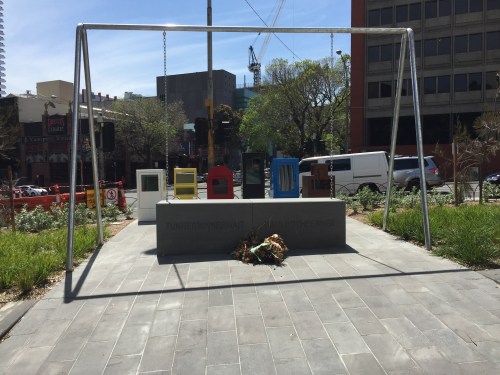
Spotted in Melbourne 16 October 2016

In a laneway near the Queen Vic market yesterday….

Exhibition: Moving Tongues 5-30 October 2016

movingtongues

Once again, here I am talking about an exhibition that’s about to close in a few days so if I pique your interest, you’re going to have to hurry up to catch it.  It’s called ‘Moving Tongues:Language and Migration in 1890s Melbourne’ and it’s on at the City Library branch in Flinders Lane, close to Ross House, until 30 October.

The first image that you encounter is that shown  in the poster above: the rectilinear street-grid imposed onto British settler colonies with little regard to topography or earlier use, conveying the impression of a single, replicable British culture.  However, this display argues that a multiplicity of languages and cultures existed within that grid, and it draws from the proceedings of Melbourne courtrooms in the 1890s to illustrate the point.

img_20161014_124852

And so we meet Charles Hodge, the long-standing interpreter in Chinese cases and the ‘Chinese oath’ that was accepted by Victorian courts for many years which involved the lighting of a flame and the recitation of a pledge to tell the truth. We read of the ultimately tragic case of young Norwegian servant Louisa Fritz who accused her employer Theodore Ulstein of rape.  We read of the presence of Syrians and “British Hindoos” and see their sleeping arrangements in the terraced shops of Little Lonsdale and Exhibition Streets, and the alliances formed with indigenous people, especially at the Cummeragunga mission.  We see the November 1898 Parliamentary hearing called by the Victorian government, in order to hear opinions of the Immigration Restriction Act that was one of the first legislative acts of the newly federated Parliament of Australia.

The print-based display is supplemented by a small number of artefacts and replicas of courtroom documents, poetry  based on the Melbourne Poetry Map and artwork.  One large art piece by John Young is based on selections from the diary of Jong Ah Sing, who was incarcerated in lunatic asylums for 33 years. He wrote his diary in an attempt to prove his sanity.

img_20161014_124834

It’s a small, modestly presented display that conveys a broader linguistic and aural view of Melbourne than that presented in the Sentimental Bloke and other depictions of the underside of Marvellous Melbourne.  But hurry up- it closes on 30 October.  The City Library is open Mon-Thurs 8.00am – 7.45, Friday 8.00 to 5.45, Saturday 10.00 to 4.45 and Sunday 12 noon to 4.45.

This Week in Port Phillip 1841: 8-14 October 1841

Governor Gipps’ visit

I let slip last week that Governor Gipps was to visit the Port Phillip District in October 1841. There had been hints and rumours but now it had been confirmed: Governor Gipps was to visit for the first time.  He hadn’t been to Port Phillip, but he had already met the superintendent Charles La Trobe, who stayed with him in Sydney before coming down to Port Phillip.  The warmth of their relationship is reflected in the Gipps-La Trobe Correspondence, edited by A.G.L. Shaw.

The newspapers didn’t know whether to gush with excitement or to continue with their ongoing litany of complaint about the Governor and  New South Wales generally.  i.e “we provide all the money through land sales and they give us nothing back”; “why doesn’t Sydney give us more for infrastructure?” etc (not unlike the State Premiers in Australia today, come to think of it).  In the end the glamour of vice-regal ceremony won out and whole columns were devoted to the visit.

We’re not at that stage yet: they were still knee-deep in planning, and a public meeting was held at the Exchange Rooms to plan the visit. First question: how should he arrive? Mr Verner suggested that

the meeting should nominate a deputation to wait upon the Governor on board the steamer on her arrival in the Bay, and to request his Excellency to land publicly at the Beach at such time as might suit his convenience.  Mr Arden was of opinion that the better mode would be for the deputation to proceed in the Aphrasia to meet the Governor, and that His Excellency should be brought in the steamer to the wharf where the colonists could assemble to receive him on his arrival.  A lengthy discussion on this topic ensued, the one party maintaining that it was desirable that His Excellency should land at the Beach, because the approach to the town from that direction was calculated to give him a much more favourable impression of its beauty and extent that the approach by the river, and the other party insisting that if subjected to the necessity of wading through the swamp, His Excellency would scarcely have leisure or inclination to survey the opening beauties of our metropolis. (PPP 11/10/41)

In the end, it was decided to leave it up to the committee.  Next question- the public dinner. Who should be the chairman? It was decided that La Trobe should be asked to do the honours, to which he promptly agreed. And so, soon this advertisement appeared:

gg

The social calibre of the stewards and the two-guinea-a-head ticket price indicated that this would be a thoroughly respectable gathering.  None the less, a correspondent to the Port Phillip Patriot (who, you may remember could well have been one of the authors of the Patriot itself) wrote to ask “is the Dignity Ball farce to be played out over again?” Certainly not, the Editor replied:

Character- not wealth or the fanciful distinctions of birth and station- is to be the test of exclusion from the dinner to the Governor, and that test no reasonable man can object to. [PPP p.2]

A night at the theatre

the-eagle-tavern-and-theatre-royal

William Liardet’s depiction of the Theatre Royal (formerly The Pavilion) shown as it stood before its demolition in 1845 and  sketched from memory in about 1875. Source: State Library of Victoria

Not quite so respectable was the prospect of a night at the theatre. It’s easy to lose sight of how closely the theatre was scrutinized in early Melbourne. The Pavilion in Bourke Street, opened in April 1841 went through several name changes.  Edmund Finn, writing as Garryowen gives one of his typically colourful descriptions of the building:

Its dimensions were to be 65 feet by 35 feet, the sum of £11ooo was to be expended on its construction.Its dimensions were to be 65 feet by 35 feet, the sum of £11ooo was to be expended on its construction,…it was one of the queerest fabrics imaginable. Whenever the wind was high it would rock like an old collier at sea, and it was difficult to account for it not heeling over in a gale.The public entrance from Bourke Street was up half-a-dozen creaking steps ; and the further ascent to the ” dress circle,” and a circular row of small pens known as upper boxes or gallery, was by a ladder-like staircase of a very unstable description. Internally it was lighted by tin sconces, nailed at intervals to the boarding, filled with guttering candles, flickering with a dim and sickly glare. A swing lamp and wax tapers were afterwards substituted, and the immunity of the place from fire is a marvel. It was never thoroughly water-proof, and, after it was opened for public purposes, in wet weather the audience would be treated to a shower bath. (p. 451)

Apparently it was licensed to hold concerts and balls, but no ‘theatre’ as such and the violation of its licence conditions led to a rather rambunctious night :

THE PAVILION. There was a tremendous ‘flare up’ in this establishment on Monday night last. Major St John had countermanded the entertainments in consequence of ballet dancing being introduced, that being contrary to the express rules laid down for their guidance. Application was then made to His Honor the Superintendent, but without it being stated to him the decision at which Major St John had arrived. His Honor, in ignorance of this circumstance, said he had no objection to the performance taking place as usual.  The time arrived, the doors opened, and the house filled to the ceiling; the leader of the band flourished his bow, a crash followed and the overture was gone through in good style; the curtain rose, and a song by a lady succeeded. At this critical juncture the chief constable, Mr Falkiner, stepped forward and caused a halt, upon the order given by the Major; an awkward pause followed, which the audience filled up by smoking cigars and sipping from stone bottles; a gentleman in top boots, accompanied by a ruffianly looking groom,  cleared the orchestra at a bound, and commenced a reel; Mr Miller quickly served upon them a writ of ejectment, by propelling them into the pit. Thus passed about an hour, when Mr Miller came forward and announced that His Honor the Superintendent had forbidden the performance- and the curtain dropped again. Then commenced a scene which we never hope to witness again- the hubbub was immense- Waterloo was a fool to it. After the house was cleared, which was with considerable difficulty, in consequence of the demand of the auditory for their money, a servant of His Honor rode up and announced that the concert might proceed; it was however too late, the public had dispersed. The parties interested in the success of the pavilion may thank themselves for this failure, having broken the rules laid down by the police magistrate for their guidance.  Until this place is under the control of respectable parties it never can prosper.[ PPG 13/10/41]

Rude servants

Reading through the Police Court columns, it comes as a jolt to realize just how draconian the N.S.W. “Act for the better regulation of Servants, Labourers, and Workpeople”(1828) legislation was,  even exceeding  the English Masters and Servants legislation on which it was based.Not just content with dismissal, employers could (and did) take their employees to court where they could be imprisoned, sentenced to hard labour or fined.  And so we read in October 1841 of Captain Smyth of Heidelberg taking his servant Ruth Robinson before the court for gross misconduct in what Smyth clearly intended as an exemplary punishment. I haven’t been able to locate any information about the Hired Servants’ Act, but it seems to have restrained Captain Smyth somewhat – although the punishment was still harsh when servants’ wages were about £15 per annum.

HIRED SERVANTS. Ruth Robinson, a hired servant in the employ of Captain Smyth, of Heidelberg, was charged with the following gross misconduct.  The previous day she wished to leave his service, when Captain Smyth said he would go to Town, and when suited with another servant, she was at liberty. During his absence the conduct of the woman Robinson towards Mrs Smyth was most abominable. She gave her mistress to understand that, the master being absent, she should not obey orders.  Upon being requested to bring in the dinner, she said that she would not, until she had dressed herself, then she would bring in the dinner, after which it was her intention to walk into Town; and as she said, so she acted.  The woman also had put herself into so violent a passion that Mrs Smyth had reason to fear personal violence. Captain Smyth said, that he brought the woman before the Bench upon public grounds; here were a number of females coming to the colony, honest and well behaved no doubt, but totally ignorant of their duties as servants; when they had obtained the necessary degree of knowledge, they became insolent, and endeavoured by every means in their power to obtain their discharge.  They were however particularly cautious not to commit themselves before their master, fearing that he might appear against them, but taking advantage of his absence abused their mistress, well knowing the objection of ladies to come into a public Court. He hoped the Bench would make such an example of this woman as to deter others from offending in like manner.

The Bench regretted that under the 10th section of the Hired Servants’ Act, they were forbidden to imprison females for misconduct in their hired services. By the 8th section of the same act they were empowered to inflict a fine, and sentenced her to pay the penalty of £5; if not paid in a fortnight her goods would be levied upon. She was ordered to return to Captain Smyth’s house, and deliver to Mrs Smyth what articles had been placed in her charge.

How’s the weather?

Winds mostly strong; a gale on 12th, weather frequently cloudy, threatening rain at times but none fell. Top temperature for the week was 70; lowest 45.

‘Big Mama’s Funeral’ Collected Stories by Gabriel Garcia Marquez

Still I paddle along as quickly as I can in my Coursera course on Gabriel Garcia Marquez‘s work, reading the literature in English with relish and the transcripts of the videos and linked articles in Spanish very slowly!

mamagrande

1962

This week I read a collection of short stories called ‘Big Mama’s Funeral’, so named for the final story in the collection. As the course explains, some of these short stories are in effect practice-runs for material that would appear in A Hundred Years of Solitude, while others ‘speak to’ other literature that would be familiar to Spanish-language readers (but not necessarily English-language ones). One of Garcia Marquez’ stories, ‘One of These Days’ involves a dentist whose patient, the Mayor, comes in with an abscessed tooth which the dentist- maliciously- tells him can only be extracted without anaesthetic. This story ‘speaks’ to a story by Hernando Telles called ‘Lather and Nothing Else’, a fantastic story available here that has a barber called upon to shave the military officer responsible for mass killings and atrocities. (To be honest, I preferred the Telles story.)

The two most memorable stories for me were ‘Tuesday Siesta’ and ‘There Are No Thieves in this Town’. ‘Tuesday Siesta’ is about a woman and her daughter who travel by train to visit a priest in order recover the body of her son, shot in an Oscar Pistorius-like encounter. Garcia Marquez captures well the hot somnolence of the Tuesday siesta  and the mounting hostility of the villagers who surround the priest’s house. The second story ‘There Are No Thieves in this Town’ involved the theft of billiard balls.

There is another short story I’ve been reading, which was published in ‘Eyes of a Blue Dog’, another collection of Garcia Marquez’s short stories.  It’s called ‘Monologue of Isabel Watching it Rain in Maconda’ and it’s the longest short story I’ve ever read because this time, I am reading it in Spanish!  By the time I’ve read half a page, I’m sweating with exertion (to say nothing of the humid, rainy weather I’m reading about) and no doubt I’ll still be reading it in three weeks when the course is over!

This Week in Port Phillip 1841: 1-7 October 1841

‘Scrutator’ fall-out

One of the problems of writing a libelous letter against the only Judge in town is that, when you’re hauled over the coals for it, it will be before that very same Judge. So 21-year-old George Arden was to learn, after publishing the Scrutator letter in the Port Phillip Gazette. At the next sitting of the court, the Crown Prosecutor made an application grounded on an affidavit made out by the Acting Crown Solicitor against George Arden for “false, scandalous and malicious libel, reflecting on the administration of justice and upon His Honor [Judge Willis] personally”.  Willis made a long speech in his own defence, then, after quite properly declaring his unwillingness to act as a judge on his own case, turned proceedings over to the Police Magistrate Major St John and three other magistrates on the bench: Powlett, Verner and Lyon Campbell.  The personalities of these magistrates is important:  William Verner and James Lyon Campbell were strong supporters of Willis and his neighbours in Heidelberg. They announced that Arden should be bound over with recognizances of 400 pounds and two sureties of 200 pounds each (in effect, a form of good-behaviour bond) and attend the Police Court the next day.

Arden fronted up as required at the Police Court on Saturday morning, where Major St John was joined by a different group of magistrates: McCrae and Were.  Now these magistrates were no friends of Willis’, each coming into conflict with him in their own right.  In Willis’ absence, they decided that it was not necessary to enforce the order (a rather ‘brave’ decision, one would think, given Willis’ combativeness).  On hearing of this decision, Willis immediately launched an appeal which was heard in Quarter Sessions on the following Monday before the same magistrates as on Saturday, but this time they were joined by six other magistrates of the district, including Powlett, Verner, Lyon Campbell.  After much discussion, they re-affirmed the order about recognizances.

The three newspapers devoted columns and columns to these events, framing it as a liberty of the press issue which, indeed it was.  All three were scathing of Willis’ actions, with even the pro-Willis Port Phillip Patriot under the proprietorship of John Fawkner declaring that Willis should “resign the office of Resident Judge into the hands of one or other of his brethren on the bench” (PPP 7/10/41).

As it turned out, Arden was released from his recognizances a month later amongst all the bonhomie surrounding the visit of Governor Gipps- but, oops!- that hasn’t happened yet. But rest assured, this matter isn’t going to go away, and we’ll revisit it in February next year.

St Francis’ Catholic Church

On 4th October 1841 Fr. Geoghegan laid the foundation stone for St Francis’ Church which still stands on the corner of Lonsdale and Elizabeth Street, looking much as it did in the 1840s.


st-francis-church-melbourne

St Francis Church 1845 from stone by Thomas Ham. Source: State Library of Victoria

The major denominations were hard at work in these early years of the 1840s building their first permanent churches to replace the rather makeshift structures had had been quickly erected as the population of Melbourne began to boom.  There was nothing that Melburnians liked so much as a good ceremony (in fact, that’s still true) and the Masons were usually on hand to make an occasion of it.  But not so when it was a Catholic chapel, notwithstanding the general co-operation between the denominations at this stage.

On Monday last the foundation stone of the new Catholic Church was laid by the Rev. Mr Geoghegan on the ground set apart for that purpose in Lonsdale-street, and upon a portion of which the temporary edifice at present stands.  In consequence of the reverend gentleman being a member of the order of St Francis, the church was dedicated to that saint.  It was contemplated that the Masonic body should have proceeded in due form, and assisted in the ceremony; but the opinions of others being at variance with this suggestion, it was dropped to prevent a schism. About £200 was collected on the ground.  The following inscriptions upon parchment were deposited, along with some coins, in the foundation stone:

stf.JPG

PPG 6 October 1841

The Port Phillip Herald, which gave more attention to news of the Catholic church than the other two papers, carried a full report of the ceremony and the addresses given in its 12 October issue.  The crowd, it seems, was smaller than might have been hoped:

The day was unfavourable, being tempestuous and showery, besides many of the congregation and persons of other religious persuasion were prevented attending by reason of occupation at either of the two Courts which were then adjudicating [on the Arden case above!] nevertheless a considerable assemblage was present at the sacred ceremony.[ PPH 12/10/41]

Fr. Geoghegan finished his oration praising the ecumenical spirit that generally existed in these early Melbourne years (the absence of the Masons notwithstanding). I’ve often wondered if it was the arrival of the bishops that hardened the sectarian lines in Port Phillip society, or did it just reflect the increasing size and complexity of a town outgrowing its frontier status?

Thanks to God we live in a country of liberty where it is the recognized right of everyone to worship God according to his conscience: Australia Felix! a country happy and true to its name, where we can appeal even to our Dissenting brethren to defend us from an encroachment on our religious freedom as if it were their own [PPH 12/10/41]

Unfortunately it seems that the coins did not stay for long in the foundation stone. On the 7th October the Port Phillip Patriot carried this report:

SACRILEGE. On Monday night last some paltry ruffians removed the foundation stone of the new Roman Catholic Chapel, which had been laid during the day, and carried away the bottle containing the inscription and the different specimens of the coins of the realm, which were deposited in the stone.  The whole value of the property stolen is not more than thirty shillings and to accomplish this notable feat there must have been at least six thieves employed, the dimensions of the stone being such as to preclude the likelihood of a smaller number being able to accomplish the theft without the aid of machinery.

How’s the weather?

Light winds 1st and 2nd, gale on 3rd, afterwards fresh and strong winds; weather damp and cloudy until 4th, afterwards bright and clear.  Top temperature 74 (23.3C), lowest 41 (5.0C) and the coldest day of the month was on 5th October.