
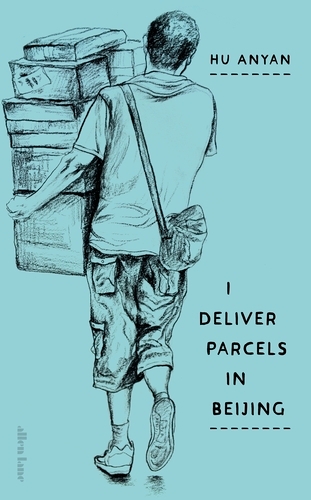
Translated by Jack Hargreaves 2025
What a strange book. I picked it up because I had heard that it was a best seller in China, and I was curious to know why. To be honest, having finished it, I still don’t know why this memoir was such a runaway success there, and who its Chinese readers might be.
The story itself is quite simple. The author is a young college-graduate who moves from home to take up a series of poorly-paid unskilled positions over a twenty-year period. His jobs include working in a logistics firm unpacking and packing items, delivering parcels for several courier companies, working in a hotel restaurant, selling bicycles, doing computer-aided artwork on comics, working in a bakery and working in his own companies selling clothes in a shopping mall. As he shifts from province to province seeking work, his accommodation often consists of an apartment partitioned into 5 sq metre ‘rooms’ with only space for a bed and a desk with shared bathroom facilities and only sometimes kitchen facilities. Sometimes he sleeps at the workplace. When working at the bicycle shop, for a 72 hour week, his rent was 1500 yuan per month, leaving him 2000 yuan per month to live on. In some of his jobs, food was provided, although often it was food that was left over. In the logistics job, the work statistics are so harsh that there is no time for toilet breaks and the temperature is so high that he sweats continuously. The hours are punishingly long. The courier job has expectations of customer service while at the same time offering such a pittance that compliance with any customer request puts him out of pocket. Companies take advantage of a three-day unpaid trial period, sometimes there is medical insurance and sometimes not, and employers take any opportunity to ‘stiff’ their workers. Amongst his co-workers he witnesses theft and dishonesty, but says nothing because he has to work alongside them. As he says:
The moral of the this story: When disgruntled, the lowly among us only have each other to pick on, because going after the powerful will only cost us in the end. (p. 202)
I see that the author was born in 1979, in the wake of the Cultural Revolution and at the start of Deng Xiaoping’s economic reforms that took China from a command economy to a market economy. He mentions a sister only once, but he does speak quite a bit about his parents. I found myself wondering how parents from such a starkly different type of economy would advise and equip their children to work in a new economy, unlike anything they had known (much like us as parents and grandparents parenting children who will work in an AI economy that is foreign to us).
My parents had only ever taught me to be kind to others. They failed to mention I also had to stick up for my own interests…Maybe because nobody had ever sat me known to talk it through before. My parents wouldn’t go near the topic. They had spent their whole lives in the same work units; the market economy was completely alien to them. …The thing was, my family was from out of town and had no relatives that lived nearby. My parents are unsociable folk, too. (p. 198)… I was starting to feel like my parents were to blame for all the rotten luck I had with people and work. They should have warned me. Their lessons on how to act had zero grounding in this world. They had said nothing about going after what I wanted, only that I should be frugal. What they told me was the wrong way to behave was exactly how everybody was behaving, and society wasn’t punishing them for it but rewarding the, and not just rewarding them, punishing me (p. 222)
Nonetheless, he did have his parents as a fall-back. Burnt out by the culture of exploitation and competitiveness, intimidated by the effort of having to interact with other people and yearning to have time to read and write, he returns to his parents’ home and in his own words, stays indoors for almost two years (p. 264). He later borrows money from them to set up one of his ultimately unsuccessful businesses. He does have a couple of girlfriends: indeed, it is because he wants to be with one of his girlfriends that he shifts from Guandong Province in 2018 to Beijing. He breaks up with another girlfriend when he is living and working in the store in Nanning, and she shifts overseas. He does not have friends, beyond his workmates and at work he is just as likely to make enemies as friends. I found myself wondering if his flight back to his parents’ home was an early example of tang ping, or lying flat culture, a rejection of societal pressure to over-work, a phenomenon in China particularly after COVID.
The structure of the book is unusual and rather hard to follow with a rather strange arrangement of chapters. The book sprang from a blog post written in 2020 (Chapter 2?) so perhaps that might explain why it is structured as it is. His story starts off in 2017 while he is working in Foshan as a package handler, but the chapter is written when he has been in Beijing for three years. The second chapter focuses on his time as a delivery worker in Beijing, followed his work in a convenience store, then in a neighbouring bike shop in Shanghai in Chapter 3. Chapter 4 is headed ‘Other Jobs I’ve Had’ where he lists jobs 1-8 (1: waiter 2: clothing store assistant 3: gas station attendant 4: fast food chain delivery 5: popsicle wholesaler 6: 3D architectural renderings 7: comic book artist 8: graphic designer for a startup magazine about anime). Jobs 9-11 were:
- 9: copy shop attendant
- 10: return to the anime magazine
- 11: his own clothing store. He then has a lengthy section about writing and reading, complete with extracts from two pieces of his writing. He then continues with the job countdown-
- 12: (2011) online store
- 13: property management at a mall
- 14: bakery shop
- 15: deli stall
- 16: selling rear view car cameras and car fresheners
- 17: the logistics job described in Chapter 1 with D company
- 18: parcel delivery with S Company
- 19: parcel delivery with Pinjun Express, both described in Chapter 2.
In the closing pages of the book, as he loses his job with Pingun Express, he observes that he had alternated between two mutually exclusive states: working and writing. He tended to do either one or the other, spending half of his life free of work, and the other half consumed by it (p. 317). He considers the nature of “freedom”, which he considers a matter of consciousness, rather than of what you possess. He observes:
So, by freedom, I suppose I am referring to a personal pursuit of sorts, and self-realization through consciousness of our individual selves- the spiritual essence that differentiates one person from another. If more of us when after this kind of freedom, the world would be a more diverse, more inclusive, more equal and richer place. It would be all the more colorful. The pursuit of freedom is what shapes our individual trajectories, our personal goals, and stops us from having to vie for space on a single narrow path…Maybe it is something we can strive for but never quite attain, and maybe I will never reach it in my whole life, but that doesn’t matter. Because the pursuit is more precious than the attainment, and this holds true for every person and for the world as a whole- like our ideals and our convictions, it is the fulcrum of our lives, not their content (p. 315)
Is this valourization of freedom the appeal of the book to a Chinese audience, I wonder? I can’t even think of the word ‘freedom’ without hearing it come out of George W. Bush’s mouth, and it seems almost antithetical to the choreographed military displays in Tienanmen Square. Is the book’s popularity a somewhat subversive embrace of that? Or was the book a bestseller in China when the recipients of packages ordered online became curious about the lives of the people who delivered them to them? Or is the book popular with the tang ping generation, with him forging the way? At times the book reminded me of George Orwell’s Down and Out in London and Paris but this is no dilettante’s or journalist’s curiosity. The jobs came first and the writing emerged later, and it seems that the author is still oscillating between the two, without the choice to leave it all behind as Orwell did.
Most of all, it made me realize how little I know about China.
My rating: 7/10
Sourced from: Yarra Plenty Regional Library
Read because: I had read an article in the Guardian about it.

