
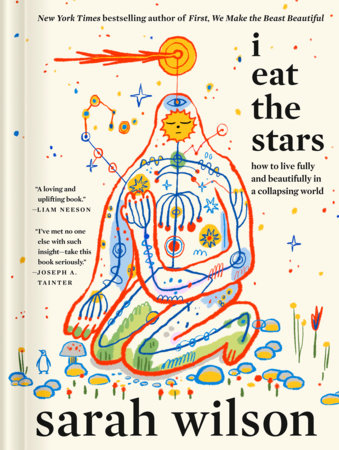
I can’t think of a book that I have read recently that has annoyed me yet affirmed me in equal measure as much as this book did. I still haven’t worked out which response is stronger.
Near the end of the book Wilson sums up her argument in a nutshell:
Facing collapse…allows us to finally get around to exploring the beautiful questions we ache to answer within ourselves. It very literally forces us to confront what matters most. What matters when we ‘lose it all’… Climate collapse has gotten us to confront truth in a fully adult way. The AI threat has us reckoning with what actually makes us us. I feel now that it is all steering us- with considerable urgency and force- to live simpler, more connected lives. To rise into a fuller, more mature, evolved expression of ourselves- as many other tumultuous, liminal, revolutionary times in history have tended to do (p. 253-4)
Even looking at this quote evokes both the things I really disliked and things I embraced in this book.
Let’s start with the ‘dislikes’ first, so that I can end on a more uplifting note.
Sarah Wilson is an Australian author and journalist who wrote I Quit Sugar, a book about anxiety First, We Make the Beast Beautiful and a book about forging a radically hopeful life forward This One Wild and Precious Life. For once, the library’s category sticker of ‘Wellbeing’ is spot-on, and I loathe wellbeing books. Warning sign number one.
This book emerged out of her Wild with Sarah Wilson podcasts, where I gather she interviews interesting people and collapsologists (who knew there was such a field) and has created her own community of podcast and Substack listeners and commentators. I am a podcast listener myself – and may indeed subscribe to her podcast feed because she does have interesting people- but the narrative tone of this book doesn’t rise above the gushing, please-like-me tone of a podcast (much as the tone of this review would be inappropriate for the Australian Book Review). Warning sign number two
She uses ‘overwhelm’ as a noun. Often. The whole book very much about her. Here she is, talking about what she is doing in order to remain faithful: meditate, dance, maximize her menstrual cycle, cry, hurt, cry more, move out of the house when she is frozen in fear, hyperventilate with nervous energy. (p.277). All part of the wellbeing trope that I dislike so much. Warning sign number three.
Moreover, much of the book is a pastiche of other people’s writing. Of course, all academics and writers draw on the work of other people. But this is more than footnoting: she describes this as ‘soul nerding’:
the practice, or art, of absorbing the considered reflections of smart, deep minds who have wrangled as we do now (p. 157)
But when does this move from drawing on knowledge and wisdom to becoming little more than a commonplace book? Even the layout of the book, with sections rarely longer than 2 pages and sometimes as short as a paragraph, separated by an asterisk, suggests a lighting upon one thought, then another, then another. Warning sign number four.
Enough griping. What did I like about the book?
I accept and agree with her perception of the world as rushing towards collapse. It terrifies me. I had to pull myself up at one stage and think “Hold on. I’m a historian. I know about this stuff”. It pushed me into thinking about Cambodia after Pol Pot; I thought back to Barbara Tuchman’s A Distant Mirror: The Calamitous 14th century; my area is 19th century Australian colonial history which saw the collapse of societies that went back millenia and millenia and millenia; I’ve been listening to podcasts about the Roman Empire for years. Humans do survive. Not all of them- indeed, a minority of them. Things do not ‘go back to normal’ but they do not stop either. Some things remain – the most important things – and they are woven into something completely different. Not without pain and sorrow – so much pain and sorrow- but they go on.
She talks about her own shift from being a climate change activist and trying to stop climate collapse, to instead giving up on hoping for better to contemplate that collapse and what it means for us. She discusses ‘prepping’ but eschews it because she asks the question- if I have prepped and others haven’t, what sort of person will that make me?
I’ve been thinking a lot recently about AI and humanity. So has she- along with many others.
…now the tech threat we face is forcing us to define ourselves away from the very AI that we efforted into being. This threat necessarily gets us asking, where does humanity end and artificial intelligence start? If AI can take our jobs and solve our technical and existential problems, if it can take the place of bones-and-beating-hearts lovers and replicate our most intimate art, what is left? What will AI never be able to take? Which is to ask: what is it that makes us human and what makes a human life worthwhile? We might have been avoiding the answer for some time, but can’t any longer (p. 117)
She is aware of herself (probably an offshoot of the self-absorption that I so disliked). She talks about ‘uncertainty intolerance’ and the encouragement in our culture to grasping for certitude, especially through 3-step You Tube videos and bedside self-help manuals. She reminds herself to watch herself over this tendency:
I’ve developed seductive techniques over decades of being a journalist, a story-teller and a self-anointed defender of things. I can often convince others- and myself- of whatever I set my mind to because I have the language to do so; I’ve mastered the certitude game (p. 147)
She notes a recent Brookings analysis that almost 2/3 of climate activists in the United States are women with an average age of fifty-two. She is fifty-two. I am fifty-two plus 18 years. One of my frequent declamations while watching the world news, as I see business meetings, tech bros, and the rapid disappearance of women on the world stage “All those bloody MEN!”. She makes a place for “a mature, feminised style of wisdom and leadership that all men and women can lean into and benefit from” (p. 242).
She is not afraid of spirituality. This is something I grapple with, and something that I am trying to integrate into myself through my involvement with Unitarian Universalism. How many other people, I wonder, sat with the census form, feeling that ‘No Religion’ wasn’t quite right, and yet not knowing how to define what you are? (thank heavens for the fill-in box).
She calls for us to create ‘islands of sanity’, a concept that she takes from Meg Wheatley:
…intentional spaces, conversations, even ways of being in which calm, considered, accepting, forgiving responses and approaches are lived out. These islands are not places where we fix the whole system. They are where we preserve human values, sanity and coherence in small communities in advance of the chaos ahead. They exist as a gentle invitation for anyone who chooses to lift that scab of denial and finds themselves tumbling into that lonely, frightening realm most of you reading this are in (p. 139).
I guess that’s what I’m trying to do in my own life: draw on the wisdom of other people, learn from history, create and build an island of sanity.
I do wonder where she goes after this book. I don’t think there’s any going back to writing books about sugar. Is she going to ramp it up even further or will she just repeat herself in book after book?
Rating: So, reduced to the algorithmic demand of Goodreads, or my own imperfect rating scale- what would I give this book? 9.5/10 for making me think? 5/10 for the narrative voice and self-absorption of it all? I’ll probably settle on 3/5 for Goodreads (because they rank in five stars).
Sourced from: Yarra Plenty Regional Library
Read because: I liked the title (which comes from a poem: Sometimes as an antidote/to fear of death/ I eat the stars.) Also, my Unitarian fellowship is going to discuss it in September.
 The Resident Judge of Port Phillip