
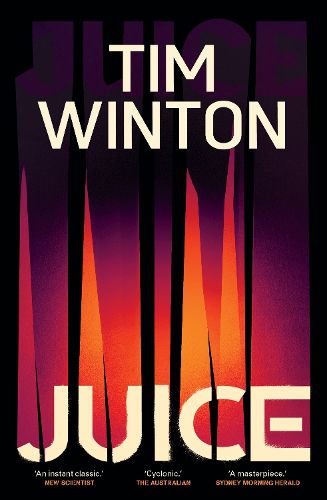
An unnamed man and a young girl are driving in a truck through a blighted stony landscape, surrounded by ash. When they draw into an abandoned mine site a man armed with a crossbow forces them from the truck cab and into a deep hole. The unnamed man does not trust the intentions of their captor towards the girl, and Scheherazade-like he tells his story to ‘the bowman’ both as a way of staying awake to protect the child and to gain the co-operation of his captor.
Set at some time in the future, the world has endured a horrific ratcheting-up of climate change and political breakdown. Temperatures regularly breach fifty degrees, and summer is spent underground in dark, stifling conditions, waiting out the months until winter, when it is finally safe to venture out into the open. Society seems to have broken down into small hamlets, scattered homesteads or gated armed communities. There does not appear to be any government, no religion, no music, no civic life. Cities like Perth and Sydney still exist, protected by walls, but they are fetid and dangerous.
As our unnamed narrator tells us (and the bowman), his father disappeared in a maritime accident when he was young and he was brought up by his ‘staunch’ mother – likewise unnamed- in the outback, growing vegetables in irrigated greenhouses in winter when the weather conditions are more benign. As he reaches adolescence he works salvaging parts from deserted infrastructure and taking their produce to ‘market’ where he barters for the things they need from other desperate, edgy people. It is at this market that he is approached to join the Service, a shadowy organization, that ruptures his world view completely. Brought up in an a-historical world, he learns about the phases of history that have brought the world to this point: ‘The Hundred Years of Light’, followed by the ‘Dirty World’, then the ‘Terror’. There were political choices that could have been made in the past (our present) that could have avoided this complete breakdown, and the wealthy descendants of the fossil-fuel executives, financiers and the lobby groups still shelter in enclaves surrounded by a luxury completely foreign to the depleted populations scrabbling to survive ‘outside’. The Service is committed to ‘acquittals’ – a euphemism for the assassination of whole families, including children- as vengeance for this climate collapse.
And so our narrator lives in two worlds: the spartan existence on the blighted landscape and the other world of secret missions, danger and bloodshed. He partners with Sun, and has a daughter, Esther, but spends months away, ostensibly scavenging, leaving his family on the homestead with his mother while he is called upon to embark on this campaign of murder and retribution that takes him to Utah, the Persian Gulf, and to Asia- all just ‘overseas’ places in this world without nations. The killing does not sit well with him, and each time he returns more and more disturbed, only to find that his wife and daughter have left. The Service keeps all of its operatives ignorant of each other and of the scope of their mission, and it is only as time goes on that our narrator learns that his whole life has been much more touched by the Service than he realized.
He tells all this to the Bowman, who he later learns has also been a Service man. Despite their common experiences, they are not the same. Our narrator’s life was saved by ‘sims’, hybrid simulacra who can withstand the heat and deprivation, but the Bowman believes that all sims should have been annihilated while they could be. Our narrator distrusts the Bowman with good reason, and even when I reached the last sentence of the book, I wasn’t sure quite what it meant.
Juice is similar to Cormac McCarthy’s The Road but the Scheherazade structure of the novel, alternating between the telling of the story at the bottom of a tunnel, and the story itself, means that it does not have the same grim relentlessness of McCarthy’s book. As a committed environmentalist, Winton does not pull his punches, naming the present-day fossil-fuel companies that the Service holds responsible for the climate collapse. In just one part of the novel, his religious faith and love of nature surfaces as well, when our narrator meets with one of the operatives who initially trained him. In what our narrator later says was the most interesting conversation of his life – just one- the operative says:
My mother used to tell me that when Nature dies, God dies along with Her… I guess what my mother meant is that without clean, wild, healthy things that can regenerate and renew themselves, the idea of God is impossible to imagine. (p. 346)
Does it matter if fiction is the vehicle for a political treatise? Not for me, as long as there’s enough depth to the characters to make them something more than mere mouthpieces. I don’t know whether Winton completely succeeded in this, but I wonder if his choice to keep his main characters nameless is not a way of intentionally distancing us as readers. I’m not sure that the introduction of the sims half-way through the book worked either, although it does raise questions about the sentience of artificially-created simulacra, and whether humanity’s only hope is co-existence with them, with the nature of the relation between human and sim left unexplored. There is much that he does not explain but to do so would detract from the earnest howl of despair at our present obtuseness that underpins the novel. He does not explain history, or the remnant technology, but this sparseness reflects the blighted nature of this world where there is no past and no future, just the survival of the season.
My rating: 8/10
Read because: Rosanna Readers Bookgroup selection
Sourced from: Yarra Plenty Regional Library
 The Resident Judge of Port Phillip