Tag Archives: Writing

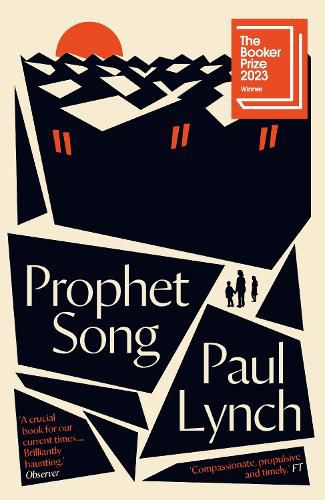
‘Prophet Song’ by Paul Lynch

2024, 320 p.

SPOILER ALERT

I am writing some weeks after I finished reading this book, and I really regret that I didn’t sit down and write it immediately afterwards. My response to it has dulled with time, but I do remember slamming it shut and announcing “Fantastic!!” I read it for the Ivanhoe Reading Circle immediately after finishing Sally Carson’s Crooked Cross (review here) and the two books complement each other beautifully. In fact, I think I will always link them mentally because they seemed to be a similar response to an uneasy, suffocating situation, separated by nearly ninety years.

The book is set in Dublin, at some unspecified time, two years after the National Alliance Party has passed the Emergency Powers Act, which gives expanded powers to the Garda National Services Bureau, (GNSB) a new secret police force. Eilish, the mother of four teenaged children, the last only a baby, answers the door to two policemen seeking her husband Larry, a teacher and trade union organizer. Within the first chapter, her husband disappears after a peaceful union march, and her attempts to find where he has been taken fail. Eilish is a mother, daughter, wife, scientist and a long-time resident of Dublin. For much of the book, and as the world becomes a sharper place, she concentrates on the mundane, the quotidian, trying to keep routines together. She holds on to the life that she had before, that she thought was immutable, too afraid to look beyond her house, her community, her family. Catching sight of herself in the mirror in the hallway

[f]or an instant she sees the past held in the open gaze of the mirror as though
the mirror contains all it has seen seeing herself sleepwalking before the glass the
mindless comings and goings throughout the years watching herself usher the
children out of the car and they’re all ages before her and Mark has lost another
shoe and Molly is refusing to wear a coat and Larry is asking if they’ve had their
schoolbags and she sees how happiness hides in the humdrum how it abides in
the everyday toing and froing as though happiness were a thing that should
not be seen as though it were a note that cannot be heard until it sounds from
the past seeing her own countless reflections vain and satisfied before the glass (p.43)

Her friend Carole, whose husband has also disappeared, urges her to resist and to look at what is going on around her as people in her street beginning hanging National Alliance Party flags from their windows, and as her house and car is vandalized. People stop talking:

…the brilliance of the act they take something from you and replace it
with silence and you’re confronted by that silence every waking moment and cannot
live you cease to be yourself and become a thing before this silence a thing waiting
for the silence to end a thing on your knees begging and whispering to it all night and
day a thing waiting for what was taken to be returned and only then can you resume
your life but silence doesn’t end you see they leave open the possibility that what you
want will be returned someday and so you remain reduced paralysed dollars an old
knife and the silence doesn’t end because the silence is the source of their power that
is its secret meaning silence is permanent. (p.165)

Eilish’s father Simon is living alone and subsiding into dementia, but he still has flashes of clarity which pierce through the domestic cotton-wool that Eilish is trying to cocoon herself within.

…if you change ownership of the institutions then you can
change ownership of the facts you can alter the structure of belief what is agreed
upon that is what they’re doing Eilish it’s really quite simple the NAP is trying to
change what you and I call reality. If you say one thing is another thing and you say it
enough times, then it must be so and if you keep saying it over and over people
accept it as true this is an old idea of course it’s really nothing you but you’re
watching it happen in your own time not in a book. (p 20)

Her sister Aine in Canada is urging her to leave while she can, but Eilish feels rooted to Dublin, still hoping that her husband Larry will return. She tries to protect her eldest son Mark by sending him away; and it is only when her thirteen year old son Bailey is killed -and she finds his body in the morgue, tortured- that she finds the strength to act. And here we come to Lynch’s purpose in writing the book. As the world hardened against refugees, he asks us to engage in ‘radical empathy’ by seeing the leaving and flight from a repressive regime from the perspective that it could happen to us, just as it has with Eilish, just as it has again and again throughout history:

…it is vanity to think that the world will end during your lifetime in some sudden event, that what ends is your life and only your life, that what is sung by the prophets is but the same song sung across time, the coming of the sword, the world devoured by fire, the sun gone down into the earth at noon and the world cast in darkness, the fury of some god incarnate in the mouth of the prophet ranging at the wickedness that will be cast out of sight and the prophet sings not of the end of the world but of what has been done and what will be done and what is being done to some but not others, that the world is always ending over and over again in one place but not another and that the end of the world is always a local event, it comes to your country and visits your town and knocks on the door of your house, and becomes to other but some distant warning, a brief report on the news, an echo of events that has passed into folklore… p. 304

There is only one perspective in this book- that of Eilish- and as you can tell from the quotes, it is told in a breathless, relentless suffocating urgency with no punctuation and few paragraphs. Yet, it was not hard to read once you relaxed into it- just as the people of Dublin relaxed into autocracy and violence, I guess. I can think of few books that frightened me as much as this one did. Absolutely fantastic.

My rating: 10/10

Read because: Ivanhoe Reading Circle selection

Sourced from: own copy

I hear with my little ear: Podcasts 9-16 November 2025

The Rest is History Episode 578 The Irish War of Independence – Bloody Sunday (Part 3) As with the previous two episodes, Dominic and Tom are joined by Irish historian Paul Rouse. I knew about the 1972 Bloody Sunday, but not about the Bloody Sunday that took place on 21 November 1920. It started with the IRA targetting about 19 men in Dublin, shooting 15 dead in 8 locations. It was personally ordered by Michael Collins himself. Not all the victims were intelligence officers, and not all were English. That afternoon there was a football match at Croke Park. The football authorities were warned to cancel it, but they decided to go ahead because the park was already half-full. At 3.30 trucks, and 15 minutes after the game began, trucks arrived. Shooting began from the outside (this is important because the British claimed that the shooting began from inside), and there was a stampede and crush. There was blowback in England with acts of violence, followed by reprisals against the IRA, who found it hard to get arms. Finally a ceasefire and truce was announced, and negotiations began.

The Human Subject (BBC) This is the final episode in the series. If the second-last episode about deep-brain stimulation seemed a bit ho-hum, this one certainly made me angry. The Trauma Victims and their Blood tells the story of Martha Milete, who was shot in 2006 when masked men invaded her house. Without ever giving consent, she found herself part of an experiment into Polyhaem, a form artificial blood which would certainly be a boon to emergency medicine, but which initially caused heart attacks in all of the first ten subjects, with two of them dying. These terrible results caused the product to be shelved but in 1996 a change in the FDA regulations meant that there was no need for individual consent from trauma patients- which is how Milete found herself part of the experiment. Instead, Polyhaem had to gain ‘community consent’, which they interpreted as giving a Powerpoint presentation at the hospital, and the initial provision of blue bracelets that had to be worn 24 hrs a day opting out (they soon ran out and it took a year to replenish them). Appalling.

Witness History (BBC) I love this program. Ten minutes- enough time for a walk home from the station- and really interesting. Orson Welles Broadcasts War of the World has interviews from various people who were involved on the radio program broadcast on the night before Halloween in 1938. I’d forgotten that H.G. Well’s short story ‘The War of the Worlds’ was set in England. When Howard Koch wrote the radio play, to be performed as part of a weekly program, it was a very boring show. So it was decided to set it in a real location in New Jersey, and to present it as a live broadcast which had interrupted the programming for the night. Up to six million people tuned in, unaware that they were listening to a radio play, and it prompted mass panic. There’s an interview with Orson Welles himself, as well as with the script writer and the producer John Houseman. Really good.

Rear Vision (ABC) America’s Radical Left Part I and Part 2 looks at the history of the left in America. Part I looks at the religiously-driven radicalism of early America and the failure to create a dedicated ‘labour’ party in United State. This failure was tied up with other competing ideas about colour and ethnic identity, and the Republican and Democratic parties were canny enough to co-opt some of the Left’s ideas- enough to undermine support for a minority party which might not gain power. Part 2 looks at the effect of the Soviet Union on Left politics, McCarthyism and the rapid re-emergence of Left ideas under the Black Power movement. The election of Zohran Mamdani to New York mayor and the persistence of Bernie Sanders shows that the Left isn’t dead yet.

‘Miss Gymkhana, R. G. Menzies and Me’ by Kathy Skelton

1990, 153 p.

I hadn’t heard of this book, which was sent to our former CAE bookgroup as part of their mop-up operations, now that the CAE no longer runs its bookgroup program. Apparently my group read it about 25 years ago, but I hadn’t joined at that stage. I am the youngest (!!) in the bookgroup, and as the book is about ‘small town life in the Fifties’, my fellow bookgroupers probably recognized even more in the book than I did. But even for me, born in the mid-50s, there was much that was familiar but is lost now, in a world that is much more complex and hurried today.

I guess you’d classify it as a memoir, but it is more a memoir of a time rather than events. The author, Kathy Skelton, was born in 1946 and grew up in Sorrento, a sea-side town that still has its tourist season and its quiet season. It’s a strange place, Sorrento: there have always been very wealthy people there, but also just ‘ordinary’ small town people there as well. In her introduction, she reflects on the nature of memory. Reflecting on famous people that she was aware of at the time- President Nasser, Archbishop Mannix, the voice of Mr Menzies, the young Queen Elizabeth and the Petrovs- she reflects:

Have I printed their images, acquired much later, on a childhood, half grasped and half remembered? Have I overlaid fragments of memory with layers of stories, recounted by others, stories that in turn are their fragments of memory?

I have done all these things, yet still believe I know these events and people intimately, that I have remembered accurately, and that these memories are shared with others who did and did not live in our town. (p.4)

Her book is centred on Sorrento, but she takes a wider view as an observer. She has a child’s-eye view of politics. Her father’s family were Liberal voters: her mother’s family were Labor, and even Communist. The arrest of the Petrovs made an impression on her, although she thought that they looked a lot like Cec and Una Burley, who lived around the corner. Cec was the school bus driver, and Una Burley was the local gossip, and many paragraphs are prefaced with “According to Una Burley….”. Robert Gordon Menzies, the Prime Minister, seemed to be an immovable fixture of the 50s and early 60s, almost beyond politics to the eyes of child (I remember feeling the same way). As with the Queen, political figures were just there, unquestioned. The school turned out to see the Queen, catching the bus into Melbourne to line up along Toorak Road, only to see a “white-gloved hand and a pale face below a thatch of violets” (p. 98). The next Sunday it appeared that the Queen might be coming down to Sorrento to visit prominent resident M. H. Baillieu, but these ended up being put aside because the Royal Couple were resting “their shoes off, stretched out on a spare bed in Government House. Their intended visit was nothing more than a rumour started by persons unknown.” (p. 99)

Likewise, she observes but does not participate in the sectarian split that divided 1950s Australian society, played out at the political level through the ALP/DLP split, and at the personal level through family allegiances to either the Catholic or Protestant churches. As the child of a ‘mixed’ marriage, she attended both the Catholic and Anglican churches. She writes of the Billy Graham crusade at the MCG on 15 March, attended by 130,000 people, 15,000 more than had watched the Melbourne 1956 premiership. She was there: she made her decision for Christ, but “I knew already that I didn’t want to enter into correspondence about God and Jesus and whether I was leading a Christian life, with anyone” (p. 63)

Her description of school life, marching, grammar classes, the march through Australian history of Explorers and Sheep are all familiar to me: obviously school rooms didn’t change much in the 50s and 60s.

Her family was not rich, and her father was a “drinker”. She feared the Continental Hotel (still prominent on the hill in Sorrento) and wished that her father was one of the Men Who Were Not Interested in Drink.

The men who were interested were in the front bar of the Continental every evening, drinking more desperately and rapidly as six o’clock approached. I tried never to go past the Conti after five because of the frightening noise, the hot air, and the beery smoke that might rush out to engulf me as the door opened with men going in and out. But more than the small and the noise, I feared looking up through the golden letters on the window, PUBLIC BAR, into my father’s eyes. (p. 132)

They only had television for two weeks in 1958 when they borrowed another family’s television and kelpie while they were on holidays. They went to the movies, they listened to the radio. They had purchased a refrigerator on hire-purchase, but her father forgot to make the payments and a note was left warning that it would be repossessed unless the money was found. As a result, her mother never bought anything else on hire purchase, and so it took years for the wood stove to give way to the white electric stove, the Hoover to take over from the straw broom, or the wireless to give way to the television.

From her child’s eye viewpoint, she observes her mother’s anger and bitterness towards her father, his family and small town life, but it is somehow separate from her. She sees the young girls who win beauty contests, marry the local footballer, and suddenly are saddled with children and shabby cardigans, all the glamour gone from their lives.

Sex, politics and religion: she sees all these but they are not questioned or challenged. It’s a world that has been congealed in aspic, with certainties and truths, petty triumphs and small luxuries. A very different world. I think that much of the appeal of this book is the nostalgia and sense of safety that it evokes. You can understand why conservatives turn to the past to go ‘back on track’ or making America/ or whatever country you choose ‘great again’. There’s not a lot of analysis, but it’s not completely local either: Skelton has, as she said, evoked memories that are both local to Sorrento, but also common to other Australians at the time. At times I felt as if I were suffocating in mothballs and tight clothes, at other times I yearned for the simplicity and innocence of earlier times. I do wonder how someone born in the 1980s or 1990s would read this book. I suspect that it really would seem, as L.P. Hartley said, like a foreign country, where they do things differently.

My rating: 7/10

Read because: Bookgroup

Sourced from: Left-over CAE book.

‘Why We Remember: The Science of Memory and How it Shapes Us’ by Dr Charan Ranganath

2024, 194 p & notes

In many ways the subtitle of this book is a better indicator of its content than its headline title. The neuroscientist and memory researcher Dr Charon Ranganath does explore the connection between the evolution of the brain and human social behaviour, but he does this mainly through an exploration of the physical structure of the brain before widening his analysis to a more sociological and legal perspective.

His book starts with the evolutionary ancient structures of the brain: the hippocampus, amygdala and the nucleus accumbens. He then goes on to look at evolutionarily-later developments like the perirhinal and prefrontal cortex and the Default Mode Network. These structural elements of the brain are bathed by neuromodulators like dopamine and noradrenaline. To be honest, I couldn’t really tell you specifically what he argued in relation to these more scientific aspects of his book (I can’t remember!) but while at times he becomes rather technical, the language and approach is fairly low-key so that you don’t feel as if you are reading a science textbook.

What interested me more was the social and behavioural aspects of memory which he also deals with. Memory has evolved to enable us to forget much of what we experience. Instead of being backward-looking, memory plays an important role in orienting us to the new and unexpected, and episodic memory helps us to predict what can happen in the future. It is episodic memory, with its placement of beginnings and endings and its tethering in a specific place and time, that declines most with age, while semantic (i.e. facts and knowledge) memory, which is transferable across contexts, remains fairly constant.

The parts that interested me most were his discussions of memory-construction. A memory is not a grab from a fixed, if sometimes inaccessible, mental film-reel, but is instead the constant retrieval and updating of a memory, with subtle alterations creeping in with every reiteration. Moreover, the story varies depending on the audience for retelling as well, as when family memories are shaped into a story with which to regale listeners. As a local historian who collects oral histories, this is a rather disconcerting thought. And more than merely disconcerting are the implications of evidence in legal cases, where long interrogations and repetitions, and in particular ‘shaping’ questioning, can embed a memory that is different from the original one. Courtroom questioning, which involves retrieval of the memory for an external audience operating on different parameters, shapes memory with sometimes dreadful consequences. It’s all very destabilizing.

I had a recent example of this. I was talking on community radio about our local historical society, and was invited to select two songs and talk about the reason for selecting them. One of them was ‘5.10 Man’ by the Masters Apprentices, which I remember for being presented as a new song by the Masters when they appeared at our school social in 1969. I decided to check the Facebook page for my school, where I knew that there had been a conversation about that social, only to find that other comments made it 1968, and the ‘new song’ being ‘Turn up Your Radio’ (which couldn’t have been right because it wasn’t released then). I found myself questioning my original memory, although self-centred to the last, I’m sticking to my 1969 5.10 Man memory.

Charan Ranganath is no Oliver Sacks. His book is based far more in the laboratory than Sacks’ work, with example after example of rather odd lab tests, often using university students, that add incrementally to the science of memory. I did find his compulsion to praise everybody that he had ever worked with rather cloying as well. He intersperses his analysis with some personal anecdotes that, while being somewhat more ‘memorable’ for me than the scientific parts, were not particularly earth-shattering in themselves, and they lacked the deep empathy of Oliver Sacks’ work. So, interesting enough in its own right, although for me the implications of his work are more thought-provoking than the actual explanation.

My rating: 7/10

Sourced from: Yarra Plenty Regional Library

Read because: I read a positive review in the New Scientist.

‘Sneaky Little Revolutions’ by Charmian Clift

2022, 448p.

[Warning: discussion of suicide]

This book, edited by Clift’s biographer and former daughter-in-law Nadia Wheatley, is marketed as ‘selected essays’. More properly, they are a selection of 80 of her 225 newspaper columns published mainly in the Sydney Morning Herald and Melbourne’s Herald between 1964 and 1969, when they came to an abrupt halt with her suicide.

The newspaper columnist was (is?) a curious beast. Although there are innumerable bloggers and sub-stack writers, there seemed to be something rather special about turning over the page of a print newspaper, and seeing an article by a regular columnist, in its accustomed place on the page. I used to enjoy the columns of Sharon Gray (who I see is actually Adele Hulse), Pamela Bone and Gillian Bouras who ended up living in Greece – all women- and Martin Flanagan in the Age. I know that Anne Deveson wrote a regular column, but I only know of her through her daughter Georgia Blain. The only physical newspapers that I still receive are the Saturday Paper and The Age on Saturdays and although they have a stable of staff writers and comment columns, the only one who comes close to my perception of the ‘newspaper columnist’ in the Charmian Clift mould is Margaret Simons with her gardening columns in the Saturday Paper, and perhaps Kate Halfpenny and Tony Wright in The Age. Somehow you feel as if you know them, and that you could plonk down beside them in a coffee shop and just take up talking with them.

Of course, it’s all artifice because despite the appearance of confidentiality and intimacy, columnists project a particular view of themselves, and one that is often quite removed from reality. This is the case with Charmian Clift whose columns brim with confidence and warmth, when instead she had lived, and was still living, a life that was far removed from the suburban Australian life of many of her readers. She and her husband, writer George Johnson, circulated in an artistic and intellectual milieu on the Greek island of Hydra that could simply not be found in Australia (barring, perhaps, the communal living at places like Heide in Bulleen). There’s little sign in her columns of the infidelities and arguments that wracked her marriage. She never mentioned her family members by name, and referred only obliquely to her husband’s long hospitalization with TB. The birth of an illegitimate, and relinquished, daughter when she was 18 years old was coded as “a wrong road…that led me to disaster”.

I could find only one mention of her alcoholism:

A whole human life of struggle, bravery, defeat, triumph, hope, and despair, might be remembered, finally, for one drunken escapade.

One can only read with hindsight her essay about her husband’s forthcoming semi-autobiographical second book Clean Straw for Nothing, which she had not dared read, for fear of what he might reveal about her through the character Cressida Morley

I do believe that novelists must be free to write what they like, in any way they liked to write it (and after all who but myself had urged and nagged him into it?), but the stuff of which Clean Straw for Nothing is made, is largely experience in which I, too, have shared and … have felt differently because I am a different person …

Indeed, several commentators have linked her apprehension about the publication of this book with her suicide in July 1969 at the age of 45- a suicide that seems so paradoxical with the fiesty, intelligent personae that she had curated through her columns.

Wheatley has titled this book ‘Sneaky Little Revolutions’, echoing a rather condescending but also self-effacing comment that Clift made about her own columns to her publisher in London:

I have been making my own sneaky little revolutions …writing essays for the weekly presses to be read by people who don’t know an essay from a form guide but absolutely love it….

Some of her essays are disarmingly suburban, but there are many others that are subversive and indeed, “little revolutions” for the mid-1960s, deep in the midst of the Menzies-era. She resisted the smugness of white-Australia that expected her gratitude for returning to comfortable Australia from a ‘foreign’ country; she supported the rights of women and decried their ‘second-class’ status; she said “sorry” some forty years before the Australian government did; and she revelled in young ‘protestants’ (i.e. protesters) who challenged the complacency of the 60s. In an essay that was not published at the time, she criticized the contingency and unfairness of the National Service draft, which left some men untouched and diverted the life course of others.

As a middle-aged (who am I kidding?) woman myself, I loved her essay ‘On Being Middle Aged’.

…the middle-aged drag time around with them like a long line of fetters, all the years that they cannot escape, the mistakes that can never be undone, the stupidities that can never be uncommitted now, the sames and humiliations and treacheries and betrayals as well as the prides and accomplishments and happinesses and brief moments of wonder…. I often think that middle-aged people have two lives, the one they’ve lived, and a parallel life, as it were, that walks around with them like a cast shadow and lies down with them when they go to sleep, and this is the life they might have lived if they had made different choices in that time when time was so abundant and the choices were so many.

There is a run of essays in the volume about her trip to central and northern Australia. At a time before cheap airfares and mass international travel, her beautiful writing brought to life a view of Australia from above- something that not all Australians had seen. In ‘The Centre’:

Pitted pores. Dried out capillaries of watercourses. Culture slides of viridian clotting thick creamy yellow. Wind ridges raised like old scars, and beyond them the even, arid serrations of the Simpson Desert, dead tissue, beyond regeneration. And yet, the tenderness of the pinks, the soft glow of the reds, the dulcet beige and violet seeping in.

She has a distinctive voice, although one that is not completely unlike my own with her colons and lists and parentheses and made-up words. The genre of the newspaper column does impose a straitjacket of must-haves: an engaging introduction, a set word length, and a rounding-off last paragraph. I found myself longing for a longer essay than the requisite six pages in my e-book and something more thorny and less self-contained.

Is there any point to re-publishing seventy year old newspaper columns? Yes, I think there is in exceptional cases, and few newspaper columnists have that honour bestowed upon them. I think that it rescues some good thought, good thinking and prescience from the flow of ephemera and evokes a humility in us to remember that many others have held certain political positions and made similar observations in the past.

My rating: 8/10

Read because: Ivanhoe Reading Circle selection

Sourced from: purchased e-book

‘What I Loved’ by Siri Hustvedt

2003, 367 p.

For the first time in over 20 years, I didn’t finish the book for my CAE bookgroup. Partly, it was because I forgot that we had changed the day of our meeting, bringing it forward. But also it was because at 367 small-print pages this is a far longer, denser book than I anticipated.

The story is narrated by an elderly professor, Leo Hertzberg about his life in New York between about 1975 and 2000. It is prompted by the discovery of five letters written to his neighbour and friend, the artist Bill Wechsler by Violet, the woman who was to become Bill’s second wife. They were to become neighbours, with Bill and his first, then second, wife living upstairs with their son Mark, and Leo and his wife Erica living on the floor below with their son Matt, who was of a similar age. Marriages disintegrate under the pressure of infidelity and tragedy. Leo finds himself acting as an indulgent-uncle type figure to his friend Bill’s son Mark, who proves himself unworthy of the love and indulgence extended to him as he disappears into the rave culture of New York and comes under the influence of the menacing artist Teddy Giles.

Leo is an art historian (one of the wankiest genres around, I reckon) and Bill is an artist and so there are long- far too long- descriptions of Bill’s contemporary artwork. Violet researches hysteria, anorexia and representations of the body and identity, and this is described at length too. Indeed, there is much in this book about representation and reality, and it all became rather precious and over-intellectualized.

The book starts off fairly slowly as a domestic narrative within a New York setting, but becomes far more urgent and fast-paced- dare I say, a thriller?- in the second half of the book. It really feels like a book of two halves. Leo is a gracious, self-deprecating first-person narrator, and so it felt comfortable to be in his company. The second half of the book was compelling enough that I continued to read it, even though our book group meeting came and went, but I found the descriptions of art and the self-conscious intellectualizing of the book rather tedious.

My rating: 6.5/10

Sourced from: A left-over book from the former Council of Adult Education

Read because: it was The Ladies Who Say Oooh (ex CAE) bookgroup selection.

‘Outrageous Fortunes’ by Megan Brown and Lucy Sussex

2025, 288 p. & notes

If nominative determinism was a real thing, this book would be about a wealthy woman, her affluent son and their convention-shattering lives. Instead, Mary Fortune worked all her life as a writer and died in poverty, and her son George Fortune spent much of his adult life in jail.

However, ‘Mary Fortune’ is a wonderful name for a writer, even though she always wrote under many other pseudonyms, especially Waif Wanderer and W.W. Although many in literary bohemia knew her real name, it was not widely broadcast. Between 1855 and 1920 she wrote articles, serialized novels, poetry and short stories in various local periodicals, particularly the long-running and popular Australian Journal. From 1868 she contributed a column called ‘The Detective’s Album’, featuring a male detective Mark Sinclair, under the initials W.W. This eventually amounted to over 500 narratives and formed the basis of her book The Detective’s Album, published in 1871 and the first book of crime short stories published in Australia, and the first detective collection by a woman in the world. In her Ladies Page columns, writing variously as Mignon, Nemia, Nessuno and Sylphid, she was both journalist and flâneur (flâneuse) walking the streets and observing – an unusual thing for a woman- and she wrote lively descriptions of Melbourne life, similar to those being penned by Marcus Clarke at the same time, but from a woman’s perspective. She wrote a fictionalized memoir in the 1880s, Twenty Six Years Ago but there is little other personal correspondence. When you read her lively, whip-smart writing you find yourself wondering why you haven’t heard of her before.

She was born Mary Helena Wilson in Ireland, and emigrated with her father to Canada probably in the early years of the Great Famine. They were Protestant, and her father worked as an engineer. In 1851, aged 18 she married surveyor Joseph Fortune, who was to give her that very rather theatrical surname. When the gold rushes erupted in Australia in 1851, her father left, and in 1855 so did she, leaving her husband behind. She and her three year old son George, travelled to Scotland, then on to Australia to find her father, no easy feat in this raucous colonial colony where identities could be erased and redrawn easily. A woman leaving with her child, especially the only child of an only child in a fairly prosperous family, was unusual but she lived an unusual life. She had a second illegitimate child while living on the goldfields, and said nothing of her earlier marriage when she married policeman, Percy Rollo Brett, claiming widow status. The marriage did not last long and they separated, throwing Mary onto her own resources, first on the goldfields, and then in Melbourne.

In the introductory chapter, the authors write:

When the search behind this biography began, little was known beyond her name: Mrs Fortune. To find her meant following her lead as a detective writer, seeking the clues hidden in her vast bibliography. A process of literary detection began. Her game was to drop self-referential fragments- names and events from her life- into her writing. Reading an author through their work can be a trap: the biographical fallacy- the assumption that writing always derives from life. Such was not true in Mary Fortune’s case, for she had a wild imagination. She could write as vividly of a vampire or a vengeful Roma sorceress as of the Victorian goldfields. Yet even at her most sensational her default mode was realist, fed by a tenacious memory. She held grudges interminably and rehashed them in print. Details repeat through the decades of her work, and – thanks for the increasingly digitised world of archives and newspapers- they can be investigated and explained. (p. 4)

Despite the availability of her work in digital form, few readers are likely to immerse themselves in Mary Fortune’s prolific output, and thus to a certain extent we have to take on trust that Mary’s writing does throw light onto her biography. I, for one, think that the authors have identified sufficient parallels and repetitions between Mary’s life and her literary output to validate this as a way of proceeding. That said, though, without Mary’s writing, it would have been a rather thin biography.

One of the most fascinating aspects of this biography, and one which the authors bring out really well, is the paradox that Mary Fortune built her literary reputation (albeit under a nom-de-plume) on criminal activity through her ‘Detective’s Album’ columns, while her only son was completely enmeshed in the criminal system as perpetrator and prisoner. George Fortune’s life, from the age of fourteen was a series of arrests and imprisonments, starting with his arrest for stealing a hat in July 1871. From here he was committed to industrial schools, farm placements, youth imprisonment at Pentridge and eventually long stints in jail in both Victoria and Tasmania. There was no glamour in his criminal history of crime and recidivism.

Mary Fortune had been married to a policeman, and in many ways she mined this connection for the rest of her life. She may have herself been a ‘fizgig’, a police informant. The ambiguous relationship between law and crime lies at the heart of any number of detective series, and it is given an extra frisson in relationships between police and informants, especially women informants. However, her literary career and her son’s criminality came into collision when she published a column in the Ladies Pages of the Herald, where she wrote as ‘Nemia’, that described her visit to Pentridge jail in Melbourne to visit a young, unnamed man. Soon after, for fear that ‘Nemia’ would be linked to the prisoner George Fortune, Mary was sacked from the Herald. She would not return to the newspaper for several years, and then only with fiction.

Mary Fortune lived in the ambiguous space between ‘upper’ and ‘lower’ Bohemia. Other writers knew her, and she conducted a long rivalry with Marcus Clarke whose Peripatetic Philosopher columns were a masculine version of own columns. She would ever only be a contributor, and an anonymous one at that, while her rival Clarke became ‘conductor’ of the Australian Journal in 1871, and as a result her presence in the journal declined. But she was a denizen of ‘lower’ Bohemia as well, with constant money worries, arrests for drunkenness, and a stint in the Benevolent Asylum in North Melbourne before shifting as a lodger between various charitable women. Her son predeceased her, dying in jail in Tasmania, and she died penniless and for many years forgotten.

But not by Lucy Sussex, who had first encountered Mary Fortune when she was working as a researcher for Professor Stephen Knight at Melbourne University, who was researching the history of Australian crime fiction. She wrote her PhD and a subsequent book on the Mothers of Crime Fiction, and a novel based on her search for Fortune called The Scarlet Rider. She edited and published a selection of Mary’s memoirs and journalism in 1989 as The Fortunes of Mary Fortune. Megan Brown completed her PhD on Mary Fortune, and they have co-presented at various conferences. In a closing chapter, Sussex describes an academic joust with another historian whom she dubs ‘Rival Researcher’ who took a rather malicious glee in obscuring her sources, and interactions with Melbourne historian Judith Brett, a descendant of Mary’s policeman ‘husband’, who helped her to start to look at Mary’s son George as a narrative thread in piecing together Mary’s life.

I’m always interested by books that are a collaborative venture because, to me, writing seems such an individual and personal endeavour. The authors only present separately in their closing chapter, yet I wonder if the seams between the authors can still be detected (the book has infected me, now I’m playing detective too!) The introduction frames the authors’ search as a game of literary detection and certainly the conclusion, which evokes the academic rivalry of A. S. Byatt’s Possession, returns to this topic. This theme of literary detection runs subtly through the narrative, reappearing when the authors interview current-day detectives and undertake computer-based forensic linguistic testing of Mary’s writing style to clarify her authorship of individual stories. While cautioning against the perils of applying modern day diagnoses to peoples’ behaviour in the past, they do so nonetheless, suggesting that George Fortune today might be diagnosed with Anti Social Personality Disorder. The reference to Nicola Gobbo as police informer was instructive for me as a Melburnian, but it will date the text and soon be irrelevant. I wonder if these eruptions of current-day commentary reflect the preferences of one of the two authors, or whether they both saw these present-day parallels. Likewise, the introduction of subheadings on just three occasions seemed to jar a little from what was otherwise a flowing narrative, and perhaps reflects the joint authorship- but I don’t know.

Mary Fortune’s good fortune was to have two biographers in Lucy Sussex and Megan Brown who have worked hard over so long to bring her name, and her full-rounded life story before 21st century readers. Their biography is deeply researched, readable and imbued with admiration and sympathy for a trail-blazing woman writer, whose writing is still brisk and lively today.

My rating: 8/10

Sourced from: Review copy from Black Inc., with thanks