Tag Archives: art

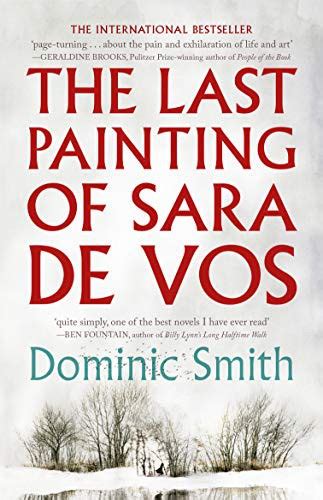
‘The Last Painting of Sara de Vos’ by Dominic Smith

2016, 372 p.

I guess that you could say that if a historical fiction book sends you off to internet-land to find out which bits are true, then it has worked. I should have taken more notice of the author’s note which explains that Sara de Vos is a fictional, composite character. But I didn’t and so, yes, there I was half-way through the book, searching high and low for the paintings that are described in the text, trying to find out more about Sara de Vos, only to find myself directed back to publicity for Dominic Smith’s book. So, to save you the search, Sara de Vos is a 17th century fictional character and the paintings described don’t exist, although there are similarities with the few details known about Sara van Baalbergen. Like the Sara de Vos of this book, she was admitted to the the Haarlem Guild of St. Luke and married a fellow painter. None of her works have survived.

SPOILER ALERT

But in Dominic Smith’s book, three of Sara de Vos’ paintings still exist- but which ones? The book opens in New York in November 1957, as a painting by Sara de Vos is stolen from the luxurious apartment of wealthy Marty de Groot, plucked from the wall above the marital bed. It ends up in the lands of Australian art historian, Ellie who is studying de Vos, freelancing in art restoration as a sideline activity. Her rather dodgy associate, Gabriel, asks her to make a copy of it. She asks no questions about where it comes from or to whom it belongs: she doesn’t want to know. It’s an opportunity to really study a de Vos painting close-up but it’s a decision that she regrets for the rest of her life, especially as her career blossoms and she becomes a noted academic and curator of Dutch Golden Age paintings. After assuming that the copy (i.e. forgery) has been resolved through her own contact- and more- with de Groot, it seems that her indiscretion of some forty years earlier is about to bring her undone as what she fears is two copies of the same painting are heading towards Australia, for an exhibition that she is curating at the Art Gallery of New South Wales.

So what was this painting, source of both desire, possession and trepidation? It was At the Edge of the Wood, thought to be painted by Sara de Vos in 1636, depicting a young girl standing against a silver birch, watching skaters on a frozen river as the sun sets. Through the flashbacks to the 1630s that are interwoven through the book, we learn that it was painted surreptitiously by Sara de Vos, who although admitted to the Guild of St Luke- something almost unheard of for a woman- was expected to paint still life pictures within a domestic setting. She and her husband Barent had been expelled from the Guild for painting unsigned landscapes outside of the Guild strictures and her life is falling apart. She is still grieving the loss of her seven year old daughter, and deeply in debt, Barent has deserted her, leaving her to make her own way.

The book, then, has three intersecting strands: Sara’s story in 17th century Netherlands; Ellie’s life in 1950s Europe and ill-advised venture into forgery and later interaction with the rightful owner Marty de Groot, and 2000 in Sydney when three de Vos paintings are heading to upend Ellie’s career. In places it reads like a mystery, and historical fiction, in other places a critique of the art scene and collecting practices, and an exploration of grief and regret. He writes exceptionally well of Ellie as an awkward, young and inexperienced girl far from home, embarrassed by her virginity and alternately attracted to and repelled by an older man who is interested in her for his own purposes. He does conversation well, and his descriptions of paintings are so crisp that you think that you might have seen them once- even though, of course, you couldn’t have. At times his description of painting and forgery techniques drag a little, but they do pay testament to the research that he has undertaken as part of writing this book.

And what was Sara de Vos’ last painting? Ah well, you’ll have to read the book…

My rating:8/10

Read because: Book Group selection, sourced from Yarra Plenty Library Book Groups collection.
A little daytrip into the city

We don’t go into the city together much because Steve finds walking difficult, but the milder weather was such a relief today that I really wanted to do something ‘in town’. So off we went….

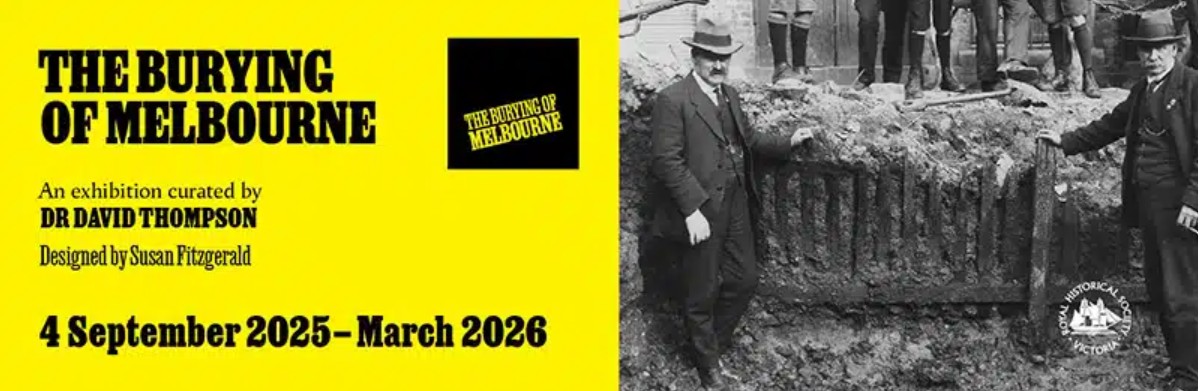
First stop was the Royal Historical Society of Victoria to see their current exhibition ‘The Burying of Melbourne’

From the RHSV’s website:

In the mid-1850s some areas of the Melbourne CBD were buried under a layer of clay at the direction of Melbourne City Council, a rather extraordinary event that until recently had been largely forgotten. It is only in recent years that archaeologists carrying out the excavations required prior to developments in the city have uncovered evidence of the clay layer.

A study commissioned by the Heritage Council of Victoria found that the burying was part of efforts by the City Council to control flooding, caused largely by the original laying out of Melbourne’s street grid without due consideration of the flow of water over the underlying topography.

The depositing of the clay layer, metres thick in some places, had a significant effect on the lives and circumstances of those affected but did result in the sealing off of a layer of archaeology stemming from the earliest days of European settlement.

This exhibition, The Burying of Melbourne, describes events leading up to the burial and looks at some of the archaeology discovered beneath the clay.

The problem was that people started building their houses before the roads were built, which meant that when the roads finally did come through, the houses were much lower than the road. As a result, the houses flooded in heavy rain. The council ordered that the properties had to be filled up to road level with clay. In some cases, particularly where the houses were not owned by the occupants, the house was in effect entombed by the clay, with new houses built on top of them. The layer of clay was located when a compulsory archaelogical inspection was made for a new development near the Wesleyan church in Lonsdale Street. Comparisons were made between the contour maps pre-filling and after-filling to identify the sites where the clay was likely to have been spread. Six terrace houses dating from the 1840s were found in Jones Lane.

This exhibition is not high-tech: indeed, it is mainly maps and photographs of the archaeological dig. There are a few of the objects on display that were located on the site, most particularly the level under the clay. But I find the idea of a whole layer sealed off by clay for 170 years quite fascinating.

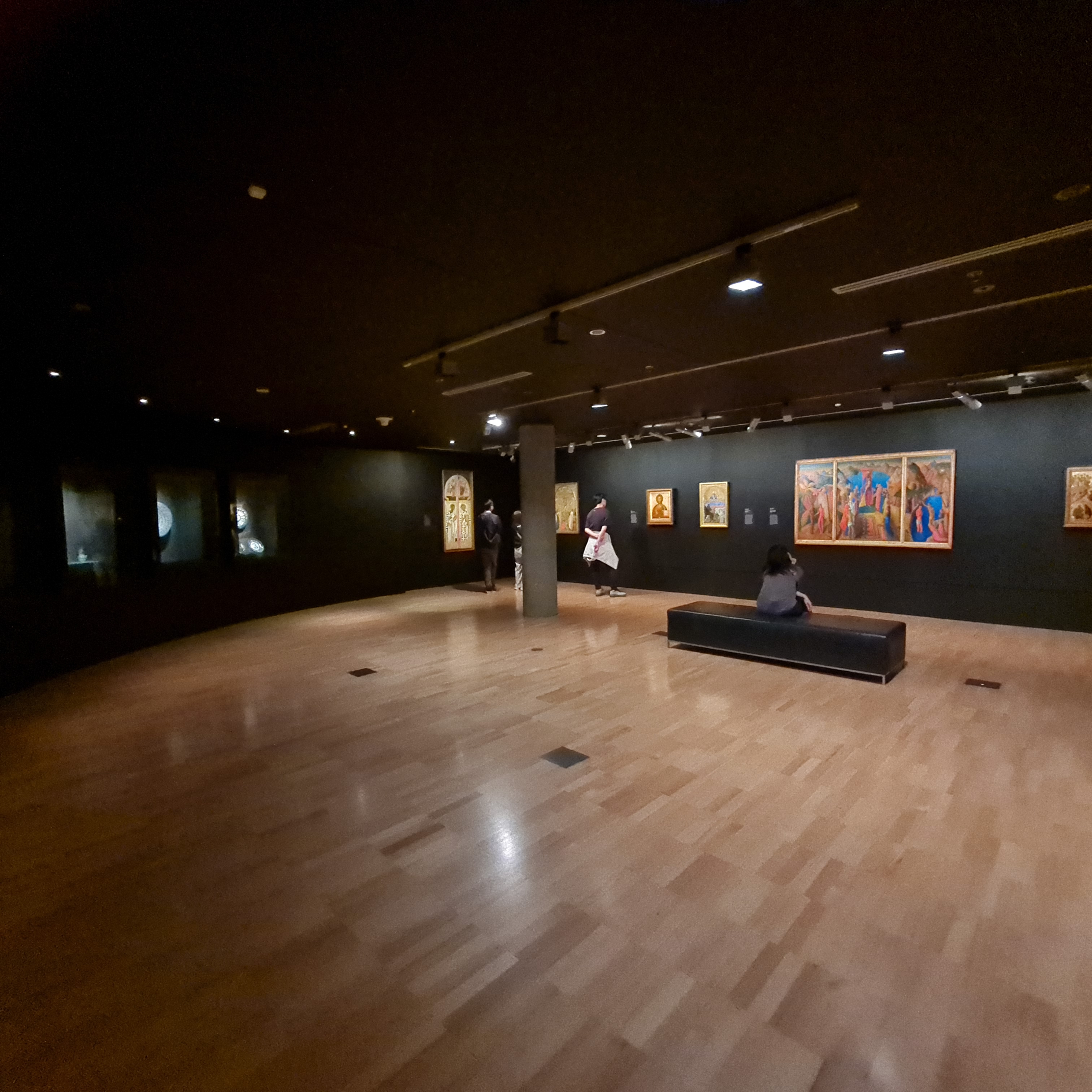
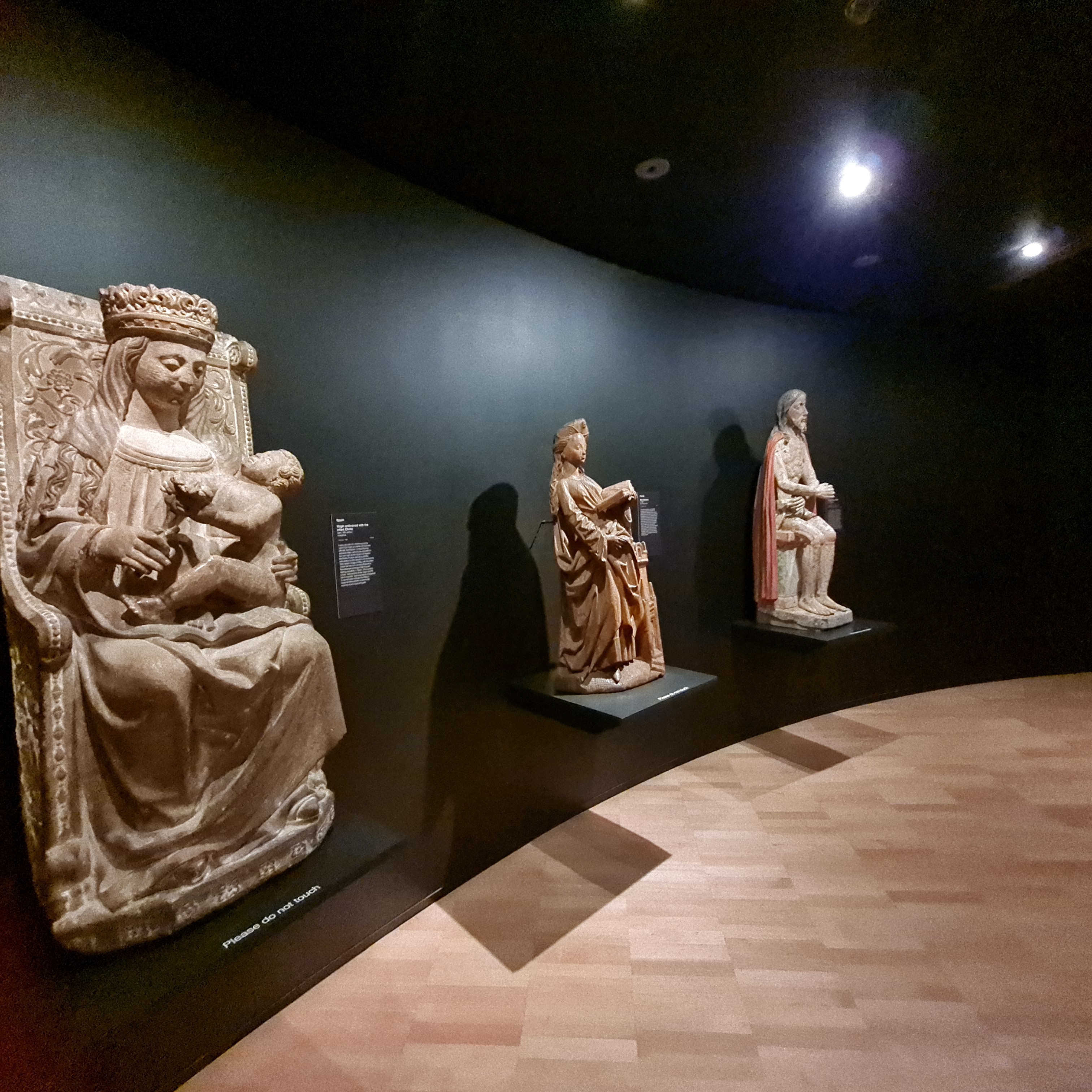
Then back onto the train and down to the Swanston Street tram for a quick trip up to the NGV International in St Kilda Rd. I wasn’t interested in the $40 Westwood/ Kawakubo exhibition (when did these exhibitions become so expensive?) and just stuck to the freebies. Somehow or other we ended up in the British and European Collection 13-16 Century, which you can see in a 3D version here if it doesn’t induce too much nausea for you. Actually you can see it online better than you can in real life because at least they turned the lights on to film it: probably because of the age of the artwork, it is very dimly lit. Their signage of the objects themselves is appalling- white print of about 12 pt font on grey behind glass. I just couldn’t read it at all. However, given that I’m not likely to visit Europe again, it was a little bit like being in a grand European cathedral close up.

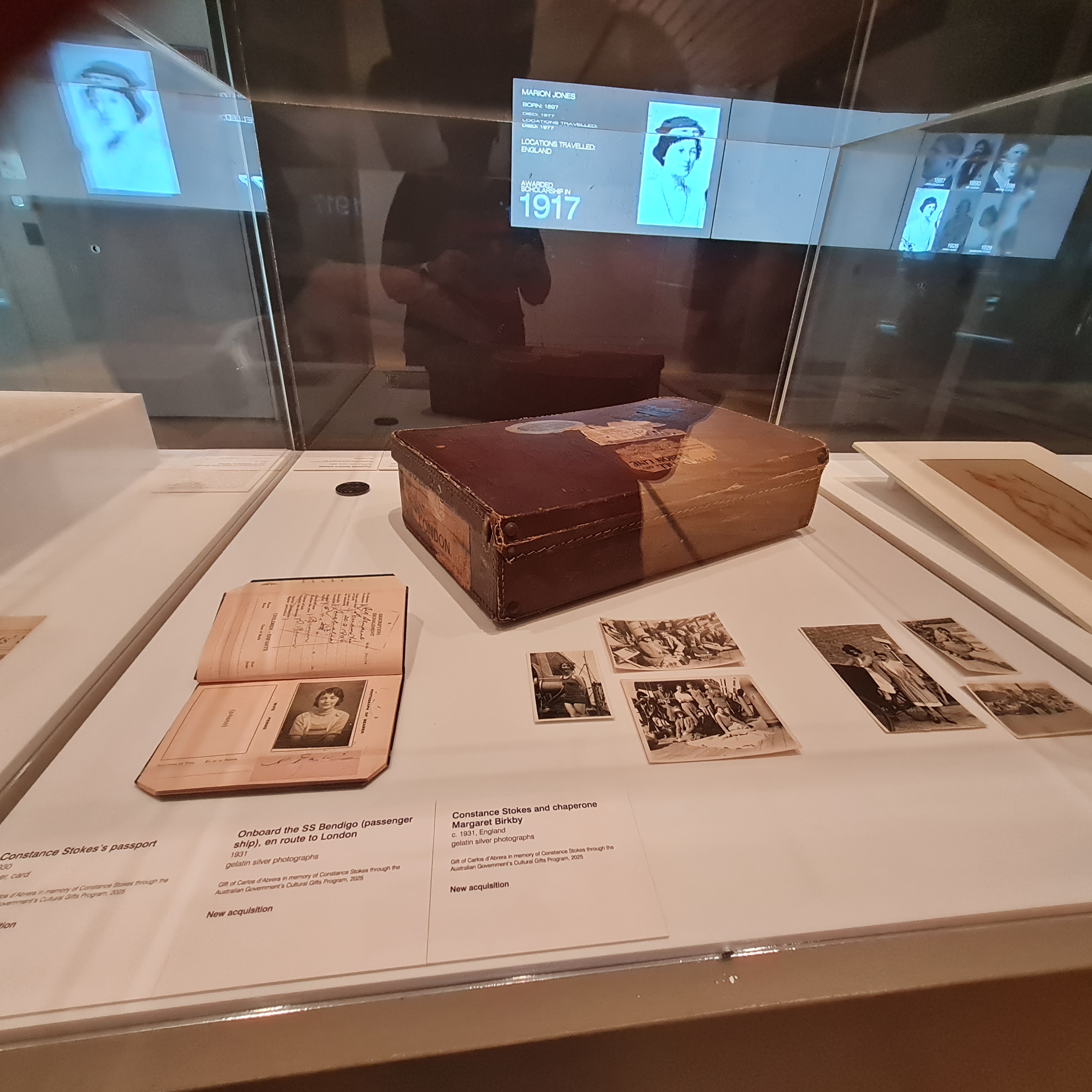
What I really intended to see was a display of the National Gallery of Victoria Travelling Scholarship. This is a tiny exhibition, tucked away on the first floor near the escalators. The NGV established its Travelling Scholarship in 1887, just 25 years after the Gallery opened. Awarded every three years, the three-year scholarship granted a stipend to study at art epicentres across Europe. Scholarship-holders were required to provide to the Gallery a replica of an Old Master painting, a nude study, and an original composition. A cheap way of increasing the size of the collection, I suppose. The exhibition is mainly just a projection on a wall, showing biographical details of several recipients (nicely balanced between male and female artists) with a few glass cases containing objects belonging to Constance Stokes (nee Parkin) trip that she received as part of her scholarship in 1929. Just a slight young girl, you get a sense of how exciting it must have been to travel over to London to study at the Royal Academy of Arts, with her passport, photographs and ball invitations.

I hear with my little ear: Podcasts 1-7 December 2025

The Rest is History Episode 580: The Irish Civil War: The Assassination of Sir Henry Wilson (Part 1) In this week’s episode, Tom and Dominic are joined by historian Ronan McGreevy, to discuss the pivotal assassination of Sir Henry Wilson, whose death launched the tumultuous Irish Civil War. Sir Henry Wilson was the MP for Northern Ireland, and an Irish Unionist. He had served in the British Army, and as a leading figure in the British Army he urged the British government to crack down on the IRA, a group which he saw as a military problem, rather than a political problem. On 22 June 1922 he was scheduled to open a memorial at Liverpool St station, which he did. On his return home, three men waited for him and shot him six times on his own doorstep. The gunmen escaped by taxi, but were surrounded by a mob. Two of the assassins were ex-soldiers themselves and part of the Irish diaspora. Meanwhile an election held in Ireland led to acceptance of the Treaty, but the anti-Treaty dissidents took over the Four Courts, where they were issued with an ultimatum by the (Irish) government to remove themselves. Among the dissidents, the issue was not so much partition, but the Oath that parliamentarians would have to pledge, not in words but in the level of independence that an Irish parliament would have. The IRA itself split, but the majority was anti-Treaty. Sectarian violence increased in Northern Ireland, and Wilson became the public face of the Unionist stance. So who ordered the assassination? Historian Ronan McGreevy, the guest on the podcast, has argued that it was the Irish Republican Brotherhood, a secret oath organization from 1858), headed by Michael Collins. The two assassins were hanged after a 1-day trial and the anti-Treaty dissidents were removed from the Four Courts. The Civil War had started.

Journey Through Time The Paris Commune: The City that ate its Zoo (Episode 2) With the so-called Government of National Defence negotiating with the Prussians, Paris now saw itself as the defender of France. One of the first things to be done was to hold an election, to affirm the legitimacy of the leaders. And who should be elected as Mayor of Montmartre but Georges Clemenceau, who was to end up as Prime Minister of France. Perhaps his anti-German sentiments during and after WWI sprang from this early experience with the Prussians. However, despite the stance taken by the Parisians, in the rural villages people wanted peace at any price so a divide sprang up between Paris and its surrounds. As the Prussians increased the siege, people ate first their horses, then their pets, rats and the zoo animals excluding the hippopotamus (too hard to kill and cut up) and the monkeys (too much like us). As with Gaza today, there was disease and incessant shelling, and eventually in January 1871 the Government of National Defence capitulated. Ruinous reparations were imposed on France as part of the surrender, and the Prussians would continue to occupy until the reparations were paid. Meanwhile the German Empire settled in at Versailles, just to rub salt into the wounds, and their insistence on parading through the streets angered the Parisians even more. Elections were held, and the rural/Paris split continued. The 300,000 armed guardsmen in Paris refused to surrender so the National Government at Versailles decided to confiscate their weapons. The Guardsmen and the parisian crowds moved the cannons onto Montmatre (the Sacre Coeur church wasn’t there then- it was a very poor neighbourhood) and in March 1871 the women rushed to Montmatre to stop the seizure of the cannons by the National Guard troops.

The Rest is Politics US edition I listen to this podcast every week, but there’s no point documenting it because things change so quickly. But Episode 132 The Mistakes that led to Trump is more historical, looking at the economic decisions that led to the populism that brought us The Orange One. (Just to ensure that I will never be admitted to US). The 1944 Bretton Woods agreement emphasized stability in the post-WW2 international economy, but in August 1971 Nixon took the US dollar off the gold standard, which at that time was a lowly $31 per ounce! The globalization and off-shoring mantra was that a rising tide lifts all boats, and China was admitted to the World Trade Organization as an emerging market, something that Donald J Trump opposed even then.

The Economist The Weekly Intelligence: Operation Midas. Wow. This podcast really got me thinking. It involves the corruption scandal in Ukraine, which led to the dismissal of President Zelensky’s Chief of Staff, Andrei Yermak. The police force in Ukraine is so corrupt that an alternate corruption watchdog structure was established, comprising the National Anti-Corruption Bureau of Ukraine (NABU) and the Specialized Anti-Corruption Prosecutor’s Office (SAPO). These were the two bodies that Zelensky was trying to get rid of, until such huge public and Western government pressure forced him to leave them alone. NABU and SAPO uncovered a huge corruption crisis where officials skimmed off millions from the state nuclear energy commission with scant regard to the effects of decaying and damaged infrastructure on the population. Why? Zelensky claimed that it was to get rid of Russian influence, but was it just to protect himself. I’d thought of Zelensky as one of the ‘good guys’ but perhaps there are no ‘good guys’ here. I’m sure that this destabilization is just what Russia wants, but is there a real and continuing problem of corruption in Ukraine?