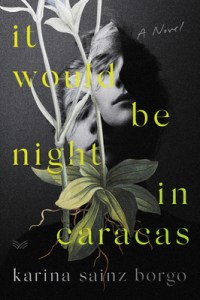
‘It Would be Night in Caracas’ by Karina Sainz Borgo

borgo

2019, 223 p. Translated from Spanish by Elizabeth Bryer

Now that the rest of South America seems to be blowing itself up politically, Venezuela has fallen out of the world news a bit. However, given that Nicolás Maduro is still in power and Juan Guaido isn’t, the situation in Venezuela probably remains much as it has been for the last couple of years. Millions of Venezuelans have left their country, driven out by hyperinflation and shortages.

This novel is set in current-day Caracas. A young journalist Adelaida Falcón has just buried her mother, who has died of cancer despite Adelaida spending the last of their money on what turned out to be useless drugs. Adelaida was the only child of a single mother, and the two women were close. As Adelaida packs up her mother’s belongings, her world becomes increasingly small, focussed just on her own apartment building.

However, it is not just the loss of her mother than is driving Adelaida’s isolation within her apartment.  Out on the streets, vigilante gangs, often under the protection of the government, are roaming and shooting. One day she returns home to find that her apartment has been taken over by one of these gangs, headed by the intimidating female gang leader La Mariscala. When she turns to her next door neighbour for help, she finds her neighbour is lying dead in her apartment, presumably through natural causes. Her neighbour’s death provides a way of escaping her increasingly claustrophobic situation. Meanwhile, she is joined by the brother of a university friend, who had been scooped up into the government’s paramilitary scheme to turn protestors into henchmen. His presence is both comforting and dangerous.

This is a very female-driven book. The two women form a family unit, and the now-deceased woman next door is crucial to the plot. Interestingly, the Spanish title of the book translates to “The daughter of the Spanish Woman”, a title which makes more sense once you have read the book. While the male gangs outside are intimidating, it is the women led by La Mariscala who are occupying and violating Adelaida’s home next door, who are the most terrifying. Meanwhile, we have the whole idea of ‘motherland’ and exile.

There are a lot of coincidences in the plot of this book, and it doesn’t do to think about them too much lest the whole scenario fall apart. Instead, I more enjoyed the tension of not knowing whether she was going to escape, especially in the closing pages of the book. Even more, I was interested in (‘enjoyed’ is not the word) the exploration of a society which is breaking down completely, leaving individuals to fend for themselves.  I suspect that the author hasn’t had to imagine too much here, and that she is drawing on her knowledge of current events in Venezuela.  It is poignant and frightening to see a formerly-wealthy country spiralling into collapse and lawlessness. It has made me read the news even more carefully.

I read this book in translation from the Spanish. While reading the book in English, I stopped at the sentence “Only a small difference in sound separates ‘leave’ from ‘live’“. That’s true in English, I thought, but I wondered what the original sentence was, because it doesn’t work in Spanish.  As if she had been reading my thoughts, the translator Elizabeth Bryer wrote a note at the end, explaining that sentence, and how hard she had had to work on it.  The original was “Tan solo una letra separa ‘partir’ de ‘parir'” ( translation: Just a single letter separates “to leave” from “to give birth”) . I think that she did a damned good job finding two English words that evoke the same idea, while having a similar sound – although the connection with motherhood doesn’t come through. Nonetheless, well done that translator!! I bet there were shouts of “Yes!” and high-fives all round when she worked it out.

My rating: 7/10

Source: Yarra Plenty Regional Library

Read because: I read a review somewhere (can’t remember where) and I like reading books from Latin America.
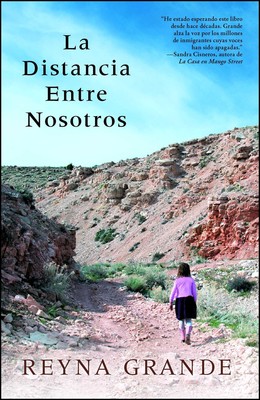
‘La Distance Entre Nosotros’ by Reyna Grande

grande_distancia.jpg

2012,  354 pages

Yes! 354 pages in Spanish! I read this book as part of my Parceros participation with Spanishland School. Our teacher Andrea held a weekly podcast where she would ask questions and discuss one or two chapters, but I fell behind on the podcasts and just kept reading, two pages per night.

The book is probably aimed at Year 7 and 8 kids in American schools. It was written in English by the author, who was born in Mexico and learned English as a second language, and then translated into Spanish.

The author, Reyna, was born in a small village in Mexico and both her parents left in order to work illegally on the ‘other side’ (i.e. America) when she was a very young child. First her father left, then he called for his wife to join him, so the children were left with their paternal grandmother, who because of her clear dislike for the children’s mother, distrusted that they were indeed even her own grandchildren. Their mother returned alone, when she found that her husband was cheating on her, and the children ended up with their maternal grandmother while their mother went back to America with another man.

In Part 2 of the book, their father returns with his new wife and grudgingly takes the three children over the border. A violent and hard man, their lives are still hard and it is only Reyna who breaks free of the poverty in which they are living. Through it all, she desperately wants her father’s approval.

Reading only 2 pages a night meant that Reyna’s long howl of abandonment wore a little thin by the end, but I came away with a much richer understanding of the ‘Dreamers’ and the desperation with which illegal immigrants try to achieve a better life.

The level was JUST right for someone who has Intermediate level Spanish. I generally had to look up about 4 or 5 words per page, which was not enough to slow me down, and I found that I could easily guess many unfamiliar words.  It is well written and poignant- I really enjoyed it.


I hear with my little ear: Podcasts 26-31 December 2019

Russia If You’re Listening (ABC) Matt Bevan’s third series on Putin, Trump and Russia has come to a close. In Episode 8 “How Russia’s rotten gas got Trump into Trouble”, he backtracks to explain how Ukraine used the nuclear weapons that were left on its soil after the breakup of the Soviet Union to negotiate gas supplies from Russia and cold hard cash from the United States.  In Episode 9, the final one, “Putin’s greatest victory- a conspiracy theory so good it got Trump impeached” he looks at Trump’s support of Putin’s accusation that Ukraine is the baddie here, and how it benefits no one but Russia. And how deliciously ironic that our Australian Matt Bevan should have a name so similar to Matt Bevin, the republican governor of Kentucky who is making some very questionable pardons.

Earshot (ABC) This podcast from  August 20189 has been rattling round on the phone for a while. Naponi’s story: Loving a man with schizophrenia tells the story of a Sudanese woman now living in Toowoomba, whose husband has been committed to a psychiatric facility for the last fourteen years. After a long history of domestic violence against Naponi, her husband was diagnosed with schizophrenia, but this is rejected by many of the male elders in the Sudanese community, who accuse her of using domestic violence as a way of getting rid of him. Australian law, witchcraft and domestic violence all come together in a confronting case.

Torn Curtain: The Secret History of the Cold War (ABC) During summer, the ABC saves money by recycling programs from the previous year’s broadcasting. They dug quite a bit deeper than that in Torn Curtain, which was originally broadcast in 2006 as part of the still-missed Hindsight.  The fact that it’s now fourteen years old doesn’t matter: it’s a fantastic program. How could I know so little about my own century? I found Episode 2 Science, Spies and Australia’s bid for the bomb to be absolutely fascinating. Much of the material has been available only in the last twenty years or so. It tells the story of  Tom Kaiser, a Melbourne PhD student in London (very good paper on him by Phillip Deery here), who was a member of the Communist Party and fell under the scrutiny of Australian authorities who wanted to prove their ‘diligence’ so that Australia would be included in Britain’s plans for nuclear weapons. Episode 5 The Nuclear War we nearly had in 1983  was excellent too, about the build up of nuclear weapons in Western Germany and the horrifying potential for inadvertent nuclear war that they provoked.  It’s really worth listening to the whole five episodes.  How did I not know these things?

99% Invisible While in the Christmas mood, I listened to Episode 334 from December 2018. Called Christmas with the Allusionist, it’s a cross-promotion of the Allusionist podcast program, a podcast about language. This episode has two stories. The first is about an events manager in Birmingham England who decided to promote Winterval (a portmanteau of Winter and Festival), a 40 day event of which Christmas was a part, only to be accused of “Political Correctness Gone Mad”. The second part was about a re-creation of a ‘Dickensian’ village and the effect of Dickens in shaping our consciousness of Christmas ‘tradition’.

Challenging myself again…

I’ll be doing the Australian Women Writers Challenge again for 2020, hoping to read twenty books during 2020. I’ll try to read a little more fiction this time.

And while I’m at it, I’ll nominate the same number of books on the Goodreads challenge – sixty- which I achieved this year by the skin of my teeth.

So off I go into 2020…..

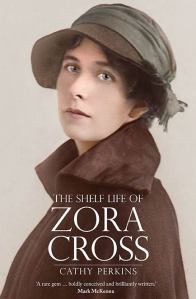
‘The Shelf Life of Zora Cross’ by Cathy Perkins

perkins_zora_cross

2019, 243 p & notes.

“Twenty pounds and you shall have her” and thus were the publishing rights for Songs of Love and Life transferred from a small self-publishing bookshop to that of the publishing behemoth, Angus and Robertson in 1917.  This book of sixty erotic love-sonnets was to become a literary sensation, going through three reprints and selling a respectable 4000 copies. Its author,  27 year old Zora Cross, wrote about love and sensuality from a woman’s perspective – something shocking in 1917.  Norman Lindsay, the artist whose own work abounds with nudes,  refused to illustrate the book, saying that women couldn’t write erotic poetry because their ‘spinal column’ was not connected to their ‘productive apparatus’. He did, however, condescend to provide a mythologized front cover which, to my eye, has nothing like the impact of an alternative cover design of  a bedroom scene with a present-day man talking off his coat, with his lover covering him with kisses.

But the sale of the publishing rights, and the choice of front cover and illustrator were not in the hands of this young, barely-published author. This book, which is a biography of the now-forgotten Zora Cross, is also an exploration of the Australian writing and publishing scene of the first half of the twentieth century, particularly in Sydney and Melbourne. I had flutters of half-formed recognition of many of the names in this book, and the author has used them as anchors in each of the chapters that move roughly chronologically through Zora Cross’ life.  As Cathy Perkins writes:

I set out to write a conventional biography, but I was drawn to an idea of a life that was made of up relationships. Each of Zora’s relationships shows a different side of her personality and each has its own tensions. (p. xii)

The opening chapter, then, is subtitled Ethel Turner, who as well as the author of the much-loved (by me!) Seven Little Australians, also wrote the children’s page in The Australian Town and Country Journal. Children would send in their contributions and letters (I remember doing the same to ‘Corinella’ in the Sun during the 1960s) and ‘Zora Cross of Pie Creek Road Gympie’ was a frequent contributor. When she grew too old for the children’s page, she finally met her mentor in person.

Ethel Turner suggested that she try her luck with the Lone Hand, the sister publication to the Bulletin, and thus Cross started up a rather fervent correspondence with the editor, Bertram Stevens, who features in Chapter 2. In this chapter we learn of Cross’s employment as a school teacher and her strange, short marriage to fellow-student Stuart Smith, with whom she had a child who died soon after birth.  Pregnant again to an unnamed father in 1913, Cross travelled northern Queensland with a theatre company, and became editor to the small Bohemian newspaper of arts and social news.

She also wrote poetry for the Bulletin, and it was through this connection that Norman Lindsay, for whom Chapter 3 is titled, was asked to provide the artwork for Songs of Love and Life.  It was published by George Robertson, who features in Chapter 4, who carefully oversaw the sales and  reviews of the books under his imprint.  She wrote copious letters to him, too, and on the walls of his office he had a copy of the beautiful portrait that graces the front cover of this book. However, despite his success with Songs of Love and Life, he declined to publish other manuscripts of Cross’, along with the manuscripts of many other women writers who were to go to fame including Katherine Susannah Prichard, M. Barnard Eldershaw and Christina Stead.

She achieved success writing about the losses incurred in WWI, in Elegy on an Australian Schoolboy written in tribute to her brother John Skyring Cross (Jack), who is explored in Chapter 5. He died of illness after being injured on the Western Front.  In 1919, George Robertson asked his assistant, Rebecca Wiley, to go on a month’s holiday with Zora, who was feeling run-down. Chapter 6, named for Rebecca Wiley, explores the often tense relationship between these two women, especially once Zora had shifted to Glenbrook in the Blue Mountains with her partner, Bulletin editor David McKee Wright, who features in Chapter 7. They never married because David was still married to his previous wife, and she was pregnant to another man when they partnered. They had two daughters together, and David legally adopted her son. He died suddenly in 1928.

Now widowed, Cross continued to write, especially for the Australian Woman’s Mirror, an offshoot of the Bulletin which predated the still-extant Australian Women’s Weekly. Chapter 8, subtitled ‘Bernice May’ refers to her pen-name in much of the writing she did for ‘women’s pages’ . After falling out with George Robertson, she embarked on a series of interviews with fellow women poets and novelists for the Mirror, including Jean Devanny, Eleanor Dark, Dulcie Deamer, and Mary Gilmore.  A long-standing presence in Cross’s life was John Le Gay Brereton, Chapter 9, a friend of Henry Lawson, chief librarian and later professor of literature at the University of Sydney. His access to resources assisted her to write a series of books about Classical Rome, which were not well received (and sound pretty dire). As president of the Fellowship of Australian Writers, Brereton was a constant source of support when Cross made frequent, and generally successful applications, for Commonwealth Literary Fund pensions and grants.   Another longstanding friend was Mary Gilmore (Chapter 10) who was punctilious in overseeing her bequest of papers to the Mitchell Library. She died in 1963 and a year later, Zora Cross died of a heart attack.

This is a very skillfully written biography, maintaining its chronological trajectory while using various friends and colleagues as a prism through which to explore Zora Cross’s personality and writing.  Cathy Perkins, the author,  who is the editor of SL magazine and other publications at the State Library of NSW inserts herself several times into the narrative, in her research and  advocacy for Zora Cross.  As well as a biography, the book explores the literary industry and the whole issue of literary presence after death. Perkins’ decision to use relationships as an organizing device emphasizes the interconnections between writers and publishers, something that is often invisible to the reader.

She captures well the breadth of Cross’ writing, and quotes generously from her unpublished works, without necessarily championing its sometimes rather dubious quality, leaving it instead up to the reader to decide.  She portrays Cross as a fully rounded character: unconventional mother and partner, hard-working, flirtatious, sometimes needy, mother, grandmother and community member. But most importantly, as a prolific and life-long writer, even if she has been -until this biography- completely unknown today.

My rating: 9/10 A really accomplished biography

Sourced from: Yarra Plenty Regional Library.

aww2020

This is my first read for the Australian Women Writers Challenge 2020


2019 Australian Women Writers Challenge Completed

In January 2019, I undertook to read twenty books for the Australian Women Writers Challenge.  I also challenged myself to read 60 books on Goodreads (which I achieved just yesterday) and to finish Harry Potter and the Philosophers Stone in Spanish. I did somewhat better than that with my Spanish reading because I also read The Lion, the Witch and the Wardrobe, a collection of short stories and La Distancia Entre Nosotros in Spanish. Looking through my Goodreads, I read 23 fiction and 37 non-fiction, 37 Australian and 23 non-Australian books.

The proportions are somewhat different for the books that I have read as part of the Australian Women Writers Challenge for 2019, alphabetically by surname.  Lots of History, Memoir and Biography here (nineteen!), but I’m rather deflated by how little fiction I read- only four! Perhaps improving on that should be my New Year’s Resolution.

Fiction

de Saint Phalle  Poum and Alexandre: A Paris Memoir

Kate Morton The Lake House

Alice Robinson  The Glad Shout

Carrie Tiffany  Exploded View

Non Fiction

Robyn Annear  Nothing New: A History of Second Hand

Judith Brett  From Secret Ballot to Democracy Sausage

Margaret Cook A River with a City Problem

Joy Damousi The Labour of Loss

Kirsten Drysdale  I Built No Schools in Kenya

Jill Giese  The Maddest Place on Earth

Jenny Hocking The Dismissal Dossier

Rebecca Huntley  Quarterly Essay 73: Australia Fair Listening to the Nation

Jane Lydon and Lyndall Ryan (eds) Remembering the Myall Creek Massacre

Cathy McLennan  Saltwater

Lee Kofman Imperfect

Doris Pilkington (Nugi Garmirara) Follow the Rabbit Proof Fence

Lesley Potter  Mistress of her Profession: Colonial Midwives of Sydney 1788-1901

Shirley Roberts  Charles Hotham: A Biography

Jill Roe  Beyond Belief: Theosophy in Australia 1879-1939

Myra Scott  How Australia Led the Way: Dora Meeson Coates and British Suffrage

Leigh Straw  Angel of Death Dulcie Markham: Australia’s most beautiful bad woman

Michelle Scott Tucker Elizabeth Macarthur: A Life at the Edge of the World

Nadia Wheatley Her Mother’s Daughter


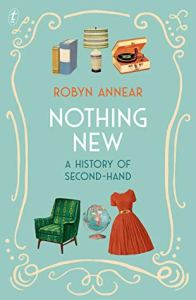
‘Nothing New: A History of Second-Hand’ by Robyn Annear

annear_nothing_new

2019, 273 p.

In Australia at the moment, as in other economies in the world, Treasurers and bankers are wringing their hands at consumers’ “failure to spend”. Different causes are attributed: low wage growth, underemployment, the China/U.S. trade war. I wonder, though, if there’s something else going on. Perhaps, as Greta Thunberg suggested, people are beginning to see that the obsession with continual growth blinds us to the changes needed to keep our planet habitable. Perhaps we are tiring of poor-quality tat that is purchased with the intention of throwing it away. Perhaps we are yearning for a Marie Kondo make-over and just to have less stuff.  For what-ever reason, we’re just not buying new merchandise in the way that we used to.

Historian Robyn Annear is a long-time afficionado of second-hand.  Right up front she admits that “Other people’s detritus calls to me. And from that siren song this book was born.” (3). Her opening chapter is titled ‘Nothing New’ and her closing chapter is titled ‘…Under the Sun’. In the intervening chapters, she embarks on a digressive history of second-hand, told with her trade-mark giggle in the narrative voice.  The book is roughly chronological from 1700s to the present day, and it jumps around the Anglosphere, with Australia considered quite naturally and unselfconsciously among Britain and America, with occasional additional reference to France and Africa.

As she explains, before the 1700s, clothes had long lives, passed on from class to class, generation to generation, mended and remade. During the late 18th century, increased consumerism and the influx of Jewish immigrants led to a commercial market in old clothes, collected by the Ol’ Clo’ man, and ending up in markets where they were revived and remodelled. An international market existed as old clothes were circulated between different countries. In this regard, Australia during the 1850s stood out, as people tended to buy new clothes on arrival in the colony, and there was a post-convict sensitivity over Australia being seen as a dumping-ground for old clothes, as well as old lags.

Once clothes really had got beyond the point of being remodelled, there were other markets for rags.  Before paper was made from wood products, rags were used for paper, with old linen kept aside intentionally to make up-market linen weave paper. Rags could be shredded to make ‘shoddy’, a reconstituted fabric which could then be resewn for new, cheap garments. They could be melted down and mixed with horses hooves and horse blood, ashes and scrap iron to make Prussian Blue dye.  The dust created in the manufacture of shoddy could be used to make ‘flock’ wall paper, and rags could be used to stuff mattresses.

However, by the 1850s there was a change, when direct donation of clothes came to be seen as “charity”, rather than as a market. As is often the case “charity” existed side-by-side with a fear of being ripped-off, so only dirty clothes, beyond repair tended to be donated for distribution to only the “deserving” poor.

With the rise of ‘rummage sales’ in America in the 1850s, and their gradual extension to London in the 1890s, the stigma of “charity” was assuaged by the charging of a cheap price for goods that were given free.  The Salvation Army created its Household Salvage Brigade, which provided a waste collection service, with the collected goods sorted into sale items, and unsellable material directed towards recycling. When the Household Salvage Brigade went into recess during WW I, St Vinnies (St Vincent de Paul) started up the Waste Collection Bureau.

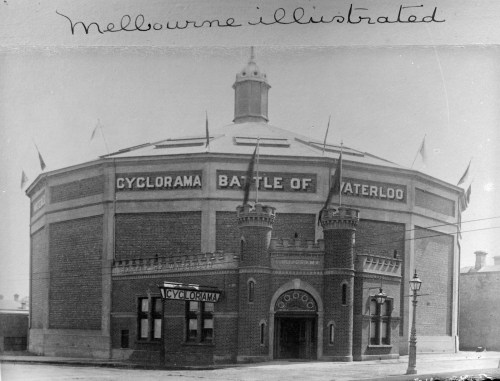
In Melbourne, the first “Opportunity” shop was located in the Cyclorama in Victoria Street in 1925, near the present St Vincents Hospital. Named by Lady Millie Tallis, who had witnessed the success of second-hand shops runs on charitable lines overseas, it was intended to raise money for St Vincent’s Hospital (unrelated to St Vinnies). The Cyclorama had been built in 1889 to house a 360 degree panorama of events like the Battle of Waterloo, the Eureka Stockade or the Siege of Paris, but by 1925 it had been rendered obsolete by the new craze for moving pictures. What better use to put a clapped out, round building?

cyclorama

Creator: Allan C. Green, State Library of Victoria http://handle.slv.vic.gov.au/10381/31352

The ‘opportunity shop’ spread to other suburbs, but it died out during the Depression, only to reappear after World War II when the years of “mend and make do” were past, and consumer spending – and, as a result, disposal of  no-longer-wanted goods-  sprinted ahead.

Second hand came to be distributed through a variety of forms: Lost Property Auctions (as Annear points out, why isn’t it Found Property Auctions?), Exchange and Marts in newspapers, antiquarian collections, charity shops as a business, the Trading Post, garage sales, Trash and Treasure markets, hard rubbish collections on the footpath, and e-bay.

Finally, there’s a whole market that is invisible to us in First World countries, whereby second-quality, secondhand goods are baled up and sent to Africa. I visited Toi market in Nairobi, the largest second-hand market, which burnt to the ground this year after being slated for demolition (hmmmmm…)  If you’re not prone to sea-sickness, this rather jerky video takes you on a bus to Toi Market- it really captures what you see in Nairobi well.

When I visited Rwanda, I was horrified to learn that Donald Trump had pressured Kenya, Tanzania and Uganda into dropping their plans to ban the import of second-hand clothes from America, in order to protect their own clothing industries.Only Rwanda persevered. However, as Annear points out, the Chinese government has stepped into the gap, and is now importing second-hand, and  increasingly, new cheap clothing from China into Rwanda.

Written in a quirky conversational tone, ‘Nothing New’ wears its scholarship lightly, but the references at the back reveal the research that has gone into the book. Where footnotes appear at the bottom of the page, they are jokes and comments, rather than references. Robyn Annear also has a podcast called Nothing on TV,  based on her Trove research, which deals with similar material and the very Australian delivery is similar to the narrative voice of the book. It’s a quick, fascinating read that will have you looking up and saying to anyone listening “Hey, did you know?…….)

My rating: 8, based largely on its enjoyment factor

Sourced from: Yarra Plenty Regional Library.

AWW2019

This will almost certainly be the final book that I add to the 2019 Australian Women Writers Challenge!

Movie: The Nightingale

Yep, it sure is violent. I was forewarned that the first ten minutes were particularly violent, but I didn’t realize that the violence continued throughout the film. It’s a vivid and gritty depiction of 1820s Tasmania, a place steeped in violence and killing.  It’s more than just tricking-up a horror film with historical artefacts: it’s also about powerlessness and dispossession and revenge. I thought that the ending was going to descend into bathos, but the last two seconds saved it from that fate.

Larissa Behrendt has written an interesting review of it.

It’s now down to one showing a day at the Nova, so it will soon disappear.

My rating: 4 stars

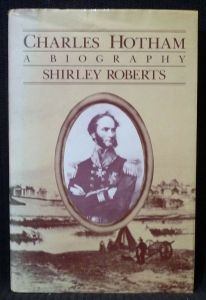
‘Charles Hotham: A Biography’ by Shirley Roberts

roberts_charles_hotham

1985, 201 p.

Even though I’m a historian of Victoria, I confess to drawing rather a blank when it comes to all but the most recent Governors of the state. La Trobe springs to mind immediately, but many of the others I ‘know’ only by things that have been named after them, especially hotels and public buildings.  I was aware that Hotham had taken over from La Trobe, and that he has been characterized as the villain in the Eureka Stockade story.  There’s a street named after him, a pub in Geelong and a mountain… but that’s about all I could have come up with before I read Shirley Roberts’ biography of Charles Hotham.

In her opening pages, Shirley Roberts announces that “Hotham appears as a man who has been most unfairly denigrated”. Clearly her intention in writing this book is to rescue him from this fate.  Of course, historians mount arguments about individuals all the time, making judgements “from the enormous condescension of posterity” as E. P. Thompson put it.  In this case, however, Roberts’ intention to scrub the mud from Charles Hotham detracts from her book as history. She accepts uncritically certain sources and cherry picks from others, and when actions contradict her argument she brushes them off as inexplicable or strange.

However, despite these flaws, Roberts has written what seems to be the only biography of a man whose short 15 month governorship coincided with a political flashpoint in a colony on the verge of receiving self-government.  It starts in a workman-like fashion, with a family tree – the kiss of death for a biography.  Probably the book would be written very differently today, with more emphasis on the networks of empire and the significance of patronage links, and a widening of the focus from white politicians to include protestors’ and women’s forms of influence. But given that we are reading the book we are holding, and not a book as we would wish it written 35 years later, she has captured well the far-flung nature of the British Empire, and the circuits along which colonial authorities and civil servants travelled.

Charles Hotham never aspired to be a colonial governor. He far preferred his naval role, and the command of ships and navy personnel without the complications of representative democracy and colonial elite structures. His work took him to Argentina, where the British Navy at first played a type of peace-keeping role between Argentina and what is now Uruguay, before intervening to protect their trade routes along the rivers that bordered the two countries. After the putative abolition of slavery, he was sent to West Africa (generally seen as a grave-yard posting) to harass slave shipping along the trade routes, especially en route to Brazil. He demanded, and received, loyalty from his crews in an established hierarchy of authority and obedience.

But these very qualities made his posting to Victoria, already seen as a problematic colony, even less appropriate and bound to end in tears. The discovery of gold had led to a deluge of new arrivals, the complete disruption of the bureaucracy, and a crying need for infrastructure. The economy was wobbly, and running at a deficit. In true economic technocrat style, he pronounced and held to hard-line economic prescriptions, announced and implemented without consultation. The colony, like those in the other Australian states, was holding its breath waiting for the legislation for self-government (see Peter Cochrane’s Colonial Ambition) and this return to authoritarian, centralized rule was not likely to please anyone – even those who had craved a more ‘governor’-like presence than La Trobe had cast.

Roberts explains the origin of Hotham’s world-view in terms of his naval background, but uses it to excuse his too-quick turn to repression, and recourse to delay through ordering a Royal Commission (that old standby to gain time). She portrays him as a man surrounded by flawed men, who let him down.

In filling out Hotham’s early career, which she does very well, she draws on a biographical sketch written by Hotham’s sister as a gift to his sister-in-law on their marriage. Although no doubt drawing Hotham in a good light, it has been gift to his  biographer, too. In her analysis of Hotham’s time in Melbourne, she draws strongly on the conservative, pro-Hotham Argus with little reference to opposing newspapers. As an author, she is mounting a pro-Hotham argument, although she does not make it clear exactly what or who she is arguing against.

I was very impressed with her ability to summarize a scenario or event clearly and succinctly, without overwhelming the reader with detail.  This was especially true of Hotham’s time in South America and Africa, which I knew absolutely nothing about.  She is not an academic historian – and the paucity of her reference list attests to this – and her book is more a matter of setting things out, rather than complicating by nuance.

Hotham only governed the colony between June 1854 and November 1855. This short period of time is largely dominated by the Eureka uprising, and Hotham’s role in it. This short, pragmatic book fleshes out his career more fully, and portrays him as more than just the villain of the Eureka rebellion. But Roberts’ determination to rescue Hotham from blame has led her to mount a polemic, rather than write a biography.  The reader should approach this book with admiration at the job she has done, and appreciation for filling in otherwise little known information. At the same time, however, this book needs to read with care and a raised, sceptical eyebrow.

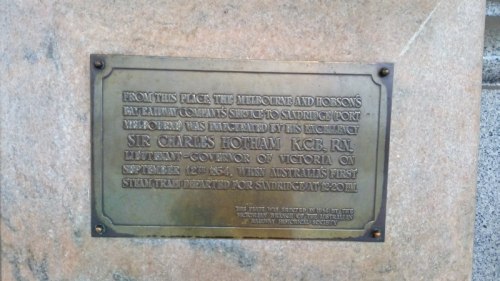
And look at this – I was half-way through the book when I found this plaque at Flinders Street Railway Station!  So he did leave a mark on Melbourne after all!

20191203_182909_small

From this place the Melbourne and Hobson’s Bay Railway Company’s service to Sandridge (Port Melbourne) was inaugurated by His Excellency Sir Charles Hotham K.C.B., R.N. Lieutenant-Governor of Victoria on September 12 1854, when Australia’s first steam train departed for Sandridge at 12.20 P.M.

My rating: 6.5/10

Sourced from: CAE bookgroups. You’ll have trouble tracking it down, I suspect.

AWW2019

I have included this on the Australian Women Writers Challenge database.


I hear with my little ear: Podcasts 17-25 December 2019

annear_nothing_on_TVNothing on TV I’ve just started listening to Robyn Annear’s podcast series ‘Nothing on TV’. It’s great. Annear is a Victorian historian, whose book Bearbrass largely sparked my interest in Melbourne, and she is wry, funny, and quirky. As is this podcast. She draws on the marvellous resources of the online Trove database to chase down odd events, and researches them further. In Episode 1 Enter the Elephant, she takes the story of a tragic drowning of a young boy in Cremorne in 1854 whose body was finally recovered by the elephant at Cremorne Gardens nearby- or was it? She then goes on to a discussion of elephants in 1850s Australia and the phenomenon of the Pleasure Garden. All accompanied by the pop of a champagne cork, and a lovely, broad Australian accent.

RevolutionsPodcast. Well, the revolutionary ‘People’s Will’  assassinated Csar Alexander II in 1881, hoping that it would launch the revolution but it didn’t. All it did was unleash another wave of repression. But by the late 1890s, the stars were aligning for the socialists again. In Episode 10.21 The Socialist Revolutionaries, Mike Duncan identifies four different groups who come under the ‘Socialist Revolutionary’ umbrella, although it’s almost Monty Pythonesque “Peoples Front of Judea” overtones. He talks about Catherine Breshkovsky – what a fascinating life! I wish I could find a biography of her.

In Our Time (BBC) I always thought that the Rapture was an American Evangelical thing, but it originated with Irish Anglican minister John Nelson Darby, who was influential amongst the Plymouth Brethren in England in 1832 and founded the Exclusive Brethren in 1848. He travelled and preached in America, where his ideas about pre-tribulation rapture theory was embraced (i.e. that God would take up the elect and whisk them up to heaven, away from the seven years of tribulation which will end when Jesus returns, ushering in 1000 years of Gods reign on earth). In this program, The Rapture, Melvyn Bragg discusses the Rapture, and its political and theological consequences.  Perhaps not for everyone – it gets pretty hard going theologically, although the second half is more interesting.