Reach out to someone you haven’t spoken to in a while. Your message needn’t be long or detailed, but make it sincere: “You crossed my mind today, and I’d love to reconnect.”
Or, if you have some extra time and know the person’s address, consider sending a handwritten note.
Well, this all felt a bit cheesy to me, although that might be a bit defensive because I am certainly not good at keeping connections going. I often think of people, but I just don’t take that last step. So I rang my former sister-in-law and had a chat with her. I don’t think I properly entered into the spirit of this one.
The Rest is ClassifiedEpisode 100 Putin’s Secret Army: Fighting with Assad in Syria (Episode 3) Prigozhin met with Dmitry Utkin, a Nazi-leaning ex-soldier with the GRU Military Intelligence Unit. His favourite composer was Wagner, which is not unexpected amongst neo-Nazis, and this became his call sign, and later the name of the group he founded with Prigozhin. The hosts of the podcast, former CIA analyst turned spy novelist, David McCloskey, and veteran security correspondent, Gordon Corera, note that in all ages and all countries have their own mercenaries, not just Russia. There was restlessness in the Crimea and Ukraine, and with his contacts and supply lines of food to the military, Prigozhin could make himself “useful”. He arranged for 200 mercenaries (the ‘little green men’) in Crimea and Ukraine before their takeover by Russia, and it was proRussian groups who shot down Malaysian airlines MH17. Using his PR skills, Prigozhin was able to muddy the waters over the whole affair. The Wagner group fought a dirty war and by 2011 they had committed 1000 men, but the 2015 Minsk theoretically brought the fighting to a close (theoretically). By Sept 2015 the Wagner group was involved in Syria, where Russia had many interests and wanted to project its power. Russia was a big arms supply to Assad, and by 2016, 2500 mercenaries had been equipped by Russia. Soon there were very violent videos circulating on the internet showing beheadings etc. which all helped to build the mythology of the Wagner mercenaries. Prigozhin’s men were involved in fighting IS in Palmyra, and he soon started taking his cut from the infrastructure he ‘liberated’. But when the Wagner group attacked a US base, the Russians denied all knowledge of him and the attack, and suggested that he was freelancing (which he may very well have been doing). Prigozhin was furious with the Russian Ministry of Defence for not backing him up. In 2018 he was indicted by the US for interference in the 2016 election, and he shifted his attention to Africa.
The Global Story. The whole world was talking about Mark Carney’s talk at DAVOS, and I just felt relief that someone was FINALLY standing up to the Orange Bully. In Is Canada leading the global resistance against Trump? we hear a familiar voice, Lyse Doucet, the BBC’s chief international correspondent who I certainly would never have picked as Canadian.
Journey Through TimeEpisode 62 Spanish Civil War: A Nation in Flames (Episode 1) Ah good- I’m looking forward to this. As they start off by commenting, the Spanish Civil War is better known for its cultural effects, especially in terms of the writers and artists it attracted. But why did it matter so much to people outside? 1936 the Spanish army staged a coup, but it neither succeeded nor failed- it just stalled, and the country split with the east coast and urban areas in favour of the Republicans, and the rural areas especially in the South for the Nationalist/Falangists and as they were known even then, the Fascists. The Nationalists were supported by Germany and Italy; the Republicans by Russia . The UK and France decided to abstain, and people in other countries, feeling that their countries had dropped the ball, arrived to fight themselves. In fact, they draw parallels between Spain then and Ukraine today. When the Republic was formed in 1931 it was faced immediately with the Depression. The coup actually began overseas, and Europe was already on edge. Hitler sent the Condor legion, and made Spain the testbed for international intervention, to see what he could get away with. Hitler felt that a Nationalist Spain would threaten France, and would block access to the Suez Canal, as well as distract attention from what he was doing in Europe. Meanwhile, Baldwin was occupied with the abdication crisis, and he gave oversight to Anthony Eden, who was on Franco’s side. The non-intervention pact was signed by France, UK, Germany, Italy and the Soviet Union and the latter three promptly ignored it. The League of Nations failed to act, and the US signed the Neutrality Act, which ostensibly meant that there would be no arms sales, no loans etc. However, that didn’t stop US companies from ignoring sanctions and giving support to the Fascists. Meanwhile, Stalin gave support to the Republican goverment in exchange for gold reserves. The International Brigades were organized through Comintern and soon began attracting participants including Orwell, Hemingway, Gellhorn and Kim Philby no less.
The Rest is HistoryEpisode 636 Revolution in Iran: Fall of the Shah (Part 1) Very topical, eh. This episode starts with an absolutely dreadful impersonation of Jimmy Carter toasting the Shah, just before the Revolution began. Dom and Tom make the rather big claim that the Islamic Revolution is comparable to the French and Russian Revolutions. I need to think about that. They point out that Iran (formerly Persia, and meaning ‘Land of the Aryans’) is neither Arab nor Sunni, and their monarchy stretches back to Darius and Cyrus, before Islam. Shah Mohammad Reza Pahlavi (the father of the man who is in the US agitating to lead the current protests) was the rather timid son and heir to an overbearing bully, and he was sent to a Swiss boarding school, where he became quite the connoisseur and Francophile. His father, who was supported during WW2 to prevent the Germans from taking over, was forced by the British to abdicate after the war in favour of his son. As a result, the Shah has long been seen as a foreign puppet. In 1953 the Prime Minister of Iran Mohammad Mosaddegh threatened to nationalize BP (formerly the Anglo-Persian Oil Company) so the CIA organized a coup. The Shah did nothing. In the mid 1950s the Shah began modernizing, and began believing his own publicity that he was a celebrity. In 1967 he organized a second coronation and renamed Persia to Iran as part of the 2500 year anniversary (quite amazing really, that any nation could have a 2500 year anniversary!) Corruption was rife, with the CIA training the Savak, the Iranian secret police, and big US arms sales going to Iran, even though the other Middle East countries tried to warn America. Then along comes Jimmy Carter- Christian, Southern Democrat, inexperienced in international affairs, populist outsider and micromanager. He appointed William Sullivan as Ambassador, but the US embassy was largely oblivious to the unrest that rising under Khomeni. Khomeni himself was born in 1900 to a middle class family, he was clever, serious and revered as a Shi’ite ayotollah. It is this Iranian Shi’ite identity that distinguishes Iran from the Arab Sunnis. Local mullahs are very important, and there was always tension between the clerics and the Shah. Khomeni entered politics in 1960, drawing on anti-Zionist, anti-imperialist rhetoric. Revolution was brewing with inflation, unemployment and the bombing of the Cinema Rex, probably by Islamic militants. Strikes shut down the oil fields but the US government, under the unlikely President Jimmy Carter, was slow to realize what was happening until finally William Sullivan, the US ambassador began warning that perhaps the US should distance itself from the Shah, because change was afoot.
Day 3 of my Real Attention Challenge. Today I had to do one task about 80% as well as I otherwise would, and let that be good enough. Huh!
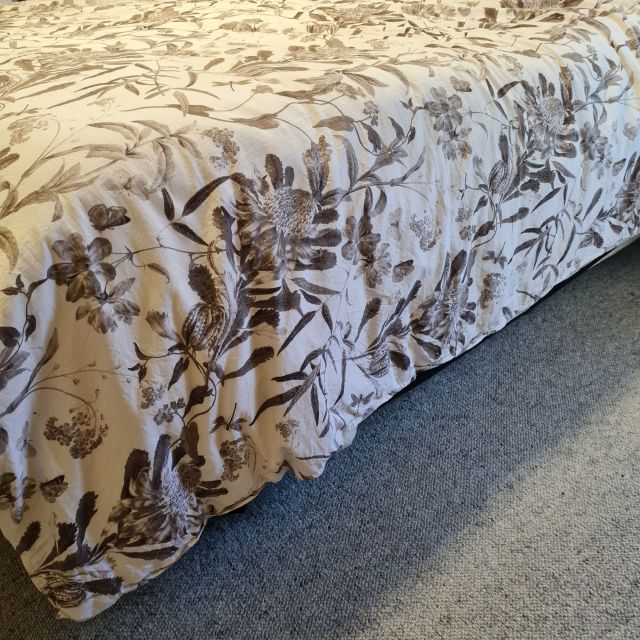
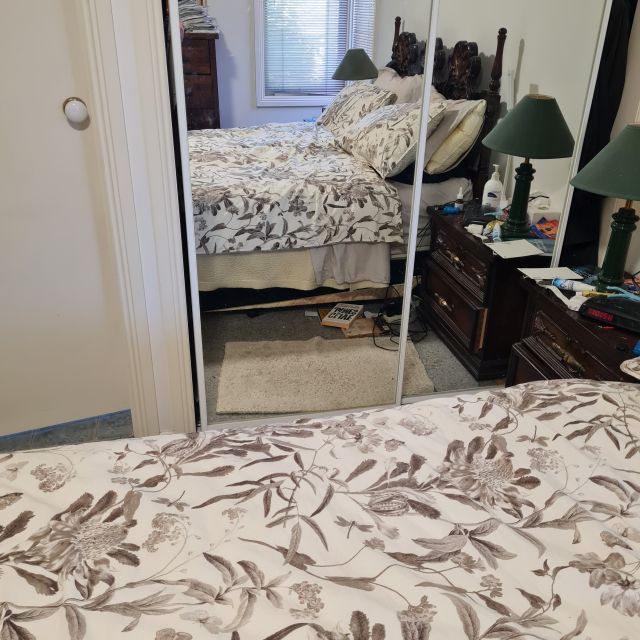
This is my bed. I loathe doonas: give me blankets any day. And don’t get me started on the absence of a top sheet in hotels. Layers, people, layers.
Anyway, we make the bed every morning: sheets (bottom and top), two blankets and a doona in a doona cover more for appearance than anything else. I tuck my blankets in, but Steve doesn’t. Worse still, you can see the blankets hanging out of the side of the bed reflected in the mirror because there’s never enough doona on his side. So every morning I spend a little while walking around the bed, making sure that the doona is even on both sides and tucking in any errant blankets on Steve’s side. I smooth out the wrinkles from the doona, and all is right with the world.
Did it matter? You bet it did. Every time I walked into the bedroom, I’d see the blankets hanging out of the side of the bed and it took every bit of self-control not to run round there, tuck them in and straighten up the doona. It put me in a bad mood for the whole day.
Then just to add insult to injury, I listened to the short reflection that went with this activity, where a man with a smooth voice rationalized his failure to wake up on time on a Saturday morning and get his kid out out of bed to go to kick-boxing by saying that it didn’t REALLY matter. Yes it did! You’re the father- show some responsibility! And if that kick-boxing instructor was a volunteer, that’s a million times worse. That’s the deal: you get your kid here on time, and I’ll teach him.
Does it matter? Yes.
Grrr. I don’t think this challenge is very good for me.
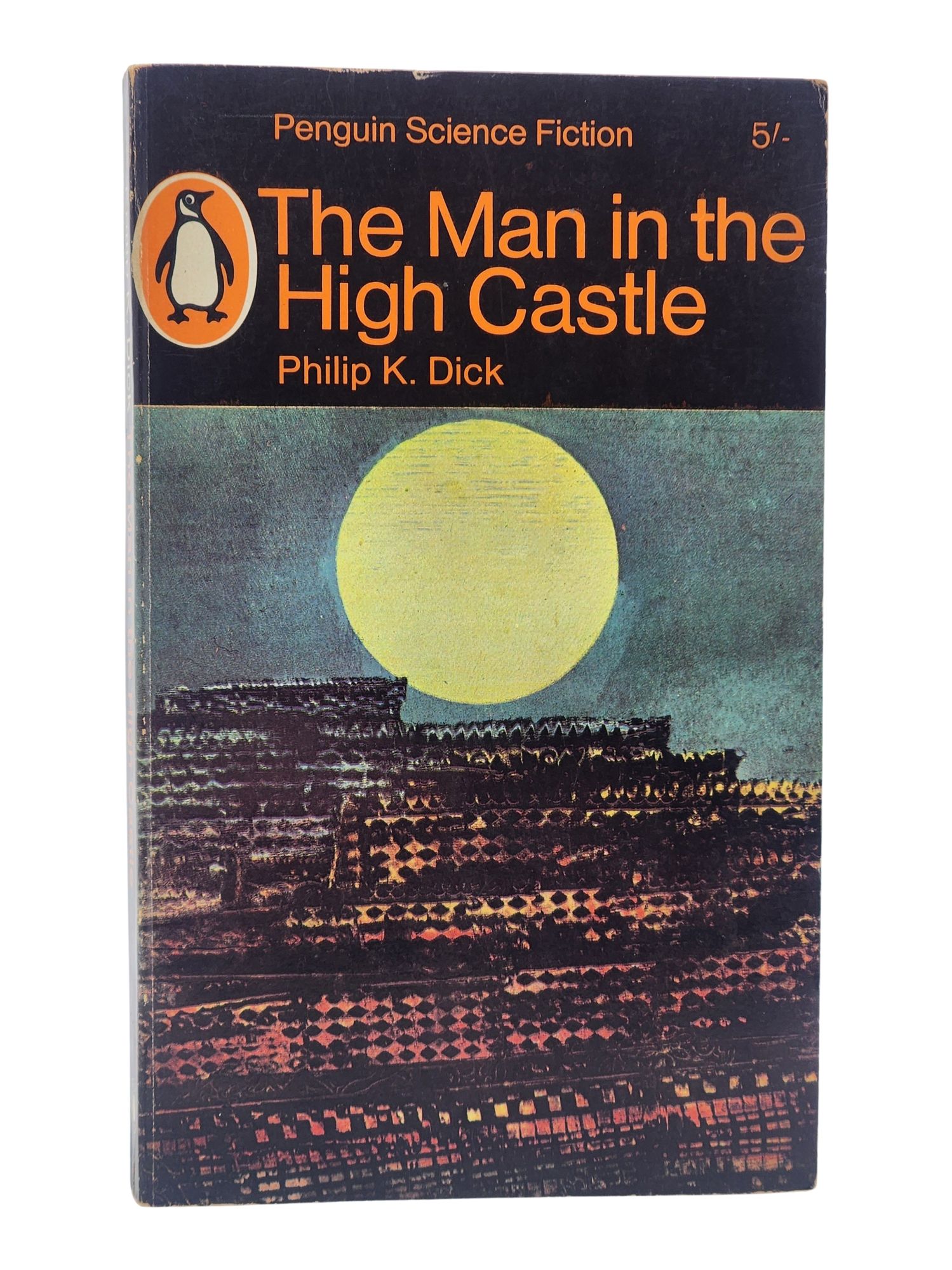
It’s interesting that my copy of The Man in the High Castle should be issued under the Penguin Science Fiction impress, because it doesn’t seem particularly science-fiction-y to me. It was first published in 1962 and envisaged a world in which Germany and Japan had triumphed during WW2, with the action occurring taking place in 1962- i.e. contemporaneously. To my mind it was more an alternative history or counterfactual than science fiction.
The narrative traces through several characters who live in an America partitioned into three. Nazi Germany controls the East Coast, as well as Russia and Western Europe. The east coast itself is divided in two: the remnant United States of America up to the Canadian border, and ‘The South’, both ruled by puppet regimes under Nazi control. The West Coast had been annexed by the Japanese as the Pacific States of America. Between the two regimes is the buffer Rocky Mountain states, where American citizens continue a depressed, oppressed existence.
The novel starts in the Pacific States of America, where businessmen Robert Childan runs a business selling pre-invasion Americana, most of which is counterfeit and manufactured by the Wyndam-Matson Corporation. Childan is contacted by Japanese trade official Nobusuke Tagomi, who seeks a gift to impress a Swedish industrialist named Baynes, who is coming to visit. Baynes, however, is really a Nazi defector who is coming to warn of the incipient activation of Operation Dandelion, a plan for Germany to attack Japan and attain world domination. Meanwhile, there is a banned publication, The Grasshopper Lies Heavy which is circulating surreptitiously, which posits that in fact, the Allies did win. Ostensibly the book is written by Hawthorne Abendsen, the eponymous ‘Man in the High Castle’. Juliana, the ex-wife of secret Jew Frank Frinke, is fascinated by the book, and travels unwittingly with an under-cover Nazi to meet the author, unaware that her companion Joe Cinnadella, has been sent by the Germans to execute Abendsen. It is a repressive and violent society, which has reverted to almost-magical times, with the I-Ching, a book of Chinese divination, guiding the actions of many of the characters, both Japanese and American.
The scenario is fascinating, but unfortunately the characters are not. I confess to losing track of who was who, and I am still bemused by the authorship of The Grasshopper Lies Heavy, although I think that the author intended this ambiguity. The characters are rather mechanical, and it is difficult to feel any connection with any of them. The end of the book becomes bogged down with a fairly metaphysical exploration of the I-Ching.
However, the book does form the political and ‘historical’ background to the excellent Prime four-season series, which managed in its first episode to evoke more sympathy and coherence to the characters than the whole book did. Interestingly, they turned The Grasshopper Lies Heavy into a film, instead of a book, which in a way made the whole scenario more implausible- who has a film projector hanging around in their apartment? Surely a book would be more portable and thus more dangerous. To eke four seasons of the TV series out of a fairly slim volume, obviously it was taken far beyond the original book, but to my mind so far, with far more success in character development than the book. So, for me, The Man in the High Castle is a book with a really fascinating premise which didn’t quite manage to develop its characters, or integrate its metaphysical aspects.
My rating: 6/10
Sourced from: My husband’s bookshelves. I had heard about the book, but never read it or seen a copy.
Day 2 of the Real Attention Challenge was to go on a short walk and to choose to focus on one thing only, instead of sweeping your gaze around.
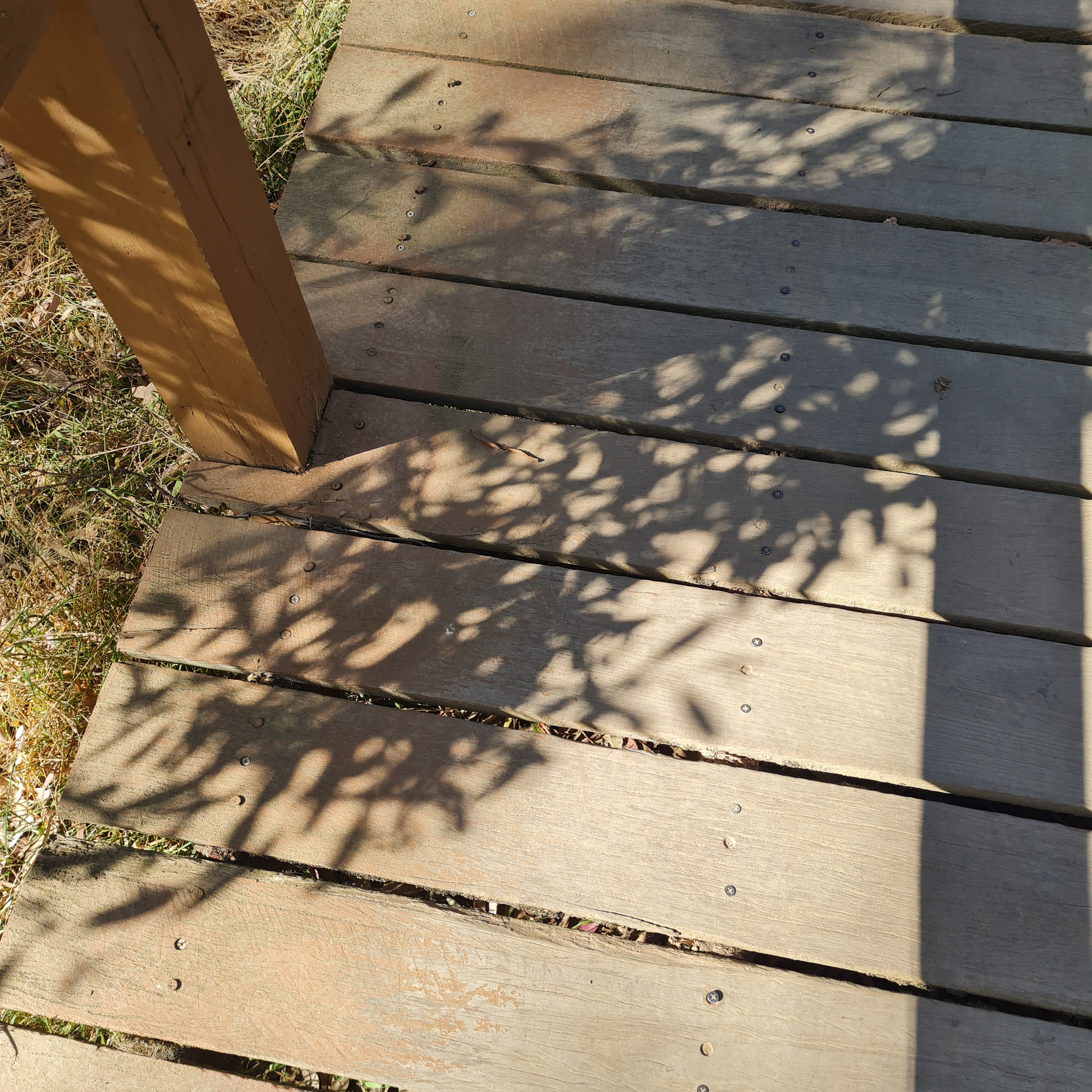
Well the walk part was easy because on Mondays I always walk to the museum in Heidelberg through the Rosanna Parklands. It was quite breezy this morning, so I decided to focus on the shadows from the trees.
I noticed the shadows of the leaves moving, as if they were dancing, and the thick density of the shadows thrown by the tree trunks. I did get a bit distracted by all the dogs running up to me, and I had to consciously fix my gaze on the ground when I passed people, instead of greeting them as I normally would. I felt a bit anti-social and I hope I didn’t pass anyone I know!
So, I’ve been subscribing to the ‘Waking Up’ meditation app for a few years now. This year they launched the Real Attention 14 Day challenge and I thought ‘why not?’ So Day 1 the challenge was ‘try something new’. Uff…something new. I am the ultimate creature of habit and it took me quite a while to think of something that I’d never done before. In the end I came up with two things
Something New Number 1: Go to Coburg Lake Park.
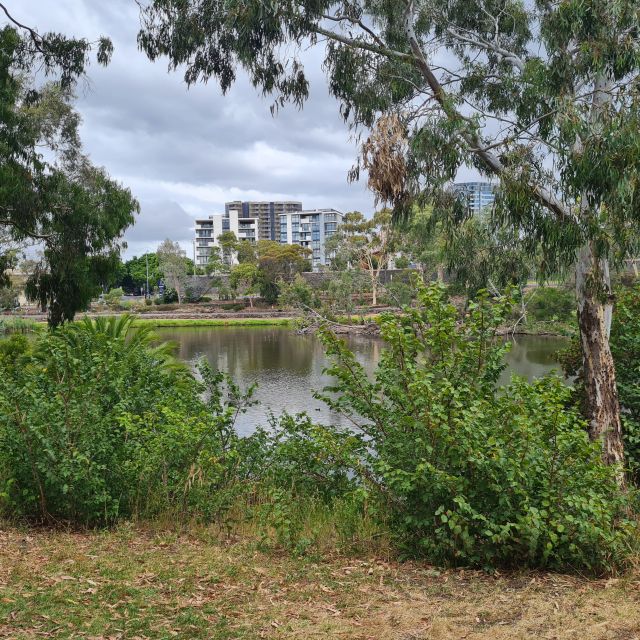
I must have driven past Coburg Lake dozens and dozens of times, but I’ve never actually been to it. It’s on Murray Road, opposite the old Pentridge Gaol which has now been redeveloped into highrise buildings, with shops, cinema etc. all enclosed within the bluestone walls of Pentridge, which can be seen on the other side of the lake in the photo above. I don’t know if I’d really like to live there: it’s just a little bit creepy. The lake is on the other side of the road from the gaol, and is reached by a bluestone bridge. Apparently Coburg had over 40 quarries in the 19th century, and this lake was constructed on the Merri Creek around the time of WW1.
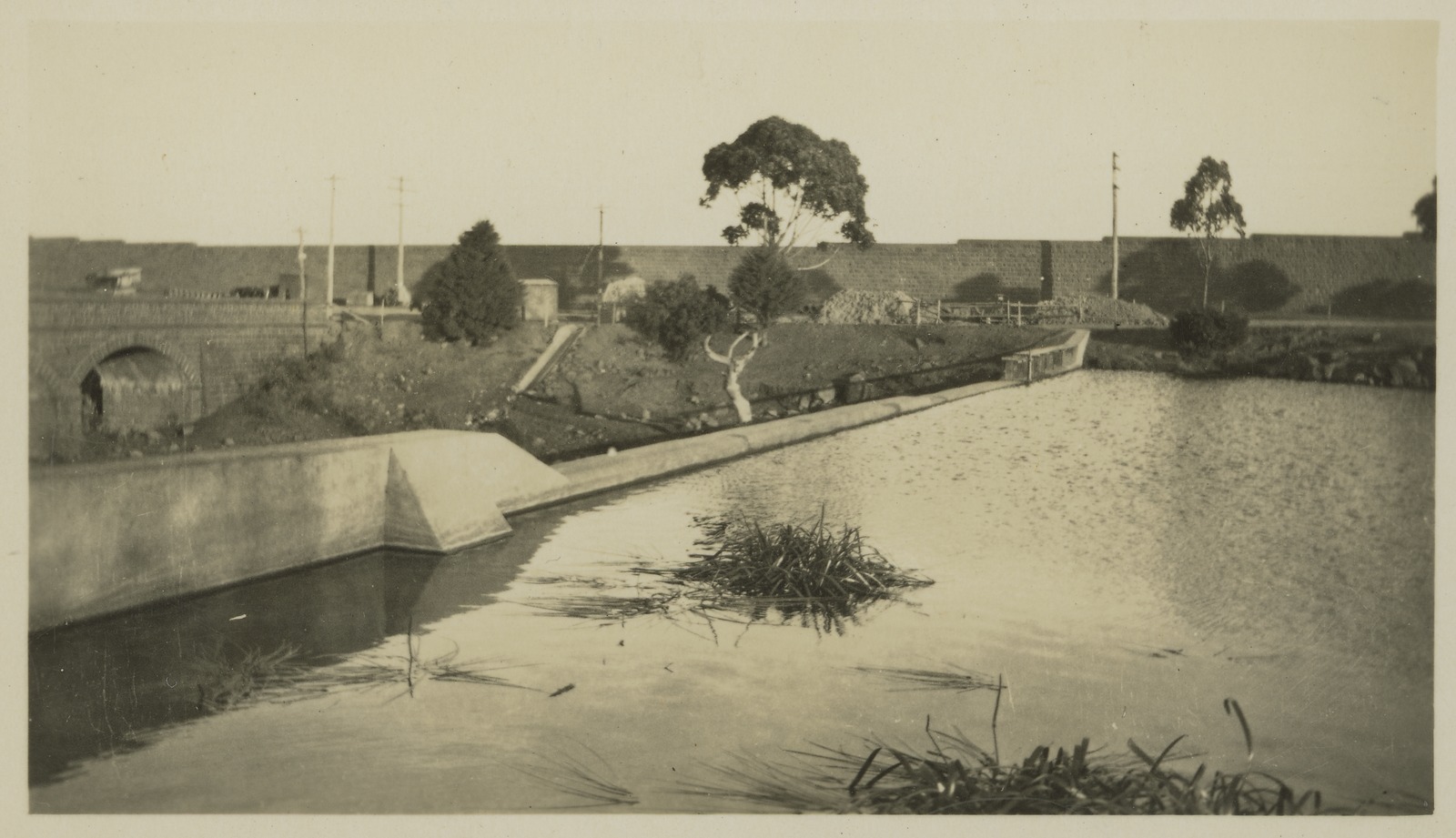
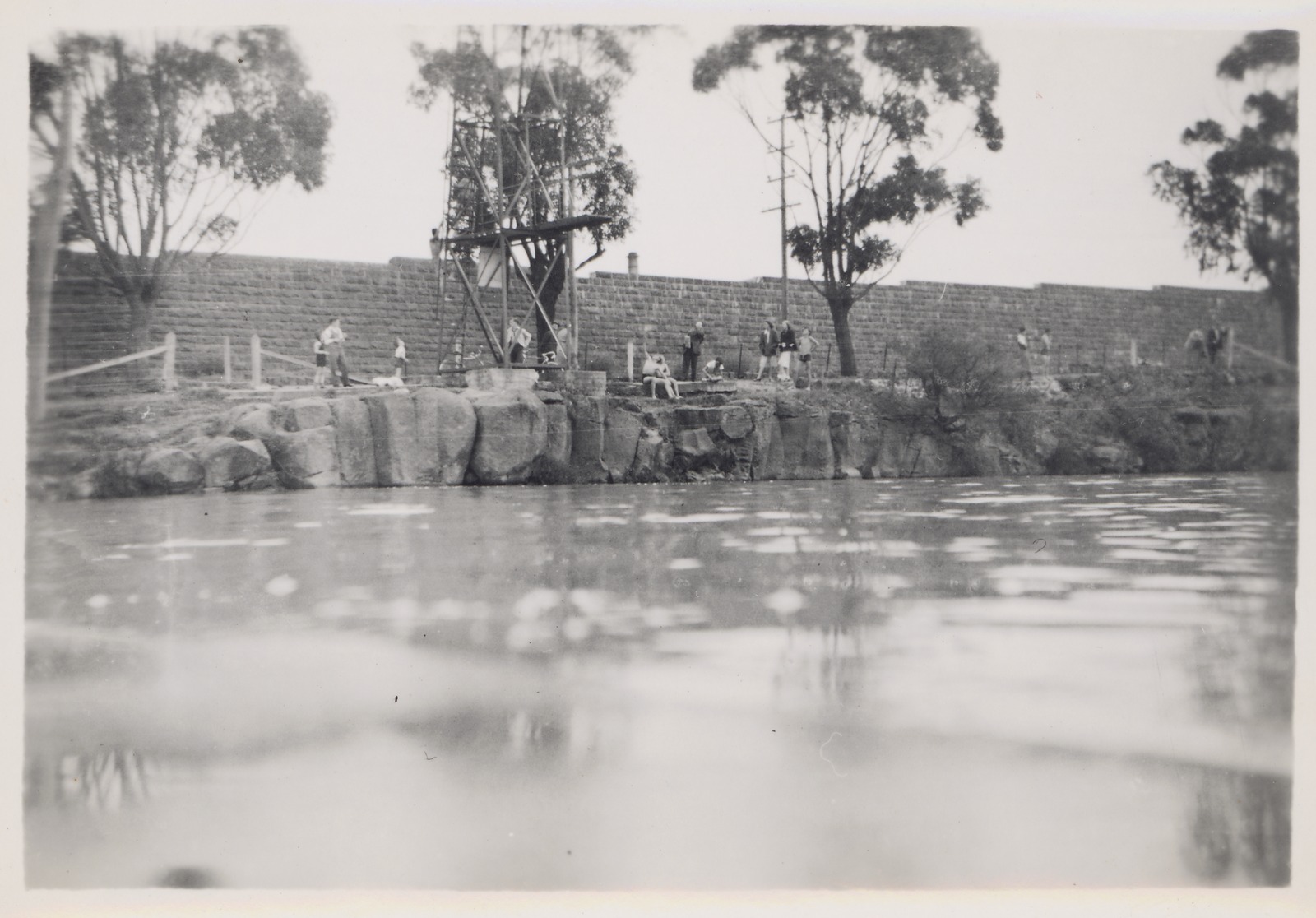
It looked pretty grim when it was first constructed. You can see the Pentridge Wall quite clearly in these photos. Just what you want as a backdrop to a picnic area.
Coburg Lake 1927 SLVDiving Tower 1948 SLV
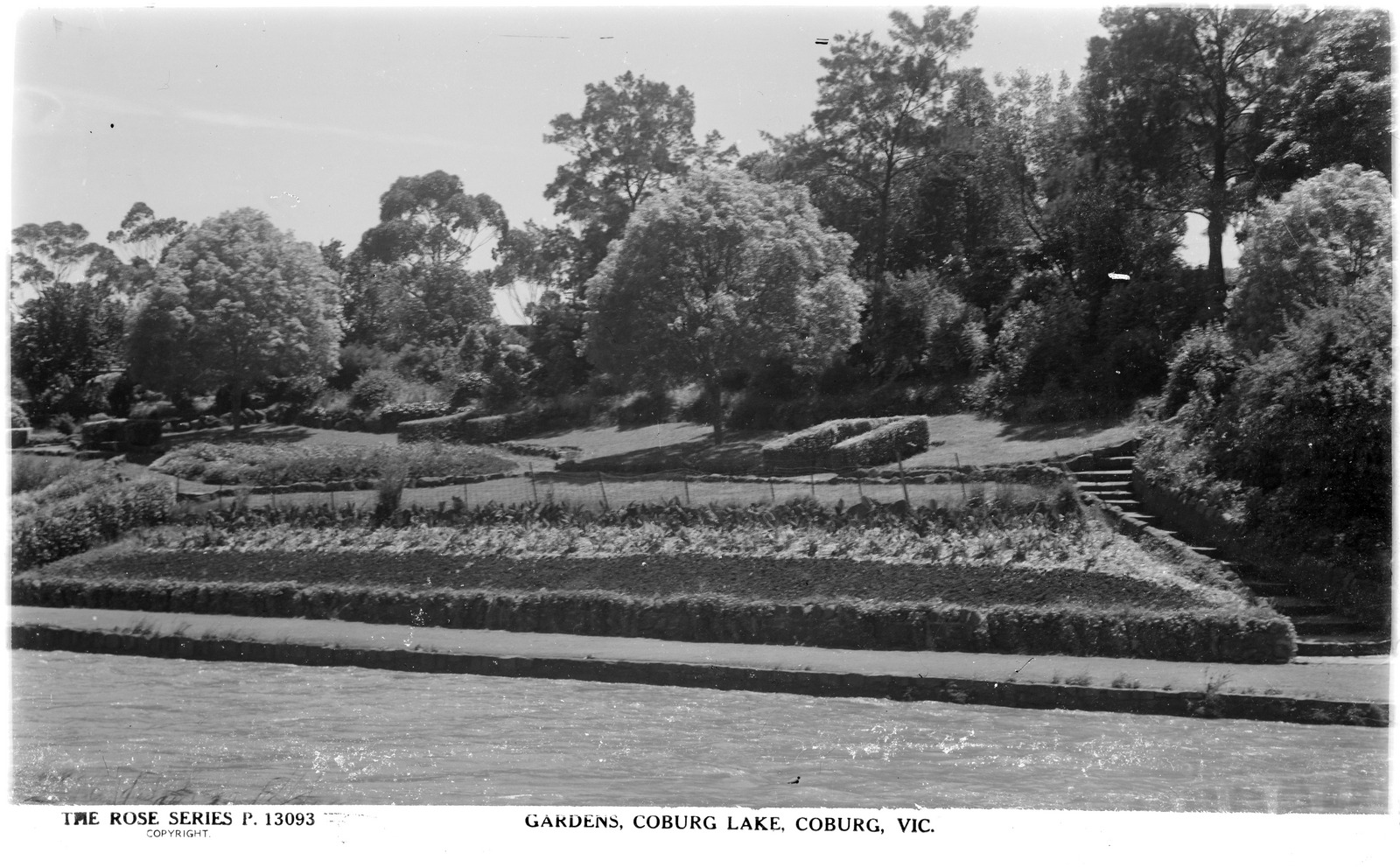
But by mid-20th century it was all looking very formal
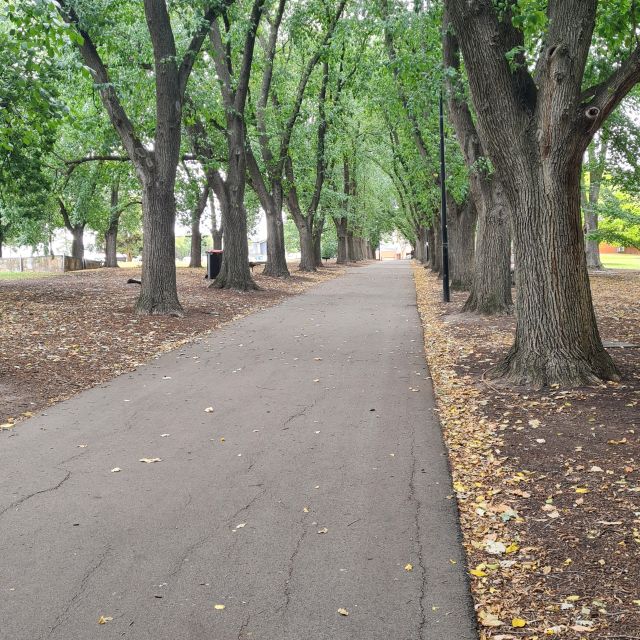
There’s still traces of the formal gardens in the park, especially the Avenue of Honour, which was planted in 1919. Originally there was one tree for each soldier, but now the remaining trees commemorate all Coburg servicemen.
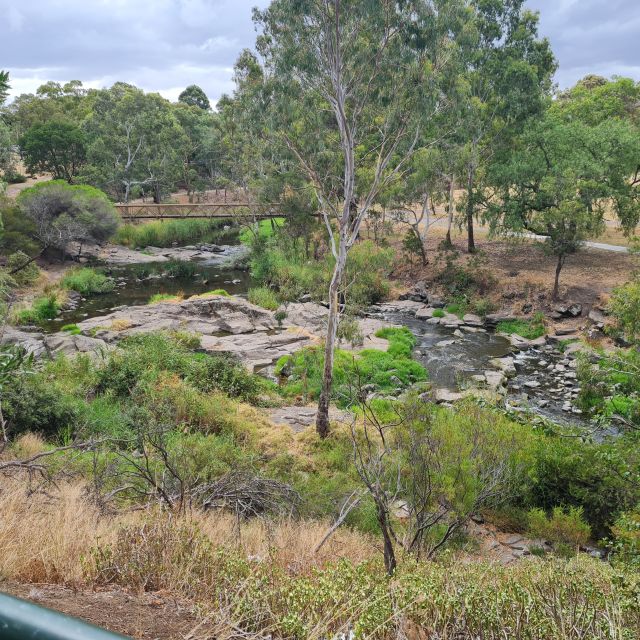
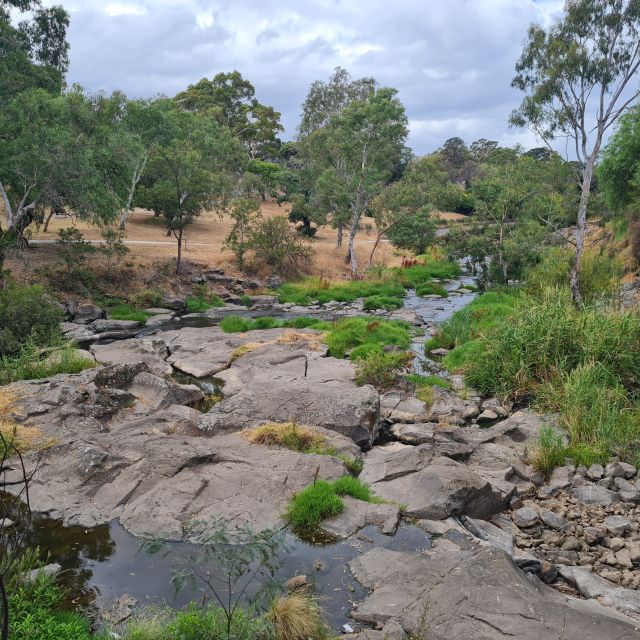
Much of the park, especially around the creek has been de-formalized. Merri (originally merri-merri in Woiwurrung) means ‘rocky’ and you certainly get a sense of the rockiness of this area before it was quarried out and tamed.
I walked along the park, through the gardens and along the creek – a pleasant little amble- until I realized that I had no idea where I had parked the car. The Challenge for today mentioned ‘getting lost’ and for a while that was exactly what I was until I finally crested the hill and saw my little car waiting there for me. So Mission Accomplished.
Something New Number 2
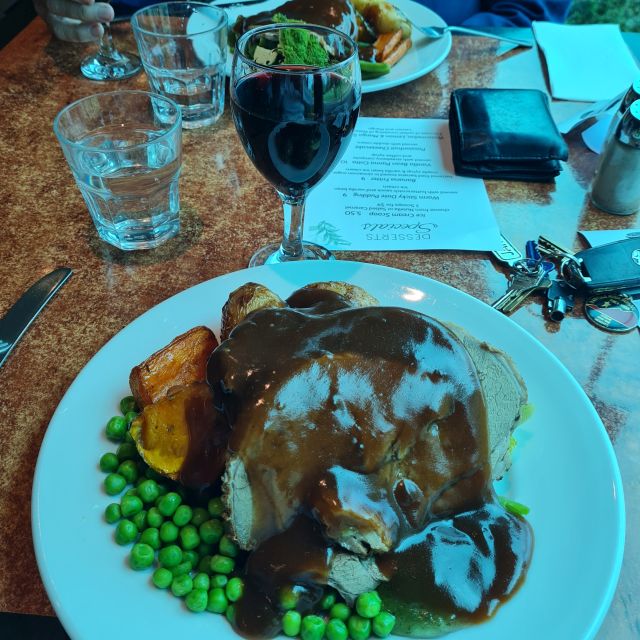
Now, this isn’t really something new because my friend Steven has been doing this for some time, but it’s new to me. He and his friends in the Sunday Roast Club go to a pub and have a Roast of the Day. Now, I have eaten millions of roast dinners, because my mother cooked a roast on Mondays and Thursdays (sausages on Tuesday, chops on Wednesday) and a very nice roast it was too. So nice, in fact, that I have never actually paid to have a roast dinner in a pub or restaurant. So, Something New Number Two was to go to an RSL and pay to have a roast of the day. And, you know, it was just like Mum used to make – none of that ‘jus’ rubbish, but real, thick gravy and roast potatoes, mint jelly, pumpkin and peas. Delicious. Mission Accomplished at Montmorency RSL.
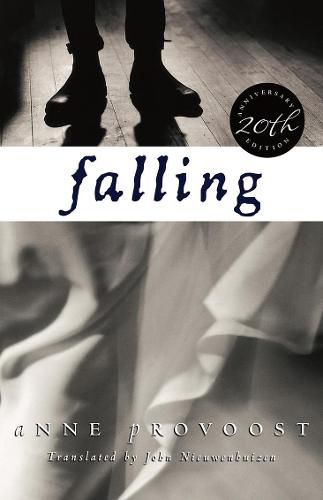
The twentieth anniversary republishing of this book has come and gone, it having first appeared in Dutch in 1995. I had heard of it, and knew that it dealt with Nazism, and assumed at first that it would be set during World War II. It came as a surprise, then, that it was set in the present day (in 1995) with themes that are probably even more resonant and urgent today than they were in 1995. My copy, collected no doubt from my local little library, had obviously been a school set-text, and the book won many Young Adult awards on its publication.
Lucas has accompanied his mother to Montourin, a small Belgian provincial town, to clean out his late grandfather’s house. The book opens with Lucas standing by the side of the road as his friend Caitlin is brought back from hospital after an accident that occurred three weeks earlier. The narrative then spirals back to explain who Lucas and Caitlin are, how she was injured, and Lucas’ part in that injury. It is written in first person, from Lucas’ viewpoint, thus aligning us as readers with his perspective of events in the weeks leading up to Caitlin’s injury.
On arriving at Montourin, he finds that there is an unspoken edge of hostility towards him and his family, exemplified by Soeur, an old nun in the nearby convent in which American-born Caitlin is staying. He does not understand why, and as he sees his mother sorting through and destroying his grandfather’s documents and belongings, he knows that something is being kept from him. He gradually learns that, after the death of one of his children during the hungry days of WW2 occupation, his grandfather denounced fifteen Jewish children and the nuns who were hiding him in the neighbouring convent, out of grief and resentment that these Jewish children were taking food rations that could have saved his daughter. Some in present-day Montourin shunned his grandfather for this action; others supported it.
Their support was generally unspoken, but outright admiration was voiced by Benoit, a young man older than Lucas, who combines menace, charisma and manipulation in his neo-Nazi outlook. Lucas is drawn into Benoit’s sphere and becomes involved, with varying degrees of culpability, in Benoit’s terrorist plans against the Moroccan refugees who have moved into the town. At the same time, he is attracted to the inscrutable Caitlin who fluctuates between flirt, friend and heartbreaker as she, too, seems to be becoming friendly with Benoit. But when Caitlin is involved in a single-car accident- the reasons for which are unclear- Lucas acts decisively, if precipitously, in a way that will change the rest of Caitlin’s life. I’m not really quite sure about the ending of the book, which is deliberately left obscure, but which struck me as a little melodramatic.
Since 1995 the presence of African refugees in Europe has only increased, as has the prominence and apparent electoral acceptability of neo-Nazi parties. This book is a warning against the slow slide towards fascism, especially for young men with no responsibilities who yearn acceptance from other young men. I can see why it would be chosen as an upper-school text, especially given its urgent relevance today. I’m not sure how it would be received by high school students though- it moves fairly slowly, and I wasn’t particularly satisfied by the ending.
Short History of…Mount Rushmore. I’m almost certain that Donald Trump will try to get his face onto Mount Rushmore. The carvings of George Washington, Thomas Jefferson, Abraham Lincoln and Theodore Roosevelt were commenced in 1927 and took 14 years to complete on a mountain that was regarded as sacred by the Sioux. Known as the ‘Six Grandfathers’ for the six large granite outcrops which it contains, it was supposed to be Native American land under the 1868 Treaty of Ford Lararmie, but that got torn up when the Black Hills were seized for mining. In the 1920s there was a boom of motor tourism to beauty spots, and Doane Robinson, the state historian of South Dakota, wanted a “Big” thing that people could travel to see. At first he suggested that six American west heroes should be carved into the mountain (Lewis and Clark, their expedition guide Sacagawea, Lakota chief Red Cloud,Buffalo Bill Cody, and Oglala Lakota chief Crazy Horse). But they brought in sculptor Gutzon Borglum, who suggested the four presidents instead to give it a national focus. Borglum was a passionate but pugilistic man, who had previously been engaged on a Confederate carving on Stone Mountain, Georgia, funded by the KKK, until he was sacked and the work he had already done on the carving was blasted away. There was lobbying to have $460,000 put aside for the work on Mt Rushmore, but Borglum decided to just have $250,00 from the government with the rest from private donations. He made 1:12 scale models in his studio, but the plans had to be redrafted because of the geology of the mountain and because there was a black vein running through the rock. He planned to add torsos to the bodies, but with the financial restrains of WW2, they went for just the heads. Gutzon Borglum died in 1941 and his son Lincoln took over. The sculpture ended up costing $990,000 and it opened in 1941. In 1971 the site was occupied by Native American protesters, and in 1981 a court ruled that the Sioux were owed compensation. However, they refused to take it, wanting the land instead. Fortunately it seems that the geology precludes adding any more heads, but I’m sure that that wouldn’t deter Trump.
In the Shadows of Utopia Season 2 Episode 18 A Cambodian Coup! The “Red Prince” falls Time Period Covered 1969 – 1970. In 1969, Pol Pot and his wife, and a number of CPK delegates walked to Hanoi. They wanted to continue the struggle against Sihanouk, but the Communist Party of Vietnam wanted them to give up, because Sihanouk was too useful to them. Meanwhile, there were increasing numbers of North Vietnamese troops in Cambodia attracting increased US bombing, with Sihanouk’s tacit approval. As Sihanouk headed overseas, by this time Lon Nol was head of the government and Sirik Matat, Sihanouk’s cousin, was in charge of the economy. There was increasing restlessness about the North Vietnamese presence in Cambodia. So in Sihanouk’s absence the 5000 real note was devalued, which had a large effect because 5000 reals was the denomination that the Viet Kong used to buy rice from the Cambodian farmers. Bombing of the north east region was ordered, and false protests were staged at the North Vietnamese embassy. On 11 March 1970 Sihanouk announced that he was returning to Cambodia, and Lon Nol announced that the North Vietnamese and Communist troops had to leave within 3 days. Sihanouk changed his mind and decided not to come back after all, and threatened to kill the cabinet who had been acting in his absence, accusing Sirik of bringing in the Vietnamese. A coup ensued. Lon Nol was forced to hand over control of the Army, and the Congress voted to overthrow Sihanouk. Meanwhile Sihanouk was in Moscow, and both Russia and China asked if Sihanouk would continue his support of the Communist cause. China was worried about Soviet influence and they suggested an uprising, using the Communist Party of Kampuchea as the resistance, with Vietnamese military training and arms, and Sihanouk as its ‘face’. Sihanouk was fuelled with a desire for revenge against his enemies, blaming traitors in the assembly and their US imperial masters and he called for a guerilla uprising. Pol Pot, who all of a sudden found himself in demand, accepted the offer under the names of the ‘Three Ghosts’ Khieu Samphan, Hu Nim and Hou Youn, nationalists who had been disappeared and supposedly (but not) executed by Sihanouk. Pol Pot himself stayed in the background. Was there CIA involvement? Probably the US was happy enough with Sihanouk, but they probably had contact with all sorts of people.
We don’t go into the city together much because Steve finds walking difficult, but the milder weather was such a relief today that I really wanted to do something ‘in town’. So off we went….
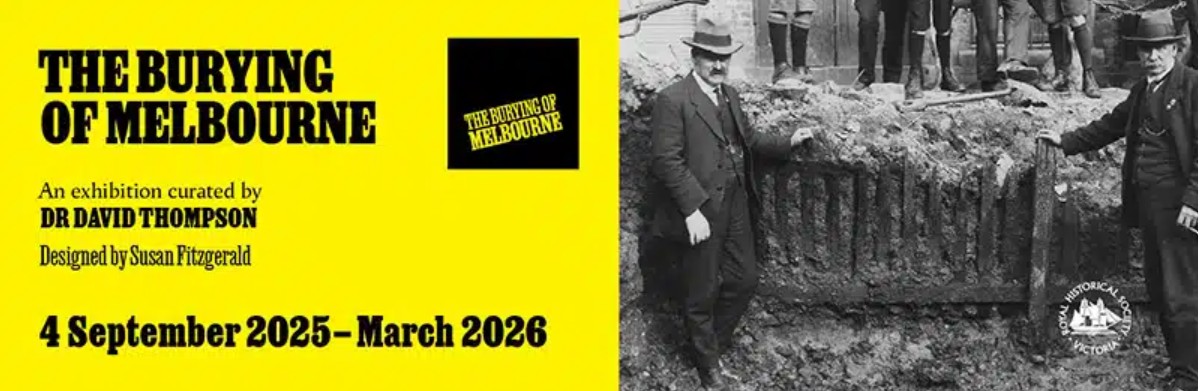
First stop was the Royal Historical Society of Victoria to see their current exhibition ‘The Burying of Melbourne’
In the mid-1850s some areas of the Melbourne CBD were buried under a layer of clay at the direction of Melbourne City Council, a rather extraordinary event that until recently had been largely forgotten. It is only in recent years that archaeologists carrying out the excavations required prior to developments in the city have uncovered evidence of the clay layer.
A study commissioned by the Heritage Council of Victoria found that the burying was part of efforts by the City Council to control flooding, caused largely by the original laying out of Melbourne’s street grid without due consideration of the flow of water over the underlying topography.
The depositing of the clay layer, metres thick in some places, had a significant effect on the lives and circumstances of those affected but did result in the sealing off of a layer of archaeology stemming from the earliest days of European settlement.
This exhibition, The Burying of Melbourne, describes events leading up to the burial and looks at some of the archaeology discovered beneath the clay.
The problem was that people started building their houses before the roads were built, which meant that when the roads finally did come through, the houses were much lower than the road. As a result, the houses flooded in heavy rain. The council ordered that the properties had to be filled up to road level with clay. In some cases, particularly where the houses were not owned by the occupants, the house was in effect entombed by the clay, with new houses built on top of them. The layer of clay was located when a compulsory archaelogical inspection was made for a new development near the Wesleyan church in Lonsdale Street. Comparisons were made between the contour maps pre-filling and after-filling to identify the sites where the clay was likely to have been spread. Six terrace houses dating from the 1840s were found in Jones Lane.
This exhibition is not high-tech: indeed, it is mainly maps and photographs of the archaeological dig. There are a few of the objects on display that were located on the site, most particularly the level under the clay. But I find the idea of a whole layer sealed off by clay for 170 years quite fascinating.
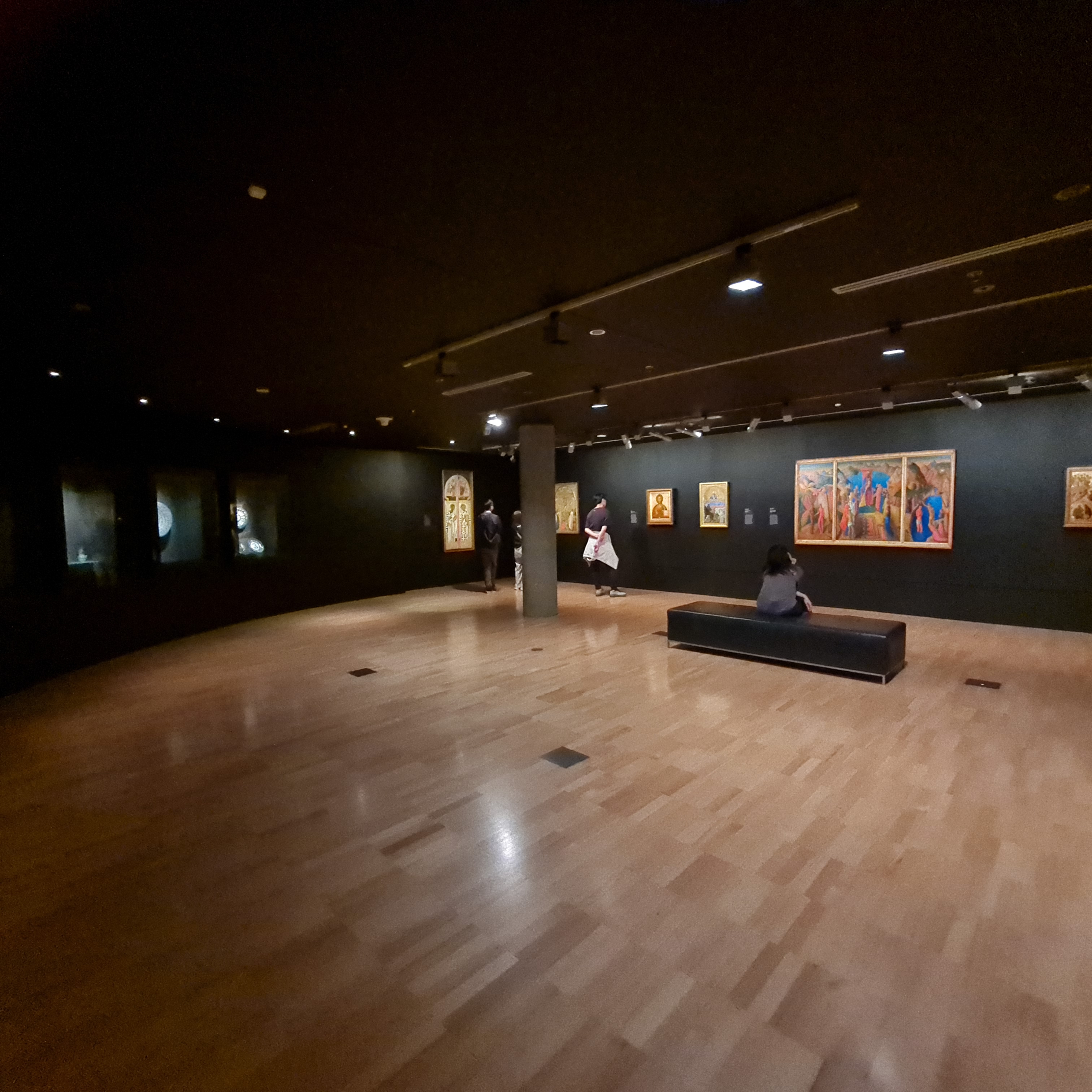
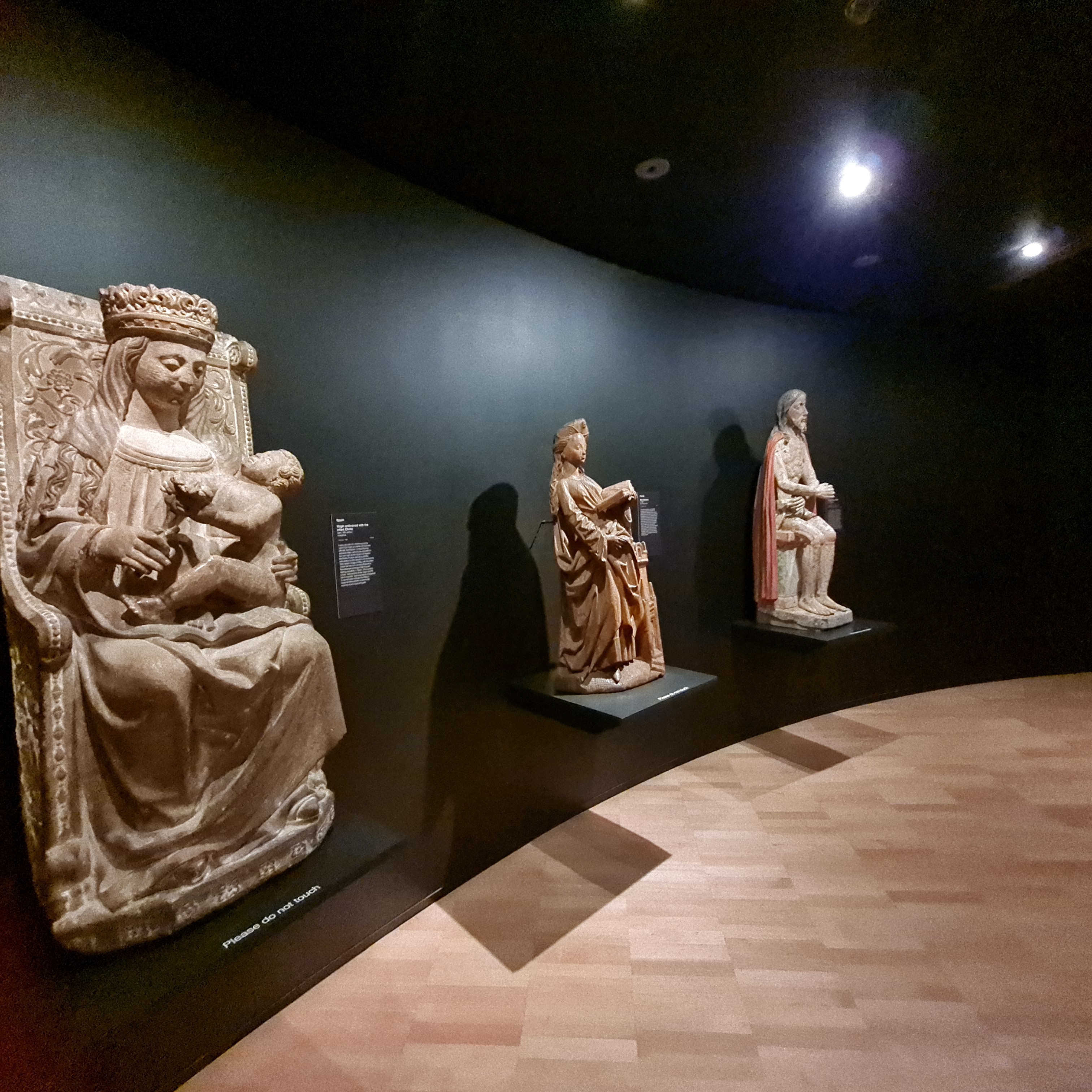
Then back onto the train and down to the Swanston Street tram for a quick trip up to the NGV International in St Kilda Rd. I wasn’t interested in the $40 Westwood/ Kawakubo exhibition (when did these exhibitions become so expensive?) and just stuck to the freebies. Somehow or other we ended up in the British and European Collection 13-16 Century, which you can see in a 3D version here if it doesn’t induce too much nausea for you. Actually you can see it online better than you can in real life because at least they turned the lights on to film it: probably because of the age of the artwork, it is very dimly lit. Their signage of the objects themselves is appalling- white print of about 12 pt font on grey behind glass. I just couldn’t read it at all. However, given that I’m not likely to visit Europe again, it was a little bit like being in a grand European cathedral close up.
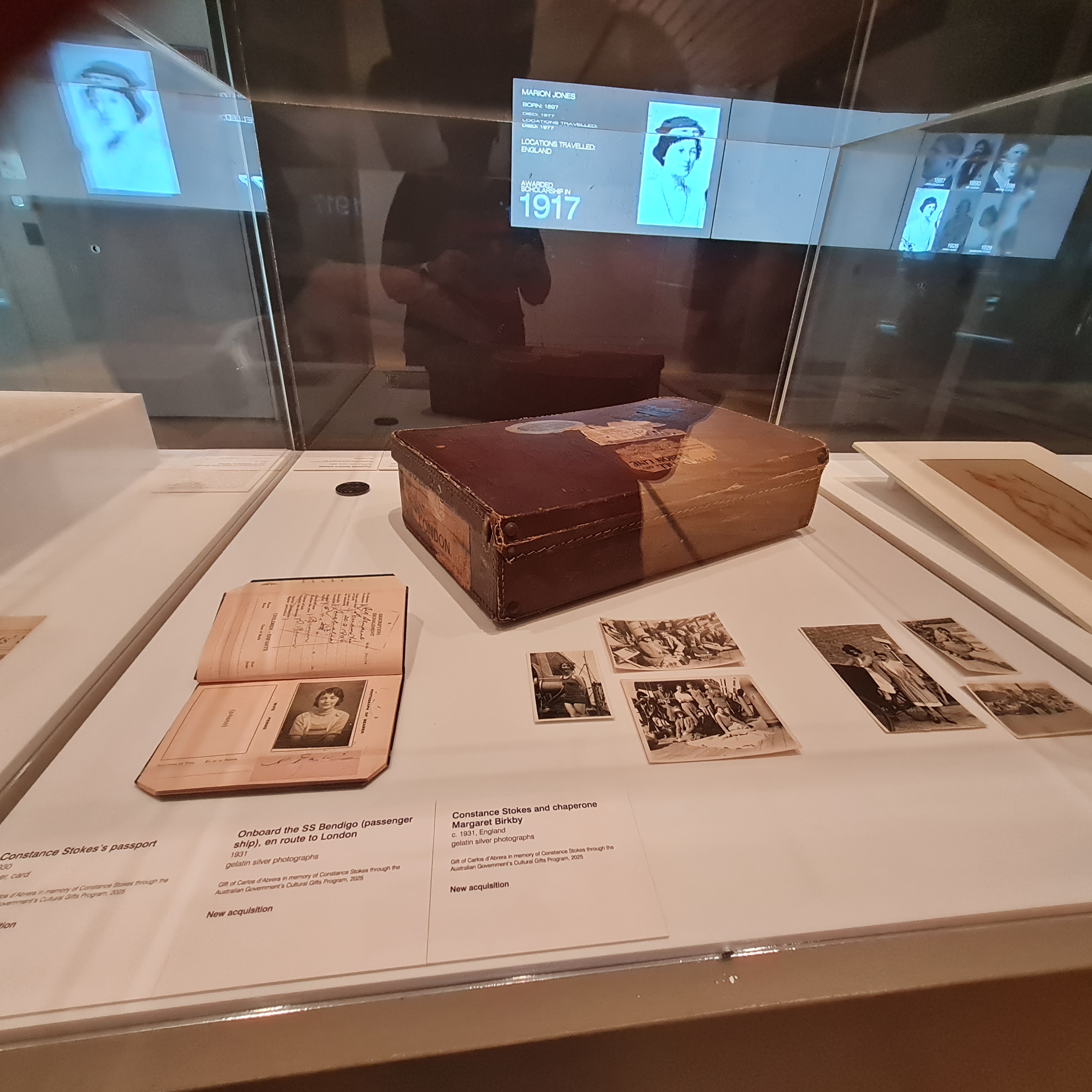
What I really intended to see was a display of the National Gallery of Victoria Travelling Scholarship. This is a tiny exhibition, tucked away on the first floor near the escalators. The NGV established its Travelling Scholarship in 1887, just 25 years after the Gallery opened. Awarded every three years, the three-year scholarship granted a stipend to study at art epicentres across Europe. Scholarship-holders were required to provide to the Gallery a replica of an Old Master painting, a nude study, and an original composition. A cheap way of increasing the size of the collection, I suppose. The exhibition is mainly just a projection on a wall, showing biographical details of several recipients (nicely balanced between male and female artists) with a few glass cases containing objects belonging to Constance Stokes (nee Parkin) trip that she received as part of her scholarship in 1929. Just a slight young girl, you get a sense of how exciting it must have been to travel over to London to study at the Royal Academy of Arts, with her passport, photographs and ball invitations.
It’s appropriate that I should be writing this review on January 26, Australia Day. Here’s a recommendation: if you’re going to read a survey history of Australia, then read this one.
There’s lots of survey or short histories written by eminent historians to choose from, many of which appear in several editions as they were updated to encompass later events: Keith Hancock’s Australia first written in 1930; Gordon Greenwood’sAustralia A Social and Political History (1955) Manning Clark’s A Short History of Australia (1963) ; John Rickard’s Australia: A Cultural History (1988); Creating a Nation (1994) by Pat Grimshaw, Marilyn Lake, Ann McGrath and Marian Quartly; David Day’s Claiming a Continent (1997) and Stuart Macintyre’s A Concise History of Australia (2000). There’s even Alex McDermott’s Australian History for Dummies (2011). One could quite justifiably ask “Does the world need another short history of Australia?” And I would answer: yes, and it should be this one.
In 1968 New Zealand historian Keith Sinclair wrote an article for Historical Studies called ‘On Writing Shist’ (that second ‘s’ is very important!) He pointed out that shist (i.e. short history) is not a summary of what is known in order to be memorized, but a summary interpretation of a topic, intended to make it understandable. It should be aimed at the educated non-specialist, and the author cannot assume more than the most vague background knowledge. Facts are illustrative and form a “very thin, hard skeleton”, and the overwhelming problem is what to leave out, rather than put in. The heart of the task is to shape the overall pattern of ideas, facts and prose, interwoven into a pattern of thought and story. It is meant to be read, rather than consulted, utilizing the novelists’ tools of suspense and pace, driven by the author’s sense of commitment to his subject.
McKenna addresses the issue of the need for “new ways of thinking about the nation’s history” right in his first chapter. He writes:
Most national histories are ‘rise and rise’ narratives. They narrate the nation’s formation and walk chronologically through familiar milestones. In Australia’s case, there’s a chapter on Indigenous Australia before 1788, before moving onto the main story: penal colony to gold rushes and responsible government, then to Federation, the First World War and the Anzac legend, the Depression, the Second World War, postwar reconstruction and the Cold War; before waves of non-British migration, the new social movements of the 1960s and 1970s and the end of White Australia usher in the emergence of a more open, global economy and culturally diverse society. Or words to that effect. The history of the nation-state- from one formative event to the next. (p. 7)
So how is he proposing to avoid this straightjacket? His fundamental strategy is to see Australia as a continent rather than a nation, to turn both Edward Barton’s declaration “a nation for a continent and a continent for a nation” on its head. He foregrounds place, both the climate, ecologies and histories of different regions of Australia, and the Indigenous understanding of history which can never be divorced from place. And rather than that awkward, dangling introductory chapter of “The Aborigines”, he integrates Indigenous perspectives and actions throughout the whole book, from start to finish. Nor does he follow a well-ploughed chronological trench: indeed, Captain Cook and Botany Bay don’t appear in detail until Chapter 9, more than half-way through the book, in a chapter titled ‘Facing North’.
He starts right up front in Chapter 1 ‘The Founding Lie’, with a reflection on the Sydney Opera House, its design and construction, then considers its site – Bennelong Point. In Chapter 2 ‘From Ubirr’ he joins hundreds of visitors at Ubirr, in the Kakadu National Park looking north to the Arafura Sea at dawn- again, starting at a place- to emphasize the great migration from Asia into northern Australia, and the influence of trade with the north. Chapter 3 ‘The Island Dilemma’ looks at the sense of geography and the ‘island’ perspective that encouraged isolation as both a negative and positive force. He takes us to Christmas Island, both its now-deserted CI Club for administrators and Europeans, then its use as a detention centre for asylum seekers. Ch.4 ‘Taking the Land’ (and there, again is that ‘place’ emphasis) starts with John Howard at the Longreach Stockman’s Hall of Fame in 1997, promising that government legislation would ensure pastoralists’ rights after the Wik decision. He traverses land policy from Cook’s act of possession to the spread of ‘settlement’ and Aboriginal resistance, especially in Queensland. He notes that Australia has silenced not only the evidence of frontier warfare, but also the many efforts at reconciliation that were made between British settlers and First Nations Australians (p. 75).
Chapter 5 ‘War and Memory’ takes us to Australia’s “most storied beach”, 15,000 kms away. In a desperate craving to be connected to European history through blood sacrifice:
Over time, the birthplace of their nation was conveniently displaced 15,000 kilometres offshore to Anzac Cove. Australia thus became the only modern nation-state to create an origin myth not located on its own soil p.90
He points out that, two decades before the outbreak of the Great War, and for at least a decade after the war ended, in areas like Wave Hill and Victoria River of the Northern Territory and the Pilbara and Kimblerley regions of Western Australia, frontier violence was still occurring. War memorials to the First World War stand in villages, towns and cities throughout Australia, but the Australian War Memorial resists calls to recognize the loss of life in frontier wars.
Chapter 6 ‘Fire and Water’ takes us to Red Bluff, Kalbarri in Western Australia way back on 25 January 1697, and the desperate search for water by the men and officers from the Dutch East India Company who anchored three ships in Gantheaume Bay and rowed towards the coast. Drought, fire and flood are “a cycle as ancient as the country itself”, and while non-Indigenous Australians have long been familiar with bushfires and floods, the memory of one is swiftly erased by the arrival of the other, as if we’re fighting the same battles with the country (p. 111). Here are the plans for irrigation using the Murray-Darling, the Snowy River scheme and the fires at Mallacoota in December 2019. In Chapter 7 ‘Fault Lines’ we go to Waverley cemetery in Sydney, and the grave of Louisa and Henry Lawson, before embarking on a really good analysis of Catholic/Protestant sectarianism, touching on Ned Kelly, Billy Hughes and conscription. Chapter 8 ‘Fault Lines’ starts with Dorothy Napangardi, one of Australia’s most acclaimed artists, and the gradual recognition and appreciation of Indigenous ways of belonging to Country in the late twentieth century. For many non-Indigenous Australians, works of First Nation artists are a reminder that, as recently arrived migrants in a country, we do not have the same keys to Country. Modern Australia has always been a migrant society, and McKenna returns 19th century migration, especially from Ireland, and the Chinese migrants lured by the prospect of wealth on the goldfields. He goes through the conversion from a white, British enclave to a diverse multicultural nation, while noting that it was driven by self-interest and economic necessity. He reminds us of the memories of discrimination and prejudice through the story of William Yang, born in 1943 on a tobacco farm on the Atherton Tablelands. In Chapter 9 ‘Facing North’ (there’s that sense of place and geography again) we finally meet Captain Cook face to face. To illustrate the short-term economic mentality of resource extraction he turns not to gold, but to pearls, and the pearling industry not just for its importation of divers from Asia, but its mix of voluntary and forced Aboriginal labour (I didn’t know about this). He then moves on to New Guinea, and Australia’s WW2 in the Pacific.
I’d like to look at Chapter 10 ‘The Big Picture’ in more detail as an example of the diffuse way in which McKenna writes, his integration of stories of individual people into broader historical events, and the sweep of a theme across time. He starts with Charles Doudiet’s sketches of Eureka, which were only discovered in 1996 through a Canadian family which found them in their attic. These sketches verified for the first time the location of the Eureka Rebellion and the use of the Eureka flag, and they are the springboard for McKenna to discuss Australian democracy and its evolution from Eureka and the anti-transportation movement, through to self-government of the colonies in the mid 19th century. Then he moves to a second picture, Tom Roberts’ ‘Opening of the First Parliament of the Australian Commonwealth 9 May 1901′ and federation as a political compromise that combined elements of the US federal constitution and the Westminster system. The opening of Parliament House in Canberra in 1927 had many guests, but two uninvited guests were Jimmy Clements and John Noble, two Wiradjuri elders who walked 150 kilometres from Brungle Aboriginal station near Tumut in NSW to attend the opening. Here McKenna turns to Indigenous agitation for their rights in the 1920s and 1930s, set against Queen Elizabeth’s tour of 1954, the first reigning British monarch to set foot on Australian soil. He returns to Indigenous activism and the 1967 referendum, and the myths that surround it, before moving on to Whitlam and his deliberate cultivation of what Whitlam called “a vigorous national spirit” and ending the era of assimilation in favour of land rights and self-determination. This was encapsulated by the photograph of Whitlam pouring a handful of red earth into the hands of land rights leader Vincent Lingiari in 1975. However, the most seismic shift was the High Court Decision in the Mabo case, and he returns to Eddie Mabo’s sketch of his ancestral land on Mer which hangs not far from Tom Roberts’ ‘Big Picture’ in Parliament House. McKenna finishes the chapter with another painting of the people on Mer executed by Tom Roberts on his way to London in 1903. Twenty years after his arrival in London, Roberts presented the painting to the British Museum, and there it stayed undiscovered until found in 2009 by a curator from the National Museum of Australia.
He closes his book with an Epilogue titled ‘Modernity and Antiquity’ which starts with suburbia and the humble Sydney houses of both John Howard and Paul Keating. He notes that in the half-century since the dismissal of the Keating government, the old verities have vanished: Australia is now one of the world’s most diverse, multicultural and liberal democracies. The Indigenous cultures that White Australia tried to eradicate are now fundamental to the nation’s identity. From a protectionist economic policy, we are now an open, free-trade economy; the alliance with the US remains the linch-pin of its defence; the population has doubled since the mid 1970s and there is a distinctive rise of environmental consciousness, with the Tasmanian Greens the first Green party in the world. He notes that the closer we come to the present, the harder it is to discern which reforms will be of lasting significance. He returns to the “Big Lie” with which he started his book, and the question that continues to gnaw at Australia’s soul is how to tell the truth about the nation’s history and what Noel Pearson called “a rightful place” for First Nations Australians. Here are the apologies, the Uluru statement and the referendum campaign. He closes as he started with a place: this time Lake Mungo National Park (the most spiritual, life-changing place that I have visited in Australia) and the potential for Mungo to be “for all Australians, black and white. It can embrace us all in its spirituality, and draw us closer to the land.” (p. 266)
This is a beautifully written, really carefully crafted and highly original book. Although part of the ‘Shortest History’ series that ranges across the whole world, I feel that it is far more directed at an Australian audience than an international one, but both readers could take much from the book. Indeed, the word ‘shortest’ obscures the deep-time and Indigenous emphasis of the book. By eschewing completely the chronological approach, he prioritizes understanding of a theme illustrated through many kaleidoscopic prisms. In the author’s note at the end of the book, he says that he decided to “say more about some things rather than a little about many things”. He has certainly succeeded in this. His prose is beautiful, drawing your interest from vignettes based on people, with a pace that doesn’t get bogged down in details. It’s excellent. Read it.
My rating: 10/10
Sourced from: Review copy from Black Inc. but that hasn’t influenced my rating!


 The Resident Judge of Port Phillip