That’s it. I’m not reading another Peter Temple ever.
In fact, I said that to myself after I had to re-read Truth for my CAE bookgroup earlier this year. I looked back at my original blog post and everything I said there, I say again. Too disjointed. Too much conversation. Too confusing. And definitely not worthy of a Miles Franklin prize.
I’m amazed to find that I’ve read as many Peter Temples as I have. I quite liked The Broken Shore, but by White Dogthe appeal had worn off. In the Evil Day was set in Africa, but it had all the same problems (too disjointed, too much conversation, too confusing etc). He does dialogue well, but why doesn’t (didn’t) he just write plays? At least the speaker is identified in a script and you don’t have to count back to see who’s talking. And who are all these people he keeps bringing in? Or capturing a setting, which he also does well: why doesn’t (didn’t) he just write travel books?
At least BlackTide is a Jack Irish story, and I can see Guy Pearce, the three old blokes at the pub, Cam, Harry Strang and Stan the bartender in my mind’s eye. Thank God for television, I say. The dodgy betting is here, and the carpentry, and a bit of sex, along with a confusing story about dodgy companies. But I really have no idea what it was about.
So that’s it. Ned Kelly Awards and Miles Franklin prize be damned. If someone chooses another Peter Temple for bookgroup ever again, I’m just going to say “Nup. I don’t like Peter Temple”.
My rating: 6/10
Read because: ONLY because it was chosen for my CAE bookgroup.
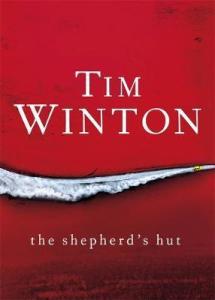
Well, Tony Abbott may have just discovered his local Little Library, but I’m very well aware of mine- both of them- one in the park and the other outside Open House, a local drop-in support centre. They have done dreadful things to my already groaning bookshelves. But how could I go past a brand-new, never-read, hard cover copy of Tim Winton’s recent book The Shepherd’s Hut?
The thing that strikes you about the book is the strong, confidently-written voice of Jaxie Clackton, young runaway who is fleeing his brutal father and the consequences of an accident. In fact, this is the only voice that we hear for nearly half the book, which is quite an achievement (and one that Alice in Alice in Wonderland didn’t appreciate- the dearth of pictures or conversations in a book). The full picture of Jaxie’s life emerges only slowly: both what he is running away from, and what he is running to. Meanwhile, Jaxie bashes his way through the hostile Western Australian landscape, until he comes across an old deserted hut.
Jaxie is rough, crude but not a bad kid. When he meets Fintan, who seems to be some type of defrocked priest, he is wary of him, although Fintan seems to take Jaxie as he finds him. The book is violent and seeped through with twisted masculinities. I found myself sitting up late to finish it and when I went to sleep, I was disturbed by the ending.
After my early love affair with Tim Winton with Cloudstreet (on the page, of course) I haven’t found another of his books that captured the magic of the first Winton I ever read. I have found myself tiring of his books about beaches and waves, and broken people. There are broken people in this book too, but this book comes closest, I think, to Cloudstreet in terms of narrative control and voice. So thank you, who-ever put it in the Little Library, and now I shall return it so that someone else can enjoy it too.
Russia if you’re listening (ABC) Well, that was annoying. The second series of Matt Bevan’s podcast series about the Trump Russian connection was just about to go to air, and then the summary of the Mueller report was released. In Episode 1, he talks about the Mueller report, Episode 2 looks at Maria Butina, the Russian spy who infiltrated the NRA (very relevant here in Australia at the moment) and Episode 3 looks at the music promoter Rob Goldstein who seemed to be involved at all the sticky moments, but now denies it all. Matt Bevan’s not leaving this story alone, and it unfolds in real time. This second episode seems rather too-overproduced, with little music stings and sound effects. It doesn’t need them.
Conversations (ABC) Richard Fidler is back! In ‘The Secret Life of the Beauty Queen Killer‘, he interviews Duncan McNab, ex-detective, crime writer and author of The Snapshot Killer, the story of serial killer Christopher Wilder who murdered at least twelve people, possibly more, in Australia and America. A readiness to give him the benefit of the doubt, the financial and family resources for good lawyers, poor policing and the prejudice against the testimony of young women, meant that he killed for over twenty year. Rather graphic, and very disturbing.
Standard Issue This podcast was founded as an online magazine by one of my favourite comedians, Sarah Millican. It ranges across many themes, although it tends to have an emphasis on female performers. Episode 192 Bedrooms of London interviews the curator of the Foundling Museum where between February and May 2019 they have had an exhibition of photographs of the ‘bedrooms’ (many are actually just single living rooms) of children living below the poverty line in London today. You can find out more about the exhibition – including a sample of the photographs) at the Foundling Museum site and a Guardian feature on the exhibition here.
The History Listen. An excellent podcast here, based on the book Blue Lake:Looking for Dudley Flats, which I reviewed here last year. This is not your normal author-interview; instead it is a dramatization of some of the events, interspersed with current day interviews. It’s excellent, and check about the History Listen webpage too, where you can find a photo of Blue Lake from 1869. There’s a good article by the author here too, with lots of photos.
The History Listen on ABC RN has a good podcast based on David Sornig’s excellent book Blue Lake which I reviewed here late last year. This podcast doesn’t so much re-tell the story as bounce off it creatively, and it’s well worth a listen.
I was planning my trip to Colombia, so I decided to seek out some books set in Colombia. This book, which won the Alfaguara Prize in 2011 (one of the most prestigious literary prizes in Spain) and its translation by Anne McLean won the 2014 International IMPAC Dublin Literary Award. So, it came bearing a hefty reputation!
It thoroughly deserves it. The writing and the translation flow seamlessly, as it shuttles between the drug violence of the 1980s and 1990s Bogota, when the book was set. A rather aimless law professor, Antonia Yamarra strikes up an acquaintance in a billiard hall with ex-con Ricardo Laverde. Standing together in the street outside the billiard parlour, they are shot at. Laverde dies, and Yamarra is injured both physically and psychically. He becomes obsessed with Laverde’s story, and meets up with Laverde’s estranged daughter. Through her he learns that Laverde had been a drug-mule pilot during the 1980s, and she shares with him a cassette tape of a black-box recording that ties together Laverde’s earlier crime and the death of Laverde’s wife. I won’t say any more, because if you read it- and I hope you will- it will spoil the story.
I found this book almost un-put-downable, and the language of both author and translator just swept me away. It’s a page-turner, but it’s also a reflection on fate and death, the ripple effects of violence, and the ease and speed with which events can veer off into other directions. It’s also a sobering look at the violence in Colombia during the 1980s and 1990s, set in a time where the narrator is oblivious to the violence yet to come. At the end of it, I found myself googling the events of the novel, and felt sobered to realize that, while fiction, it is grounded in fact. Perhaps not the best pre-holiday reading, but certainly an excellent book that fully deserves all the praise it garnered.
Sourced from: Yarra Plenty Regional Library
Read because: I was going to Colombia (not exactly reassuring reading, I must admit)
Revolutions Podcast: Still the Mexican Revolution goes on. With my recent interest in WWI in Australia, I’ve been alert to the connections between the Mexican Revolution and WWI. Then there were suggestions in some quarters that Mexico should side with Germany against America. Did you know that trench warfare was used in quelling the Mexican Revolution too? The rebels decided that they’d attack the trenches at night, only to be dazzled by floodlights that lit the trench complex.
New Books in Latin American Studies. I’ve only recently subscribed to this podcast. Given the cost of academic books here in Australia, it’s highly unlikely that I will read any of the books discussed, so listening to the authors talking about their books is a good second choice. In a cross-over with New Books in German Studies, historian Daniel Stahl talks about his new book Hunt for Nazis: South America’s Dictatorships and the Prosecution of Nazi War Crimes. It’s a wide-ranging transnational history, dealing with not only South America but the differing and changing responses to calls for extradition over time. For example, during the 1970s when North American interest in the Holocaust was increasing (e.g. film, an second-generation preparedness to talk about what their parents could not) and their demands for extradition of war criminals were becoming louder, many South American countries were led by military generals.
Rear Vision. While I’m in South and Central America (in my head at least, now that I’m no longer there physically), the always excellent Rear Vision has a good podcast that sums up the last twenty years or so of Venezuelan history for a quick-catchup, and another very good podcast explaining how the neo-liberal politics championed by the United States have contributed to the ‘caravan’ of economic and political refugees fleeing Central America.
I read this book during a week when yet another young girl was raped and murdered walking home in Melbourne. As in 2019, so too in 1930. However, I don’t think that Mollie Dean’s rape and murder elicited the same outpouring of anger and grief in 1930 and at least in 2019 we have been spared the prurient exposure of the flaws of the victim, as distinct from the perpetrator.
Mollie Dean was violently raped in a St Kilda laneway at the age of twenty-five. She was intelligent, sexually active and she flitted around the edges of the bohemian scene in 1930s Melbourne. There is little hard evidence about her: just a nondescript photograph, a few bureaucratic reports, and some letters. And yet she has lived on, through the artistic and academic world of which she was only marginally a part. She was painted by the man who was one of the police suspects. Her story was incorporated into George Johnston’s My Brother Jack, which has in turn appeared on stage and screen. Other contemporary writers have taken up her story as well: she featured in a play Solitude in Blue and has recently been fictionalized in The Portrait of Mollie Dean.
Mollie is the focus of the book, but it is also a portrait of the artistic scene in Melbourne, with many familiar names: Max Meldrum, Mervyn Skipper, Justus Jorgensen, Nettie Palmer. Being a north-eastern outer suburban girl myself, I was drawn to the Eaglemont and Montsalvat settings, both being familiar to me.
Gideon Haigh’s treatment of Mollie Dean is non-fictional, and there is a long list of sources in the back. It is a very discursive account – rather too discursive – with every possible connection followed up in Haigh’s network of Melbourne bohemianism in the 1930s. As a result, an index was sorely missed as you found yourself wondering whether you had encountered a name previously or whether it was just another addition to the ever-burgeoning list of contacts and connections.
The Massey lectures seem to be the Canadian version of Australia’s Boyer Lectures. The speaker is given a wide scope when they are invited to talk about “whatever they want”. Jennifer Welsh, as a political scientist, chose to speak of The Return of History. She is referencing Francis Fukuyama’s bold declaration in 1989 of ‘The End of History’ and his book, as she says, is the “dancing partner” to her lectures. Each lecture is conducted in a different Canadian city, taking her across the country over the series.
Jennifer Welsh is Professor and Chair in International Relations at the European University Institute in Florence (Italy) and a Fellow of Somerville College, University of Oxford. From 2013 until 2016, she was the Special Adviser to the United Nations Secretary General on the Responsibility to Protect.
In the first lecture “We Were Wrong“, she points out that liberal democracy has had an uneven trajectory, starting with the French Revolution and American War of Independence, with little of the inevitability of success that Fukuyama suggested. Before WWI, she says, there were only ten democracies; they doubled post-WWI but decreased again in the 1930s when the very idea of liberal democracy was questioned. By 1941, there were only nine again and the world looked to be on the edge of “a new dark age” as Churchill put it. The numbers of democracies quadrupled in the 1960s with decolonization and by the late 1980s, when Fukuyama made his bold claim of the “end of history”, half of the world’s population could be said to be living under democracies. However, from the viewpoint of 2016 (and this viewpoint has been oft-repeated since, and indeed intensified), democracy is in trouble. She sees that the world is divided into two groups: a liberal democratic core on the one hand, and on the other a large portion of the world “where the sun of history still shines”. They are separated by a gulf of incomprehension. She cautions us to recognize that liberal democracy was not inevitable. Indeed, she argues, history is back with a vengeance.
In the second lecture ‘The Return of Barbarism’ she argues that while history is returning, it is with a modern twist, exemplified by the IS’ use of swords to behead, similar to in medieval times, and the twenty-first century use social media to distribute that same beheading. ISIS, she suggests, is a product of 21st century interventions in the Middle East, and its spread is rooted in the failure of the Arab Spring. We have seen such things before. She draws parallels between the influx of foreign fighter to ISIS with the bolstering of Republican fighters in the Spanish Civil War, and she reminds us that some of the siege footage coming out of Madaya in Syria evokes the Siege of Leningrad during WWII.
“The Return of Mass Flight”, the third lecture, examines the question of refugees. She points out that in 2015, there were 65 million forcibly displaced people, the highest number in history. One in 113 people was either a refugee, asylum seeker or forcibly displaced. She goes through the development of the UNHCR (which was expected to last only three years) and the creation of the Refugee Convention, and asks ‘What is so different about today’? She points to four things: first, that it is quantitatively different; second, Europe’s response of fences and walls; third, the multiple motivations for immigration and fourth, the reliance on new technology exemplified by images of refugees with smart phones, which tends to undercut our idea of what a refugee should look like.
‘The Return of the Cold War’, Lecture 4, starts off with the Ukrainian Revolution of 22 February 2014 – something that felt momentous at the time, but soon began following a familiar trajectory. At the time of her lectures (2016), events in Syria, the emphasis on power supply through gas lines, and the revival of espionage all seemed to be following an old story too. However, she sees at least three differences between the original Cold War and current events. First, we do not see now the deep ideological challenges that underpinned the Cold War in the 1940s and 50s. Second, the original Cold War was global in scope, whereas now it is in the geo-political realms. Third, the status of both the USSR and US is different. Still, as she warns, it would be possible to get back to Cold War status again, and both sides need to look at their own actions if we’re to avoid that. Instead – and here’s her ‘history but with a twist’ theme coming through again- what we are seeing now is a modern hybrid of ‘sovereign democracy’ where elections are used to delineate the lines of power, and appeals to nationalism insulate the government from outside influences e.g. migration and foreign interference. She draws parallels between the Allied triumphalism at the end of WWI, and the smugness of the 1989 fall of the Berlin Wall.
In the fifth and final lecture, ‘The Return of Inequality’, she says that she’s going to return to the local. Actually, each of the other lectures has an intermission where she speaks to someone local from the city in which the lecture is delivered (e.g. someone of Japanese heritage who was interned during WWII, a director of a refugee centre etc). In spite of her intention to ‘go local’, she directs a lot of attention to the United States, and the increase of inequality world wide. She notes that in this 21st century ‘Gilded Age’ (and she references the original Gilded Age), inequality is bad for society and bad for the economy, it can easily morph into inequality of opportunity, and it has the potential to turn into political power and political influence. She notes that democracy has always been self-correcting and that it has always been anxious. Francis Fukuyama, whose ‘End of History’ thesis sparked her response in this lecture series is still optimistic, but she is more ‘Chicken Little’ than he is.
I enjoyed this lecture series. It was a bit frustrating that I couldn’t download them, so I only listened to them at home through wifi (although I could have paid for them on I-tunes). Still, what a wonderful thing that a lecture series can be accessed months, nay years! after it is delivered, on the other side of the world no less!
2010, 887 pages – yes, 887 pages. Translated from the Spanish by Nick Caistor
Oooffgghh!! That was a long read! I was about to write that I rarely read big chunky historical fiction books but on reflection, that’s not true. I loved Kristin Lavransdatter, I eagerly await the final volume of Hilary Mantel’s Thomas Cromwell trilogy, and I really enjoyed Amitav Ghosh’s Ibis trilogy. Perhaps it’s that I often read trilogies and suchlike as they are released, several years apart. But I read this book all in one gulp.
I heard about it from a guide who took me on a historic walk in Cordoba last year, and I very much enjoyed reading about places that I had been in Granada, Seville and of course Cordoba.
It is set in 1564, long after the reconquest of Spain by the Christian Kings. However, as we see all too often in the midst of the sectarian wars that still afflict us, mere conquest is not enough to expunge the beliefs, stories and world view of a conquered people. The Islamic Morisco people in 16th century Spain are defeated, but restive, and uprisings erupt across Al Andalus, put down violently with massacres and enslavement on both sides.
Hernando is the son of an Arab woman and the Christian priest who raped her. His stepfather despises him, and he kidnaps Hernando’s one love, Fatima, and takes and mistreats her as a second wife to spite him. He is shunned by the Christians who educate him into their beliefs, and he secretly visits Hamid, an old teacher who educates him into the Islamic beliefs. These two streams of belief, which he can call on when he needs to, mean that he is distrusted by both sides as he moves between the two cultures.
It is his facility with both Christianity and Islamic that drives him to a project to unite the two faiths through the figure of Mary, who is revered by both traditions. I found this part rather tedious and I’m not sure that it was really necessary to the story. But overall, it is a rather driven narrative, which barely takes a breath. Just when you think that things are about to be resolved, yet another twist occurs…and hence the nearly 900 pages.
I hadn’t heard of this book, which is written by a best-selling author. I was surprised for a moment to find that Lisa at ANZLitLovers had read it (until I remembered just how widely she reads) and her review is much more detailed than mine. I wasn’t even sure if it was written by a male or female author, but after reading the sex scenes with too much throbbing manhood for my liking, I decided that the author must be a man. I was not wrong.
To have the book recommended by a Spanish speaker, keen to show the beauties of her cities, is no small thing. It complicates the easy historical concepts of ‘conquest’ and ‘reconquest’, and I very much enjoyed the descriptions. When I was told about the book, I was reassured that I’d be able to find it in translation which is just as well. I doubt that I’ll live long enough to translate a book of nearly 900 pages in Spanish!
It’s a pity that Keira Knightly was case as Colette in this movie. She’s too well-known and I was consciously aware of that throughout most of this movie, except for one striking scene where she becomes very angry. Dominic West was very good, and disappeared better into the character. I must confess to never having read any of her work, and really knew little about her. Still, an interesting take on celebrity and marketing in the literary world of a century ago.


 Conversations (ABC) Richard Fidler is back! In ‘