Category Archives: Uncategorized

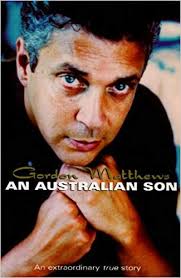
‘An Australian Son’ by Gordon Matthews

matthews_australianson

1996, 230 p.

There are spoilers in this review

In his short disclaimer about” changed names to protect identity etc.” at the start of this book, Gordon Matthews writes:

This book was an act of catharsis. I wrote it to make peace with myself.

The motivations for writing a memoir are many and varied, and I suspect that ‘catharsis’ is quite a common one. However, I’m not sure that all catharsis needs to be put into print. I closed this book feeling complicit and somewhat sullied, and I wondered why Gordon Matthews published this book.

At one level, I can understand it. Identity, or the search for it, is one of the touchstones of modern life. In Australia,  there is heightened awareness of the Stolen Generations of indigenous children after years of Royal Commissions. In this book, with the small black and white photograph on the back cover of a cheeky, curly-haired boy who certainly looks aboriginal, we think that we are reading the story of an adopted child who learns later in life that he is part of the Stolen Generation. But that’s not what happens (and here’s the spoiler, so look away now!). Adopted by a middle-class white family; teased by his private school ‘friends’ who call him ‘Abo’; conscious always of his difference, he is encouraged by an Aboriginal Liaison Officer to apply for a university scholarship and eventually gains a designated position as Australia’s first indigenous diplomat. Then he finds out the truth: that his father is Sri Lankan, not Aboriginal, and his whole identity falls apart. Although his Aboriginality was not a deliberate hoax, he knows that he cannot continue to claim an indigenous identity that he does not hold.

I was slightly surprised by his telling of how he came to embrace  and be embraced in what he thought was his own Aboriginality.  It seems at one remove from the broader Aboriginal community, seeming to be based mainly within the university and bureaucracy. Is this because he is in Canberra, perhaps? I’m not sure quite when the actions in this book took place, and maybe things have changed. As I understand it, indigenous identity involves both family connections and genetics (rather ironic given how ‘blood’ ratios have historically been used as such a weapon) and acceptance by the community. It is only near the end of the book, when he has admitted that he is not indigenous, that his relationships with the community come into sharper focus.

Secure and happy enough with his adopted parents, it is his search for racial identity in particular that impels his search to find his birth parents. He is curious about them, but not as individuals in their own right, but as the key to his racial understanding of himself. He eventually finds them in America. After giving him up for adoption, they married and went on to have other children. Gordon finds  not only both parents grieving their relinquished first child, but also blood siblings who have been completely unaware of his existence.

The relationship with his birth mother was tense, despite his parents’ joy at finding him and embracing him as part of their family. Contact between him and his family cooled. His birth parents did not want him to publish this book, and it was at this point that I felt I wanted to drop the book from my hands. This was such a fragile relationship, and he was asserting his right over his own story at the risk, I suspect, of alienating and losing this new family that he had found on the way to discovering his racial identity. Pigheaded? Self-sabotaging? Selfish?

The book raises complex questions about identity, race and family. There is a distance in the telling, both at an emotional level and in the slightly stilted language. Whatever he might have been as a diplomat, Matthews is not a ‘natural’ writer.

I can find nothing on the internet about what happened next to Gordon Matthews, or his family.  The silence is a little unnerving. I have no idea how the publication of this book was received by his family at the time, and I wonder if, more than 20 years later, he would say that it was worth it. I guess I will never know.

My rating: 7

Sourced from: Council of Adult Education. It was the June book for my bookgroup.


Movie: Peterloo

I was rather disappointed in this film. It felt like a clunky, poorly-written stage show, with  buffoonish parodies of the villains. It was a very wordy film, probably because much of the speechifying was taken from the orations at the time and, as one of the characters says, “I don’t know what you’re talking about”.  Many of the working-class characters felt like parodies- as if they were in a Monty Python movie.

However, it wasn’t all bad. The approach towards the protesters was more nuanced, picking up on the differences of political strategy and levels of education, and the tension leading up to the Peterloo massacre was well held. It was odd that there was no explanation of the fall-out from the massacre – perhaps because only 18 died? – and the consequences were political in terms of more repression, which doesn’t fit well into a “what happened next” paragraph?

I think I just expected more from a director of Mike Leigh’s stature.

My rating: 3/5

Movie: Destroyer

Counting up on Wikipedia, Nicole Kidman’s filmography comes out at more than 60 movies.  She can be forgiven, then, for the occasional dud. But Destroyer isn’t a dud, and she is brilliant. Told in present day, where Kidman plays haggard, dysfunctional cop Erin Bell, the film flashes back where she plays that same cop some 30 years earlier, operating undercover in a gang that holds up a bank with tragic consequences.  There’s a fair bit of violence in the film, both in the present day and flashback sequences, and rather too much of ‘old’ Kidman staring impassively at the camera. The makeup is excellent, as ‘young’ Kidman doesn’t look all that different to how she looked 30 years ago in her early films.  Certainly, there’s little of the cool sophistication of many of the characters she tends to play now.

My rating: 4 stars

I hear with my little ear: Podcasts 16-25 May 2019

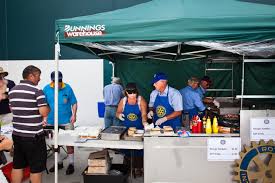
sausagesizzle

Bunnins Sausage Sizzle Wikimedia

History Listen. We’ve just had an election here in Australia, and just about the only commentary that I can bear to listen to at the moment is the History Listen’s ‘Unauthorized history of the sausage sizzle.’ More than just the democracy sausage, it includes Lions and Bunnings sausage sizzles and a brief history of the humble snag.


Somewhat more serious is their episode ‘Escape from Iran‘ where the narrator tells her mother’s story of escaping from Iran after the revolution on account of her Baha’i faith, and the family’s life in Australia.

Grenfell_Tower_fire

Grenfell Tower Fire Source: Wikimedia

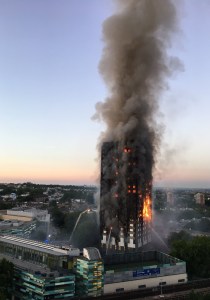
The Documentary (BBC) This is a wonderful trove of podcasts! Flat 113 at Grenfell Tower is a wonderful (if rather distressing) piece of story telling about the fire that engulfed the 14th floor of the Grenfell Tower building in London. Taking just one floor (and yes, I know that Flat 113 was on the 14th floor, even though the numbering suggests otherwise- just a symptom of the questionable renovation of this public housing), the podcast traces through the sequence of events and mis-steps that led to several deaths in Flat 113.

Order!Order! is a look back at the Brexit question. Somehow 31 October is drawing closer again and still the whole sorry saga goes on.

Bolivia’s Mennonites, Justice and Renewal tells the story of the extremely conservative Mennonite communities who have established themselves in Bolivia since the 1920s. Almost Amish in appearance, they speak a form of low German, and they eschew modernity (although, as the documentary points out, there are now break-away communities which take a more liberal and modern approach).  In 2009 more than 100 women and children reported rapes within the community, for which a group of men were convicted, but within the traditional Mennonite groups there are attempts to have the sentences overturned.

Slavery’s Untold Story. Did you know that the Cherokees held slaves? After the Civil War, these slaves were liberated as ‘freemen’, but in recent years as people of Cherokee origin are encouraged to reconnect with their culture, a document from the 1860s is crucial in establishing claims to be admitted as full members of the Cherokee tribe. The waters are muddied by the casino money and entitlements that attach to Cherokee identity, and prejudices against African American appearance amongst people who also hold Cherokee heritage.

99% Invisible. From the 1950s up until the collapse of Communism, Russian theatre-goers were exposed to a steady diet of Bollywood movies. Part of it was that the Russian government wanted an alternative to Hollywood, but this documentary suggests that there might have been cultural affinities between Russia and India as well.  From Bombay with Love is well produced and interesting.

New Books in History  The podcasts here are very low-tech, and involve a historian talking about their recently released book. In Reforming Sodom: Protestants and Gay Rights, Heather R. White looks at both the liberal, reforming Christianity in the UK and US of the 1970s onwards (think: Unitarian Universalism and ‘Love Finds a Way’; the churches’ response to Stonewall etc) , and conservative Pentecostal Christianity of more recent decades (think Israel Folau), and their differing responses to homosexuality.


I hear with my little ear: Podcasts 8-15 May 2019

Forest 404 (BBC) I don’t know quite how I got onto this, but somehow or other it ended up on my phone. I don’t even quite know what it is: I think that there are stories, (of which this Episode 1 is the first) that are linked to soundscapes and related talks. Anyway, this first episode is set in the 24th century when a librarian, Pan, is charged not with conserving but destroying sound files from the 21st century, which are taking up too much storage space. After the Cataclysm (which waits to be explained), data storage space was recognized as finite, so all the sounds of the past, e.g. a Barak Obama speech, the words when man first walked on the moon etc, are being expunged. Then Pan comes across a recording of a rainforest, and even though she doesn’t know what it is, she finds herself drawn towards it.  I don’t know if I’ll persist with this, but the concept of ‘sound’ as artefact is ideal for the podcasting medium.

99% Invisible. Pharmaceutical companies direct their energies towards diseases where they are going to make profits – big profits. This program, Orphan Drugs is actually from November 2018, and it looks at the drugs that pharmaceutical companies decide not to continue manufacturing, even though they may have been life-changing for a small number of people. It tells the story of Abbey Meyers, whose son suffered with Tourette’s Syndrome, who finds herself as an advocate for orphan drugs, trying to lobby government and drug companies to continue to make these no-longer-lucrative drugs available. Of all people who stepped in to help with Jack Klugman and his brother, from Quincy M. E. (remember that?) who used the program to highlight the issue. But, as Abbey Meyers, be careful what you wish for. The resultant Orphan Drugs legislation, which she spent decades lobbying for, has had unintended consequences.

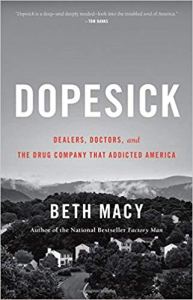
dopesick_macyConversations (ABC) And while we’re on the subject of Big Pharma, the estimable Richard Fidler interviewed Beth Macy, the author of Dopesick: Dealers, Doctors and the Drug Company that Addicted America.  In ‘Taking the Pulse of a Dopesick Nation‘, she tells the story of how drugs like oxycontin etc. were falsely marketed as being slow-release and therefore non-addictive, as the memory of the dangers of prescription medicine receded and ‘pain’ began to be seen as a treatable condition in its own right again in the 1990s.  The information that came with these prescription drugs warned not to break the coating of the pill, because, as it happened, it was only the coating that made them slow release. Ironically, she sees the only solution in treating addiction as a medical problem and using other drugs as a way of treating the ‘dopesick’ feeling after coming off these drugs, because abstinence and all-or-nothing thinking just doesn’t work. Very interesting and makes you disgusted at the lack of morals of Big Pharma.

While I was there at Conversations, I also heard Susan Orleans (who wrote The Orchid Thief) telling the story of the burning of the Los Angeles Central Library in 1986 – something that certain escapes my memory. Did you know that when books are wet, they either need to be dried out within 48 hours or frozen? That’s how thousands of books ended up in meat storage freezing facilities for years. You can hear it at ‘When the Library Burned

And although there was nothing particularly new in it, ‘How a milkmaid with cowpox changed history‘ was quite interesting in that it brought together a lot of stories about disease and vaccination.

Background Briefing The Night Parrot is the Holy Grail for bird watchers, and there have been a number of programs on the ABC celebrating the ‘discovery’ of the Night Parrot by bird watcher John Young. But in this program ‘Flight of Fancy: the mysterious case of the Night Parrot’, there are now real questions about the veracity of this ‘find’, and I can only assume that Our ABC did its legals before broadcasting this program, made by Ann Jones from ‘Offtrack’.

The Documentary BBC World Service Well, this was depressing listening from two very different places in the world. ‘Polands Partisan Ghosts‘ is about the adoption by the far right of the ‘Cursed Soldiers’ who were responsible for murder and arson in the time immediately following the Second World War. ‘India’s Forbidden Love‘ is about inter-faith and inter-caste marriages that are running up against the prejudices of the past, fanned by increased religious/national identity. Poland and India couldn’t be more different, but the rise of intolerance cloaked in nationalism right across the world frightens me.

TV series: I Know Who You Are

For the past few weeks I’ve been transfixed by a 16-part drama on SBS On Demand called “I Know Who You Are”, or in Spanish “Sé Quién Eres”. A law lecturer is found bloodied and dishevelled on a country road, claiming to have amnesia. It then transpires that the blood of his missing niece is found in his car, but he claims no memory of what had happened to either him or his niece.  There is a whole shoal of red herrings in this series, and everyone is horrible. Women, in particular, have very strong roles in the series, and all the characters are unforgettable.  My Spanish class was split over the ending, but I found it satisfactory. Spanish, with English subtitles and well worth spending the time on.

https://www.sbs.com.au/ondemand/program/i-know-who-you-are

Banyule homestead. A good resolution?

I fervently hope that this article is true and that this saga can be put aside for the next thirty years.

https://www.realestate.com.au/news/banyule-homestead-to-be-restored-and-lived-in-after-offmarket-sale/?rsf=syn:news:nca:hs:socref&fbclid=IwAR0CQxjxd33xpzkdfzYD_r8bgFAAB_eCNjnTwbKEuMdqx2MSmEzCvDhtOFs

‘Black Tide’ by Peter Temple

Temple_BlackTide

1999, 356 p.

That’s it. I’m not reading another Peter Temple ever.

In fact, I said that to myself after I had to re-read Truth for my CAE bookgroup earlier this year. I looked back at my original blog post and everything I said there, I say again. Too disjointed. Too much conversation. Too confusing. And definitely not worthy of a Miles Franklin prize.

I’m amazed to find that I’ve read as many Peter Temples as I have. I quite liked The Broken Shore, but by White Dog the appeal had worn off. In the Evil Day was set in Africa, but it had all the same problems (too disjointed, too much conversation, too confusing etc).  He does dialogue well, but why doesn’t (didn’t) he just write plays? At least the speaker is identified in a script and you don’t have to count back to see who’s talking. And who are all these people he keeps bringing in? Or capturing a setting, which he also does well: why doesn’t (didn’t) he just write travel books?

At least Black Tide is a Jack Irish story, and I can see Guy Pearce, the three old blokes at the pub, Cam, Harry Strang and Stan the bartender in my mind’s eye.  Thank God for television, I say. The dodgy betting is here, and the carpentry, and a bit of sex, along with a confusing story about dodgy companies.  But I really have no idea what it was about.

So that’s it. Ned Kelly Awards and Miles Franklin prize be damned. If someone chooses another Peter Temple for bookgroup ever again, I’m just going to say “Nup. I don’t like Peter Temple”.

My rating: 6/10

Read because: ONLY because it was chosen for my CAE bookgroup.

‘The Shepherd’s Hut’ by Tim Winton

winton_shepherdshut

2018, 267 p.

Well, Tony Abbott may have just discovered his local Little Library, but I’m very well aware of mine- both of them- one in the park and the other outside Open House, a local drop-in support centre. They have done dreadful things to my already groaning bookshelves. But how could I go past a brand-new, never-read, hard cover copy of Tim Winton’s recent book The Shepherd’s Hut?

littlelibrary

The thing that strikes you about the book is the strong, confidently-written voice of Jaxie Clackton, young runaway who is fleeing his brutal father and the consequences of an accident. In fact, this is the only voice that we hear for nearly half the book, which is quite an achievement (and one that Alice in Alice in Wonderland didn’t appreciate- the dearth of pictures or conversations in a book). The full picture of Jaxie’s life emerges only slowly: both what he is running away from, and what he is running to. Meanwhile, Jaxie bashes his way through the hostile Western Australian landscape, until he comes across an old deserted hut.

Jaxie is rough, crude but not a bad kid. When he meets Fintan, who seems to be some type of defrocked priest, he is wary of him, although Fintan seems to take Jaxie as he finds him.  The book is violent and seeped through with twisted masculinities.  I found myself sitting up late to finish it and when I went to sleep, I was disturbed by the ending.

After my early love affair with Tim Winton with Cloudstreet (on the page, of course) I haven’t found another of his books that captured the magic of the first Winton I ever read. I have found myself tiring of his books about beaches and waves, and broken people.  There are broken people in this book too, but this book comes closest, I think, to Cloudstreet in terms of narrative control and voice. So thank you, who-ever put it in the Little Library, and now I shall return it so that someone else can enjoy it too.

My rating: 9 (I think)/10

Sourced from: The Little Library in Macleod Park

I hear with my little ear: Podcasts 8-15 April 2019

Russia if you’re listening (ABC) Well, that was annoying. The second series of Matt Bevan’s podcast series about the Trump Russian connection was just about to go to air, and then the summary of the Mueller report was released. In Episode 1, he talks about the Mueller report, Episode 2 looks at Maria Butina, the Russian spy who infiltrated the NRA (very relevant here in Australia at the moment) and Episode 3 looks at the music promoter Rob Goldstein who seemed to be involved at all the sticky moments, but now denies it all. Matt Bevan’s not leaving this story alone, and it unfolds in real time. This second episode seems rather too-overproduced, with little music stings and sound effects. It doesn’t need them.

McNabConversations (ABC)  Richard Fidler is back! In ‘The Secret Life of the Beauty Queen Killer‘, he interviews Duncan McNab, ex-detective, crime writer and author of The Snapshot Killer, the story of serial killer Christopher Wilder who murdered at least twelve people, possibly more,  in Australia and America. A readiness to give him the benefit of the doubt, the financial and family resources for good lawyers, poor policing and the prejudice against the testimony of young women, meant that he killed for over twenty year. Rather graphic, and very disturbing.

Standard Issue This podcast was founded as an online magazine by one of my favourite comedians, Sarah Millican. It ranges across many themes, although it tends to have an emphasis on female performers. Episode 192 Bedrooms of London interviews the curator of the Foundling Museum where between February and May 2019 they have had an exhibition of photographs of the ‘bedrooms’ (many are actually just single living rooms) of children living below the poverty line in London today. You can find out more about the exhibition – including a sample of the photographs) at the Foundling Museum site and a Guardian feature on the exhibition here.

The History Listen. An excellent podcast here, based on the book  Blue Lake:Looking for Dudley Flats, which I reviewed here last year. This is not your normal author-interview; instead it is a dramatization of some of the events, interspersed with current day interviews. It’s excellent, and check about the History Listen webpage too, where you can find a photo of Blue Lake from 1869.  There’s a good article by the author here too, with lots of photos.