Category Archives: Uncategorized

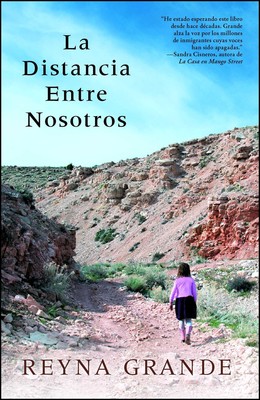
‘La Distance Entre Nosotros’ by Reyna Grande

grande_distancia.jpg

2012,  354 pages

Yes! 354 pages in Spanish! I read this book as part of my Parceros participation with Spanishland School. Our teacher Andrea held a weekly podcast where she would ask questions and discuss one or two chapters, but I fell behind on the podcasts and just kept reading, two pages per night.

The book is probably aimed at Year 7 and 8 kids in American schools. It was written in English by the author, who was born in Mexico and learned English as a second language, and then translated into Spanish.

The author, Reyna, was born in a small village in Mexico and both her parents left in order to work illegally on the ‘other side’ (i.e. America) when she was a very young child. First her father left, then he called for his wife to join him, so the children were left with their paternal grandmother, who because of her clear dislike for the children’s mother, distrusted that they were indeed even her own grandchildren. Their mother returned alone, when she found that her husband was cheating on her, and the children ended up with their maternal grandmother while their mother went back to America with another man.

In Part 2 of the book, their father returns with his new wife and grudgingly takes the three children over the border. A violent and hard man, their lives are still hard and it is only Reyna who breaks free of the poverty in which they are living. Through it all, she desperately wants her father’s approval.

Reading only 2 pages a night meant that Reyna’s long howl of abandonment wore a little thin by the end, but I came away with a much richer understanding of the ‘Dreamers’ and the desperation with which illegal immigrants try to achieve a better life.

The level was JUST right for someone who has Intermediate level Spanish. I generally had to look up about 4 or 5 words per page, which was not enough to slow me down, and I found that I could easily guess many unfamiliar words.  It is well written and poignant- I really enjoyed it.


Challenging myself again…

I’ll be doing the Australian Women Writers Challenge again for 2020, hoping to read twenty books during 2020. I’ll try to read a little more fiction this time.

And while I’m at it, I’ll nominate the same number of books on the Goodreads challenge – sixty- which I achieved this year by the skin of my teeth.

So off I go into 2020…..

Movie: The Nightingale

Yep, it sure is violent. I was forewarned that the first ten minutes were particularly violent, but I didn’t realize that the violence continued throughout the film. It’s a vivid and gritty depiction of 1820s Tasmania, a place steeped in violence and killing.  It’s more than just tricking-up a horror film with historical artefacts: it’s also about powerlessness and dispossession and revenge. I thought that the ending was going to descend into bathos, but the last two seconds saved it from that fate.

Larissa Behrendt has written an interesting review of it.

It’s now down to one showing a day at the Nova, so it will soon disappear.

My rating: 4 stars

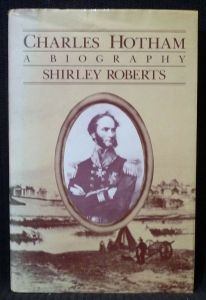
‘Charles Hotham: A Biography’ by Shirley Roberts

roberts_charles_hotham

1985, 201 p.

Even though I’m a historian of Victoria, I confess to drawing rather a blank when it comes to all but the most recent Governors of the state. La Trobe springs to mind immediately, but many of the others I ‘know’ only by things that have been named after them, especially hotels and public buildings.  I was aware that Hotham had taken over from La Trobe, and that he has been characterized as the villain in the Eureka Stockade story.  There’s a street named after him, a pub in Geelong and a mountain… but that’s about all I could have come up with before I read Shirley Roberts’ biography of Charles Hotham.

In her opening pages, Shirley Roberts announces that “Hotham appears as a man who has been most unfairly denigrated”. Clearly her intention in writing this book is to rescue him from this fate.  Of course, historians mount arguments about individuals all the time, making judgements “from the enormous condescension of posterity” as E. P. Thompson put it.  In this case, however, Roberts’ intention to scrub the mud from Charles Hotham detracts from her book as history. She accepts uncritically certain sources and cherry picks from others, and when actions contradict her argument she brushes them off as inexplicable or strange.

However, despite these flaws, Roberts has written what seems to be the only biography of a man whose short 15 month governorship coincided with a political flashpoint in a colony on the verge of receiving self-government.  It starts in a workman-like fashion, with a family tree – the kiss of death for a biography.  Probably the book would be written very differently today, with more emphasis on the networks of empire and the significance of patronage links, and a widening of the focus from white politicians to include protestors’ and women’s forms of influence. But given that we are reading the book we are holding, and not a book as we would wish it written 35 years later, she has captured well the far-flung nature of the British Empire, and the circuits along which colonial authorities and civil servants travelled.

Charles Hotham never aspired to be a colonial governor. He far preferred his naval role, and the command of ships and navy personnel without the complications of representative democracy and colonial elite structures. His work took him to Argentina, where the British Navy at first played a type of peace-keeping role between Argentina and what is now Uruguay, before intervening to protect their trade routes along the rivers that bordered the two countries. After the putative abolition of slavery, he was sent to West Africa (generally seen as a grave-yard posting) to harass slave shipping along the trade routes, especially en route to Brazil. He demanded, and received, loyalty from his crews in an established hierarchy of authority and obedience.

But these very qualities made his posting to Victoria, already seen as a problematic colony, even less appropriate and bound to end in tears. The discovery of gold had led to a deluge of new arrivals, the complete disruption of the bureaucracy, and a crying need for infrastructure. The economy was wobbly, and running at a deficit. In true economic technocrat style, he pronounced and held to hard-line economic prescriptions, announced and implemented without consultation. The colony, like those in the other Australian states, was holding its breath waiting for the legislation for self-government (see Peter Cochrane’s Colonial Ambition) and this return to authoritarian, centralized rule was not likely to please anyone – even those who had craved a more ‘governor’-like presence than La Trobe had cast.

Roberts explains the origin of Hotham’s world-view in terms of his naval background, but uses it to excuse his too-quick turn to repression, and recourse to delay through ordering a Royal Commission (that old standby to gain time). She portrays him as a man surrounded by flawed men, who let him down.

In filling out Hotham’s early career, which she does very well, she draws on a biographical sketch written by Hotham’s sister as a gift to his sister-in-law on their marriage. Although no doubt drawing Hotham in a good light, it has been gift to his  biographer, too. In her analysis of Hotham’s time in Melbourne, she draws strongly on the conservative, pro-Hotham Argus with little reference to opposing newspapers. As an author, she is mounting a pro-Hotham argument, although she does not make it clear exactly what or who she is arguing against.

I was very impressed with her ability to summarize a scenario or event clearly and succinctly, without overwhelming the reader with detail.  This was especially true of Hotham’s time in South America and Africa, which I knew absolutely nothing about.  She is not an academic historian – and the paucity of her reference list attests to this – and her book is more a matter of setting things out, rather than complicating by nuance.

Hotham only governed the colony between June 1854 and November 1855. This short period of time is largely dominated by the Eureka uprising, and Hotham’s role in it. This short, pragmatic book fleshes out his career more fully, and portrays him as more than just the villain of the Eureka rebellion. But Roberts’ determination to rescue Hotham from blame has led her to mount a polemic, rather than write a biography.  The reader should approach this book with admiration at the job she has done, and appreciation for filling in otherwise little known information. At the same time, however, this book needs to read with care and a raised, sceptical eyebrow.

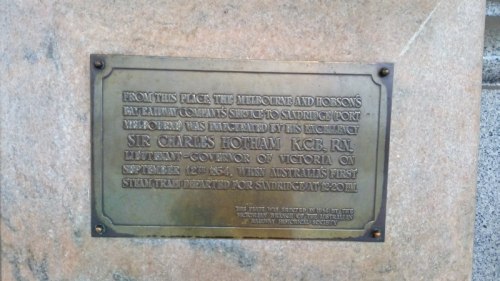
And look at this – I was half-way through the book when I found this plaque at Flinders Street Railway Station!  So he did leave a mark on Melbourne after all!

20191203_182909_small

From this place the Melbourne and Hobson’s Bay Railway Company’s service to Sandridge (Port Melbourne) was inaugurated by His Excellency Sir Charles Hotham K.C.B., R.N. Lieutenant-Governor of Victoria on September 12 1854, when Australia’s first steam train departed for Sandridge at 12.20 P.M.

My rating: 6.5/10

Sourced from: CAE bookgroups. You’ll have trouble tracking it down, I suspect.

AWW2019

I have included this on the Australian Women Writers Challenge database.


I hear with my little ear: Podcasts 17-25 December 2019

annear_nothing_on_TVNothing on TV I’ve just started listening to Robyn Annear’s podcast series ‘Nothing on TV’. It’s great. Annear is a Victorian historian, whose book Bearbrass largely sparked my interest in Melbourne, and she is wry, funny, and quirky. As is this podcast. She draws on the marvellous resources of the online Trove database to chase down odd events, and researches them further. In Episode 1 Enter the Elephant, she takes the story of a tragic drowning of a young boy in Cremorne in 1854 whose body was finally recovered by the elephant at Cremorne Gardens nearby- or was it? She then goes on to a discussion of elephants in 1850s Australia and the phenomenon of the Pleasure Garden. All accompanied by the pop of a champagne cork, and a lovely, broad Australian accent.

RevolutionsPodcast. Well, the revolutionary ‘People’s Will’  assassinated Csar Alexander II in 1881, hoping that it would launch the revolution but it didn’t. All it did was unleash another wave of repression. But by the late 1890s, the stars were aligning for the socialists again. In Episode 10.21 The Socialist Revolutionaries, Mike Duncan identifies four different groups who come under the ‘Socialist Revolutionary’ umbrella, although it’s almost Monty Pythonesque “Peoples Front of Judea” overtones. He talks about Catherine Breshkovsky – what a fascinating life! I wish I could find a biography of her.

In Our Time (BBC) I always thought that the Rapture was an American Evangelical thing, but it originated with Irish Anglican minister John Nelson Darby, who was influential amongst the Plymouth Brethren in England in 1832 and founded the Exclusive Brethren in 1848. He travelled and preached in America, where his ideas about pre-tribulation rapture theory was embraced (i.e. that God would take up the elect and whisk them up to heaven, away from the seven years of tribulation which will end when Jesus returns, ushering in 1000 years of Gods reign on earth). In this program, The Rapture, Melvyn Bragg discusses the Rapture, and its political and theological consequences.  Perhaps not for everyone – it gets pretty hard going theologically, although the second half is more interesting.

Chewy, chewy

20191221_174017

My brother is no Marie Kondo. He finds it very hard to throw anything out, which is why he brought this 45 rpm record back to me yesterday. Yep, it has my name on it. Chewy, chewy? The Ohio Express? Do you even remember that song? We started humming ‘Sugar, Sugar’ until we realized that we had the wrong song, and then we were stumped. What was Chewy, Chewy???

Ye Gods.

In 1968 I received 25 cents pocket money per week. Singles like this cost 99 cents. That’s a month of saving. I have been robbed.

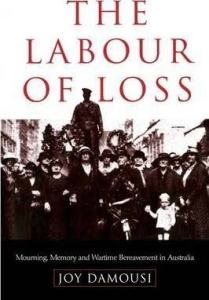
‘The Labour of Loss’ by Joy Damousi

damousi_labour_loss

1999, 163 p & notes

It really wouldn’t have surprised me if this book had been reissued in the last five years, but it wasn’t. It would have done very well in the deluge of books about WWI between 2014 and 2018, and dealing as it does with loss experienced during and resulting from World Wars, it fits very neatly into the  ‘history of the emotions’ school of historical enquiry, which has high prominence at the moment.  But it wasn’t reprinted, and so it remains a fore-runner to much work that has been completed in its wake.

As Damousi says in her introduction

This book examines the stories of those for whom loss in war remained the experience through which they understood themselves, and through which they shaped their lives. After the wars ended, their lives had been irrevocably changed through continuing grief, for the burden of memory would remain with them as they attempted to rebuild an internal and external world without those to whom they had been so fundamentally attached. (p. 6)

Damousi is very conscious that she is dealing with ‘white’ soldiers and the experiences of their families, and mentions in several places that the burden of memory was often disregarded for indigenous soldiers.  A strong gender theme runs through her analysis.

The book is divided into two parts. The first deals with the First World War, the second part deals with the Second World War.

Part I : The First World War

1. Theatres of Grief, Theatres of Loss

2. The Sacrificial Mother

3. A Fathers Loss

4. The War Widow and the Cost of Memory

5. Returned Limbless Soldiers: Identity through Loss

Part II The Second World War

6. Absence as Loss on the Homefront and the Battlefront

7. Grieving Mothers

8. A War Widow’s Mourning.

Conclusion

The themes of the grieving mother and wife are dealt with in both sections, while other themes e.g. soldiers writing to bereaved families, the return of limbless soldiers, or absence from home are dealt with in one section only. I’m not sure that there is a qualitative difference between these emotions and events between the two world wars, and perhaps the decision to locate a topic in one war rather than the other depended on the sources that Damousi uses.

As Damousi points out in Chapter 1, when a soldier died at the front, it was quite common for his friends in the battalion to write to his grieving family themselves. Sometimes bereaved families ‘at home’ drew their son’s friends to themselves like adopted sons. While writing these letters to other families at home, the soldiers were almost rehearsing their own possible death.  Meanwhile, back on the homefront, delayed letters continued to arrive from sons who had been killed , and bereaved families forged their own links with each other.

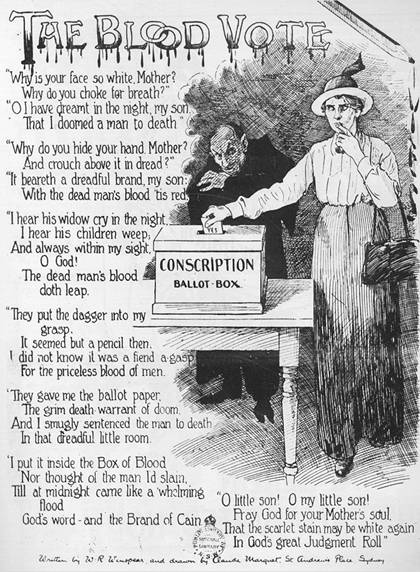
Blood_vote

Wikimedia


Chapter 2 and Chapter 7 both deal with grieving mothers, but in World War I the mother figure had a political as well as familial role. Not only was the mother lauded for “giving up her son” but the Conscription debates drew heavily on the image of the mother both as  the one who sacrificed, but also the one who determined, men’s fates.  ‘The Blood Vote’, for instance, placed the burden of decision onto mothers, rather than fathers or sisters.

Yet when it came to financial support for widowed mothers who lost their sole breadwinner, mothers soon found the limits to compassion for their sacrifice. After being giving a prominent role in the immediate post-WWI period, by the 1930s mothers found themselves shunted to the side of parades and their pensions became increasingly inadequate over time, especially when additional payments were granted to widows but not mothers.

In the World War II section on mothers, Damousi makes similar observations, drawing on the diary of Una Falkiner, whose son died in a plane accident in September 1942, and Hedwige Williams whose son  Charles Rowland Williams died in Germany in May 1943. This chapter -, shaped perhaps by the sources available? – seemed to me to have a deeper emotional timbre than the corresponding WWI chapter.

Chapters 4 and 8 deal with war widows. What is common to the experience in both wars was that the war widow tended to become public property as her lifestyle and life choices were judged by others to determine whether she qualified for a widow’s pension. It became rather unedifying as neighbours, other widows and mothers informed on those who they felt were ‘undeserving’. Again, in relation to the Second World War section, the same themes recur in the experience of women in the two wars, but in Damousi’s account she draws more heavily on a particular source – in this case, Jessie Vasey, the widow of General George Vasey who died in an Australian plane crash when he and several other high-ranking defence officers died near Cairns. She channelled her grief into political and charitable action for war widows but, once again, after the immediate post-war years, women found themselves and their sacrifices pushed aside.

The correspondence between the Vaseys also features strongly in Chapter 6  ‘Absence as Loss’ where Damousi  draws on Vasey’s letters back home to illustrate the yearning for domesticity expressed in much wartime correspondence. Interestingly, I have just finished listening to an excellent podcast series called Letters of Love in World War II, where a British couple range over philosophy, yearning and domestic trivia in their 1000-letter correspondence. Again, it is perhaps not so much a qualitative difference between the two wars, as a question of sources.

The depth of sources has possibly also influenced Damousi’s decision to deal with fathers’ grief in World War I, and not in World War II. In Chapter 3, ‘A Father’s Loss’ she examines the extensive archive of John Roberts, an accountant with the Melbourne Tramways Board, who lost his son Frank on 1 September 1918 at Mont St Quentin. Perhaps there was a particular plangency in losing a son so close to the Armistice; or perhaps the almost-obsessive pursuit of every possible way of documenting and making contact with those who may have seen, or been with, his now-departed son reflected Roberts’ own personal approach to traumatic events. In either case, Roberts’ correspondence is a rich and complex archive of grief for the historian.  More generally, however, fathers maintained a more prominent public part than mothers and widows in commemorating their sons through political organizations and they leveraged their ability to influence policies.  In the Second World War, however, fathers (many of whom had served themselves in World War I) found that the reactivation of war challenged their ideas of patriotism and their own earlier sacrifice. They often found themselves harking back to their lost pre-WWI world, which they had been unable to secure.

Of course, World War I and World War II was interspersed by the experience of the Depression. It forced hard decisions about sacrifice and worth in finding and holding scarce employment. As Damousi points out in Chapter 5, initially there was strong pressure for governments, councils and private employees to offer jobs to returned WWI soldiers, and particularly soldiers who had been injured. However, when jobs became scarce,  returned men without injuries were preferred employees, and war widows were expected to yield their jobs to returned soldiers.

I’ve been thinking a lot about the title of this book.  I’m not sure if the loss that she mentions here involves “labour” as such, although it certainly was a life-changing event for those who were left. But then I find myself thinking of the title of Shakespeare’s play “Love’s Labour Lost” which to me has its echoes in this title. For, without actually spelling it out in her title,  what comes through in Damousi’s examination of memory and grief, is “love”.

AWW2019I have included this on the Australian Womens Writers Challenge database for 2019.

Source: La Trobe University Library


Cuba’s National Art Schools

In the movie Yuli, the young Carlos Acosta stumbles on the abandoned National Art School on the outskirts of Havana. When I saw it in the film, I recognized what it was from an episode of ‘News in Slow Spanish’. In that episode they talked about these stunning, abandoned buildings, but being a podcast only, I didn’t realize just how incredible they are.

Loomis_school_ballet-small

By DuendeThumb – Donated to Creative Commons by author John Loomis, CC BY-SA 3.0, https://commons.wikimedia.org/w/index.php?curid=14906296

Started in the early 1960s after the Cuban revolution on the site of a Country Club golf course, the Cuban government drew on the skills and vision of international architects to design a school for the arts that nestled into the curves of the former golf links.  But this sinuous, visionary architecture did not conform at all to the prefab, concrete architecture of the Soviet Union, which increasingly dominated Cuban architecture, and they were never finished.

Loomis_school_music

By DuendeThumb – Donated to Creative Commons by author John Loomis, CC BY-SA 3.0, https://commons.wikimedia.org/w/index.php?curid=14906270

They were abandoned, and despite being put on the 2016 World Monuments Watchlist, two of the buildings are now close to collapse.  The movie Yuli is correct in that dancer Carlos Acosta wanted to restore them, but that caused controversy because it was seen as a form of privatisation by stealth.

In the most recent article that I could find (from 2018) it would appear that the Getty Foundation granted $195,000 for a project to conserve the site. (I wonder if that is still proceeding, given Trump’s attitude towards Cuba? And Cuba’s attitude towards America, as well)

I found a fascinating essay called Reading the Future of Cuba in its Abandoned Art Schools, which describes the background to the project, its use of space, and the role of the crowd in revolutionary spaces.

And here is a video, which starts off with very stirring Russian music, but then moves to a documentary about the construction of the schools. It’s in Spanish only, but if you turn on the subtitles (also in Spanish), you’ll probably be able to follow it.  It’s fascinating.  If I go back to Cuba someday, guess what I want to see.


‘The Great Irish Famine: A History in Four Lives’ by Enda Delaney

Delaney_Irish_Famine

2012 (under the title ‘The Curse of Reason’), 2014, 235 p. & notes.

Enda Delaney finishes his book with the death of Michael Collins, aged fifty, by the side of the road on 23 November 1850. This isn’t the famous Irish Michael Collins: instead he is an otherwise unknown man who, dying of hunger, was taken into a house. The priest was sent for, and he died on the floor.  He comes into historiographical view because of the inquest that was held into his death. That is one of the problems with writing about the Irish Famine: it can be writ large because such huge numbers were involved but when you come down to individuals, it’s harder to find them. The reality is, as Nobel Laureate Amartya Sen wrote, starvation ‘is the characteristic of some people not having enough to eat. It is not the characteristic of there being not enough to eat.’ (cited p. 115)  Those people not having enough to eat were overwhelmingly the poor, illiterate and  politically weak.

Books about the Irish Famine are nothing new – indeed, there has been a deluge of them since the 150th Anniversary in 1997. Because of the flow of Irish immigrants to America, Canada and Australia, each of those settler countries has its own Irish famine refugee stories as well. Where this book differs, perhaps, is that it takes a biographical approach to an economic/political event that is usually approached from a wide-angled perspective.  The four lives that Enda Delaney has chosen, because of the limitation of the sources, are not the victims. Instead, they were at the other end of the famine. There is John MacHale, the Catholic Archbishop of Tuam, who at first saw the famine as God’s punishment on his flock for their sins. Over time, he became increasingly critical of the British Government response. There is the radical nationalist John Mitchel, a leading member of the Young Ireland and Irish Confederation movements, who ended up in Van Diemen’s Land for his seditious activities. There is Charles Trevelyn, the assistant secretary to the Treasury, who has often been depicted as the Main Villain because of the policies implemented by the British Government. Finally, there is Elisabeth Smith, the Scottish-born wife of a Wicklow landlord, whose sympathies for the Irish peasantry became increasingly rigid.

The book moves more-or-less chronologically, but the four stories are interwoven with the factual narrative.  He is particularly good on the colonial networks that indirectly linked Elisabeth Smith and Charles Trevelyn, who were both in India at one stage. As events change, so too do people, and you can see the increasing radicalism (albeit expressed in different ways) with John MacHale and John Mitchel; the hardening attitudes of Elisabeth Smith who would otherwise be seen as a relatively enlightened landlord, and the increasingly harsh political medicine being doled out by the British Government wanting Ireland to deal with its own problems.  Even though Trevelyn is seen as the author of these policies, I know through my own work with the Colonial Office, that civil servants in a parliamentary system could not act completely independently.

I always tend to think of 1845 as the Irish Famine year, but in fact it continued right through until the early 1850s. Many of the people who perished died of ‘fever’ rather than outright starvation, although it was severe malnutrition that weakened their whole system. The British Government instituted a system of work-for-the-dole, but this broke down completely when people were just too weak to work. They then insisted that the Irish Poor Law look after the people in the workhouses, rather than have access to British Assistance.

What comes through most strongly is a dogged determination to follow the prevailing economic orthodoxy of free markets and punitive charity which 165 years later still holds sway.  Food was still being exported from Ireland; food imports into Ireland were not allowed to threaten the market; ‘charity’ was grudging and demanded complete abasement.  What did work was soup kitchens, but they were withdrawn prematurely in case people became ‘dependent’. The flood of famine refugees was feared and stigmatized, and landlords took the opportunity to clean-out small landholders by eviction, or somewhat more charitably, emigration schemes.

The power of this book is seeing these politics of ideology, and the politics of resistance being expressed in the words of individuals, and watching their positions harden as the crisis continued.  If you’re looking for ‘getting to know’ these individuals at an emotional or moral level, this is not the book for you. The book does work, however, at the level of personalizing the political. The original title of this book was ‘The Curse of Reason’, and although probably too vague as a title for a publisher, the orthodoxy of the free market and individualism was indeed a curse.  Hard-baked ideology, of any kind, is really not an edifying sight.

You can hear Enda Delaney being interviewed here.

My rating: 7/10

Source: La Trobe University Library


’21 Lessons for the 21st Century’ by Yuval Noah Harari

Harari_21-lessons-for-the-21st-century

2018, 318 p

This is the third book written by Israeli historian Yuval Noah Hariri. His first, Sapiens: A Brief History of Humankind was published in Hebrew in 2011, and translated into English in 2014. His second book, published in 2016, Homo Deus: A Brief History of Tomorrow subverts the idea of ‘history’ to look to the future (a no-no amongst historians). In this third book, he returns to the present and the immediate future with 21 Lessons for the 21st Century.

Historians are certainly getting around! As with The Road to Unfreedom (my review here), it seems that historians no longer restrict themselves to things that have already happened, but are venturing into prediction. I don’t know that I’m particularly persuaded that a historian has any particular skill for prognostication, beyond an awareness of precedence and a span in their view. Hariri is an academic military historian – a historical genre that I am not fond of, but he wanders far from his origins here.

The book itself is divided into five parts. Part I, The Technological Challenge, mounts for me what was the most insightful part of the book, where he marries the broadening provided by Big Data (‘infotech’) and the narrowing provided through algorithms (‘biotech’) to argue that the world will soon have a large “useless” class, which will need to be managed socially and politically. Many of the professions and skills that we assume are based on human insight can, in actually, be reduced to a series of algorithms, and this even extends into the creative sphere, where music, art and film can be tailored to a market ruled by algorithms. (I think of Spotify and how it can easily provided me with a whole afternoon of listening pleasure without me even thinking about it).

Part II The Political Challenge looks at globalisation.  He refutes the idea of a ‘clash of civilizations’, arguing that all 21st societies (with the exclusion of Islamic State) subscribe to the same economic template. Nationalism, religion and immigration all challenge globalisation, exemplified by the current tensions within the European Union.

Part III, Despair and Hope looks first at terrorism and war, but then argues instead for a spirit of humility, especially in advancing ‘God’s’ claims. Although he is Israeli, he holds all religions at a skeptical distance.  Part IV, Truth, examines ignorance and fake news, and the manipulation of political opinions through algorithms and popularism. His final section, Resilience, emphasizes that during the 21st century, people will be exposed to relentless expectations of change that our current education system cannot prepare them for. He finishes what was, for me, a rather limp recommendation of meditation – a  disappointing ending to what was, in places, an insightful book.

This book felt like a series of essays, a bit like a chocolate ripple cake concertinaed together with an introduction and bridging paragraph launching you off into the next essay. I thought that the first two parts of the book were much stronger than the other sections. Even though I am open to deepening my spirituality, his promotion of meditation just felt ‘off’ in this book.

One very sobering thought, though. My grandchild, due in late 2019/2020 has every chance of living into the 22nd century. I really fear for him/her. I don’t think that we’ll learn the 21 lessons here well enough to offer a world better than what we have now.

My rating: 7/10

Sourced from: Yarra Plenty Regional Library.