Puno doesn’t look the most prepossessing town in Peru. Like all other Peruvian cities, it has a Plaza de Armas, and taken from this drone footage, it has more high-rises than I would have imagined. I wonder how they would stand up in an earthquake- do they have earthquakes there? Oh yes, they do- they had a magnitude 7 on 1 March 2019.
But the real appeal of Puno is that it is the gateway to Lake Titicaca. You can do a tour which includes a night on Taquile island in a homestay. I must say, viewing all these videos from the comfort of my desk, that there is a much stronger emphasis on the tourist economy here than other places that I’ve been to. I know that people’s livelihoods depend on the sales they make, but it seems to have such a distorting effect on the economy.
So how would I feel about a homestay? Here’s an interesting article about the experience. I think I’d probably do it- I don’t envisage that I’d be coming back here. Do they speak Spanish, I wonder? Or Quechua?
Would I really subject a 15 month old baby to a 10 hour rail journey? Probably not. But as I’m not really doing this, let’s enjoy the train trip from Cusco to Puno
or if you want a 3 minute video instead (although it is travelling in the reverse direction)
The reality is that if we had gone to Peru in April 2020, we would have had to miss this whole Machu Picchu leg because we were advised that we shouldn’t take 15 month-old Nina to such a high altitude area. But given that we didn’t go…… let’s go now.
You could hike for four days…or you could catch the train. I’d catch the train. There’s a few options, but I think I’d go on the Vistadome with the windows in the roof.
Why are all these people called ‘Cody’ and ‘Rory’? Here’s Cody, rudely interrupted by advertising exploring Machu Picchu. What I liked was how he showed the train trip up, waiting for the bus, then puffing and panting to be one of the first people on the peak (my eyes are rolling). Anyway, he got some good shots.
And a slightly more formal National Geographic video. I just can’t imagine what Hiram Bingham would have thought when he saw it for the first time.
I’m still working up to Machu Picchu- leaving it to last.
Quite close to Cusco are the ruins at Q’enco. It is one of the largest huacas (holy places) in the Cusco region, and like other huacas, it was built amongst naturally occurring rock structures. It is believed that sacrifices and mummification took place there. ‘Q’enco’ or Q’inqu is a Quechua word meaning ‘maze’, but it was the Spanish conquistadors who named it that: it is not known what the Inca actually called it. The name refers to the zigzag channels carved into rock where it is thought that the priests poured the sacred chicha, which they drank during the sacrifices.
Close to these ruins are eucalypt forests- yes, eucalypts! Apparently there are very few native trees left in Peru. Eucalypts were brought from Australia especially during the agrarian reform programs of the 1960s and 1970s. They were first promoted as a source for mine supports, and then as a source for fuel and building materials. They have since discovered that eucalypts dry out the soil and are highly flammable (we could have told them that), and there are now reafforestation projects to replace the eucalypts with Queuña and Chachacomo trees, native to the area.
Well, this is all rather close to Cusco, so let’s venture a little further afield to the Maras Salt Mines, about 40 kms out of Cusco. There are over 5,000 salt ponds, some unused and some owned by families. There is a subterranean spring which is directed into an intricate system of tiny channels that run down onto the ancient terraced ponds, none of which is more than 30 cm deep. As the sun evaporates the water, the salt precipitates on the walls and floor of the ponds.
The ponds are owned communally, and new families tend to get the outlying, disused ones at first. The size of the pond assigned depends on the size of the family. Last year tourists were banned from walking around the ponds because of people throwing contaminants into them, and now they are restricted to an observation deck.
Arequipa is known as the “Ciudad Blanca” (White City) because many of its public buildings are made of a beautiful white volcanic stone. It is the second most-populated city in Peru. It is surrounded by snow-covered volcanoes and it looks stunning. As usual, there is a Plaza de Armas, built on the Spanish template. This one was built in the 17th century and has much more architectural unity than some of the other Plaza de Armas. It’s on the UNESCO World Heritage List.
This video is in Spanish, but you’ll get the idea: (actually, it’s nice clear Spanish)
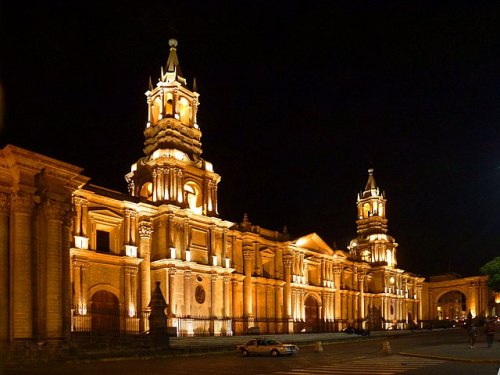
The Basilica Cathedral of Arequipa takes up the whole of one side of the square. It has been damaged several times by earthquakes, and after the most recent one in 2001 the left tower was completely destroyed and the right tower was badly damaged. The altar and the twelve pillars are made of Italian marble, the brass lamp in front of the altar is from Spain and the pulpit was carved in France. The organ was shipped out from Belgium, and is said to be the largest in South America, but it got damaged on the way out and doesn’t sound the best, apparently.
It looks spectacular at night
Source: Wikimedia. Creator: Bruno Locatelli
Historically, the Spanish population retained fidelity to the Spanish crown, even when the independence movement was afoot elsewhere. In 1805 the Spanish crown gave the city the title “faithful” by Royal Charter. It remained under Spanish control under the Battle of Ayacucho in 1824 (which was later than many other cities). There has long been rivalry between Ayacucho and Lima.
Apparently, there is even a distinctive dialect, where they elongate the last vowel of the final word in every sentence. And, unusually for South America, they use the ‘vos’ form of ‘you’ (replacing ‘tu’ and ‘usted). They seem to use ‘vosotros’ too. I’d be doomed: I never bother learning the vosotros form. Life is too short.
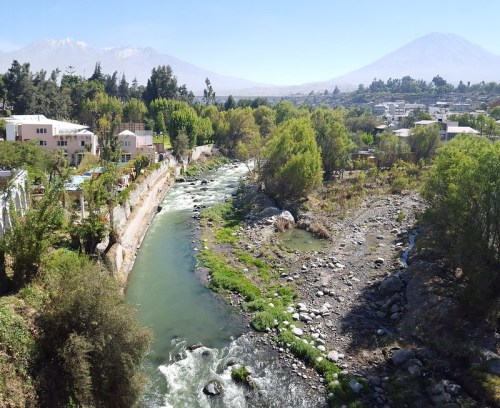
You’ve got to love a city that has the Chili River running through it. Unfortunately, all the city’s waste water is dumped into it.
Flickr: Santiago Stucci
You can go white water rafting on the Rio Chili, about 20 minutes out of the city where I should imagine the water might be cleaner. It advertises itself as being for “all ages” but nah- you young ones go ahead and I’ll mind the baby.
Heather Cox Richardson. Heather Cox Richardson is an American political historian who has been posting daily blogposts about American politics. Like the rest of us, she is shut in at home, so she has decided to do two weekly videos. The first is, I suspect, a quick run through of her American History 101 and a tie-in with her recent book How the South Won the Civil War. The other weekly video is a Q&A about recent political events in America. Given that I never studied American history, I’m interested in her Thursday (US time) American history series. She just sits there and it all spiels out, so she’s obviously done this before. Now that I am actually on a phone plan that gives me plenty of data, I just stream it while I’m walking because there’s nothing to see other than a woman sitting in front of bookshelves. But she’s very fluent, and clear and engaging. You can get the videos through her Facebook page. Excellent listening.
Rear Vision (ABC) Of course, I’m far more interested in Latin American history now that I’m learning Spanish. Rear Vision has a really good podcast from May 2018 that gives a summary of Latin American history in the twentieth and twenty-first century, especially in view of what seemed to be in 2018 a return to right wing government. (It hasn’t completely turned out that way, Jair Bolsonaro notwithstanding). Latin America makes a right turn is an excellent, if somewhat outdated, summary.
Somewhat more recent is the program A destructive mine and a civil war: Bougainville’s path to an independence vote. Well, after the referendum they were supposed to go to the polls to elect their regional council in May this year- I doubt that will happen. And the program Protests in Lebanon, also from November 2019 is about the protests against the sectarian carve up of politics in the Lebanese constitution. It’s strange to listen to these programs now that the world has been turned upside down by coronavirus, but of course the issues won’t go away.
Hey- if I had been there, I would have wanted to go and see this!
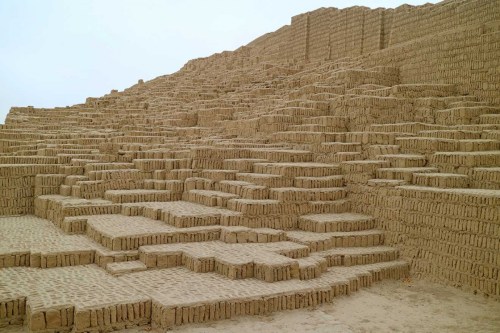
It’s a whacking great adobe and clay pyramid, built in Miraflores (where we were intending to stay). It was built as an important ceremonial and administrative center for the Lima Culture, a society which developed in the Peruvian Central Coast between the years of 200 AD and 700 AD. It was built in two sections: the western half of the site was an important ceremonial center for religious rites, complete with a 22-metre-high, seven-level pyramid. The eastern half of the site was used as an administrative outpost for the surrounding irrigation zone and included several open spaces likely used for public meetings. The two sections were divided by a large wall. They were invaded by the Waris, who were invaded by the Ychmas, who were absorbed into the Incas.
Shame about the bloody great restaurant in the middle of it. What were they thinking? I wouldn’t have eaten there on principle.
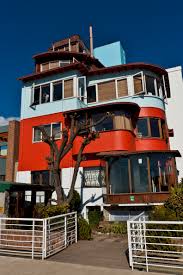
Well, we were supposed to go to Valpairaso yesterday. I went there last time I stayed in Santiago (see my blog post at the time) and I was disappointed then that I didn’t get to see the poet Pablo Neruda’s house, La Sebastiana, in Valparaiso because it wasn’t included on the tour I chose. I had thought of doing a pilgrimage to his three houses this time but that fell through – so I’ll do it now from beautiful Macleod.
La Chascona. This is the one that I saw in the middle of Santiago. You can read my blog post about it here.
La Sebastiana in Valparaiso – well, here’s a video about it. I went on those strange looking hill trolley cars too. Neruda obviously had very fixed aesthetic tastes, because the two houses are very similar. Actually, there were big fires in Valparaiso right on Christmas last year at about the same time that the Australian east coast was burning. You can see footage from the fires here and here. I wonder if they’ve rebuilt – and if so, how.
My Marvellous Melbourne is produced by the Melbourne History Workshop at the University of Melbourne history department, led by Prof Andrew May. Episode 2 features an oral history of waterside worker, Henry Briggs, recorded as part of the National Library of Australia Oral History Collection. Then Stefanie Trigg gives a fascinating interview about bluestone in Melbourne and Stella Marr talks about the Red Cross Archives.
Earshot – (ABC) Aziz Abdul Aziz Muhamat is a Sudanese asylum seeker who had been in detention on Manus Island since 2013. In Part 1.Flight from Manus he goes from Manus Island to Geneva to receive a Human Rights Defender Prize, accompanied by journalist Michael Green, with whom Aziz has been making a podcast to publicize the plight of detainees on Manus. In Part 2 A Stranger in Geneva, he needs to decide whether he should take up the offers of asylum offered by other countries, or whether that would be a betrayal of the men he left behind on Manus.
Now this is curious. Because my phone is full of old podcasts, I found Earshot’s Wrongful:Goldfingered – The Mickelberg Story about the Mickelbergs and the Perth Mint robbery. And now it seems to have completely disappeared from the ABC Earshop program page. Are there more legal proceedings, perhaps? Anyway, it’s an interesting program about crooked cops, a gold robbery, Perth at its brashest back in 1982.
Yes, it’s another of my ‘blink and you’ll miss it’ postings about a movie I have seen just before it finishes its run at the cinemas. I knew nothing about this movie, except that it was Australian. With a cast of Miriam Margolyes, Richard Roxburgh, Emma Booth and Deborah Mailman, I thought that it must be doing something right. Set in Albany W.A. it’s the story of a 12 year old girl trying to heal the grief and anger in her family. She befriends her young classmate who is dealing with his own trouble through believing that he is living in another dimension, and endangering himself trying to return to another dimension. It walks the narrow line between saccharine tweeness and an affecting, brilliantly acted depiction of family grief. Both child actors were excellent, and I’m sure young Wesley Patten will be the new Aaron Pederson in the next 10 years.

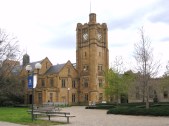 My Marvellous Melbourne is produced by the Melbourne History Workshop at the University of Melbourne history department, led by Prof Andrew May.
