
It’s the first Saturday of the month, and so it’s Six Degrees of Separation day. The rules of the meme are here. In October the starting book is Henry James’ The Turn of the Screw which I confess to not having read. But I gather that it’s about a governess – and I have read about governesses, so off I go!
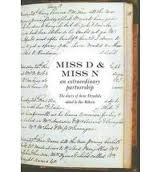
The first governess I thought of was Caroline Newcomb, who shifted across from Hobart to Port Phillip in 1836 to act as governess for the (in)famous John Batman’s family in the very early days of Melbourne’s settlement. She ended up in Geelong, where she met Annie Drysdale, and together the two women formed a partnership to run sheep on the the 10,000 acre Boronggoop property on the Barwon River as women squatters – certainly a novelty at that time. Their lives are described in Miss D. and Miss N. where Bev Roberts edits and annotates Anne Drysdale’s diaries.
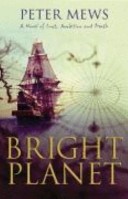
Sometimes I’m a bit of a purist with my historical fiction, but I love it when a novelist does the research then subverts it completely. This is the case with Peter Mews’ Bright Planet, which takes its name from a real ship that often appeared in the Port Phillip Shipping News columns. It’s set in a Melbourne known as Bareheep in the early 1840s, complete with a mixture of historic and fictional characters, and like Robyn Annear’s Bearbrass , it’s a real hoot.
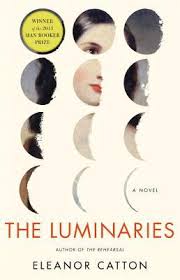
Eleanor Catton’s The Luminaries uses astrological principles as an organizing structure for her sprawling (and too long, in my opinion) book about the New Zealand gold rush in Hokitika. It’s a bit like a great big Victorian door-stopper of a book with myriad characters. I thought that it was technically clever, but just too long-winded.
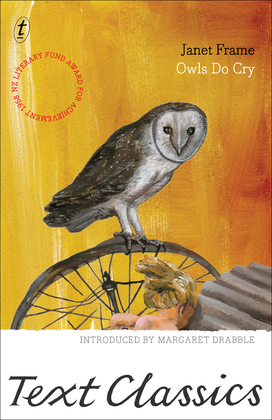
Think New Zealand, and think Janet Frame. Owls Do Cry was her first novel, a thinly disguised autobiography, and it is often considered to be New Zealand’s first modernist novel. It’s a startlingly original book, dealing with mental illness and it still packs a punch after more than 60 years.
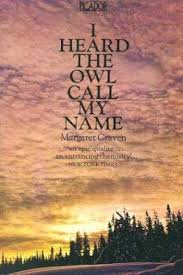
Speaking of owls, I Heard the Owl Call My Name by Margaret Craven is a quiet, meditative book about a young priest who, unknown to him, has only a few years left to live. He is sent to minister to a small Indian village, where Christianity, commercialism and the outside world are encroaching on the traditional myths and practices that the villagers share with him. It’s a beautifully written book, but a bit ponderous.
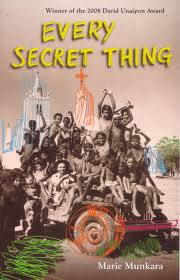
Not at all ponderous is Marie Munkara’s Every Secret Thing. It is a series of tales set around an Aboriginal mission in far northern Australia with the Mission mob, the Catholic clergy, trying to convert the Bush mob who lived just outside the Mission. The Bush mob move back and forth between the arbitrary strictures and efforts of the clergy and their own more grounded life outside. They are clear-eyed about the hypocrisy and smallness of these white priests and nuns, but they are also painfully aware of the degree of control that the mission has over their lives. It is imbued with a quick, cutting, deft wit that overlays anger and sorrow.
And so that brings me to the end of my chain. It seems that with the exception of one book, I’ve stayed mainly in the Southern Hemisphere this time!
 So, another month- another Six Degrees of Separation – see the ‘rules of the game’
  But the title put me in mind of George Johnston’s Clean Straw for Nothing (1969), the second of his David Meredith trilogy, and the sequel to My Brother Jack. Unfortunately, I read it before I started my blog, so you’ll just have to take my word for it that I absolutely loved all three books of the trilogy.
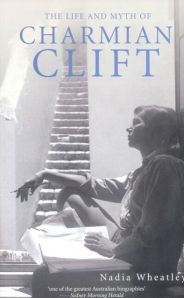 So caught up was I by the trilogy that I became fascinated by Charmian Clift, writer and journalist and, as it happens, George Johnston’s wife. Nadia Wheatley wrote a brilliant biography of her called The Life and Myth of Charmian Clift (2002) which, again, I read before starting this blog.
 Clift was a journalist, although more of the domestic kind, with long-running columns in the ‘women’s pages’ of the newspaper. Jeannine Baker explores the world of Australian woman war journalists in her
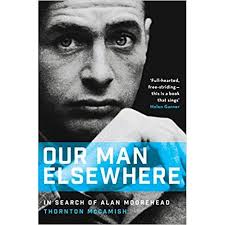 Mentioned in passing is the Australian journalist Alan Moorehead, who was also in Spain during the Civil War. Thornton McCamish wrote a fine biography of Moorehead in his
  Moorhead wasn’t the only historian to write about Burke and Wills. English writer Sarah Murgatroyd wrote an eminently readable history in her book The Dig Tree (2002), which again, I read before I started this blog. It was quite tragic to learn that she died of cancer just a few weeks after it was published. It has been republished as one of the Text Classics, which is impressive for a book published so recently.
 So, the starting book is Siri Husdvedt’s What I Loved. I could have sworn that I have read this book, but I have no record of it at all, and when I read the synopsis it doesn’t sound familiar either. But I gather that it starts off with an art historian and a painting, so that leads me to….
 Alex Miller’s
 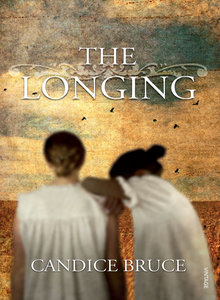 Candace Bruce’s
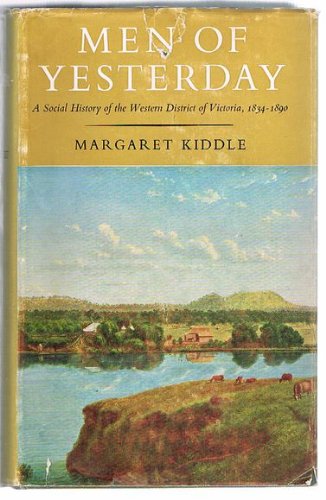
  Margaret Kiddle’s Men of Yesterday: A social history of the Western District 1834-1890. This book, written in 1961, is written by a daughter of the Western District herself, celebrating the white settlement of western Victoria. Its reverence for ‘settlement’ and ancestral pride, without considering the theft of indigenous lands, does not sit well today but it is beautifully written by a young historian who died before it was published. Another historian who discovered Margaret Kiddle’s work was
 Chris Womersley’s
  Laura Spinney’s
  Usually the first Saturday of the month passes me by and I miss out on the Six Degrees of Separation meme from Kate’s blog
 Australia had its own Bright Young People too, but they generally did not have the entrenched wealth of those in Britain, and they gravitated more towards the arts and the intelligentsia.
  A real live Bohemian is the late Mirka Mora, whose biography
  Emily Bitto’s
  When I think of strays, I think of dogs which takes me to Ceridwyn Dovey’s
  Dovey? Dovey? Where have I heard that name before? That’s right- Margaret Whitlam was Margaret Dovey before she married Gough. I haven’t yet got round to reading Jenny Hocking’s two-volume biography of Gough Whitlam. However I did read her
 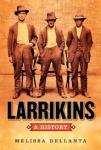 Ah! they’re a gang of larrikins – such a beautifully Australian word!- which is explored in Melissa Bellanta’s history
  Bob Hawke was a bit of a larrikin, and played up to the image. His America’s Cup jacket and white bathrobe were a bit cringe-inducing, but many Australians had a soft spot for his wife, Hazel. She was a dignified Prime Minister’s wife, especially after he left her for a younger woman, and she was courageous in her openness about her battle with Alzheimer’s (or ‘The Big A’ as she called it), documented in her daughter Sue Pieters-Hawke’s book
 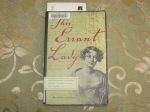 Before there were Australian Prime Ministers, there were Governors, and Lady Jane Franklin was the wife of Governor Sir John Franklin in Van Diemen’s Land in the late 1830s and 1840s, before he sailed off into the Arctic in the Erebus, never to be seen again. On a much smaller scale, Jane Franklin was pretty intrepid too, traveling alone to Port Phillip and Sydney, and in
  Jane Franklin has spawned a number of biographies and has been incorporated into fiction as well, most recently in Richard Flanagan’s
  Peripatetic English author Nicholas Shakespeare was not born in Tasmania, but felt drawn to it by its beauty, only to find that he had family connections there as well: Army officer and merchant Anthony Fenn Kemp and Petre Hordern, a failed alcoholic from a wealthy family, who submerged himself in the bush and dragged his family into poverty. In his book
  And with a surname like ‘Shakespeare’, of course one thinks of plays – especially ‘Hamlet’. The play-within-a-play is a motif that Sue Miller, whose books I’ve been reading for decades, uses in her
