
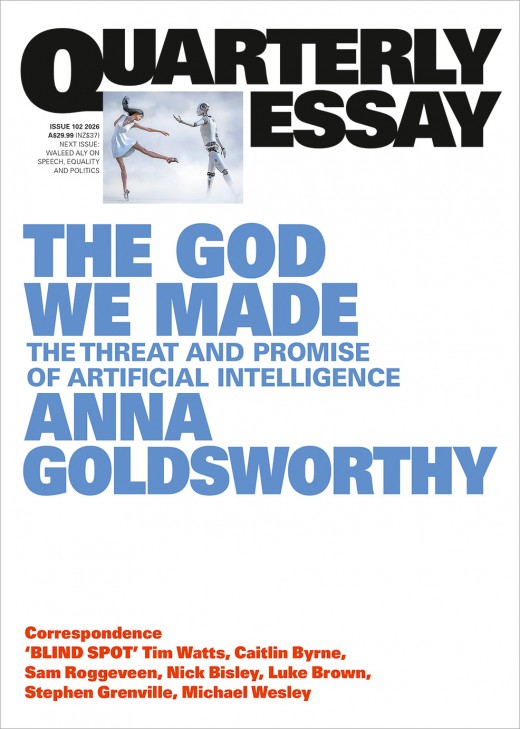
It’s notable how often in discussing Artificial Intelligence (AI) we reach for theology. Anna Goldsworthy, in her Quarterly Essay subtitled ‘The threat and promise of Artificial Intelligence’ starts off with the warnings we have had from antiquity: Prometheus stole the fire; Eve ate the apple; curiosity killed the cat and Oppenheimer built the bomb.
And now, in a moment as much theological as technological, we are birthing our most persuasive god yet. But what sort of god is this? It is not an Olympian, freighted with the flaws of our corporeality: lust, greed, wrath. It is, instead, forged from the raw material of our minds, and bears their imprint. So man created God in his own image, in the image of man he created Him. (p. 1)
Anna Goldsworthy is not a computer scientist: if anything, she couldn’t be further from computer science, as she is a concert pianist and chamber musician, as well as working in academia. If you are an AI user who only dabbles around with a bit of Gemini and Claude, that works to your advantage because she explains things in a very clear, non-technical way. Her concern is not with the specifications and scripts of AI, but instead with the question of what AI does to us as humans- and that, I think, is the more interesting question.
As you might expect from a musician, she particularly looks to the humanities and way we express ourselves in writing and through music and the arts. Art, she suggests, is a deliberate source of friction (p.29). I like this idea of friction, because that’s what AI doesn’t have- instead it is quick and confident and apparently produced without effort (if you ignore the data factories churning away 24 hours a day).
Creativity flourishes under limitations. I have devoted much of my life to the somewhat ludicrous problem of making the percussion instrument of a piano sound like a voice or an orchestra, of attempting to press human experience through an imperfect machine of hammers and strings and levers. But if the awkwardness of the machine were eliminated, my spirit would not be freer. We set ourselves rules- for sestinas, sonnets and even soccer- in order to fly within them. (p. 29)
She returns to the idea of friction that we receive from other people, in particular people who have their own limitations, who are transient, who are creatures of time and entropy and finally death (p. 56) :
… we need the friction of other people- stubborn, surprising, opaque- to challenge us in our thinking. We need the socialisation and testing of ideas, not just against algorithms but against other minds (p. 75)
She ranges over a number of issues that have arisen in relation to AI: the predictions of annihilation; the number of computer scientists who have ‘walked’ from the big companies once they realize the power of what they have created; the obsolescence of whole swathes of work and how to make meaning in its absence; the effect of AI-speak on our own writing style, and the cheapness of AI replicating a writer’s style; the phenomenon of people ‘befriending’ their chatbot; the sycophancy of chatbots and situations where chatbots have encouraged people into harm.
She intersperses her own hesitations against the adolescent superciliousness of her children and their friends R. O and Z who actually, I found rather insufferable and could have done without. I think I’d rather spend time with the author and her uncertainties and fears than the bumptious heedlessness of her children.
Essentially, she comes down to the body – even while raising the spectre of embodied AI- and the limitations that it imposes upon us, and the meaning it gives us. I think that this is where I land too, especially as I grow older and recognize the effect of time and experience on something so resilient and yet transient.
The first and last of all our problems is the body: this thing that aches and laughs and bleeds and experiences pleasure. It is the source of our vulnerability and our delight. It is also our trump card, the one thing we have that AI does not: our only true property, 60 per cent water, vulnerable to sharp objects, subject to time (p. 30)…the thrillseekers among us may still want to try human: to reinsert ourselves into the cradle of AI civilization, into that crucible that is flesh, to see what a body feels like- with all the risk that entails, with all its unique pleasures and knowledges (p. 83)
My rating: 8/10
Sourced from: purchased Quarterly Essay subscription
Read because: I did a service on AI and Being Human at my Unitarian fellowship.

