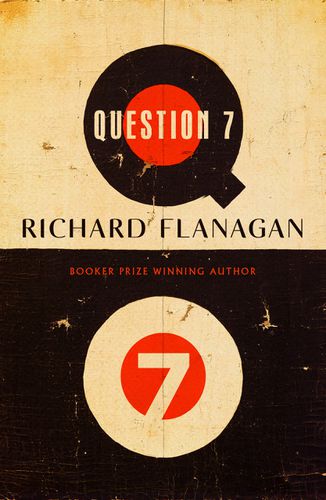
When I first heard about Richard Flanagan’s Question 7, I thought “But that’s just a rehash of everything he’s already written”. It’s true that there are flashes of his earlier work, almost as if he’s tipping his hat to it in passing. The Tasmanian section evokes The Sound of One Hand Clapping, Wanting and Gould’s Book of Fish, his mentions of his father’s wartime experience sparks memories of Narrow Road to the Deep North and his mother’s death was explored in The Living Sea of Waking Dreams, and the final chapter brings to life Death of a River Guide. But this makes the book sound like a glorified ‘greatest hits’ and it’s much, much more than that. It’s brilliant.
The title is taken from a Chekhov story, where a question is posed in the form of those schoolroom maths questions that still give me a sinking feeling in my stomach:
Wednesday, June 17, 1881, a train had to leave station A at 3am in order to reach station B at 11pm; just as the train was about to depart, however, an order came that the train had to reach station B by 7pm. Who loves longer, a man or a woman?”
Who, indeed. The real question is love, not the train or the timetable, and it’s a question that is unanswerable. So too, is the question of causality that brings each of us where we are.
Without Rebecca West’s kiss H. G. Wells would not have run off to Switzerland to write a book in which everything burns, and without H. G. Wells’s book Leo Slizard would never have conceived of a nuclear chain reaction and without conceiving of a nuclear chain reaction he would never have grown terrified and without growing terrified Leo Szilard would never have persuaded Einstein to lobby Roosevelt and without Einstein lobbying Roosevelt there would have been no Manhattan Project, and without the Manhattan Project there is no lever at 8.15 am on 6 August 1945 for Thomas Ferebee to release 31,000 feet over Hiroshima, there is no bomb on Hiroshima and no bomb on Nagasaki and 100,000 people or 160,000 people or 200,000 people live and my father dies. Poetry may make nothing happen, but a novel destroyed Hiroshima, and without Hiroshima there is no me and these words erase themselves and me with them. (p.237-8)
We meet all these contingencies and people in this book, written as a series of small shards within ten chapters: the Enola Gay pilot Thomas Ferebee, physicist Leo Slizard, the writers H.G. Wells and Rebecca West, his parents, his childhood in Roseberry, Tasmania, the Burma Railway and indigenous dispossession. Themes arise, drop and rise again, and parts of the book are an extended reflection on death and memory, encountered over and over. It’s hard to fit in into any one genre: it’s history, non-fiction, memoir and philosophy all rolled into one. The most compelling writing in the book comes at the end, when he tells his experience of nearly dying – indeed, did he die and is all this just a dream?- that he fictionalized in Death of a River Guide. My dinner was ready, and I was being summoned with increasing impatience, but I had to keep reading, even though I knew that clearly, he did, survive – and if it was a dream, then we’re all enmeshed in it too.
I have always loved Richard Flanagan’s right from Gould’s Book of Fish, which was the first of his books that I read. I’ve read interviews as part of the publicity for this book, where Flanagan said that he didn’t know if he’d write another book and I must admit that I closed it, feeling that he had written himself completely into the book, wondering how he could ever write anything else after this.
The best book that I have read in ages.
My rating: 11/10
Sourced from: borrowed for a friend (for far too long!)
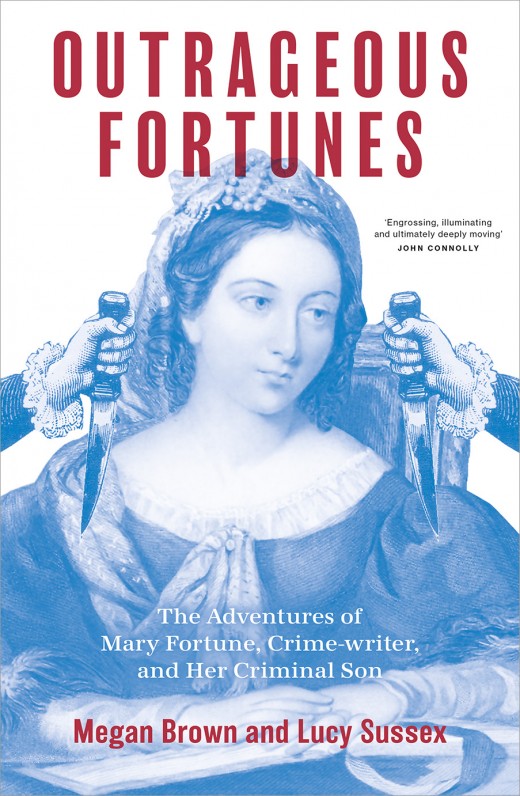
If nominative determinism was a real thing, this book would be about a wealthy woman, her affluent son and their convention-shattering lives. Instead, Mary Fortune worked all her life as a writer and died in poverty, and her son George Fortune spent much of his adult life in jail.
However, ‘Mary Fortune’ is a wonderful name for a writer, even though she always wrote under many other pseudonyms, especially Waif Wanderer and W.W. Although many in literary bohemia knew her real name, it was not widely broadcast. Between 1855 and 1920 she wrote articles, serialized novels, poetry and short stories in various local periodicals, particularly the long-running and popular Australian Journal. From 1868 she contributed a column called ‘The Detective’s Album’, featuring a male detective Mark Sinclair, under the initials W.W. This eventually amounted to over 500 narratives and formed the basis of her book The Detective’s Album, published in 1871 and the first book of crime short stories published in Australia, and the first detective collection by a woman in the world. In her Ladies Page columns, writing variously as Mignon, Nemia, Nessuno and Sylphid, she was both journalist and flâneur (flâneuse) walking the streets and observing – an unusual thing for a woman- and she wrote lively descriptions of Melbourne life, similar to those being penned by Marcus Clarke at the same time, but from a woman’s perspective. She wrote a fictionalized memoir in the 1880s, Twenty Six Years Ago but there is little other personal correspondence. When you read her lively, whip-smart writing you find yourself wondering why you haven’t heard of her before.
She was born Mary Helena Wilson in Ireland, and emigrated with her father to Canada probably in the early years of the Great Famine. They were Protestant, and her father worked as an engineer. In 1851, aged 18 she married surveyor Joseph Fortune, who was to give her that very rather theatrical surname. When the gold rushes erupted in Australia in 1851, her father left, and in 1855 so did she, leaving her husband behind. She and her three year old son George, travelled to Scotland, then on to Australia to find her father, no easy feat in this raucous colonial colony where identities could be erased and redrawn easily. A woman leaving with her child, especially the only child of an only child in a fairly prosperous family, was unusual but she lived an unusual life. She had a second illegitimate child while living on the goldfields, and said nothing of her earlier marriage when she married policeman, Percy Rollo Brett, claiming widow status. The marriage did not last long and they separated, throwing Mary onto her own resources, first on the goldfields, and then in Melbourne.
In the introductory chapter, the authors write:
When the search behind this biography began, little was known beyond her name: Mrs Fortune. To find her meant following her lead as a detective writer, seeking the clues hidden in her vast bibliography. A process of literary detection began. Her game was to drop self-referential fragments- names and events from her life- into her writing. Reading an author through their work can be a trap: the biographical fallacy- the assumption that writing always derives from life. Such was not true in Mary Fortune’s case, for she had a wild imagination. She could write as vividly of a vampire or a vengeful Roma sorceress as of the Victorian goldfields. Yet even at her most sensational her default mode was realist, fed by a tenacious memory. She held grudges interminably and rehashed them in print. Details repeat through the decades of her work, and – thanks for the increasingly digitised world of archives and newspapers- they can be investigated and explained. (p. 4)
Despite the availability of her work in digital form, few readers are likely to immerse themselves in Mary Fortune’s prolific output, and thus to a certain extent we have to take on trust that Mary’s writing does throw light onto her biography. I, for one, think that the authors have identified sufficient parallels and repetitions between Mary’s life and her literary output to validate this as a way of proceeding. That said, though, without Mary’s writing, it would have been a rather thin biography.
One of the most fascinating aspects of this biography, and one which the authors bring out really well, is the paradox that Mary Fortune built her literary reputation (albeit under a nom-de-plume) on criminal activity through her ‘Detective’s Album’ columns, while her only son was completely enmeshed in the criminal system as perpetrator and prisoner. George Fortune’s life, from the age of fourteen was a series of arrests and imprisonments, starting with his arrest for stealing a hat in July 1871. From here he was committed to industrial schools, farm placements, youth imprisonment at Pentridge and eventually long stints in jail in both Victoria and Tasmania. There was no glamour in his criminal history of crime and recidivism.
Mary Fortune had been married to a policeman, and in many ways she mined this connection for the rest of her life. She may have herself been a ‘fizgig’, a police informant. The ambiguous relationship between law and crime lies at the heart of any number of detective series, and it is given an extra frisson in relationships between police and informants, especially women informants. However, her literary career and her son’s criminality came into collision when she published a column in the Ladies Pages of the Herald, where she wrote as ‘Nemia’, that described her visit to Pentridge jail in Melbourne to visit a young, unnamed man. Soon after, for fear that ‘Nemia’ would be linked to the prisoner George Fortune, Mary was sacked from the Herald. She would not return to the newspaper for several years, and then only with fiction.
Mary Fortune lived in the ambiguous space between ‘upper’ and ‘lower’ Bohemia. Other writers knew her, and she conducted a long rivalry with Marcus Clarke whose Peripatetic Philosopher columns were a masculine version of own columns. She would ever only be a contributor, and an anonymous one at that, while her rival Clarke became ‘conductor’ of the Australian Journal in 1871, and as a result her presence in the journal declined. But she was a denizen of ‘lower’ Bohemia as well, with constant money worries, arrests for drunkenness, and a stint in the Benevolent Asylum in North Melbourne before shifting as a lodger between various charitable women. Her son predeceased her, dying in jail in Tasmania, and she died penniless and for many years forgotten.
But not by Lucy Sussex, who had first encountered Mary Fortune when she was working as a researcher for Professor Stephen Knight at Melbourne University, who was researching the history of Australian crime fiction. She wrote her PhD and a subsequent book on the Mothers of Crime Fiction, and a novel based on her search for Fortune called The Scarlet Rider. She edited and published a selection of Mary’s memoirs and journalism in 1989 as The Fortunes of Mary Fortune. Megan Brown completed her PhD on Mary Fortune, and they have co-presented at various conferences. In a closing chapter, Sussex describes an academic joust with another historian whom she dubs ‘Rival Researcher’ who took a rather malicious glee in obscuring her sources, and interactions with Melbourne historian Judith Brett, a descendant of Mary’s policeman ‘husband’, who helped her to start to look at Mary’s son George as a narrative thread in piecing together Mary’s life.
I’m always interested by books that are a collaborative venture because, to me, writing seems such an individual and personal endeavour. The authors only present separately in their closing chapter, yet I wonder if the seams between the authors can still be detected (the book has infected me, now I’m playing detective too!) The introduction frames the authors’ search as a game of literary detection and certainly the conclusion, which evokes the academic rivalry of A. S. Byatt’s Possession, returns to this topic. This theme of literary detection runs subtly through the narrative, reappearing when the authors interview current-day detectives and undertake computer-based forensic linguistic testing of Mary’s writing style to clarify her authorship of individual stories. While cautioning against the perils of applying modern day diagnoses to peoples’ behaviour in the past, they do so nonetheless, suggesting that George Fortune today might be diagnosed with Anti Social Personality Disorder. The reference to Nicola Gobbo as police informer was instructive for me as a Melburnian, but it will date the text and soon be irrelevant. I wonder if these eruptions of current-day commentary reflect the preferences of one of the two authors, or whether they both saw these present-day parallels. Likewise, the introduction of subheadings on just three occasions seemed to jar a little from what was otherwise a flowing narrative, and perhaps reflects the joint authorship- but I don’t know.
Mary Fortune’s good fortune was to have two biographers in Lucy Sussex and Megan Brown who have worked hard over so long to bring her name, and her full-rounded life story before 21st century readers. Their biography is deeply researched, readable and imbued with admiration and sympathy for a trail-blazing woman writer, whose writing is still brisk and lively today.
My rating: 8/10
Sourced from: Review copy from Black Inc., with thanks
I recently watched the Netflix series based on this book, and instantly wanted to read the memoir on which it was based. My curiosity was piqued by a comment in the ‘Making of’ documentary, also on Netflix, that they had changed the modern day part in the television series because the author is still a young living, working, active writer in Germany, and they didn’t want the series to affect her present-day life. When I was about 7/8 of the way through the book, and she was still in New York, I realized that the book and the series were quite different.
Deborah Feldman was raised by her grandparents in Williamsburg, Brooklyn. Her family was part of the Satmar sect of Hasidic Judaism, a sect with Hungarian roots that had been very much shaped by the Holocaust. Believing that God had allowed the Holocaust as punishment for assimilation and Zionism, the group embraced extreme conservatism in custom, dress and language, speaking only Yiddish. Her father, who was largely estranged from his daughter, seemed rather intellectually and socially challenged, and her mother had deserted the sect while Deborah was small. Although her aunts, particularly Aunt Chaya, have an influence on her upbringing and prospects, it is actually her grandmother Bubby and grandfather Zeidy, who bring her up in a loving but strict environment, where family and religion are paramount. Being brought up by elderly grandparents gives her freedoms that she would not have had in a family of siblings: she is well-educated for a Satmar girl, and she becomes an inveterate reader. As she approaches womanhood, the family orchestrates her arranged-marriage to Eli, a man equally in thrall to his own family and religion. Although Eli is in many ways more liberal than some other men, he can veer between domination and permissiveness, and when they cannot consummate their marriage, they are both under pressure from each other and their families.
There are some important differences between the book and the television series. In the book, her liberation comes not through music but through surreptitiously attending higher education, and it occurs in America, not in Germany. She leaves after she has her child, not before; indeed it is her desire to protect her son from the misogyny and strictures of Hasidic Judaism that impels her to leave her husband who, initially at least, seems just as happy to have the marriage fail as she is. She is largely silent about the custody arrangements for their son, Yitzy.
The memoir (i.e. book) was written in 2012, when she was still in the midst of act of leaving. The entire memoir is written in the present tense, but the present becomes closer and closer. As a result, the pacing of the book moves from fairly slow reflection and narrative, to a present-day rush of emotion. Because it is a memoir, the narrative is shaped completely by her viewpoint and her own flaws and strengths. (An interesting critical review of the book by another Satmar woman who also left the community can be found here.) Is it a well-written memoir? Possibly not: there is no overarching theme, beyond that of grievance and longing for freedom, perhaps. For a memoir, it has a lot of dialogue which tips it into some other genre.
Nonetheless, I found this memoir fascinating, and hard to put down. Part of that stems from my curiosity about Hasidic Judaism, particularly within enclaves like in Williamsburg. (There’s an interesting photo-essay about Williamsburg here). Yes, I have borrowed her sequel as well, a recent retelling of her 2014 follow-up Exodus.
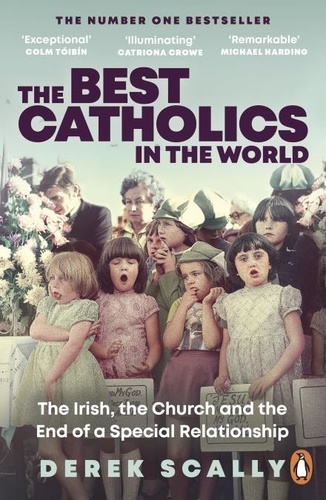
It amazes me that, of all countries in the world, IRELAND should have voted for gay marriage and legal abortion. My impression of Ireland is that it is mired in religion and conservatism, and I don’t think that I’m alone in this perception. In this book, Derek Scally, after many years of living in Germany, returns to Ireland, the land of his childhood, and asks himself how these changes came about. It is a story both of his own personal journey from a weakly-held Catholicism into a consideration of how Ireland, as a country, can come to terms with its past.
The book is divided into three parts. In Part I, ‘The Leaning Tower of Piety’, he writes of his own Irish upbringing and his own contact through St Monica’s Church with Father Paul McGennis, who was later to plead guilty to four counts of indecent assault. In going through the church archives, he learns of the league table on donations that existed between the parishes, and through speaking to old parishioners he learns of the suspicions about Paul McGennis, and the inability of parish priest Michael Geaney to impose any authority on him. In Part I he challenges the perception that there is a special type of ‘Celtic Christianity’, suggesting that this is the result of previous centuries’ public relations, generating important political momentum, emotional comfort and offering touchstones against historical events like the Penal Laws and Protestant/English occupation. It was not enough: he suggests that Irish Catholics perceived themselves the Most-Oppressed-People-Ever. Yet, when he looks back to his own education within the Catholic system in the 1980s by revisiting the text books used at the time, he feels patronized and short-changed by the experience.
Part Two ‘Implosion’ looks at the effect of the clerical sexual abuse revelations in the 1990s. He focuses on Fr. Brendan Smyth, who was investigated in 1975 but went on to abuse children for a further sixteen years. The fallout, when it came, spread beyond his own activities: Cardinal Brady, who was involved in the 1975 investigation, was also accused of cover- up. He interviews Sean Brady, a man whom some see as a modest figure who knew which boats not to rock; while others see him as a coward and an accomplice to a predatory paedophile priest. Australian readers will see parallels with Archbishop George Pell. He goes on to explore the Magdalene laundries and the treatment of inmates in religious-run institutions. He argues that when the Catholic Church lost its monopoly on giving meaning or creating a sense of community, coupled with the sense of betrayal over the hypocrisy and intransigence of the church regarding sexual abuse, many left the church.
In Part Three ‘Among the Ruins’ he talks about the reformulated religion that transformed Famine-era faith into an earnest, Rome-focussed Sacred Heart Catholicism. He draws on his experience of living in Germany to wonder if Ireland does not need some form of national reckoning, as a form of healing and reconciliation. He considers the roles of museum and memorials in this process. At the end of the book he writes:
This journey has taken me from apathy to ambivalence, then anger to acceptance…[For] whatever anger I harbour towards the Irish Church, echoing the anger of those whose lives were ruined by its institutional inhumanity, I see remnants of its noble aspirations through the many ordinary Irish people who tried- and try- to lead better, Christian lives. No one can draw a line under the past, or airbrush away their role in it, but- for perhaps the first time ever- Irish people can approach their history on their own terms. That is, if they want to. (p. 307)
I’m not quite sure how to rate this book, and my reading was interrupted by a two-week holiday and so I did not read it as a continuous whole. I was happy enough to pick it up again, but I don’t know if I really grasped his argument well. In fact, summarizing it here gives me a better shape of the argument than the actual experience of reading the book did.
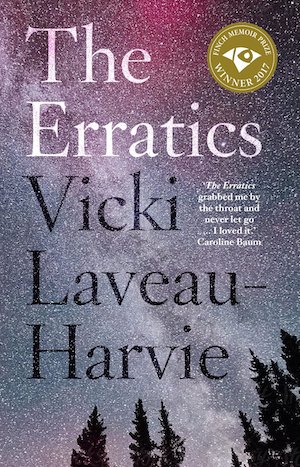
I confess that I started this book warily. “Mad as a Meat Axe” write two daughters on their mother’s medical chart at the end of the bed, sniggering at the thought that the initials MMA might prompt some medical profession to treat their mother for MMA and kill her. The two daughters, who are never named, are visiting their mother in rehab for a broken hip, even though their mother denies their existence, and has had nothing to do with them for eighteen years. I would not want these daughters.
Obviously much has gone on in this family, but we are never told. Our narrator tells us that, for her:
My past is not merely faded, or camouflaged under the dust of years. It’s not there, and I know a blessing in disguise when I see one. I have managed to shake free and flee to far-flung places where I feel reasonably safe because I do not carry a lot of my past. (p.140)
And yet, after 18 years, this Canadian academic returns home to see her father, whom her mother has announced “doesn’t have long”, and her mother whose hip has disintegrated. Along with her sister, who has remained in Canada despite the 18 long years of estrangement from her parents, they arrange (conspire?) for their mother to be moved into some form of care, so that their father can escape from her clutches. Her mother has long since given power of attorney to someone else, and she announces that her daughters are only after her money. Are they? Who is mad as a meat axe here?
It took a while for me to shake my suspicion of the narrator. I wonder if this book is some sort of Rorschach test: I have been the child left (albeit in a completely different situation) and so perhaps I read it differently. As older sister, the narrator has fled to Australia and established a marriage and career there, while her younger sister, just by virtue of being in Canada, carries the memories, the hurt and responsibility. The narrator knows this, but this does not change her actions:
…However different we are and however badly she judges me, whatever gulf already separates us, she is my sister. I do not want the gulf to fill with the seething resentment she will feel because she is doing it all, but I know this will happen. I am telling her that I know this will happen. I know she will feel violent annoyance with me when I suggest something because I’m not there and I don’t know, and I’m not the one doing it and I, on my far away island continent, will sit quietly, gnawed by guilt. (p. 157)
We never learn what has happened in this marriage and family. We have little back-story for her parents, beyond the fact that her father made money through the oil industry and that he fought in WWII. We have no images of a courtship, a marriage or a family life with young children. Everything is refracted through the narrator’s rage- which oddly enough, she deflects onto her sister.
No, I see rage here. A rage expressed by staying on the other side of the world, and by allowing her younger sister to carry this burden. A justified rage, from the snippets that we received, but rage nonetheless, despite protestations of guilt.
This is a memoir, and as such the author has ultimate freedom and responsibility to shape the narrative however she wishes. The memoir starts with a preface, describing the Erratics, huge boulders deposited by the Cordilleran Ice Sheet as it moved through Alberta and Montana. The Erratic that sits in the Canadian town of Okotoks, where the memoir is set, has cracked and fallen in on itself, posing danger to anyone approaching it. On the final pages, we revisit this image of the Okotoks Erratic with the spirit of her mother sitting atop it, beside Napi the Trickster.
To be honest, I’m still not sure who the Erratic is here: mother or daughter. But either way, it feels as if there is some sort of space here for release.
To be honest, I thought that Homage to Catalonia was a novel, and it never even occurred to me that it might be an eye-witness account, written in the year after his return from fighting in Spain. The book starts in Barcelona, where he embarks on rudimentary training using antiquated equipment before heading for the front. He had joined to support the Republican government from an ideological commitment, entering Spain under the auspices of the Independent Labour Party and by chance ended up with the POUM militia (Partit Obrer d’Unificació Marxista) an anti-Stalinist communist party.
His account, which was written after the event, traces his arrival in Barcelona, and his time on the front first in the hills around Zaragoza and his later deployment with a group of Englishmen to a position at Monte Oscuro, within sight of Zaragoza. He is then sent 50 miles away to Huesca where he takes part in an attack, throwing two bombs which he thinks may have hit their target. After three months on the front, which seem mainly to have been a time of lice-picking and boredom, he returns to Barcelona where the Republican forces have turned on each other. Disillusioned by the political infighting, he returns to the front, where he is shot through the throat, shuffled from hospital to hospital and finally discharged from duty. At this point, the internal Republican politics mean that he is in danger because of his previous involvement with POUM and so he and his wife decide to leave Spain.
The political infighting amongst the Republicans was completely unknown to me. I had always thought of the Spanish Civil War as being Republicans vs. Franco’s Nationalists. But the battle was just as much one within the Republican forces. At one stage while reading, I became completely overwhelmed by the acronyms for the various Republican groups and just happened to notice a footnote that referred to ‘Appendix 1’. (I was reading this as an e-book, and footnotes at the bottom of the page are awkward, clunky things). Lo and behold, there were two chapters attached as appendices, completely about the politics and machinations of the various Republican groups that had previously been part of the text, but had been later shifted to be appendices lest they disrupt the flow. I found these two fairly long chapters illuminating, describing the ideological differences between the Russian government and the other communist groups over the role of proletariat and whether they were ‘ready’ for Revolution. Once I had this sorted out in my mind, I could return to the rest of the book.
[Was it the right decision to excise these chapters from the main text? Probably, because he does get into the ideological weeds here. But I would have struggled on with the acronyms had I not followed up on the footnote to the appendices. Perhaps he should have sign-posted the appendices better.]
As a journalist, Orwell is a keen observer, and he captures well the boredom of trench warfare, interspersed with times of frantic, bumbling terror. His description of being shot reminded me a little of Tolstoy’s account of the battlefield in War and Peace. I must say, though, that he seems to be a particularly inept soldier, with little solidarity with the Spanish soldiers he was fighting alongside, with whom he could barely converse with his rudimentary Spanish.
And I can see why Anna Funder in Wifedom looked at the space around “my wife” in Orwell’s work and wondered about Eileen O’Shaughnessy. In Orwell’s book, she is this nameless, shapeless figure bobbing around behind the lines (literally), sending parcels, warning her husband, fleeing with him, but always just “my wife”.
My rating: 8/10
Sourced from: free as part of Kobo subscription. Inspired to read it by the film ‘The Teacher Who Promised the Sea’.
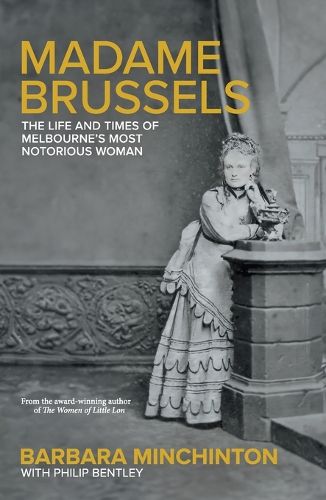
This book is both companion and expansion of Barbara Minchinton’s The Women of Little Lon (my review here) which looked at the sex work industry in nineteenth century Melbourne. Madame Brussels is one of the brothel keepers that Minchin described in the earlier book as part of the ecology and economy of Melbourne’s brothel precinct, but here she deals with Madame Brussels as biography, rather than one name among others.
Madame Brussels is probably the best known of Melbourne’s ‘flash madams’, now immortalized with her own lane and roof-top bar. She was certainly well known in the late 19th century, too, through her political and policing contacts that largely shielded her from prosecution, court appearances and notoriety. Caroline Hodgson nee Lohmar was born in Germany, married in UK and arrived in Melbourne with her husband ‘Stud’ Hodgson in 1871, shortly after her marriage. She rode the exhilaration of the ‘Marvellous Melbourne’ land boom, suffered the 1890s recession, and was increasingly hemmed in by the ever-tightening moral strictures of the early 20th century.
Soon after her arrival in Melbourne her husband left her to work as a policeman ‘up-country’, returning twenty years later in the depth of the 1890s depression in poor health. Left in a strange city as a deserted wife, she opened a boarding house in Lonsdale Street and gradually began accumulating property adjoining her original purchase, later purchasing property in South Melbourne, Middle Park and Beaconsfield Parade in St Kilda. She presided over her brothels, but there is no evidence that she worked as a sex worker herself. Her brothel attracted politicians and magistrates and there were rumours that Alfred Plumpton, then music critic for The Age and composer, was her lover. Although she appeared in court several times, she was always well represented and almost magically the magistrate’s bench filled up with worthy JPs who were not otherwise active in the courts (but may well have been active in her brothel). She remarried after her first husband’s death, but this marriage to fellow-German Jacob Pohl was no more successful than her first, as he soon left her to live in South Africa for several years. After a couple of years’ absence from the brothel scene, she started up again but times and politics had changed.
In the years preceding the turn of the century she became increasingly name-checked by moral reformers, particularly Henry Varley, and became a regular object of scandal in John Norton’s Truth newspaper (which had plenty of the former, and little of the latter, despite the name). In April 1907, after appearing in court charged under new laws with “owing and operating a disorderly house”, she closed her brothel in Lonsdale Street, and died soon after in 1908. Despite an extravagant funeral, she had little to show for the wealth which had passed through her hands.
As might be expected of a notorious entrepreneur, the sources for her life are skewed by real estate transaction documents and court appearances reported breathlessly by the newspapers. There is a genealogical record, although it is patchy: for example, it is not clear whether her ‘adopted’ daughter Irene was actually her own daughter. There are the annual ‘in memoriam’ notices that she placed in the newspapers after her first husband’s death, as was the practice in the early 20th century. But in terms of letters, diaries etc, there is nothing.
In an afterword Phillip Bentley, who is credited as co-author writes:
…we have remained resolute our desire for all conjecture to have a basis in fact and so have resisted the temptation to speculate on how she overcame her early education towards ‘moral earnestness, humility, self-sacrifice and obedience to authority’ in order to become Melbourne’s most famous brothel madam of the nineteenth century (p. 253)
I’m not absolutely convinced that the authors fulfilled this resolution. There are many times that they raise questions which they leave hanging in the absence of evidence, but the questions are raised nonetheless, couched in “may” and “could” statements. The chapter ‘A Curious Gentlemen’s Club’ I found particularly unconvincing, where the question of flagellation is raised, largely on the basis of her first husband’s uncle’s involvement in the ‘Cannibal Club’ and the presence in Melbourne of journalist George Augustus Sala, who was said to have coined the phrase ‘Marvellous Melbourne’ as well as being the anonymous author of flagellation pornography. As the final paragraph of the ten-page chapter says:
In all the records and writings and newspaper reports examined to date there is no suggestion that Caroline’s establishments offered anything other than ordinary common-or-garden variety male-female sex. There are no wild rumours, no snide passing remarks from journalists or parliamentarians under privilege, in fact no hints at all of anything alone the lines of the ‘fladge brothels’ in London. That does not mean it was not happening of course: it means that if it was, we simply can’t see it. (p. 82)
Likewise the chapter where they raise the question of whether her first husband Stud was homosexual raises the question but then admits “There is no way we can know for certain whether Stud was gay” (p.140). I’m not sure that raising questions, identifying parallels and possible networks is sufficiently rigorous, although surely a temptation when writing a life of such notoriety which provided relatively barren and biassed documentary evidence.
This book stands on its own two feet, but I think that I appreciated it more for having previously read The Women of Little Lon, a book which has firmer evidentiary foundations than this one. But I guess that’s part of the challenge of biography: finding the individual person while confronting the dearth of evidence. Even Phillip Bentley admits that perhaps they have not unpacked her personality as much as they would have liked (p. 253), but certainly the authors have succeeded in bringing out the person behind the name now adopted by popular culture with such glee.
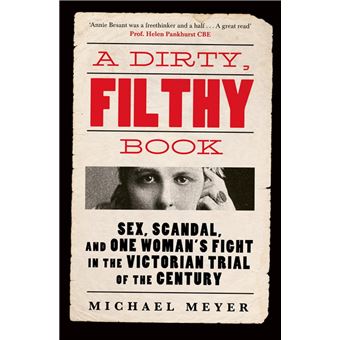
Some people seem to live not just one life, but many. Annie Besant was one such woman who went from parson’s wife, to public speaker and publisher, social worker and activist, to university student and Theosophist. Michael Meyer’s book, subtitled ‘Sex, Scandal and One Woman’s Fight in the Victorian Trial of the Century’ focuses particularly on the court case in which she and her colleague Charles Bradlaugh were charged with “unlawfully wickedly knowing wilfully and designedly” printing and publishing “a certain indecent lewd filthy bawdy and obscene book called Fruits of Philosophy” which would bring the subjects of Queen Victoria into “a state of wickedness lewdness debauchery and immorality”, as well as offending against the peace and dignity of the Queen. (p. 140)
Neither of the accused had actually written the book, which was quite an old text written forty years earlier by an American doctor, Charles Knowlton. In fact, Charles Bradlaugh didn’t think much of the book at all, but it was more the principle of making knowledge available at a cheap price (sixpence) that drove Annie and Charles to defend publishing the book in court. They wanted a high profile case, and they got it. Conducted in Westminster Hall (before it burnt down), it was a jury trial held before the Lord Chief Justice Sir Alexander Cockburn. Already an accomplished public speaker, albeit completely untrained in the law, Annie conducted her own defence, and from the extracts published in the newspapers in this widely-discussed trial, she did a damned good job of it too.
She, even more than her co-accused Charles Bradlaugh, had a lot to lose. She had married a clergyman, Rev. Frank Besant at the age of 18, without actually loving her husband but hoping, as a devout Christian, that the role of minister’s wife would be a way through which she could serve the Church and her fellow man. It was an unhappy marriage from the start. She had two children, a son Digby and daughter Mabel, and managed, through her brother, to procure a separation from her husband but he kept custody of her son, and refused a divorce. If found guilty, Annie would lose custody of her daughter as well.
She had lost her faith during her marriage, and after her separation became heavily involved in the National Secularist Society, where she met Charles Bradlaugh. They were very close, although Meyer does not explore whether their relationship was sexual or not. Both were still married, and as public figures, could not expose themselves to scandal. She wrote numerous articles for the National Reformer weekly newspaper published by the NSS and was an accomplished public speaker. It was this experience of debate and public discourse that stood her in good stead in the courtroom at Westminster Hall, but did not shelter her from the fallout of the case. Charles Bradlaugh went on to have a successful political career, being repeatedly re-elected and repeatedly refused being able to take his seat in Parliament because, as a secularist and atheist, he refused to swear on the Bible. As their lives split off in different directions, the obloquy of her atheism prevented her from being able to graduate from the University of London, once they accepted female students, even though she was clearly a brilliant student. She threw herself into social activism in the East End, particularly in leading the Match Girls strike about working conditions and the use of white phosphorous in making lucifer matches at Bryant and May. Over her life, she had been a devout Christian, a strident atheist, and eventually she moved into Theosophy, to which she devoted the latter part of her life. She abjured her earlier publications, and especially the book about birth control methods that she wrote after the court case which was even more explicit than Fruits of Philosophy. It really is as if she had several careers.
In the book, there are parallels drawn between Besant and two other women. The first of these is circus performer Zazel (Rossa Richter) who drew fame for being shot out of cannon, night after night. The second is Queen Victoria herself, who had a much happier experience of married life than Annie Besant did, and whose politics were diametrically opposed. Queen Victoria was not particularly aware of Besant, but she did record her disapproval of Bradlaugh in her diaries.
When I first started reading this book, I enjoyed its breezy tone and discursive narrative but I soon tired of it. In trying to contextualize Besant and her various campaigns, he draws on newspapers to illustrate what else was occurring at the time, and in the end it became a distracting lack of attention- as if he couldn’t bear to let a juicy tidbit pass, without reporting it. I enjoyed his reporting of the court case itself, but the lack of discipline elsewhere in the book detracted from his analysis of the case and its aftermath. Like the court case itself, it all felt a bit tabloid.
The author is a travel writer, which did not surprise me. He is also Professor of English at the University of Pittsburgh, which did.
Nonetheless, it’s a really interesting story and, despite his digressions, Meyer tells it in an engaging and entertaining style. I just wish that there had been a little less ‘colour’ and more analysis.
I’ve never read The Iliad. I knew bits of it, most particularly the final scenes where the enraged Achilles is dragging the body of Hector around behind his chariot, but I’ve never read the whole thing. I’m not a big audio-book listener either, but in this case I decided to listen to it, knowing that it was originally an oral story. I had audios of the Fagles translation downloaded from who knows where, but they were many separate files and I kept getting lost. So in the end, I succumbed to the prose version by W.H.D. Rouse which felt a bit like cheating. However, I had first been drawn to finally tackle it after listening to a podcast on Achilles, where extracts from The Iliad were read out, and if that narrated version was not prose, then it certainly sounded that way. (The show notes don’t reference the translation). At the same time, I listened to an excellent series of lectures by Michael Dolzani at the Expanding Eyes podcast Episodes 44 to 56, which I have referenced in my I Hear With My Little Ear postings between 23 Oct 2023 and 16 January 2024.
It took me several weeks. Was it worth it? For much of the time, I would have said ‘no’. There are whole books devoted to call-outs to various warriors and their families: you can just imagine the listeners sitting, waiting for their family’s name to be called out, and their triumphant glances when it was. There are many chapters devoted to battles as men are run through the shoulder with swords, eyes plucked out etc etc etc. There are oddly placed chapters that describe ceremonial games held to celebrate a fallen warrior, with the results told in tedious detail.
Above all, there is the image of the hero: brave, fearless, unswervingly loyal. The obverse of the coin: proud, arrogant, stubborn. The image of hero has lured whole contingents of men to their death in its wake.
But there are also moments where we see the heroic ideal held up against other more human traits, most particularly the bond of father and son. This plays out most strongly in the last books of the epic, and these books alone make the rest of the testosterone-driven gore worthwhile.
This month the Six Degrees of Separation meme run by Kate at BooksAreMyFavouriteandBest is a bit different. Instead of her choosing the starting book, she has invited us to start with a book that we have just finished, or read in the last month.
Well, the last book I read was Shirley Hazzard’s The Great Fire and even though I know that some people love it and have read it multiple times, I wasn’t particularly impressed. But I haven’t posted my review yet, so you’ll just have to wait to find out why.
But, my disappointment in the book notwithstanding, where did it take me?
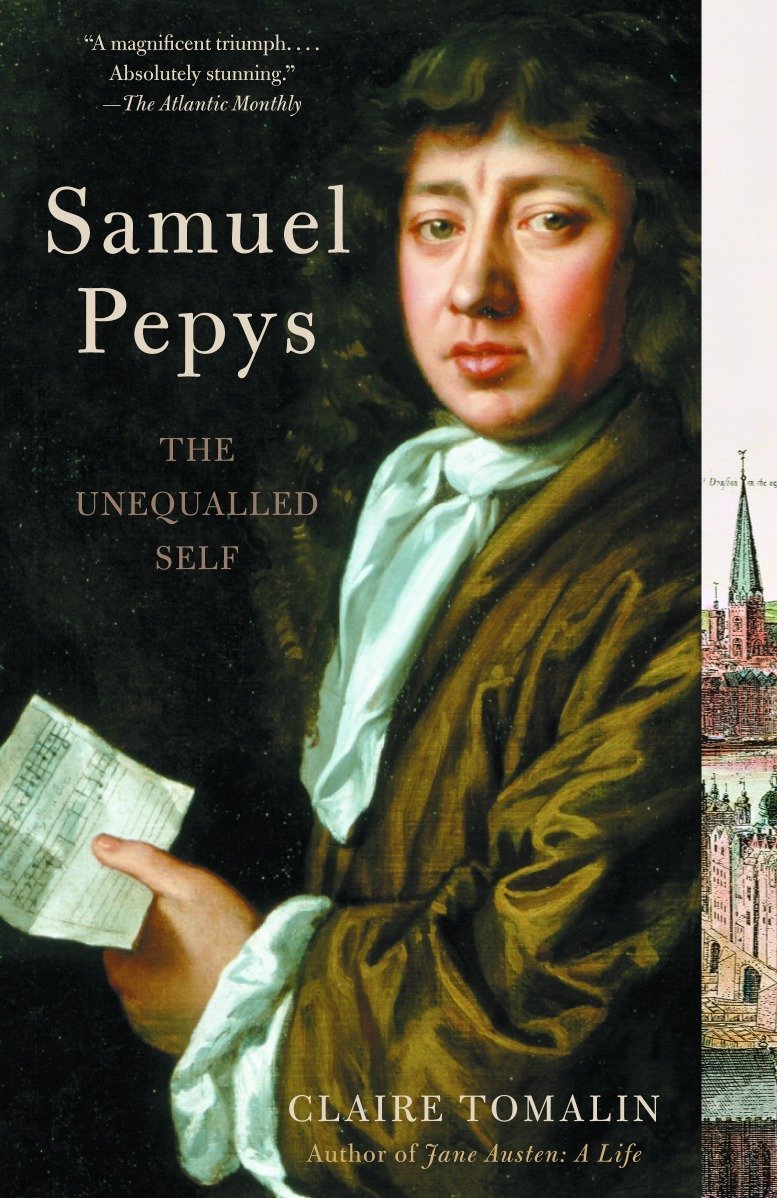
Despite the title, Hazzard’s book is not about the Great Fire of London at all- instead it’s set in Japan, Hong Kong and China in 1947 as the victorious Western powers occupy the territory. But Claire Tomalin’s Samuel Pepys: the Unequalled Self does deal the Great Fire of London because diarist Samuel Pepys wrote about it. In her biography, Tomalin gives us a rounded view of this 17th century Londoner and although many others have written about Pepys, I don’t think that anyone else could do it better than she has. My review is here.
John Lanchester’s Capital is set in Pepys Road South London in December 2007, just before the Global Financial Crisis. The book follows the little dramas of the inhabitants of Pepys Road in short chapters of just a couple of pages each. Somehow Lanchester filled over 500 pages largely about ordinary lives where nothing much happens and yet left me wanting more. I just loved it, and my review is here.
While we we’re in London, who else should we turn to but Peter Ackroyd, who has written several books about the city. London Under is atmospheric and erudite, steeped in literature and popular culture, especially that of the nineteenth century as he explores the river systems and infrastructure existing like a network under London Streets. The language flows seductively and smoothly in a very easy, beguiling read. My review is here.
Colum McCann’s This Side of Brightness is set underground as well, but this time amongst the men tunneling under the Hudson River for the subway system in 1919. I read it before I start blogging, but I really enjoyed it.
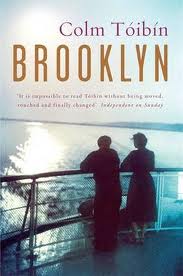
And thinking about New York leads me to Colm Toibin’s Brooklyn. I enjoyed the book enough the first time, but I absolutely loved the movie, and I went back and enjoyed the novel much more on a second reading. There is no back story; small events are told simply and in detail; every little act is described by a narrator who seems to be hovering up in the corner of the room, watching everything. It’s about a young girl who emigrates from Ireland to Brooklyn, and I felt that he described homesickness so well . My review is here.
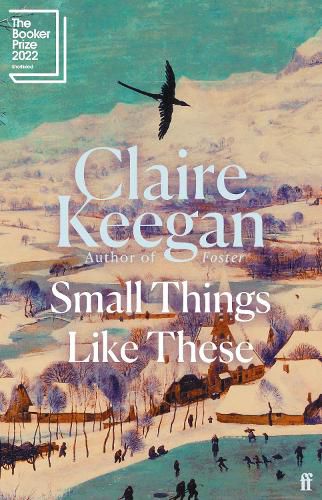
The main character in Brooklyn left Ireland, while Claire Keegan’s books are firmly set there. They are only short- they’re novellas really- but they’re so beautifully crafted. She wrote the short-story, expanded into a novella that became The Quiet Girl movie which I howled the whole way through. Small Things Like These is set in 1985 as Bill Furlong, a fuel merchant with five children who has lived in his small village all his life, becomes aware of the convent and its power over the children in its ‘care’ and the complicity of the village in turning a blind eye. My review is here.
So, although I might have been less than enamoured with The Great Fire, it has certainly taken me all around the globe!