Feting the gentleman captors
Not a lot else happened in May, other than the excitement of catching the Plenty Valley bushrangers. So grateful were the good people of Melbourne to the ‘young gentlemen’ who were feted with capturing them, that it was proposed to hold a dinner in their honour:
it is proposed to give the brave little band of amateurs who succeeded in capturing the bushrangers, a public dinner. This is as it should be: no men more honorably deserve such a mark of public respect.[PPH 3/5/42]
A venerable list of Port Phillip Gentlemen put their names to the proposal (including Cavenagh, Arden and Kerr – the editors of the Herald, Gazette and Patriot respectively)
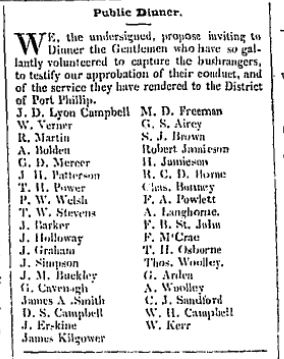
The Port Phillip Herald reported that
The Forthcoming Dinner for the captors will take place Thursday next 26th May at Royal Hotel, tickets 35 shillings each, can be obtained until Wed evening from the stewards. His Honor, Judge Willis, had signified his intention of being present, but has declined on account of the sentence not having yet been carried into effect upon the unfortunate men. The partition wall between the large front room above stairs and an adjoining back apartment will be removed [PPH 24/5/42]
But then, as the night of the dinner drew near, the editors of the Press learned that the Stewards of the dinner had decided to omit a toast to ‘The Press’, the same insult that had been levelled at them at the Governor’s Dinner as well. As a group, the editors decided to boycott the dinner. They wrote to the guests of honour:
To Messrs Snodgrass, Fowler, Gourlay, Chamberlain and Thomson. Monday 25 May 1842. GENTLEMEN As the absence of every one connected with the Melbourne Press from the dinner to be given to you tomorrow by your fellow-colonists cannot fail to be observed and commented upon, we are desirous that our absence should not be considered as indicating any want of respect for you, or any disinclination to join in a tribute we think you have well deserved. We feel it due to ourselves, however, as the representatives of the Press of the Province, to shew, by our absence from the dinner our sense of the indignity (a second time offered to us) in the exclusion of “The Press” from the list of toasts to be given, under the authority of the stewards, every other toast of a public nature which it is customary to give on such occasions, being inserted in the list which has been furnished to us. We have the honor &c Wm Kerr Ed. Patriot, Geo Cavenagh Ed. Herald, A.F.A Greeves Ed. Gazette, T. H.Osbourne, Ed. Times.
And the gentleman guests wrote back:
To Mr Kerr and the Editors of the Melbourne Journals. Wednesday evening.
GENTLEMEN- In the names of Messrs Gourlay, Fowler, Thomson and myself, I beg leave to acknowledge the receipt of your communication, and to inform you that our position, as guests to the gentlemen who have tendered us so handsome a testimonial, prevents us interfering in any way with the arrangements they may have made with the Editors of the Melbourne papers for our entertainment.
Permit me to express our regret on our hearing, for the first time, your intention to deprive us of the pleasure of your society on the forthcoming occasion, which we were led to expect from having observed the names of Messrs Kerr and Cavenagh- two of your body- on the list of those gentlemen who offered us so flattering a compliment. I have the honor to be, Gentlemen, Your obedient humble servant, Peter Snodgrass. N. B. Mr Chamberlain being absent from town prevents his replying to your letter. P. S. [PPP 26/5/42]
After the publication of the correspondence, there was a meeting of “a large number of gentlemen” who intended going to the dinner, who resolved that the toast would be proposed in defiance of the Stewards. Then the Stewards had a meeting behind closed doors on the afternoon of the day on which the dinner was to take place and they decided to propose the toasts themselves, and issued cards of admission to the reporters at 5.30 with the dinner to start at six. The editors returned the tickets with the intimation that “the Editors could not think of exposing their Reporters to an indignity, they were themselves staying away from the Dinner to avoid” [PPP 30/5/42]
And so, avoid it they did, but being newpaper men after all, the Port Phillip Herald did publish a report of the dinner after all.
THE PUBLIC DINNER Pursuant in the previously notified general meetings at the Royal Exchange Rooms, as fully reported in the columns of the Melbourne Press, a public dinner was given on the evening of Thursday, to the gallant captors of the bushrangers now in the condemned cells awaiting execution – more especially to do well deserved honor to Messrs Fowler, Gourlay, Snodgrass, Chamberlain and Thompson, to whose heroic conduct the inhabitants of the province owe such deep gratitude for the early termination of the career of as desperate a gang of banditti as ever infested the Middle District. [PPH 31/5/42]
The Port Phillip Gazette wasn’t too impressed with this break in editorial solidarity:
Our contemporary the Herald diminishes our regret at the inability to report the dinner, having published yesterday a full account of the proceedings, by its own reporter. As the note to Messrs Snodgrass, Gourlay, Fowler, Chamberlain and Thompon, signed by all the Editors, commences with these words- “Gentlemen, The absence of everyone connected with the Melbourne Press &c“- we presume it was not read by the Editor of the Herald, or it is obvious that he neither could consistently attend the dinner, nor give a report of it, because he would not have exposed his reporter to an indignity he would avoid himself. [PPG 1/6/42]
But the celebrations didn’t finish with just a dinner.
MASONIC COMPLIMENT- On Wednesday evening last, at a meeting of the Lodge of Australia Felix, Mr Stephen proposed that a token of regard should be offered to Messrs Gourlay, Fowler and Snodgrass for their heroic conduct in capturing the bushrangers. It was consequently resolved, unanimously, that Masonic Medals, according to their rank held in the order, should be presented to the above named gentlemen upon which should be engraven an appropriate inscription. Although unusual for the Masonic body to take cognizance of [indistinct] circumstances, yet from the fact of there being no less than three out of four of the “intrepid band” freemasons, the [indistinct] deem it a fitting occasion, in no way opposed to the constitution or traditions of the craft, to mark their [appreciation?] of the service rendered to the community; and the public will learn from this …that whilst Masons acknowledge [?benefits?], the fraternity are ever ready to [indistinct] their lives in protecting…their country when duty calls them into action. [PPH 28/5/42]
Duello
It was a rather propitious time for Peter Snodgrass to be revelling in all this public adulation, because there was the little matter of an appearance in the Police Court which might otherwise dimmed his lustre. I find it really strange to juxtapose boggy, unmade Collins Street, with its tree stumps still visible, and all the aristocratic geegaws of ‘cutting’ someone dead and challenging to a duel, as if they were in the streets of London.
THE DUELLO. At the Police Office on Friday last, Messrs Peter Snodgrass and John Maude Woolley were bound over to keep the peace towards all her Majesty’s subjects, but particularly towards Captain George Brunswick Smyth. From the evidence of Captain Smyth, it appeared that one the previous day he met Mr Snodgrass in Collins-street, but not being desirous to rank any longer in the list of that gentleman’s acquaintances, he had given him “the cut direct”. In the evening of the same day Captain Smyth received a visit from Mr John Maude Woolley, whom he described as anything but sober; Mr Woolley announced himself commissioned by Mr Snodgrass to demand an explanation from Captain Smyth, touching his reasons for shunning Mr Snodgrass, and in the event of his inability to assign a satisfactory reason, to name a friend with whom to arrange the preliminaries of a hostile meeting on the following morning. Captain Smyth, however, declined acceding to either course, and hinted his desire to be freed from the presence of a visitant in Mr Woolley’s condition, whereupon Mr Woolley, threatening postings, horsewhippings and all the other numerous ills a club life is heir to, left the house. In the morning Captain Smyth brought the parties before Major St John, at the Police Office, and they were bound over to keep the peace [PPP 23/5/42]
Two views of the hospital
A temporary hospital was opened in Bourke Street when it became clear that the very first hospital in William Street, open only to convicts and new immigrants, was inadequate. The Port Phillip Gazette was full of praise for the institution:
THE TEMPORARY HOSPITAL. On Tuesday last an opportunity was afforded the writer of inspecting the temporary hospital in Bourke-street, in the company of Dr O’Mullane, one of the visiting surgeons. This institution, it may not be generally known, is supported entirely on casual charity, and the funds are hardly sufficient to enable it to drag on its existence. It was originally proposed to build a permanent hospital, towards the maintenance of which it was intended to apply for the appropriation of certain revenues which are in like manner afforded to a similar institution in Sydney. A public meeting of its supporters decided that the building should not be opened until £800 had been collected by subscription; the great distress prevalent during the past hot season induced the same parties to consent to the establishment of a temporary hospital, which was placed under the control of an interim committee. The ministers of the various congregations in Melbourne, who were appointed on the committee, have been using the greatest exertions- especially, we are warranted in saying, the Rev Mr Thomson- to incite the charitable feelings of the more wealthy inhabitants in its behalf; but at various times the funds have run so short as to leave not enough even to defray the purchase of bandages and other trifling articles of daily use. The object of our personal notice is both to record the public thanks which are due to the gentlemen in the management of the institution, and to raise more abundant means for the continuance of their services. The professionalists who have charge of the patients are Drs O’Mullane, Wilkie, Meyers and Thomas; these gentlemen, as well as either of the resident clergymen, will receive the donations of the charitably inclined, and apply the receipts to their proper purposes [PPG 11/5/42]
The Port Phillip Patriot was somewhat less charitable
Several worthless characters in town, keeperss of houses of ill-fame and persons of a similar description, have taken it into their heads that the temporary hospital (towards the maintenance of which they have never contributed a farthing exception in the shape of drunken fines) is quite at their disposal whenever any of their unfortunate inmates have become incapacitated by disease or sickness from following their loathsome trade. Some of these fellows will take no refusal, but will hurry the patients up to the hospital door, bundle them in and then off, and leave them. Some days ago a trick of this kind was played by a worthless fellow named Hyams, well-known in the police records, who left at the door of the hospital in a dying condition an unfortunate woman named Maxwell, who after running a career of dissipations for several years in Hobart Town, had come here to perish. On Wednesday week another worthless fellow of the name of Young who keeps a house of very questionable fame in Bourke street, nearly opposite the Southern Cross Hotel brought a young girl, one of the inmates of his house, who was suffering severely from erysipelas in the leg, and bundled her down at the door of the hospital in the midst of all the rain, and there abandoned her. The Committee would do well to being some of these worthies before the police, and Major St John we daresay would contrive to read them a lesson they would not forget for some time. [PPP 5/5/42]
Another indigenous execution on the way
The newspapers carried news that three indigenous men were being brought to Melbourne from the Port Fairy district to face the court. It was a rather indirect route to Melbourne from Port Fairy via Launceston.
THE ABORIGINES Three aborigines from Port Fairy arrived in town, via Launceston, on Tuesday evening last, having been forwarded by Capt Fyans, from Port Fairy in charge of a trooper of the Border Police. Their names are Rogers [sic], Cock Nose and Jupiter; the former is charged with the murder of Mr Clement Codd, in the neighbourhood of Port Fairy, about 18 months ago, and the two latter with stealing and spearing sheep and cattle. Mr Seivewright, the Protector, it is said, had thrown the shield of his protection around Roger, though there is abundant poof of his guilt, and Capt Fyans had actually to resort to stratagem to get the murderer taken into custody [PPP 19/5/42]
This story has further to go.
How’s the weather?
I’m missing the first week of May, but for the rest of the month the warmest temperature was 65(17.8) on 13th of May and the coldest temperature was recorded on 24th May with a high of 48 (8.9) and a low of 39 (3.9)