Category Archives: Uncategorized

Vale Wisteria….

It’s never good when things go BANG at 7.00 a.m. on a drizzly, humid Saturday morning in January.

Oh dear. Not good at all.  Down came the pergola on the back deck, weighed down no doubt by about fifteen years’ growth of wisteria.   I had noticed the previous day that it was very dark out there, and didn’t realize how thick the leaves had become on the top of the pergola.  We used to prune it fairly hard to stop it getting up into the roof- but obviously not quite hard enough.

My wisteria gave me much pleasure.  Sure, it dropped blossom and covered the deck with its purple haze, but it smelled beautiful and the bees loved it.

We spent all weekend pulling it down.  The pergola had rotted underneath it- in fact, I suspect that the wisteria was holding up the pergola rather than the other way round.  It looks very bare and glare-y out there.  I’ve had to cover the fern with a sheet. I think I shall call it Miss Havisham.

I used to love how green and cool it was under the pergola in summer looking out from the kitchen sink.  Not quite the same now.

My deck and the large sliding doors leading into the dining room face north, so I’m keen to have another pergola with a deciduous vine, to get the winter sun and shade in summer.  I’m thinking an ornamental grape, hoping that it doesn’t have quite the voracious wandering habit of the wisteria.

But, oh dear, I do grieve its loss.  Yes, I know- first world problem.

Australian Women Writers Challenge—-I’m back

aww-badge-2015-200x300

And so here I am again, signing up for the Australian Women Writers Challenge again  for the third year.  I’ll go for the Franklin again, and I’ll try a bit harder this year to concentrate on women historians.  And just think of all the reading I can do after the thesis is finished!!

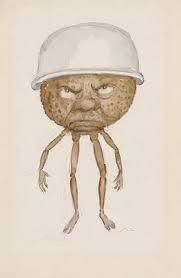
Pudding people first at Christmas

magicpudding

I have had half of last years Christmas pudding in the freezer all year. “Must eat that pudding sometime” I’d think each time it tumbled out. So here I was in December, thinking about Christmas lunch, wondering if it would be TOO bad to serve up half an elderly pudding? I decided that perhaps, all things considered, it might be.  The reality is that I’m the only person in the family who really likes plum pudding, which is why there was probably half a pudding in the freezer in the first place.    Did I really want to make another pudding only to add yet another half-pudding to the freezer?  (I suppose at this rate, by Christmas 2015 I’d have a whole pudding in two bits!)

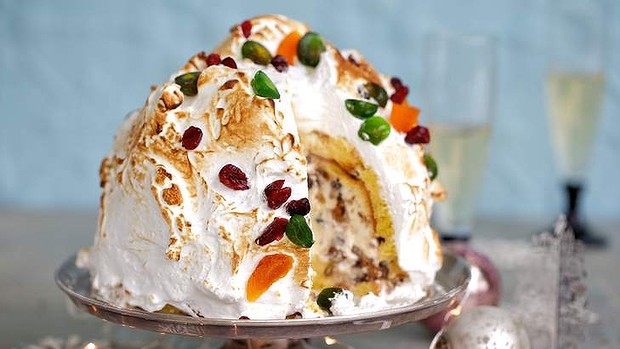
Then I spied a recipe in the Age for a Christmas Bombe.  That sounds interesting- a mashup of pannetone, ice-cream, plum pudding and pavlova. Delicious or disgusting?  It looked good in the picture.

JM-wide2-bombe-20141209120837749359-620x0

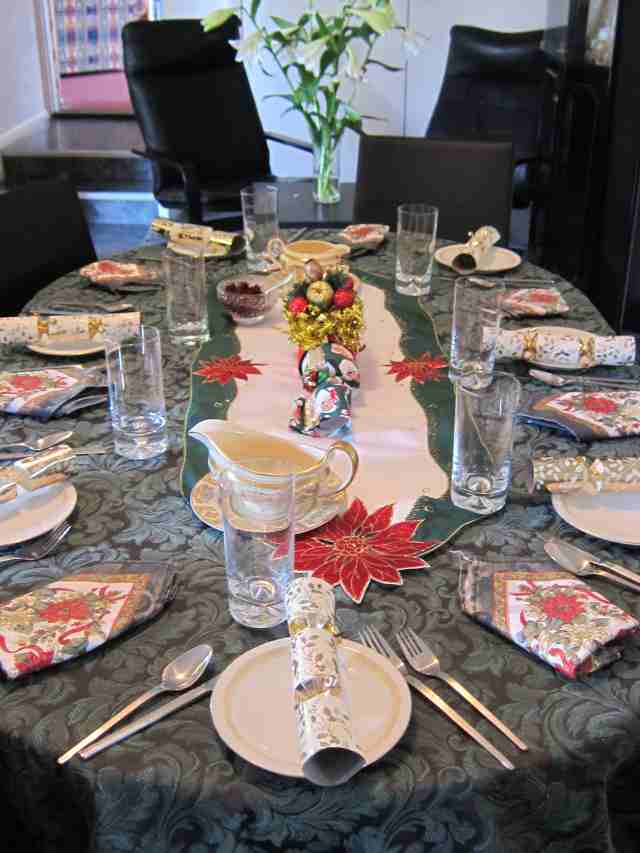
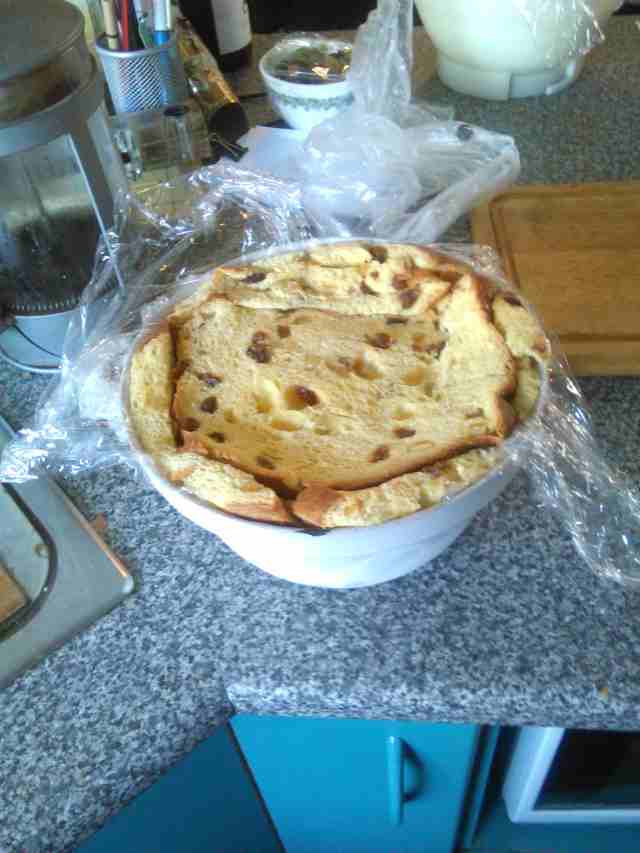
So by Christmas morning, there was a  pannetone-lined basin filled with plum-pudding icecream securely tucked away in Dad’s freezer (my freezer is too full of old puddings, you see….) ready for the great bombe-ing later in the day.  The table was set, waiting for my guests.

IMG_1209a

So, first thing to get the pudding out of the bowl.

IMG_20141225_144805a

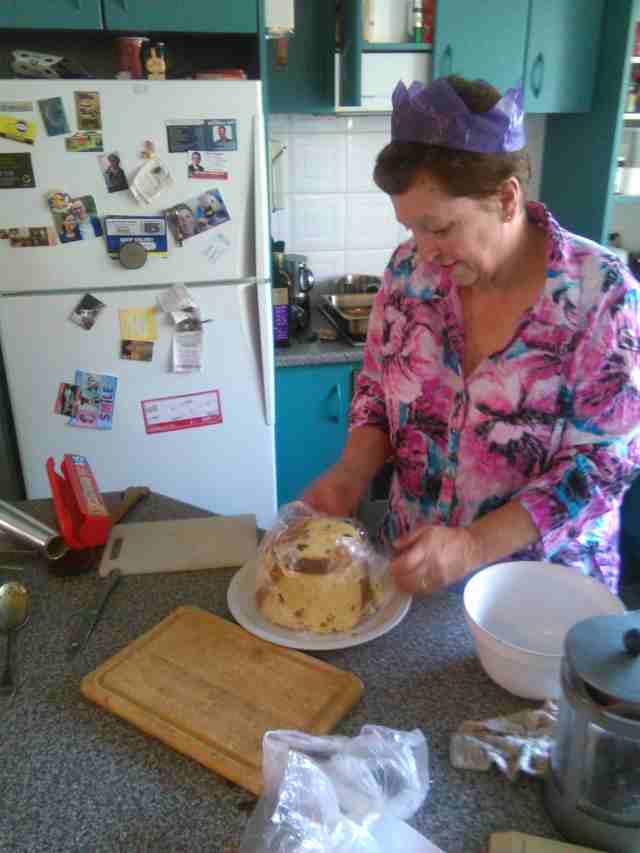
Sh*t! It won’t come out!!!

IMG_20141225_144858a

Oh yes it did. (Phew!)

IMG_20141225_144942a

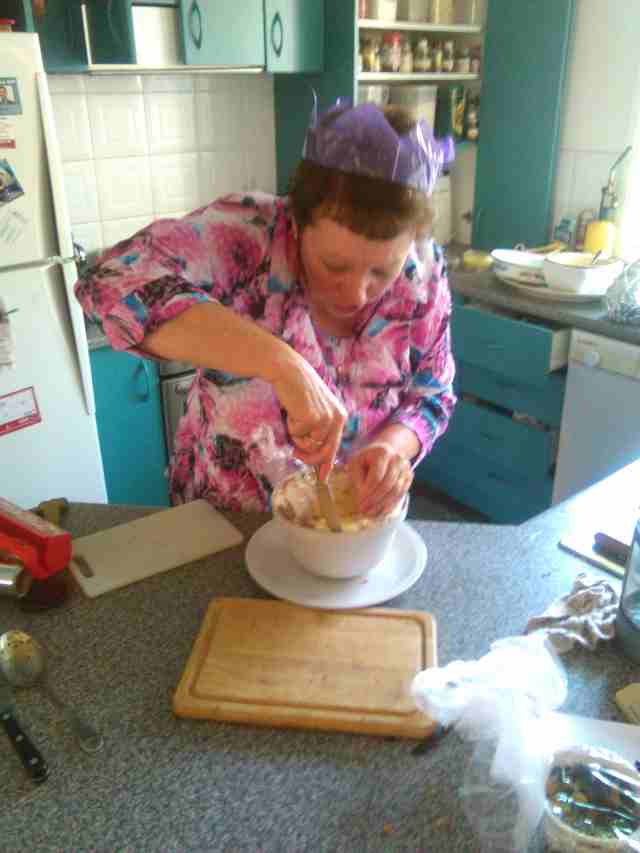
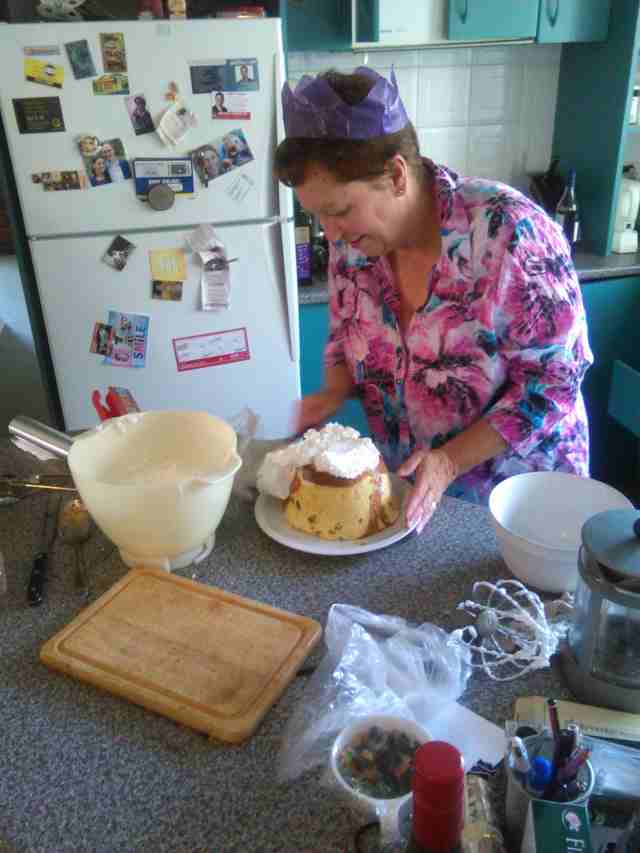
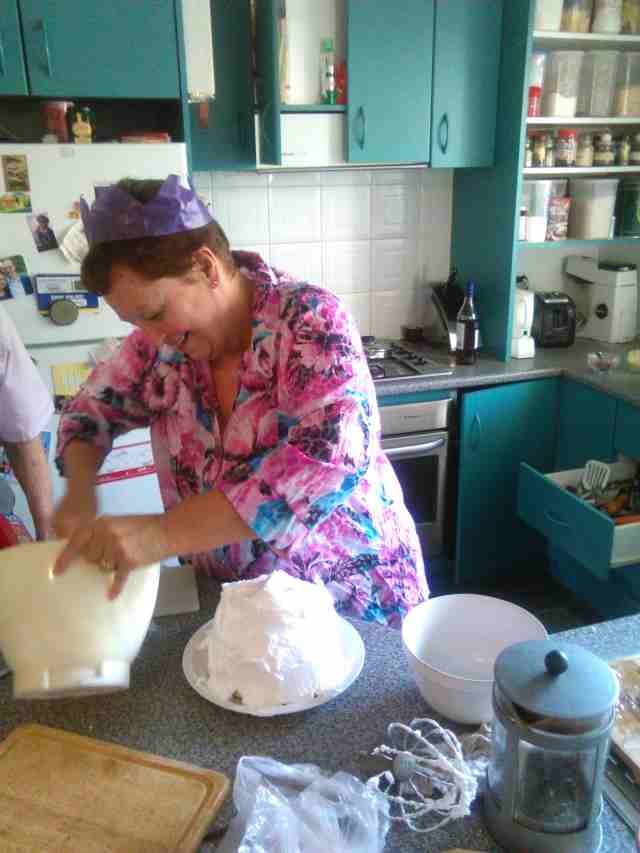
Now the great smothering with meringue.

IMG_20141225_145020a

IMG_20141225_145204a

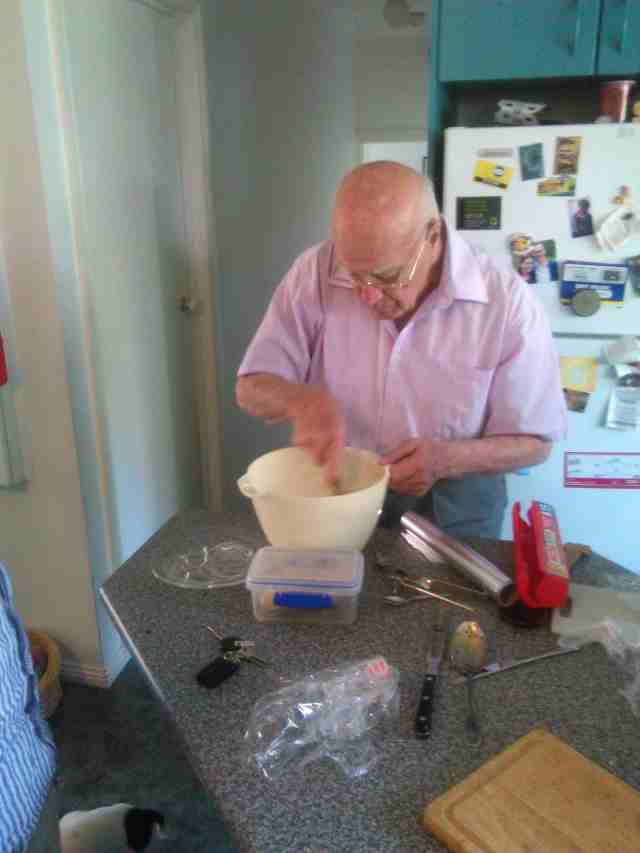
Someone can always be trusted to clean the bowl and lick the beaters. (In this case, my 85 year old father!)

IMG_20141225_145336a

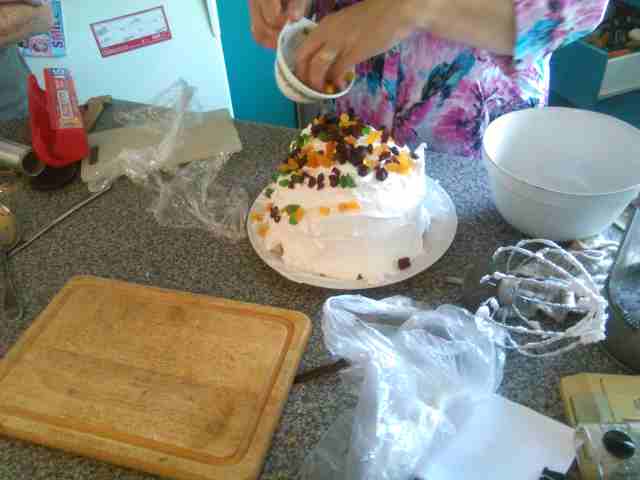
Hey, this doesn’t look too bad.

IMG_20141225_145330a

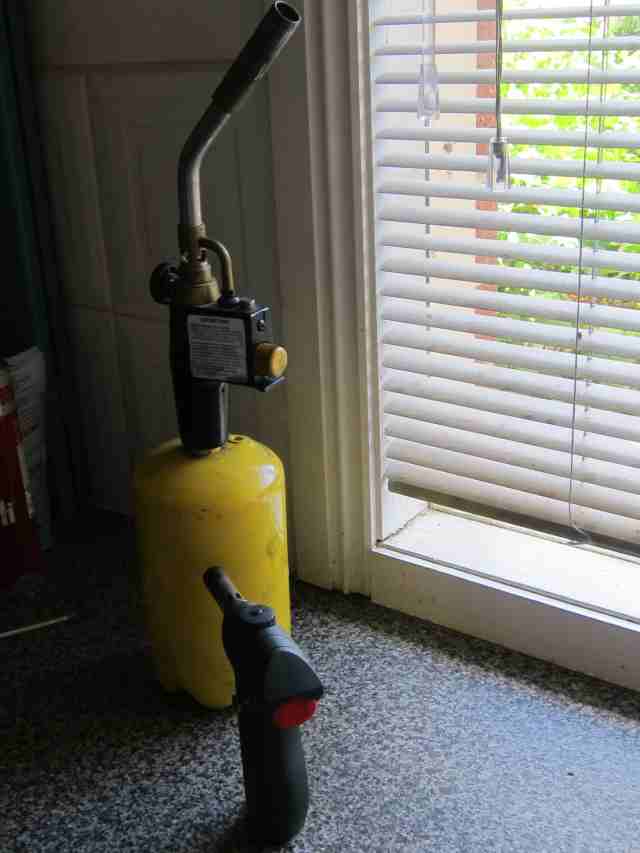
Now, for the Great Flaming.   I don’t have a kitchen blowtorch, but my stepson has two.  Not kitchen ones, though.  Which shall I go for?  The industrial-strength flame-thrower? Or the little one?

IMG_1214a

Will the big one shoot my pudding into the venetian blinds, incinerating us all?  Will the small one take an hour as a feeble flicker s-l-o-w-l-y adds a tinge of colour to the meringue?

I’m not brave.  The little one it is.

IMG_20141225_145509a

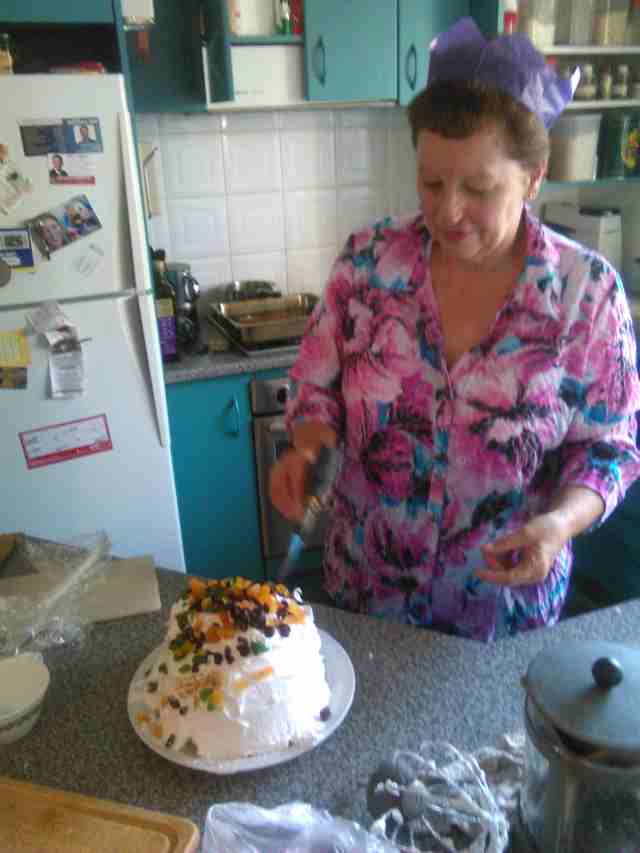
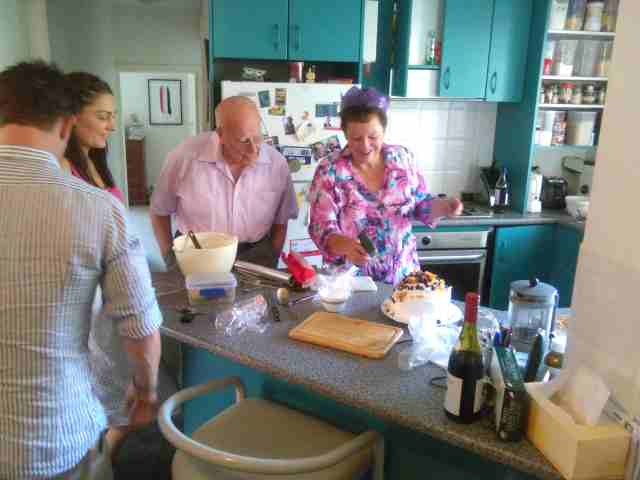
If I’m going to immolate myself as well as the pudding, you’re all coming with me.

IMG_20141225_145501a

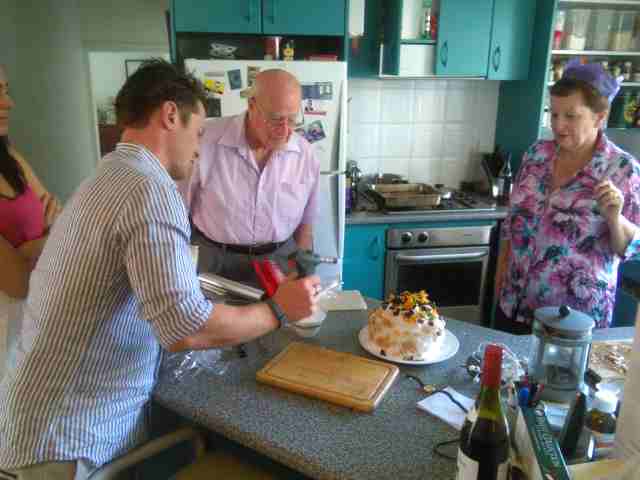
Damn. We’ve forgotten how to turn the blowtorch off.  Oh well, it will run out of gas soon.

IMG_20141225_145556a

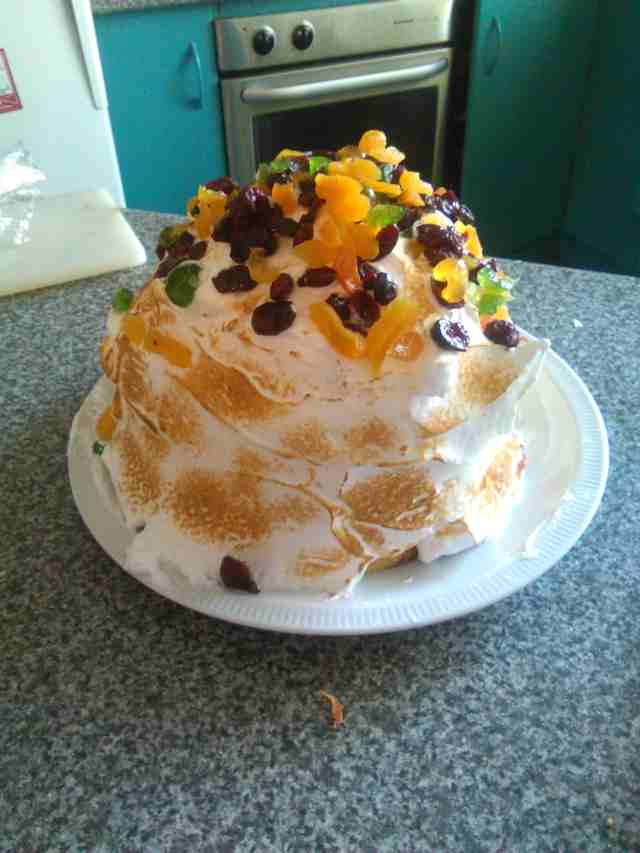
And here it is!!

IMG_20141225_145849a

Guess what? I’ve got half a Christmas Bombe in the freezer.  But, unlike Albert, the  Magic Pudding, this cut-and-come-again pudding probably won’t still be here this time next year.

After all, now that we have an Andrews Labor Government,  it’s all about pudding.

Christmas in Port Phillip 1841

We haven’t visited Judge Willis’ Port Phillip for a while.  Now that Christmas is here, let’s read an article about Christmas that was published in the Port Phillip Patriot of 1841, Judge Willis’ first year in the Port Phillip District.

CHRISTMAS IN AUSTRALIA  (Author not identified)

…Hitherto…no one has attempted to give us a sketch of an “Australian Christmas”. This festive season, in our country, has not yet been described, and in order to make up for a deficiency so glaring, I shall endeavour to convey to the reader unacquainted with our genial clime, an idea of the twenty-fifth of December in this portion of the Southern hemisphere…

…The inhabitants of this colony have adopted a great many of those customs of their ancestors and the Australians look forward to the arrival of Christmas with the same degree of fondness and veneration as a Briton. Variations in the mode of living and a difference of soil and climate may cause this season to be celebrated with less precision and minuteness here than in England. We certainly have not the same associations [?] of antiquity to instigate us, and fill us with any degree of enthusiastic ardour, yet our love of Christmas is by no means of an ordinary description…

The author then indulges in some reminiscences of Christmas back ‘home’ before remembering that it’s Christmas in Australia that he’s writing about.

During the week immediately preceding the twenty-fifth of December, every family in the whole colony appears to be thrown into a state of bustle and activity. The farmer hurries to the metropolis with his eggs, his poultry, and the produce of his lands, and purchases an ample supply of Christmas dainties for the due celebration of the approaching holiday. Raisins, currants, wines, spirits, and a large variety of other niceties, which it would be impossible for me to enumerate, are obtained by the active housewife to adorn and set off the Christmas dinner. Every one is employed in providing for the eventful day, and the ordinary avocations of society seem to be almost forgotten.

I was particularly interested in some of the comments below, most particularly the mention of Aborigines  bearing Christmas Bush.  In his book Aboriginal Victorians, Richard Broome reminds us that early Melbourne (c. 1835- approx 1841) was an Aboriginal town, with the visible presence of Aboriginal people quite a common sight.  (See Section III p. 15 of Broome’s book, available through Google preview here). Although Superintendant La Trobe issued orders in September 1840 that ‘no Aboriginal blacks of the District are to visit the township of Melbourne under any pretext whatever’, this directive was impossible to enforce.   I wonder if there was some sort of exchange going on here, with the aborigines  collecting the Christmas bush and bringing it into town, knowing that it was prized by the settlers for decorating their houses?  Were the aborigines ‘in crowds’ or were they wandering through the crowds of settlers, I wonder?

Christmas-eve at length arrives, and the scene which it presents both in town and country is of a very peculiar and pleasing description. The aborigines themselves seem influenced by the day, and may be seen in crowds strolling through the town, bearing “Christmas bushes” for the purpose of adorning the houses.

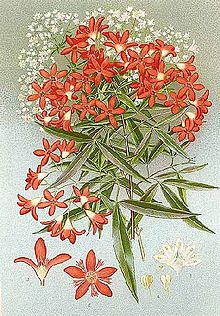
I must admit that I’m not familiar with Christmas Bush, and the writer mentions that it is no longer common around Melbourne.  I assume that he’s referring to Ceratopetalum gummiferum, but I note that it now only seems to be found in New South Wales.

[These “Christmas bushes” are plucked from a beautiful tree which is now becoming very scarce in the vicinity of our towns. This tree usually attains the height of about twenty feet, and when in full bloom has a very picturesque appearance. The bark is smooth and frequently mottled, the leaves vary from two to three inches in length, are rather narrow, and terminate in a point, have the edge indented like a saw, and are of a glossy dark-green colour. The flowers are of the cruciform species, similar in shape to a cabbage blossom, and when in full vigour are of a fine red colour. Indeed, I think the whole vegetable kingdom could scarcely furnish a more appropriate shrub than this for the purpose of adorning our houses on Christmas Day.]
Christmasbush

Here in Melbourne the weather on Christmas Day  tends to be highly variable.  I remember hot Christmas Days, but I also remember huge hail storms and some pretty ordinary weather.  Nonetheless, it was the novelty of a hot Christmas that impresses our author.

… In Australia the difference of climate causes the scene to bear a different and less animating aspect. Instead of the cool breezes and snow storms of an English winter, the sultry winds of summer and the scorching rays of an almost vertical sun, effectually put a stop to all sorts of amusement. In the towns, clouds of dust occasionally darken the atmosphere and render the weather peculiarly disagreeable. Under these circumstances every one is constrained to rest quietly within his doors, and wait patiently until the approach of night may in some degree moderate the oppressive blast. Even then there is a warmth in the air- a calm, sultry heat, which renders it totally impossible for any one to arouse himself to exertion. Instead of blazing fires glowing in the hearth, every fire-place is ornamented with evergreens; and instead of sitting opposite the burning ‘yule clog’ the peasant seats himself quietly in the open air on the outside of his humble cottage.

Well, this little ‘peasant’ here in 2014 won’t be sitting quietly in the open air outside my humble cottage.  She will, however, be relaxing on Christmas night after lunch with her family.  Happy Christmas readers – or whatever salutation you prefer.

Australian Women Writers Challenge 2014 Finished

Well, it’s the end of the year and time for toting up my reads for The Australian Women Writers Challenge again.  I had intended to read more histories written by women, and I’m rather disappointed to see that I hadn’t really read as much as I thought I had.  I do, however, have an excuse as this thesis really does need to be written.  In fact, the high number of fiction books gives a hint as to why it hasn’t been finished this year as planned.

Here they are, then:

FICTION

The Golden Age by Joan London

When It Rains by Maggie Mackellar

The Kayles of Bushy Lodge by Vera G. Dwyer

All the Birds, Singing by Evie Wyld

After the Fire, A Small Still Voice by Evie Wyld

Letter to George Clooney by Debra Adelaide

NON-FICTION  (Memoirs, biographies, non-fiction)

Velocity by Mandy Sayer

The Tainted Trial of Farah Jama Julie Szego

Boy, Lost by Kristina Olsson

Night Games Anna Krein

Housewife Superstar Danielle Wood

The Ghost at the Wedding Shirley Walker

Mrs Cook: the Real and Imagined Life of the Captain’s Wife Marele Day

Madness by Kate Richards

HISTORY

Shattered Anzacs Marina Larsson

What’s Wrong with ANZAC?  Marilyn Lake and Henry Reynolds

The Forgotten Rebels of Eureka Clare Wright

Broken Nation Joan Beaumont

And my favourites?  The Golden Age for fiction; a dead heat between Boy, Lost and Madness for non-fiction and Shattered Anzacs for history.

awwbadge_2014Posted to Australian Women Writers Challenge 2014

Imagine there’s no countries

I don’t normally get my history from the New Scientist, but there was an interesting article in the 6 September 2014 issue called “Imagine there’s no countries…” written by Debora MacKenzie.  Her article incorporated some historical approaches (Benedict Anderson etc) but also highlighted findings from the social sciences related to nationhood.  For example, here’s some rather disjointed observations from the article that attracted my attention:

Robert Dunbar of Oxford University has found that one individual can keep track of social interactions linking no more than about 150 people. He came up with this figure through studies of villages and army units throughout history and the average tally of Facebook friends (!!).  Society transcended that number by the invention of hierarchy, which meant that leaders could coordinate large groups without anyone having to keep personal track of more than 150 people.

Peter Turchin of the University of Connecticut notes that Eurasion empires grew largest where fighting was fiercest, suggesting that war was a major factor in political enlargement.  Picking up on the idea that hierarchy facilitated larger groups than the 150 figure, Turchin suggests that in addition to their immediate circle, an individual interacted with one person from a higher level in the hierarchy, and typically eight people from lower levels.

These hierarchies, of course, are not nation states.  A number of historians have concluded that states define nations, not the other way round.  For example, in France in 1789, half its residents did not speak French; while in Italy in 1860 at reunification, only 2.5% only spoke standard Italian.

When nation-states fail, they break down into civil war.  Civil wars are often blamed on ethnic or sectarian tensions, but there are other nation-states that combine multiple ethnicities and religions.  What makes the difference, the article suggests, is bureaucracy.  An interesting thought, especially given the rage that conservatives, in particular, direct towards ‘red tape’.  While we might complain about lengthy processes, queues etc. a return to  the alternative of patronage, bribery and ‘who you know’  being the basis of service provision  is pretty unappealing.

My mum 08/09/25- 17/12/10

Four years ago today.

011

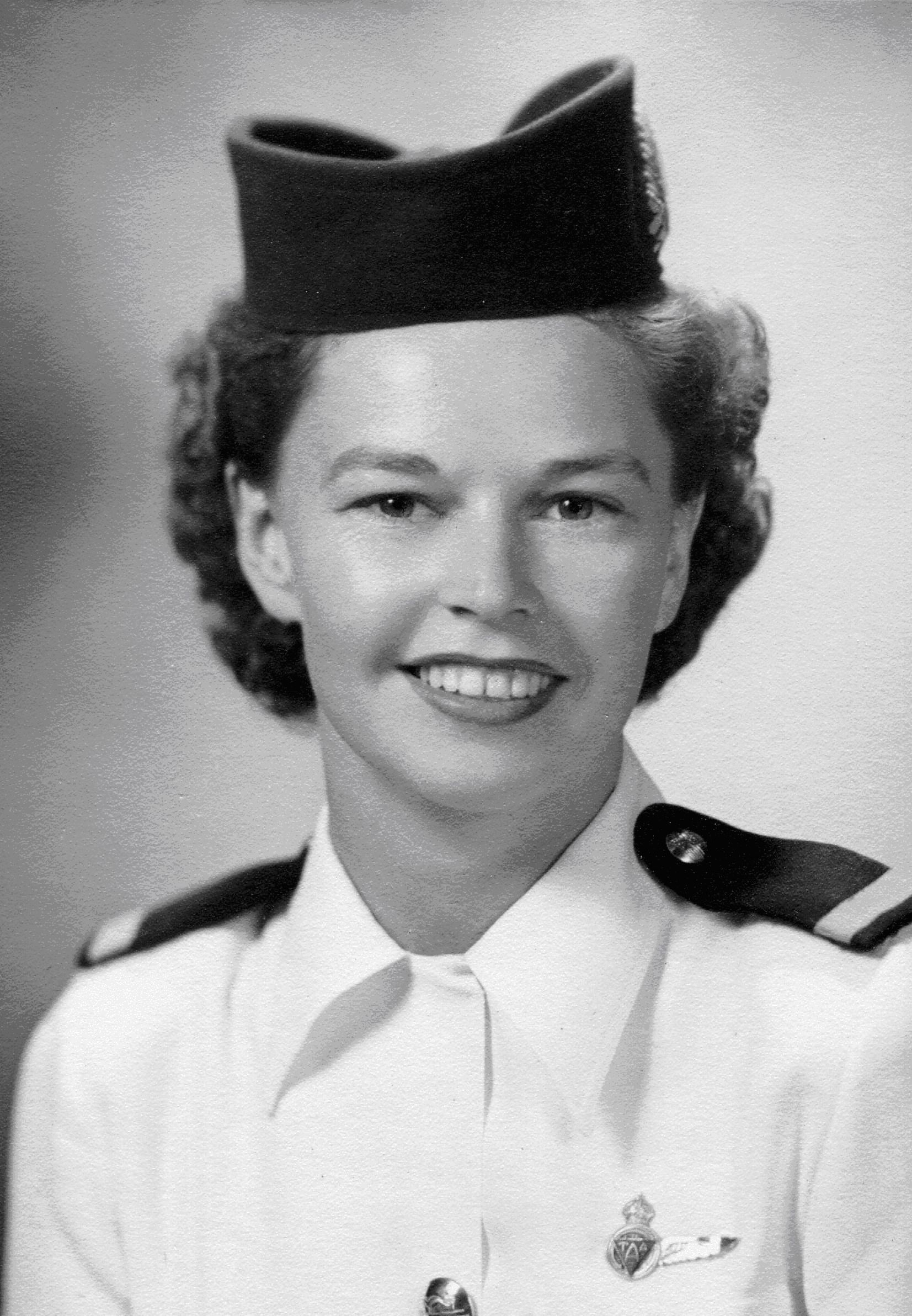
Mum was an airhostess with TAA before she married.

Warrior of the Mind- Inga Clendinnen

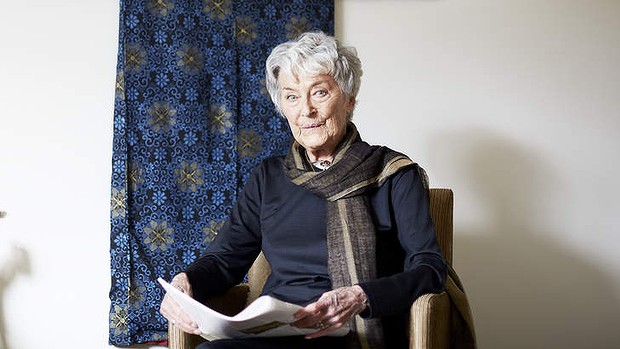
When I read this interview by journalist Jana Wendt with Inga Clendinnen – my most revered historian- I didn’t know whether to smile or weep.

To be honest, I did both.

Clendinnen2014


My response on learning of her recent death is here.


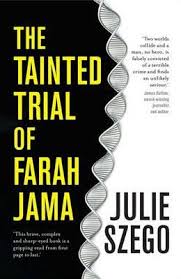
Julie Szego ‘The Tainted Trial of Farah Jama’

szego

2014, 256 p.

Our attention span for court cases is very short indeed.   There might be a splash of publicity during the committal hearing, then nothing is heard for some time.  The actual case, some months later, might attract attention if it is particularly salacious or graphic.  The sentence is given, then the main characters subside back into obscurity and you’re left thinking “Now, what was that case again?”.  Usually.  But sometimes there is something about a case that snags the attention of a passing journalist or essayist, who picks at the threads and expands our gaze beyond that particular case into society more broadly.  This book does just that.

Farah Jama was a young Somali man who was jailed for raping a woman thirty years his senior in a nightclub.  He insisted that he was not at the nightclub and that he had never seen the woman before.  The woman could not recall seeing any African men at the club that night, and could remember nothing at all about the attack.  Farah was convicted solely on DNA evidence and eighteenth months later his conviction was overturned.

In this book, journalist Julie Szego traces through the crime, the case and the circumstances that led to the overturning of his conviction.  On the way she finds herself on the edges, and eventually outside, the local Somali community as Farah becomes increasingly resistant to her questioning. He becomes determined to take his own story back with an eye to his own book somewhere down the line, and sees her as a competitor.  She finds herself bridling against his anti-woman stance, even while she can understand it on one level.  Her investigation takes her into the management practices and risk management policies of the Macleod Forensic Laboratory where the DNA was tested, and the organization’s defensiveness after several previous errors in dealing with DNA.

I think that the first book of this kind I read,  where the journalist wades into the backwater of a crime, was Truman Capote’s In Cold Blood.  I’ve read several others in recent years: Helen Garner’s Joe Cinque’s Consolation and The First Stone, Chloe Hooper’s The Tall Man and Anna Kreins Night Games.  It strikes me, looking at this list, that these later books are all written by women, and they all share an ambivalence and tentativeness about coming to a firm conclusion.  This is probably because defamation lawyers are lurking, but also I wonder if there’s not a reticence to be too black-and-white, too certain.

It’s a strange genre in that generally readers know the outcome before they even crack open the book.  The books do not appear on the shelves until some time afterwards, and they often follow a flurry of newspaper and television coverage at the time of the crime and then at key points in the resulting trial.  The writer herself (or himself, in the case of Capote) becomes part of the story as well and often has to face her own prejudices and doubts. There’s often a larger picture as well: the football culture, black/white policing relations, the sharp edge of perfection, feminism and in this case, Somali ‘integration’.

This book is an easy read, told in an easy conversational style. There are chapters, but the narrative is presented in small segments within a broadly chronological structure.  The focus shifts from one participant to another, and in this case, there are no baddies as such, only powerlessness and an underlying question of racism.  Questions are raised, of course, about the dubiousness of the prosecution in the first place, and the reliability of DNA evidence.

Sometimes I watch television reports of the sentencing statements given from the bench after a particularly newsworthy crime.  The judge often mentions that the accused “showed no remorse” as a factor for increasing the sentence. That seems odd to me. Why would a person who claimed that they had not committed the crime- especially to a stranger- be expected to show remorse?  Perhaps a detached, abstract sympathy, but no remorse.

Farah Jama has every right to be angry.  I guess that we can take some small comfort that everything worked out in the end, although we have no right to expect him to feel that way.  The ease with which any questions about his original ‘crime’ were deflected is unsettling.

awwbadge_2014I’m posting this review to the Australian Women Writers Challenge.

Abbott on MH-17

I see in an opinion poll today, that Abbott has been ranked well above Barak Obama and David Cameron on showing leadership in the wake of the MH17 disaster.  I note, too, that in terms of who respondents would prefer to stand up for Australia’s interests overseas, Bill Shorten came out on top. 

The results comparing world leaders do not surprise me at all. Neither Obama nor Cameron seem to be making it an issue of national identity in the way that Abbott has, given the relatively few victims from either of those countries.  A more sensible comparison would be with the Dutch and the Malaysian leaders, both of whom represent countries that have suffered, but who have expressed their sorrow without the hairy-chestedness of Abbott.

I do not feel at all reassured by Abbott’s handling of this tragedy. The man’s judgment is off. I have no affection at all for Putin, and I strongly suspect that evidence will point to weapons provided by Russia, but let the evidence fall where it will.  And it’s all about evidence.

In the immediate aftermath, on the basis of no evidence whatsoever, Abbott declared Russia’s involvement:

I stress: it is not an accident, it is a crime, and criminals should not be allowed to get away with what they’ve done,” Mr Abbott said. “So, there has to be a full impartial international investigation and Russia should certainly not be allowed to stand in the way of that just because the aircraft has come down over territory controlled by Russian-backed rebels….

We also know who is very substantially to blame for those problems, and the idea that Russia can somehow say that none of this has anything to do with them because it happened in Ukrainian airspace frankly does not stand up to any serious scrutiny.

“I want to say to the Australian people that as far as I am concerned, when you have a situation where Russian-backed rebels appear to have killed Australians using, it may well turn out to be, Russian-supplied heavy weaponry, Australia takes a very dim view indeed and we want the fullest possible investigation….

“I just want to say that it is absolutely imperative if Russia is to maintain any international standing at all that there be complete Russian co-operation with this,” he said. “No provocation, no excuses, no blame-shifting, no protecting of people who may be backed by Russia but who may have been involved in this terrible event….

 
This instant rush to judgment is Abbott’s alone: both the Dutch and Malaysian heads of state cautioned the need for evidence.  No such qualms with Abbott.
 
Bill Shorten interjected his own bit of hairy-chested nonsense with his suggestion that Putin would not be welcome at the G20 and Abbott quickly adopted it as a “fair question”.  It’s not.  Australia may be hosting the G20, but Russia’s presence is not a matter for Australia alone.
 
Our response has been militaristic from the start, dubbed “Operation Bring Them Home”.  Then there was the declaration that we would be sending armed police to “secure the site”.  Oh we don’t want to get involved in the politics, says Abbott, we just want to bring our people home. As soon as Australian weapons are carried onto that soil, it’s political alright. Fortunately that thought bubble seems to have lapsed and wiser heads have prevailed.
 
He seems completely oblivious to the fact that there is a war going on over there. I note that neither the Ukranians nor the rebels have stopped fighting: in fact, the Ukranians seem to be stepping up their attacks to regain territory.
 
Australia did make good use of its Security Council seat to garner unanimous international support for an impartial enquiry: a Council seat that the Coalition had sneered at previously.  All this concern for international protocols is rather galling given the deliberate disregard for similar international protocols in relation to refugees.
 
It’s a good reality check to listen to European reports of the recovery effort: try BBC, or Deutsche Welle.  There you’ll learn that it is the Dutch-  those Dutch who have treated the victims with such grace and dignity, those Dutch who in the midst of their sorrow held back from lashing out until the evidence is in- who are taking the lead here.  Just as well, too.