Category Archives: Uncategorized

And here we go again….

Well, well, well- look at what’s back on the market.

Banyule Homestead.

Banyule2015

The advertisement with more beautiful pictures is here.  The auction is scheduled for 16 May 2015.

For more about the history of Banyule Homestead, please visit my other site:

banyulehomestead.wordpress.com

What Cooda that song have been?

We were sitting in the car on the way to the supermarket on Saturday morning, listening to the Coodabeens on the radio.  The Coodabeen Champions is a comedy sports show which features Greg Champion’s parodies of popular songs, with the reworked lyrics often submitted by listeners.  So there we were, humming away and laughing to a song from the 1970s, and when we turned to each other and asked “What was the name of the original song?” neither of us could remember. I hummed it, he whistled it (because I can’t whistle) but the chorus just wouldn’t spring to mind.  I had a feeling that it was an Australian group (I had Black Sorrows lurking around there somewhere), although it sounded a bit like Jethro Tull’s ‘Thick as a Brick’.

Ah Google- what did we do before you? I downloaded a podcast of the second hour of the show, having deduced that we were listening at about 11.30 am.  When I listened to it again, all I could remember was the line “the season goes so quickly” (which also featured in the parody) and that was enough for Dr. Google – the answer is:  Seasons of Change by Blackfeather.

Blackfeather was a band that had many, many changes in lineup and in 1970 it recorded their album ‘At the Mountains of Madness’ with Infinity Records.  According to the Australian Music History website

On this album was a song that was to become not only a hit for two different bands, but also proved to be the catalyst for another major problem within the band. The song “Seasons of Change” was recorded using a couple of musicians from the band Fraternity, Bon Scott and keyboardist John Bissett. Bon had sung some backing vocals and had played recorder on the track. He loved the song and asked could he record it with Fraternity. A deal was eventually struck that allowed Fraternity to record it and release it as a single on the understanding that Blackfeather would not release their version in competition. Unfortunately, against the bands wishes, the record company reneged on the deal as soon as they saw how popular the song was. This caused a major rift between the band and the record company which eventually led to more lineup changes.

I was only aware of the Blackfeather version:

So the Fraternity version, headed by Bon Scott (of later AC/DC fame) came as a surprise to me. It’s much slower, with a rather gentler Bon Scott than we’re used to seeing:

Well, well. The things that can be dragged up out of the past from a Saturday morning listen to the Coodabeens!

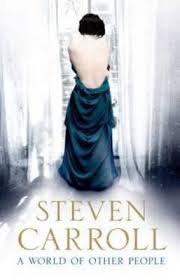
‘The World of Other People’ by Steven Carroll

carroll_worldotherpeople

2013, 278 p.

I recognized the author’s name and remembered that I’d read some of his books before. I was drawn in by the prospect of a book set in the Blitz in 1941, a setting that I find fascinating, so I borrowed it.  I only had to read about five pages in to remember that, yes, I have read several Steven Carroll books before and I had a love/hate relationship with every single one of them.

This book is no exception.  Steven Carroll writes in the present tense, swapping from one character to another, and alternating between second and third person.  I dislike the use of the second person  and I have mixed feelings about present tense. His books are very visual, centred on a particular image to which he keeps returning.  Like a sewing machine darning a hole, he keeps going back and forth, back and forth, embroidering and over-stitching an image or an event.

As soon as I remembered this narrative voice, I remembered how much I disliked it.  Nonetheless, I kept reading and I’m glad (I think) that I did.   It’s a beautifully written, poignant story and I felt sad to finish it.

Iris is a young Oxford Graduate and aspiring writer, employed as as a civil servant by day and aa fire-watcher by night during the Blitz. Along with a clutch of other people including the poet T. S. Eliot, she waits all night on the rooftop of the Faber and Faber building, watching for bomber planes and their fiery load, and directing the fire trucks to the conflagration.  She doesn’t know it, but the Blitz proper has already ended, but one night she and her fellow watchers see a plane swoop down low -too low- over the city buildings. Minutes later they hear a dull explosion. She catches T. S. Eliot’s eye and realizes that she is seeing Eliot at work right there, in that moment,  as writer as he grabs an experience that will later be transformed into poetry.

A year later, in the ruptured world of war-torn  London, she meets Jim, an Australian pilot in Bomber Command, who has been invalided  out of flying duties after an accident.  They meet and fall in love.  I shall say no more, lest I give the story away.

Books and writing are an important theme in the book, and T. S. Eliot and his poem ‘Little Gidding’ (which I must confess, I have never read) play an important part in the story. As a result, I think that much of the ‘cleverness’ of the book went right over my head, and so I just read it straight, completely unaware of any layers of meaning below the surface.

The book has obviously been carefully researched, but it wears it lightly.  By inhabiting at various times both Jim and Iris’s consciousness, Carroll has given us well-rounded, complex characters, and the plot pulls you to what you know is going to be a tragic end.  The ending solves a little conundrum set up in the opening pages in a very satisfying way.

This present-tense voice and habit of perseveration is obviously Carroll’s narrative ‘thing’ and it’s unfortunate for me that it grates  so harshly. I feel as if he’s almost writing to a template, where the setting and events change but the voice goes on and on.  Nonetheless,  I enjoyed the book in spite of the way it was written, which I suppose is testament to the strength of the  characters and story.  I must remind myself next time I pick up a Steven Carroll book  that I really don’t like the way he writes, and that I should just put it back onto the shelf.

Ah- another woman with her back to us.  The image has little connection with the story.

Andrew Furhmann has written a far more detailed and intellectual review (full of spoilers)  which can be read at the Sydney Review of Books. His review makes me feel rather embarrassed that I missed so much in my very surface reading of the book.

What would Willis do….about Queensland?

When observing legal doings in our current day, the thought often strikes me “What would Judge Willis do?” – if he hadn’t sailed from our shores 172 years ago, that is.  As a Judge with a keen interest in his brother judges and the government of the day, I think he’d be very interested in what’s going on in Queensland at the moment.
You may remember that there was much controversy over the former Attorney General Jarrod Bleijie’s appointment of Tim Carmody to the Chief Justice position.  Tim Carmody was the Chief Magistrate, so that was quite a leap up the judicial ladder.  The President of the Bar Association resigned in protest at the appointment. Of course, there has been an election in the meantime, and a new if rather precarious government elected.

So, how will this controversially-appointed Chief Justice go? I wonder.

The Guardian has an interesting article by Richard Ackland, which reports some eye-brow raising comments made in a valedictory speech by retiring and well-respected Supreme Court judge, Alan Wilson.  After thanking the Chief Justice for making the space available for the farewell function, he said that he would not have embarked on the proceeding if the Chief Justice had been presiding. But that was not the end of it, he said:

I wish to say some more things that will colour these proceedings in a way with which some may disagree, or find upsetting. I have agonised about this. In saying what follows I speak entirely for myself, and express only my own views and opinions without the foreknowledge or approval of any of the judges. None of them has seen these remarks, in draft or at all. I want to speak about the leadership of the court.

The speech is available in full here, and well worth a read.

I think Judge Willis would be in his element.

And the footy season begins again

I love the first round of the footy season.  To be more specific, I love the first five minutes of the first match of the first round of the footy season.  For just five minutes,  we’re all equal on zero points.  The premiership is within grasp for every team- even the wooden spooners, who this year happen to be my team, St Kilda.

Oh dear, I think that it’s going to be a very long season or two or three for my Sainters.  I confess to shedding a tear when we were beaten in our last Grand Final appearance in 2010 , fearing that I probably won’t live long enough to see them win another flag. I saw ‘another’ advisedly, because they’ve only won the premiership once in 118 years as an inaugural member of the Victorian Football League.  Some years ago my children bought me a limited edition St Kilda poster which was part of a series produced by the AFL showing the number of premierships that each team has won.

IMG_1548

Such elegant starkness, that one premiership.  Not tacky and over-crowded like some of those other teams’ posters.

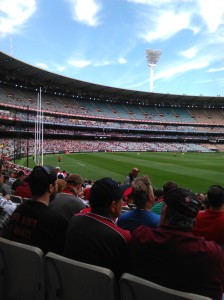
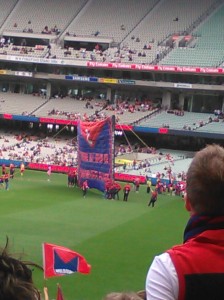
Anyway, first round and a rare phenomenon in recent years: a match at the MCG on a Saturday afternoon.  Mr Judge barracks for Melbourne, and I suspect that this year I am going to have to look for comfort to Richmond and Melbourne,  my two ‘second’ teams.   So off we toddled to the ‘G on a balmy April afternoon, with the leaves in Yarra Park just beginning to turn, the slight whiff of bush burn-off in the air, the sun warm but not hot.

The AFL has repented of its sins in recent years by scheduling more matches at the MCG, lowering the prices of pies and, it seemed to me, reducing the number of nagging announcements about what you CAN’T do at the MCG.  One thing I didn’t like, though, was the neon-lit injunction to ‘Make a Noise for the Demons’ that ran around the fence surrounding the oval before the match. They had similar announcements at the baseball match we went to in Toronto back in 2011, and I remember thinking that at least football fans didn’t have to be instructed to barrack. Maybe not.

Well not yesterday, anyway because what a match it was!  You had the feeling that -perhaps- this is a football club that has languished at the bottom of the ladder for a few years just beginning to stir!  “It’s a grand old flag….”

And look at the ladder proudly headed my two ‘second’ teams !

IMG_1549

It’s not really being disloyal, is it?  I’m just having a little flirtation while my true love is away on a very, very long holiday.

Back ‘er up

What is it with all these books with a woman’s back on them?  Perhaps images are cheaper if they’re facing the other way.  I shall make a collection, I think.

This slideshow requires JavaScript.

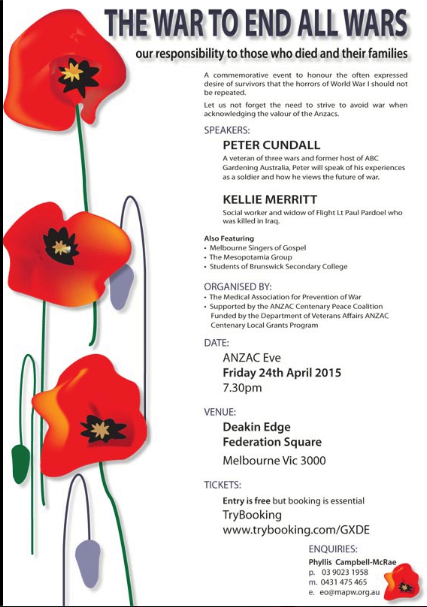
ANZAC Centenary Peace Coalition – Second forum

Where I’ll be tonight:  Melbourne Peace Memorial Unitarian Church, Grey Street, East Melbourne

peacecoalition2

‘When We Have Wings’ by Claire Corbett

corbett

2011, 480 p.

I must confess that I’m not a great speculative-fiction reader, although my husband is.  I like the idea of it- the interplay of scenario, plot and character- but somehow one of them seems to miss out.

The scenario that underpins When We Have Wings is that medical technology and genetic manipulation has enabled those with the finances and desire to have wings grafted onto their backs. This self-selected elite is able to soar, literally, above the rather brutish and ugly city below, giving only grudging access to their beautiful architecture and affluent culture to the wingless, earth-bound masses below.  It’s not clear what country the book is set in, although the reference to RARA (Rural and Regional Areas) suggests that it’s Australia, although obviously nation is no longer important in a society so hierarchically ordered by the class and status denoted by wings.  Access to the city is limited and those without wings are relegated to service positions only, while outside the city boundaries, environmental change and the stripping out of wealth leaves a grubby and increasingly violent and deprived underclass. It’s set in the future, but it’s a future that is highly recognizable to us.

The book is told from two perspectives.  The first is that of Peri, a young girl employed as a carer for baby Hugo, although it’s a much darker arrangement than this  She is rewarded by her employers with wings, and it is with these wings that she absconds with Hugo.  She is rescued by a group of rebel flyers who, while revelling in their wings, are resisting the corruption of the flying elite. The second perspective is that of Zeke, the wingless private detective who has been employed by Hugo’s father,  to search for her.

The book has many things going for it: an engaging and rich premise; a female main character who reveals tenderness and fear; a bit of sex; a bit of a detective thread. Unfortunately, it’s also very long.  I found myself wishing that there had been a sharper editorial pen deployed here, slashing some of the description of flight mechanics in particular.  It’s 480 pages in length, and I’m just not sure that there’s enough emotional meat here- as distinct from ideas- to sustain such a long book.

aww-badge-2015-200x300I read this as part of the Australian Women Writers Challenge for 2015.

‘This House of Grief: The Story of a Murder Trial’ by Helen Garner

garner_grief

2014, 288 p.

This has been yet another of the  books  that I’ve purchased and had sitting in its little brown paper ‘Readings’ bag waiting for a self-indulgent Christmas-time read, long after everyone else seems to have read it. Helen Garner seems to evoke strong reactions in her readers. I don’t think that it’s just that she chooses controversial topics: I think that it’s Helen Garner herself that some readers object to.  As for me- I wish I knew her, although I suspect that she’d bridle against the thought that she could be claimed by a reader, and I think I’d feel a bit intimidated by her. I like the way that she puts her head on one side and considers hard…but then comes to a decided opinion.  I like her occasional tartness and her willingness to revisit her own judgments.

Any Melburnian could tell you about the Farquharson case- an appalling “accident” on Fathers Day 2005, where three young boys drowned when the car driven by their father after an access visit went off the road and ran into a dam. The father suffered a coughing fit, he said; an explanation accepted at first by his ex-wife at the first trial, but she later changed her mind. It was a convoluted legal process, involving a trial, an appeal and then a retrial and Helen Garner attended it throughout, drawn by equal parts of fascination and incredulity.

The subtitle to Garner’s book is “The Story of a Murder Trial” and the book largely consists of her observations of the theatre of the court as this performance of administering justice wends its slow, deceptively soporific way through questions that go to the heart of love, family, obsession and betrayal.  What a good observer she is-  the square faces that people pull when they’re trying not to yawn; the impatient ‘come along’ grasp of a sister pulling her adult brother through the press pack that sets itself up along the Melbourne footpath outside the court for the nightly news. Garner has her opinions: she judges.  I wonder if the witnesses who appeared in the stand have read this book and found themselves stripped bare by her eagle eye.

She’s very good.

aww-badge-2015-200x300I’ve posted this to the Australian Women Writers Challenge for 2015.

‘Restless Men: Masculinity and Robinson Crusoe 1788-1840’ by Karen Downing

downing_restlessmen

Basingstoke, Palgrave Macmillan, 2014, 175 p & notes

ISBN9781137348944 (hbk.)

Allow me to rave. I’ve just finished reading Karen Downing’ book, Restless Men and I’m in awe of its breadth, intellectual complexity and insight that has made me look again at the writings of the immigrating men who came to Australia’s shores.  I always think that’s a good sign in a history: you re-read documents and stories that you’ve encountered before with new eyes, and find yourself giving a little nod in acknowledgment to the historian as you do, wishing that you could nudge her and say “Look- there’s another example!”

History is full of restless men. Constantly active, averse to being settled, they have been explorers, traders, pirates, crusaders and invaders, the forgers of empires that have come and gone across time, heroes and villains.  Such men- if not the drivers of history, at least its colour and movement- have been so ubiquitous that constant activity seems to be part of the essential character of men themselves.  Fiction, too, is full of restless men. From the ancient Greek hero Odysseus to the crew of the Starship Enterprise, imagined men have been forced, coerced and have chosen to leave home in the name of patriotism, protection, profit and pleasure.  The most enduring of these literary figures is the protagonist of Daniel Defoe’s Robinson Crusoe, first published in 1719. (p. 1)

Again and again, Downing finds examples of young (and not so young) men braving the seas to the colonies who identify with Robinson Crusoe, a book that they had read in their childhood which had become a wider part of the contemporary consciousness of the 19th century.  Wild escaped convicts (think William Buckley) were dubbed real-life Robinson Crusoes,  William Joyce, a young mechanical engineer fired up by the letters he had received from Port Phillip from his brother declared in his memoirs that “I felt I was going to be a sort of Robinson Crusoe” (and so he brought a huge amount of luggage out with him lest he run out!); explorers called themselves Robinson Crusoe.   Defoe’s book itself did not make men restless, but it captured the tension in men’s lives of the time between material circumstance and dreams, traditions and adventures, wildness and domestication.

In structuring her book, Downing deliberately eschews a straight cause-effect relationship, and a similarly simplistic here-to-there trajectory.   Nor is she treading a well-worn path: her book is an exploration of masculinity that doesn’t engage in the question of separate spheres, or the construction of male identity vis-a-vis women.   Instead, she focusses on the ideas of manliness between men.

Chapter 1 Confined by the Gout- Perceptions of Men’s Physical Health describes the perception that civilization and industrialization were seen as a threat to men’s bodies, with the health-giving colonies often seen as a panacea.   Chapter 2 The Ecstasies and Transports of the Soul- Emotional Journeys of Self-Discovery turns to men’s letters, journals and memoirs to capture the tropes of fiction (and especially Robinson Crusoe) in describing the emotion of leaving home.

Chapter 3 My Head Filled Early with Rambling Thoughts- Raising Boys and Making Men examines the theories of boy-raising current at the time. She looks particularly at the literature they imbibed as part of their education that valourized restlessness at the same time as driving them into conformity. Chapter 4 Satisfied with Nothing But Going to Sea- Seafaring Lives and Island Hopes examines a response to this restlessness through seafaring in empire, focussing particularly on island experiences and the Bounty mutineers in particular.

Chapter 5 To Think that This Was All My Own- Land, Independence and Emigration grounds (literally) this restlessness into the promises held out for land, adventure and independence by the emigration literature and colonization proposals of the early 19th century.  Chapter 6 The Middle Station of Life- the Anxieties of Social Mobility  explores the uneasiness between the dreams held out to restless men and the confining, restricting effect of the brittle distinctions of rank and order that were replicated in the colonies.  In Chapter 7 A Surprising Change of Circumstances – Men’s Ambivalent Relationship with Authority this ambivalence is extended into an examination of the debates about crime and punishment and loss of autonomy- a particularly loaded debate in an ex-penal colony. Chapter 8 The Centre of All My Enterprises- the Paradox of Families explores the paradox that many of these restless men were, like Robinson Crusoe, torn between wanting to establish and maintain a family as much as they wanted to escape familial obligations.

As you can see, this book traverses unusual and unexpected territory.  There are themes that run across it as well – adventure, land, independence- with their different and contested meanings.  It ranges broadly across a wealth of writing, and while limiting her view to the Australian colonies, her argument works for the other settler colonies as well.

Early Port Phillip teemed with these restless men and I’ve met them during my own work on Judge Willis– the young Burchett boys, some of the financial adventurers among the Twelve Apostles, and a whole host of the first generations of Port Phillip arrivals.  They brought their restlessness with them, and it affected the nature of a new colonial society. At the same time, I’ve taken her argument and held it against the mobility of the colonial civil servant, and found it a useful counterpoint.

This is an academic text but I’m regretful that the expense of this book means that only those with university library borrowing rights are likely to read it: even the Kindle edition is prohibitive- how can that be?  It’s a shame, because it’s an enjoyable read in its own right.

aww-badge-2015-200x300I’ve reviewed this book as part of the 2015 Australian Women Writers Challenge under the history/biography/memoir category.