Category Archives: Uncategorized

The Statement from the Heart

The Garma festival, held each year in Arnhem Land, took place last week. In its own words,

Garma attracts an exclusive gathering of 2,500 political and business leaders from across the globe. YYF is committed to improving the state of Indigenous disadvantage by engaging business, political, academic, and other leaders of society to shape global, regional, and industry agendas.

This year the theme was “Truth Telling”.  A number of speakers made reference to the ‘Uluru Statement’, a beautifully written, important report from the Referendum Council, which had been appointed by the government and comprising indigenous and non-indigenous representatives. You can read the Final Report of the Referendum Council here. Even if you don’t read the whole report, read the Uluru Statement from the Heart.

It was delivered to government in May 2018 and almost immediately quashed.  The speed and apparent finality of its dismissal by the government was damning. The Great Australian Silence descends again.

But there’s talk. Noel Pearson  spoke. And Richard Flanagan wrote.  Read it.


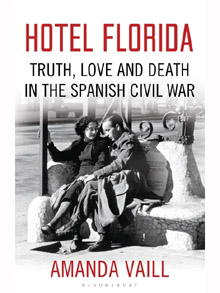
‘Hotel Florida’ by Amanda Vaill

Hotel Florida by Amanda Vaill.jpg

2014, 464 p.

I read this book solely because I was going to Spain. Beyond what I’d read in Ghosts of Spain, I knew very little about the Spanish Civil War beyond Guernica, the idea of it being a dress-rehearsal for WWII and the participation of writers and intellectuals who went there to fight. So I have no opinion either way about the completeness of Vaill’s account, her felicity to the sources and the robustness of her argument.  I leave all that to historians of the Spanish Civil War. I read it just “because”.

In her author’s note, she notes “Hotel Florida is a narrative, not an academic analysis”. However, as the lengthy notes at the end of the book show, this is a heavily researched book, steeped in the sources. The linchpin of her narrative is the once-deluxe Hotel Florida, a hotel in Madrid, frequented by government figures and journalists.  The six main ‘characters’ of her book all stay there at one time or another: writer Ernest Hemingway and journalist Martha Gellhorn, war photographer Robert Capa and Gerda Taro (you can see some of their photographs here) , and press officers/censors/propagandists Arturo Barea and Isla Kulscar. These three couples are all real-life people (even though I confess only to being familiar with Hemingway and Gellhorn). She draws on diaries, letters and the published works of her characters, and you sense her picking the gems from other people’s words.

The book proceeds chronologically, from the first uprisings of Franco and his troops against the republican government, and traces through the departure of the republican government to Valencia, and the eventual overrun of Franco’s forces.  It moves its focus from one character to the other, as they shift between Spain and Europe and America. There’s a shifting cast of other writers and celebrities, drawn to Spain as well, including Eric Blair (George Orwell), Dorothy Parker, Antoine de Saint-Exupéry, – why, even ‘our’ Errol Flynn turns up.

I don’t think that at any time I ever lost an awareness that this was a non-fiction book. She is not just relating facts: she shapes an argument as well. She emphasizes the Soviet influence on the republican government, she is suspicious of the veracity of Gellhorn’s reportage and she doesn’t have much time for Hemingway. Her sympathies are overwhelmingly with the loyalist republicans. She looks at the relationships between the couples as well.  Hemingway dangles Gellhorn as his ‘bit on the side’, relishing the scandal but afraid of his wife; the Capa/Taro story is probably the most affecting of the whole book; while Barea and Kulscar are buffetted by the political winds that make commitment to any side dangerous.  Although she focuses on these three couples, who to a certain extent sweep across the fighting as observers rather than participants, Vaill does not let the reader forget that this is an actual war with bombings and many, many deaths.

I don’t know whether this book is ‘good’ history or not. A review in the Guardian by Paul Preston criticizes its Cold War tone and reliance on suspect sources.  While ‘narrative’ in tone, it is not novelistic as such, but more a group biography told through a kaleidoscopic lens. I feel that I came away with a much better understanding of the Spanish Civil War- at least, from the republican side. As for whether her analysis of the Soviet influence is correct or not- I leave that to others. I just read it “because”.

Sourced from: e-book from Yarra Plenty Regional Library

My rating: 7.5

Friday essay: the ‘great Australian silence’ 50 years on by Anna Clark

https://theconversation.com/friday-essay-the-great-australian-silence-50-years-on-100737

An excellent essay in The Conversation by historian Anna Clark reflecting on WEH Stanner’s 1968 Boyer Lectures where he coined the term ‘the great Australian silence’ to describe the occlusion of indigenous people from narratives of Australian history. Her essay comes fifty years after those essays, but also in the contemporary context of the political response to the Uluru statement and  Lyndall Ryan and others’ work on the massacre map.

I encourage you to read it.

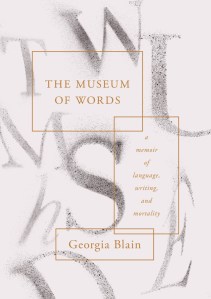
‘The Museum of Words’ by Georgia Blain

blain_museumofwords

2017, 176 p.

Packing up an elderly parent’s house is hard. You are sorting, packing, throwing all those familiar markers of a life, acknowledging that they are worth nothing and yet knowing that they were treasured. You feel sad and guilty.

In her book ‘The Museum of Words’, Georgia Blain tells of packing up her mother’s house for sale. Her mother, author and journalist Anne Deveson, was still alive, but in care and oblivious to the practical financial arrangements that were being made around her.  The personal stuff had been largely cleared away, and the  house was being prepared for the open inspection, that odd state where a house has to be curated to look lived in , but not too lived in. In Anne’s study, there was a corkboard left on the wall, stripped bare when they were repainting. Georgia hastily found a pile of photos in a cupboard and began to decorate the board.  Dogs, grandchildren, holiday photos, children’s photos, Georgia pinned them up. “I felt as if I was creating a museum of happiness” she told her daughter and husband.(p.48)

Blain has called this last book ‘The Museum of Words’, and in reading it you can’t help but think that this is Blain’s own act of pinning up her life. Dying with brain cancer, with a glioblastoma the size of a golf ball, she writes of the experience of her illness, threaded by perverse coincidence with the illnesses of her mentor, friend and human rights activist Rosie Scott, who was dying with exactly the same condition, and her mother who was dying with Alzheimers.  She writes of herself as daughter to Anne and in turn, as mother to her daughter Odette. Men do not play a large part in the story. This book is in many ways a love letter to all three of these women, to the act of writing, and in her final paragraph, an assertion of gratitude for life itself.

The book is interspersed with photographs, which act as a way of telling when the words don’t come.  There are spaces on the page, which I didn’t recognize as quickly as I might have in an e-book instead of a printed edition

In the foreword, written by her husband Andrew after her death, and in Blain’s book itself, there are several references to the increasing difficulty with writing that Blain experienced.  You can sense that the flow is disrupted and that the sentences are perhaps less complex than they might otherwise have been. But most of all, I was left with my eyes brimming at the thought of her actually finishing the writing of this book and her decision as an author writing her own life to round it off and to write the final sentence before turning to the task of editing.  Too young, too soon, too much left unwritten.

Sourced from : YPRL e-book

My rating: too hard to rate.  In terms of emotional punch, though, 10/10

AWW-2018-badge-rose-199x300 I have registered this review with the Australian Women Writers Challenge.
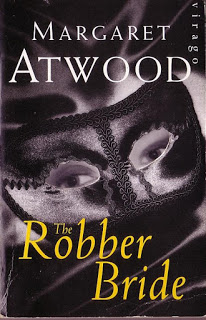
‘The Robber Bride’ by Margaret Atwood

robberbride

1993, 576 p.

Set in Toronto, this book was published in 1993. Three female friends, Tony (Antoinette), Charis and Roz are having lunch together when another woman enters the restaurant: Zenia, a mutual ‘friend’ who was supposed to have died several years earlier. Each of these women has her own history with Zenia, a charismatic woman who variously lied, cajoled, blackmailed and bullied her friends.  The title comes from a Grimm Brothers fairytale ‘The Robber Bridegroom’ where a young woman was threatened by her betrothed and his gang of men.  In an inversion of the fairytale, Zenia steals the husbands and partners of her friends.

After a too-long opening section which places the three women at the restaurant, the book then turns to each of the friends in turn. Tony is a military historian, a rare woman in a male-heavy academic field, who sees the world through her historical consciousness of memory, chance, inevitability and choice. Charis (formerly Karen) is a floaty-hippy type woman with a gruelling family background. Roz is a successful business woman whose own family background is shadowy.  Zenia finds her way into each woman’s vulnerability and uses it against them. While doing so, she engineers the break-up of their relationships with their men.

The real skill of this novel is Atwood’s full-blood rendering of each of these women in turn. In effect, it could be three books in one. They are all equally well-developed as characters, and their relationship with Zenia is plausible. The same cannot be said of Zenia, who remains enigmatic and depicted, in a rather over-wrought style, as the personification of evil. That’s the only truth about her: all the rest is lies and deception.

I was satisfied with neither the beginning nor ending of this book.  For the first fifty pages I kept thinking “Oh, just get on with it” and the ending was too quick and not entirely believable.  But the middle part – and that is where the crux of the book lies- is really well written.

It’s hard not to see this book in the context of The Handmaid’s Tale (1985) and Cat’s Eye (1988), both of which also deal with women’s cruelty to other women, although the cruelty here is at an individual, personal level rather than social or institutional.  It raises good questions about how feminine aggression is manifested, and how other women respond to it. It’s interesting to consider how the story would differ if a man preyed on the wives of his male friends, and how they would respond to his perfidy.

Sourced from CAE bookgroup

My rating: 8/10

Serenading Adela: the short movie!

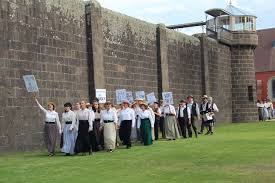
You might remember that in January of 2018 I was involved in a street opera ‘Serenading Adela’, which commemorated the centenary of Adela Pankhurst’s imprisonment in Pentridge Prison, and the night when women marched to the prison to ‘serenade’ her with socialist and anti-conscription songs.  A full video of the performance will be made, and this short promotional film has been released to attract potential funders.  You’ll be hard-pressed to find me, although occasionally I can be glimpsed.  Anyway, enjoy the performance…. it was great fun.

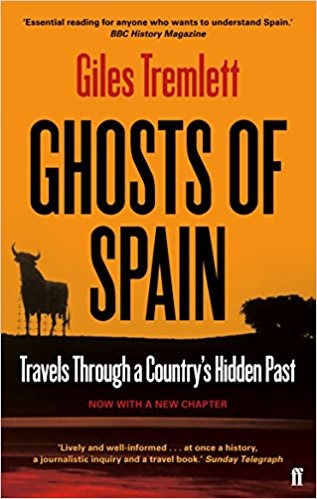
‘Ghosts of Spain: Travels Through a Country’s Hidden past’ by Giles Tremlett

tremlett

2012 second edition, 446 p.

I’m not a particularly keen reader of travel books, but as I’m going to be in Spain in the next few days, I decided to read this book which has gathered pretty good reviews. It’s written by a journalist who has lived in Spain for over twenty years, making him enough of an insider to understand what he is seeing, but enough of an outsider to have his attention attracted by the unfamiliar.

Throughout the book he refers to the ‘two Spains’ – the conservative, religious Spain and the outward-looking, liberal if not socialistic Spain – that still exist in Spain today. The first three chapters are about Franco and the Spanish Civil War and the general agreement to look the other way and leave well enough alone.  After these first chapters I thought that the book was going to continue in this vein, but it became more journalistic and digressive. He moves around different regions of Spain (the Basque Region, Catalan district and Gallacia), as well as discussing childrearing practices and death rituals.  There’s a good map and a good index, so it acts well as reference book.  It’s fairly current, with a good discussion of the Madrid terrorist bombings, immigration and the economic recession following the global financial crisis that particularly affected Spain and Greece.

I won’t know until I’ve been there how useful any of this is going to be, and whether there will be resonances in what I see. Quite apart from the anticipation that the book has aroused, it was an interesting and entertaining read with a narrator that you feel you’d like to know.

My rating: 8/10

Read because: Voy a Espana!

‘Like a Fading Shadow’ by Antonio Munoz Molina

molina

2017, 308 p. Translated from the Spanish by Camilo A Ramirez

This book takes as its starting point the little-known fact that after the assassination of  Martin Luther King, the chief suspect James Earl Ray spent ten days in Lisbon, trying to obtain an Angolan visa. When this did not succeed, he went to London, where he was arrested.

This thread of the story, based on true facts, is interwoven with the author’s own narrative of the act of writing. This itself is split into two further threads: in 1987 when, as a young writer, the first-person author went to Lisbon to write another story (which we never get to read) set in Lisbon, and then a return journey in 2012,  when the author returns to Lisbon, then travels to Memphis to research the James Earl Ray story for, presumably, the book you are reading.

This all sounds rather complex, but it’s not really while you’re reading it, once you realize that there are two separate author narratives in play.  In a way, it is almost a relief to break away from the increasingly fevered, paranoid world of James Earl Ray which, left unmediated, would be suffocating.  As his money runs out, he is becoming encircled by his own fears and distrust as much as anything else.  When the end comes – as we know it does – Molina jumps ahead to James Earl Ray in prison years later, writing his own narrative that centres on ‘Raoul’, the man Ray claimed to have been behind the assassination. Molina reports this, but sceptically.

Separated by twenty-five years, the older author ‘I’ is a more balanced, reflective man than the younger author, who left his wife with a newborn second baby in order to follow his passion in writing his novel.  As an older man, he is by now reflective about the act of writing, the role of novelization and the narrative imagination.

The last part of the book takes us almost minute-by-minute to Martin Luther King, hanging over the balcony of the Lorraine Motel.  We know exactly what is going to happen, yet Molina manages to wind up the tension as we wait for the finger to press the trigger.

The time shifts in this book are complex, but Molina keeps good control of them.  It’s a taut, controlled book that draws you on, even though you know how it’s going to end.

My rating: 8.5

Sourced from : Yarra Plenty Regional Library

Off we go again

IMG_6122

Guess where I’m going this time? Some wedding shoes; a hiking hat and boots; a Spanish phrase book.  Yep.  I’m going to David’s wedding in Nairobi, I’m going to look at gorillas in Rwanda/Uganda then I’m off to the south of Spain.

Wot larks!  You can follow me at my other blog:

https://landofincreasingsunshine.wordpress.com/

‘A Good Day to Die’ by Lisa Birnie

birnie_gooddaytodie

1998, 227 p.

When I saw that this book was my bookgroup’s selection for May, I wondered how I would cope with it, as Dad died at home in January this year. My qualms might seem rather paradoxical, given that I chose to read Pat Jalland’s Australian Ways of Death right in the midst of Dad’s passing. Somehow that seemed different.  I wanted to read Jalland to contextualize what I was feeling within a historical frame of distant times and foreign mindsets – a comfortable and comforting exercise for me- whereas these were contemporary, personal stories told from my own city.  I felt that I could trust Jalland’s distance and span as a historian, but I didn’t feel the same way about a journalist with an eye to the good story.  As it turned out, the book wasn’t as confronting as I feared it might be, but my misgivings were not assuaged by the time I finished it.

Lisa Birnie was a writer-in-residence who spent several weeks at McCulloch House, a palliative care centre attached to Monash Medical Centre. There she spoke with patients, families and staff members while seeking the answer to her question: “Is euthanasia desirable or necessary or could accessible palliative care supplant the need for it?” As the weeks went on, and as she met more patients, her question changed to “Should a rigidly circumscribed law be drafted that permits patient-requested euthanasia in cases where all palliative care practices to control pain have been unable to do so?”

The fraught question of euthanasia was one that she had grappled with in her earlier book Uncommon Will: The Death and Life of Sue Rodriguez (1994), where she followed the legal battles of a young woman with Motor Neurone Disease to commit suicide with a doctor’s assistance.  She came away from that case concerned that euthanasia would inevitably be used against people who did not want it, and that it would pre-empt further research and provision of good palliative care.  Moreover, by her own admission, Birnie acknowledges being ‘spiritual’, and I think that both these dispositions drove her to explore and frame her questions as she did.

The book is divided into eleven chapters, each fronted with an epigraph and a short title: Hope, Denial, Searching for Meaning, Pain, Living Fully Until Death, Attitude, the Caregiver, Faith, Last Rites, Grief and Love, The End and the Beginning.  Each chapter is similar in structure, starting first with the story of a particular individual, their illness and their family, followed by an interview with a staff member.  I felt just a little voyeuristic, prying into this most intimate and physical of events, but there was much to think about too. There was young Michael, aged 30, dying with melanoma shortly after his second child was delivered by caesarean so that he could see him before he died; or Adrian, also in his thirties, whose mother clung to the hope of a miracle.  There were people who kept having more and more surgery; a woman who wanted her daughter and friend to be part of her death; a man with sarcoma of the mouth who drew from the strength of his brother; and most memorably a driven business-man whose anger at his illness was an extension of his need to control his family and business as well.

Her approach is anecdotal, not analytic.  Only in one chapter did she venture beyond the walls of McCulloch House to consider palliative care in the home (as we did with Dad). I feel that she was somewhat ‘captured’ by McCulloch House and her feelings about palliative care in the home are equivocal.  She did not ever come to a definitive view. She was more conscious of the limitations of pain relief for a small percentage of people and her concerns about euthanasia becoming normalized still stood.

This book was written twenty years ago. I wonder how she would feel about the Assisted Dying legislation passed in Victoria last year.  She alluded to negative experience from the Netherlands, which does not tally with my perception of the overseas data presented to the enquiry and legislation last year.   Most particularly, her book deals only with patients dying with cancer. She does not deal with patients with dementia, or MND and other degenerative diseases (not that the Victorian legislation gives any comfort to dementia sufferers and their families.) By the end of the book, I was left feeling that she had not really shifted all that far in her attitudes from where she was at the start i.e. a spiritual woman concerned about the ‘slippery slope’.  On the other hand, I was pleased that the question was still left open in her own mind.  I do wonder, too, if she’s still alive (she was born in 1928, although still very actively writing in 2014) and whether she still feels the same way.

It was interesting (and somewhat sobering) to listen to our book group discussion, amongst a group women aged mid-60s to mid-80s. I was a bit surprised at the strength of feeling against assisted dying held by some of our members, reflecting the strength of my own feelings to the contrary, I suspect.

Read because: CAE bookgroup

My rating: 8?  It’s difficult to separate my own feelings about her conclusions, from my feelings about the book

AWW-2018-badge-rose-199x300

I have added this to the Australian Women Writers Challenge database. To be honest, I hadn’t heard of her before and I didn’t realize that  she was Australian. She was born in Australia and started her career at the Warrnambool Standard, then the Hobart Mercury and Argus before travelling to London to cover royal events. She then travelled to San Francisco, and later lived in Vancouver.

There’s a podcast from 2014 where she talks about her journalistic career at https://soundcloud.com/cjsfradio/sxw-oct-15-lisa-hobbs-birnie