Category Archives: Uncategorized

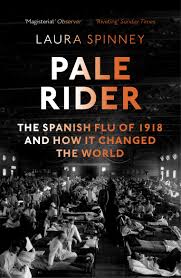
‘Pale Rider: The Spanish Flu of 1918 and how it changed the world’ by Laura Spinney

Spinney_palerider

2017, 295 & notes

It is like the final insult. After four years of death, injury, mud and sand in WWI, it was the ‘Spanish flu’ that killed soldiers  just as the war was turning. It engulfed the whole globe -not just those countries involved in the war-  with most of the deaths occurring in the thirteen weeks between mid-September and mid-December 1918.

Flu epidemics have been with us for thousands of years. Because writing only emerged 4500 years ago, we cannot know when the first one was. We know that there was a  flu epidemic in Uruk in Iraq around that time; there is speculation that flu devastated the armies in Sicily in 212 BC; the first recognized flu pandemic is thought to have begun in Asia in 1580; there was one in 1830 and another ‘Russian’ flu in 1889.

The ‘Spanish’ flu of 1918-19 didn’t start in Spain. Indeed, according to Laura Spinney’s book Pale Rider, a hundred years later we’re still not sure where it did start. Maybe in the poultry farms of Kansas; maybe in the army barracks at Etapes in northern France where birds flocked in the Somme estuaries; or maybe in Shansi province in China, where ducks were herded through the paddyfields to eat insects. What is common to these three locations is birds. Recent research  involved disinterring an obese woman from the permafrost to sequence the flu virus still present around her organs when she died in 1918, and sure enough, the “Spanish” flu was a form of avian flu which had crossed over to humans.

The ‘Spanish’ flu arrived in Spain in May 1918. It had been in America for two months and in France for at least a couple of weeks. But because any mention of flu was censored in nations at war, it was only in neutral Spain that it was reported in the local newspapers. Although “Spanish” was the name that stuck, most countries named it after another country- generally a country they didn’t like: in Senegal they called it Brazilian flu; in Brazil they called it the German flu, the Poles called it the Bolshevik disease; in Iran it was the British flu.

Whatever it was, it affected an estimated 500 million people, 1/3 of the global population in 1918. Between 50,000 and 100,000 million people died.  It came in three waves: the first in March-April 1918; the second and most deadly wave in August 1918 when it spread through most of Europe, Iran, India and China; a third wave in early 1919 which affected Australia which had largely escaped the other waves through effective quarantine; and perhaps a fourth wave in the winter of 1919-20.  In Australia, more than 12,000 people died.

Children and old people have always been vulnerable during an influenza epidemic. What was unusual about the ‘Spanish’ flu was that if you  map out the distribution mortality rates, it shows a W-shape, with people between  20-40 particularly susceptible. Spinney suggests that flu might have been particularly virulent among otherwise healthy people because their immune system went into overdrive. Perhaps some older people, who would normally have been susceptible, had gained some immunity from the 1889 ‘Russian’ flu.

Modern medicine was powerless. Aspirin was prescribed in huge doses, and indeed there has been a claim (which Spinney largely discounts) that very high doses of aspirin , which causes the lungs to fill with fluid, may have actually contributed to the deaths of a sizeable proportion of the flu’s victims. (p.122). However, this argument cannot explain why so many people died in India and other countries where aspirin was not available. Another common treatment was high doses of quinine which added vertigo and vomiting to the symptoms, and may have contributed to the visually “washed out” appearance of the world that many recovering victims reported.  At a time when there was no firm distinction between commercial and folk medicine, it is no wonder that people resorted to traditional medicine and practices to ward off the disease, like ‘black weddings’, an ancient Jewish ritual which involved choosing a groom and bride from the most unfortunate in society (beggars, disabled) and conducting a wedding in a graveyard to fend off the disease.

Spinney’s book has an introduction, eight parts and an afterword. Part I, ‘The Unwalled City’ places influenza within a historical context, both across the centuries and the immediate WWI medical and social environment. Part II ‘Anatomy of a Pandemic’ describes the spread of the Spanish flu across the world. Part III ‘Manhu or What Is It?’ deals with the incomprehension and impotence of medicine and governments against the pandemic when it first emerged.  Part IV ‘The Survival Instinct’, which I found the most interesting, looked at the medical and social responses across the globe. Part V ‘Post Mortem’ looks at the search for the first ‘Spanish’ flu victim, and the toting up of the final figures. Part VI ‘Science redeemed’ details medical and scientific progress in understanding the pandemic, while Part VII ‘The Post-Flu World’ looks at the fall-out medically, socially, culturally and militarily after the last wave.  Part VIII ‘Roscoe’s Legacy’ discussed disease control in the future. The Afterword ‘On Memory’ looks at how the pandemic has been remembered, or more pertinently, forgotten.

Spinney’s book joins a surge of interest in the 1918-19 epidemic now that it is coming up to its centenary. Unlike many books that concentrate on its effects in one city or country, hers is a truly global approach to the pandemic.  As a science writer, she focuses on the disease, its manifestations and the scientific response, but she also interweaves this with a consciousness of how the experience of suffering and recovering from the flu leached out into music and literature in the succeeding decade.

As for her claims for it changing the world?  I’m not quite convinced, given how easily it has been forgotten. She argues that it ended the war because the German soldiers were so sickly; she suggests that it led to the introduction of universal health care (I’m not so sure- the NHS, Medicare/Medibank etc were introduced post WWII), and posits that the British negligence in treating Indians with influenza was an eventual catalyst to Independence (another event that seems to me to be too chronologically distant from the pandemic to be convincing).

Nonetheless, I found this book a fascinating read. It is well written, well-researched and rather chilling.

Sourced from: Yarra Plenty Regional Library

Read because: I’m aware that the centenary is upon us.

Rating: 8.5



Movie: Vita and Virginia

This was a very wordy film, as you might expect given that it was set amongst writers and artists in the Bloomsbury circle. Elizabeth Debicki was excellent, playing an ungainly and  mentally fragile Virginia Woolf. There was rather too much of Vita and Virginia staring face-on to the camera in close-up, talking, and felt myself getting rather bored by it all. I wanted to like it more than I did.

I saw this as part of the British Film Festival.

Movie: The Ladies in Black

It’s romantic, it’s feel-good and it’s look-good. And I loved it.

I hear with my little ear 8-14 October 2018

In Our Time. The Almoravid Empire. I wish I’d listened to this before I went to Spain. I tended to see the Muslim influence as a single entity, and didn’t take enough notice of the turmoil between different dynasties that ruled over Al-Andalus. In this case, the Almoravids stopped the Spanish reconquest in 1086. They were a Berber people, noted for their men having their heads covered, and more religious than the Umayyad Emirate. They were in Spain until 1147 when they were defeated by another Berber group, the Almohads. Their main centre of influence was in Northern Africa.

Conversations ABC The Science of the Dreamtime. Richard Fidler interviews Patrick Nunn, Professor of Geography at University of the Sunshine Coast in Queensland, who argues that indigenous people often incorporate eye-witness accounts of natural phenomena from generations past into their story-telling. Such events include meteors, volcanoes and, amongst Australian indigenous peoples, the rise in the sea level at the end of the last Ice Age that reshaped Australia’s perimeter.

News in Slow Spanish Latino #278 (includes a segment on chocolate and vanilla, two of the indigenous products of South America) #279

The History Listen A program about William Ah Ket, the first Chinese-Australian barrister in Australia.

A day trip to …Ormond

historyweek2018

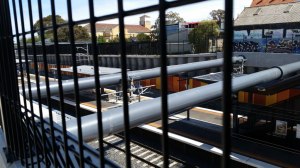
To be honest, I wasn’t really quite sure where Ormond is. Having now visited it to see Box Cottage, which was open for History Week, I can now tell you that it’s on the Frankston train line.  Ormond station has been rebuilt as part of the Level Crossing Removal Project and looks quite a lot like Rosanna station except that it is below street level and Rosanna is high above it. I guess that there will be a legacy of these concrete and stainless steel stations, with their orange and limegreen geometric ‘decorations’.

20181007_135909_smll

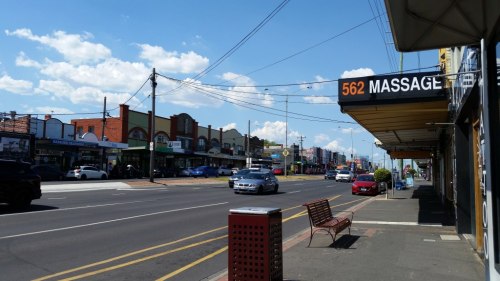
North Road Ormond is rather unprepossessing.

20181007_135830_small

We had lunch at Mountains of Bears, and it was excellent. It’s located down a little 1950s arcade with tables outside in the arcade, as well as in the cafe. We had an excellent paella- better than I had in Spain and much closer to home. They took a great deal of care with their coffee art.

We had ventured down to Ormond to visit Box Cottage Museum, which houses the City of Moorabin Historical Society.  The cottage has been reconstructed after falling into disrepair on the adjoining block. Another house had been built in front of it, and so it stayed at the back, used as a shed in what had by 1970 become a timber yard.  The timber yard owner, Mr Lewis suggested that the cottage be dismantled and relocated. It was reconstructed in the adjacent park as part of Victoria’s bicentenary, with timbers donated by Mr Lewis.

The original owners were William and Elizabeth Box, who arrived in Melbourne in 1855. At first they leased market garden allotments before they purchased two ten acre lots on what had been the Dendy Special Survey in 1868 and 1869. The cottage was built sometime in the 1850s.  They were successful market gardeners and raised 13 children in the cottage before building the larger house at the front.  From 1917-1970 it was occupied by the Reitman family who leased and then purchased the houses and land. August Reitman was a monumental mason, potter and sculptor, and was employed to carve war memorials in Victoria after WWI. His business shifted to Highett and the cottage was used as a workshop.

There is also an outside barn area with agricultural and household artefacts, including an original wagon that took vegetables from the market gardens to Melbourne. Because of the sandy road, a sort of tram line was built into the roads to assist the wheels on heavily laden drays.

Box Cottage was open today for History Week, but it generally opens on the last Sunday of the month between February and November between 2.00 and 4.00 p.m.

Infanticide: an interesting article

There’s an interesting article on the Australian Policy and History website today. It’s called “‘How is this not murder?’ Infanticide and the Law in Australian History”, written by Caroline Ingram.

Update: Serenading Adela

The best-laid plans of mice and men….

The full length version of Serenading Adela will not be shown after all, because of technical difficulties. They’ll still be showing the other short film, and the cut-down version of Serenading Adela that had already been released online.…and there will still  be cake.

Serenading Adela: The Film Launch

adela

Update: The full-length film of the performance will not be available for the event. They will still show ‘Against the Odds’ and the shorter version of the film already released online.

You might remember that earlier this year I was involved in the ‘Serenading Adela’ project. It commemorated the night, one hundred years earlier, when women marched up Sydney Rd to Pentridge Prison to ‘serenade’ Adela Pankhurst, who was incarcerated there under the War Precautions Act.  They made a film of our performance, and they’re launching it tomorrow Friday 28th September at the Brunswick Scout Hall, 213a Weston St Brunswick at 2.30 p.m.  As well as the film of the performance, there will be a short feature ”Against the Odds: The Victory over Conscription in World War I’

Surely that’s better than watching two footy teams that we don’t care about – indeed, may even actively dislike- marching in the city!

See the Facebook event at

https://www.facebook.com/events/299952080796125/?active_tab=about

Or if you’re boycotting Facebook, here’s the blurb:

Did you love “Serenading Adela, A Street Opera” and want to watch it again? Or were you one of the many who were too late for tickets?

Please join us to launch our new full-length archival video of the Centenary Performance of Serenading Adela, a Street Opera. It’s being edited from footage of four cameras there on the day, by Jeannie Marsh and Bernard Peasley.

In the best matinee tradition, we’ll show a short first: ‘Against the Odds: The Victory over Conscription in World War I’ tells how diverse groups and individuals collectively defeated conscription and left a lasting legacy for Australia. From the Living Peace Museum, with a Brunswick focus.

We’ll be serving a delicious afternoon tea to follow the film.

FREE ENTRY but donations towards film costs and future projects will be enthusiastically solicited.

The Scout Hall is 213A Weston Street Brunswick. Note as this is the Grand Final Public Holiday, crossing the city by tram may be a challenge – a train to Parliament, then the 96 tram to Miller Street, recommended (or check PTV for updates).

Six Degrees of Separation: From ‘Where Am I Now?’ to ‘Sex and Suffering’

A few of the blogs that I follow join in with the Six Degrees of Separation meme, hosted by Booksaremyfavouriteandbest .  I gather, if I’ve read it correctly, that everyone starts off with the same book. Participants then make mental leaps to name six other books that they’ve reviewed on their blog. [See Sue’s comment below – it doesn’t have to be reviewed on your blog]. This time the meme starts off with Mara Wilson’s Where Am I Now?

Well, I hadn’t even heard of the starting book, or of Mara Wilson. But the little girl on the front looked familiar- and of course! It’s Matilda!

Her surname is Wilson, and she shares it with Rohan Wilson whose book The Roving Party fictionalizes John Batman, the putative founder of Melbourne as he bashes his way through the Van Diemen’s Land bush to ‘conciliate’ the remnants of the Plindermairhemener people in 1829.

A non-fictional approach to that same John Batman (and yes, that really is his name) is taken in Bain Attwood’s Possession, which closely examines Batman’s ‘treaty’ with the indigenous people of Port Phillip, and the uses to which the Batman/Fawkner ‘discovery’ story has been put in Melbourne historiography.

A more famous book called Possession, written by A. S. Byatt won the Booker Prize in 1990.  I’ve read it, of course, but that was before I started writing this blog. Hilary Mantel was one of the judges and so naturally we mentally leap to Bring up the Bodies, her not-yet-completed trilogy about Thomas Cromwell.

The topic of bodies is linked to death, but death seems to evade the old colonel in Gabriel Garcia Marquez’s The Autumn of the Patriarch, as he wanders his decrepit palace, wanting to die but somehow waking up again the next morning to start all over again.

Two other patriarchs, on different sides of the American ideological chasm over abortion in present-day America are found in Joyce Carol Oates’ A Book of American Martyrs.  Dr Gus Voorhees is shot for his pro-choice activities, and Luther Dunphy, an evangelical Christian, is the man who shot him.

The Royal Women’s Hospital in Melbourne delivered babies, but it also tried to save the lives of women whose abortions had been botched or incomplete. Janet McCalman’s Sex and Suffering is a history of the hospital, from its earliest days in Melbourne.

What an odd place to finish up! That was rather fun.

Movie: Mary Shelley

It’s the 200th anniversary of the publication of Mary Shelley’s Frankenstein and so there’s been quite a bit about both the book and its author around this year.  This film, directed by Saudi filmmaker Haifaa al-Mansour looks at Mary Shelley as daughter, sister and partner as well as writer. I liked the way that it emphasized the importance of Shelley’s impoverished father William Godwin and mother Mary Wollstonecraft as intellectuals, although their radicalism was downplayed. The film finishes on rather a high note with the publication of the second edition, although it could have extended even further where the loss and poverty of Shelley’s life became even more tragic.  However, while mentally cheering inside, I don’t know that I actually buy the suggestion that the book was written as Shelley’s jab at the two monstrous men in her life, Percy Bysshe Shelley and Lord Byron (who is particularly creepy in the this film.) Elle Fanning is luminous, and it’s beautifully staged.

My rating: 3.5 stars (of 5)