Author Archives: residentjudge

Position, position, position

[You may be aware that I am very concerned about issues involving Banyule Homestead in Heidelberg.  I have started another blog dealing with Banyule Homestead and Heidelberg more generally, and please visit it!  You can find it at http://banyulehomestead.wordpress.com  I have cross-posted this entry]

The area of land between the Yarra River and the Darebin Creek was prime agricultural and grazing land, and the Government knew it.  It was parcelled up for sale at the first Government Land auction that was held in Sydney in 1838.  The fact that the sale was held in Sydney is significant: it meant that you needed to be in Sydney to purchase.  As a result, the land was purchased largely by Sydney-based speculators, especially Thomas Walker, who remained in Sydney.  The 920 acre Portion 6 that Banyule Homestead was later to be built on was purchased by Richard Henry Browne for 1334 pounds.

However, Portion 5, to the west of the Banyule Estate (the Brown St. hill and up to Upper Heidelberg Rd for 21st century locals!) did not sell, and was offered up for sale, in Melbourne this time, on 26th February 1840.

And just to show that position, position, position was important then too- here’s the advertisement from the Port Phillip Herald 21 February 1840.  You’ll see that Banyule (spelled ‘Banyuille’) is mentioned, and that Joseph Hawdon (who had not yet built Banyule Homestead) is listed among “the most respectable gentry” who lived in the area. And for those of you stuck in traffic along Rosanna Road, remember that you are travelling on a “romantic and beauteous road”.

National Biography (?) Awards

I notice that the longlist for the National Biography Awards has been announced.

  • Robyn Arianrhod Seduced by Logic, University of QLD Press
  • Tim Bonyhady Good Living Street: The Fortunes of My Viennese Family, Allen & Unwin
  • Alexander Brown Michael Kirby: Paradoxes & Principles, The Federation Press
  • Pamela Burton From Moree to Mabo: The Mary Gaudron Story, UWA Publishing
  • Sophie Cunningham Melbourne, NewSouth Publishing
  • Delia Falconer Sydney, NewSouth Publishing
  • John Howard Lazarus Rising, Harper Collins
  • Paul Kelly How to Make Gravy, Penguin
  • Mark McKenna An Eye for Eternity: The Life of Manning Clark, Melbourne University Publishing
  • Martin Thomas The Many Worlds of R.H. Mathews: In Search of an Australian Anthropologist, Allen & Unwin
  • David Walker Not Dark Yet, Giramondo Publishing
  • Patrick Wilcken, Claude Levi-Strauss, Bloomsbury

I’m interested by the inclusion of the Sydney and Melbourne books.  There has been a trend over recent years of writing ‘biographies’ of inanimate objects (think Mark Kurlanky’s Cod and Salt) and locations (think Ackroyd’s London: A Biography).

I see that the guidelines for the award specify that the work be “classified as either biography, autobiography or memoir; be written in book form and consist of a minimum length of 50,000 words”.  I haven’t read either the Melbourne or the Sydney book, but I do know that both have a heavy emphasis on memoir, as well as a more factual approach to the two cities.

Still- an interesting inclusion for a biography award.

Vale A.G.L. Shaw

I see in today’s newspaper that A.G.L. Shaw has died, aged 96.  His full name was Alan George Lewers Shaw, but I only ever heard him referred to as ‘Agl’ (pronounced ‘aggle’).  He was Professor of History at Monash University between 1964 and 1981, and took a leadership role in the Friends of the La Trobe Library, the Royal Historical Society and the C.J. L Trobe Society.

I first encountered him as the author of one of the textbooks we used in HSC Australian History in 1972- I can’t remember if it was The Story of Australia or The Economic Development of Australia– and with the callowness of youth, I always assumed that anyone who was old enough to write a textbook would surely be dead and buried by then.

However, I encountered him again once I commenced my work on Judge Willis some 27 years later only to find that he was not only not dead and buried, but still working hard.  I often find myself reaching for Shaw’s A History of the Port Phillip District: Victoria Before Separation, a book published in 1996 and remarkably, the first general history of the Port Phillip District written since Henry Giles Turner’s History of the Colony of Victoria in 1904.  Although there were books on particular subjects, and although such books usually had an introductory chapter on the period before 1851, he could find no general survey history.  So he decided to write one.  His introduction gives a hint of the flavour of the history that was to follow:

It is old-fashioned narrative history, and though I fully realise its statements can not be proved philosophically ‘true’ and that my judgements are my own, and therefore influenced by subjective bias and prejudice, in writing it I have been searching for the truth and trying to produce a narrative of unique events.  These are clearly not subject to general laws, which is not to say they are ‘uncaused’, but rather that they are the result of human agency, largely dependent on human motivation.

In one sense this seems a success story and therefore can be denigrated as ‘Whig’ history, but this depends on the meaning ascribed to success.  Everyone achieves something, whether it be good or bad, great or small, and I have tried to write about the bad as well as the good.  Such a mixture is, to my mind, inevitable given the mixture of qualities belonging to the members of any community- weak and strong, heroes and villains, intelligent and stupid, far-seeing and short-sighted, strong-minded and weak-willed, pushing and subservient, arrogant and humble.  From the interplay of these comes the community development, beneficial or harmful, and it is the story of that development in the Port Phillip District before the discovery of gold that I have tried to tell- though my prejudices will inevitably have influenced my telling of it.  (p. xv)

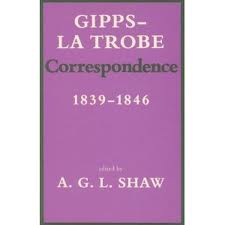
It is the interplay of personalities that is most clearly on show in my favourite of his works, and one that migrates frequently between my bookshelf and my desk: the Gipps-LaTrobe Correspondence,  written in 1989.

This is an edited collection of the ‘back-channel’ personal correspondence between Governor Gipps in Sydney, and Charles La Trobe, the first superintendent appointed to the nascent settlement of Port Phillip.  La Trobe was, perhaps, an unusual candidate for appointment.  Unlike many of the colonial appointees, he did not have a military or judicial background- indeed, he had spent quite a bit of time ‘rambling’ in Switzerland, then camping with Washington Irving in North America.  He had, however, worked on three reports on the emancipation of West Indian slaves in the mid-late 1830s, and it was this work that brought him to the attention of the evangelically-inclined Secretary of State, Lord Glenelg at a time when the Colonial Office was particularly attuned to the recommendations of the Select Committee on Aborigines (British Settlements). La Trobe brought with him his Moravian background, but he had had no experience at all in administration, and he was appointed as subordinate to Governor Gipps, an older and much more experienced officer of military background in Sydney.  La Trobe stayed briefly with Gipps en route to Melbourne, and the warmth of the relationship they established there is reflected in these personal letters.  It is a largely one-sided collection of correspondence, with relatively few letters remaining from La Trobe to Gipps, but as with such archives, it is possible to detect the tenor of the missing correspondence.  A.G.L. Shaw’s contribution to this collection is his extensive and minutely-detailed footnotes to the letters, providing not only context, but also small details of who, where, when. He is so sensitive to the reader’s needs that almost as soon as the question about something you have read forms in your mind,  the footnote number pops up to show you that Agl has thought about it before you.  And so, from a rather over-awed distance, thank you Agl Shaw.

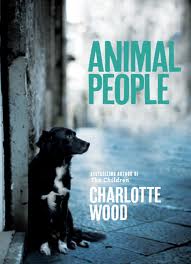
‘Animal People’ by Charlotte Wood

2011,  262 p.

There must be something about the challenge of writing a book set completely within one day, because many writers seem to have done it: James Joyce, Virginia Woolf (and in homage, Michael Cunningham), Gail Bell and, although I haven’t read it yet, my latest craze, Mollie Panter-Downes.  Limiting one’s focus onto a single day gives scope for close scrutiny of the quotidian and the elapse of hour after hour runs underneath the narrative like a bass-line.  But there’s a risk too – we all have our own mundane lives that are ticking over hour by hour too, and somehow or other the author needs to make you care enough about an ‘ordinary’ person to devote some hours of your life to watch someone else’s day unfolding as well as your own.

Characterization is fundamental to this contract between writer and reader.  You don’t need to like the character as such, but you have to at least care.  In this case, Stephen is a bit of a drifter, with a dead-end job as a kitchen-hand at the zoo, living a rather spare and bitten-down existence, aware of his family’s disappointment in him, likeable enough but wary of being tied down by commitment.  As he wakes on this hot Sydney morning, he knows that he is going to break off his relationship with Fiona, a good, passionate, separated woman, that day.  In this, he is quite steely, even though he knows that she is beautiful, that she loves him and her young daughters tolerate him, and that his mother has already absorbed them as ‘family’.  He combines inflexibility with irresoluteness; he is hard as steel and yet soft, he is selfish without asking for anything.  We probably all know someone like him.

Charlotte Wood is a good observer and it’s as if she has inserted herself behind our own eyes.  Her descriptions of the various people who orbit around Stephen have a verisimilitude similar to those in Tsiolkas’ The Slap– in fact, in many ways this book reminded me of The Slap in reverse.  The mounting heat of the day, and the brittle mania of a child’s birthday party add to the sense of unreality and the rising shriek of the day, as Stephen drifts closer and closer to making his break with Fiona.

There’s a second theme in the book- that of animals and the human relationship with them- that I felt was rather heavy-handed.  The parallels were rather too obvious, and it just seemed rather laboured.

I have read several very positive reviews of the book- in fact, people seem to be struck emotionally speechless by the book (for example, John Purcell on Booktopia and Michelle on Book To the Future).  I wouldn’t go that far.  Certainly, it was very easy to read, and I was quickly drawn in enough to want to keep reading, and it captured urban, middle class Sydney very well.  It had just a touch of the ‘book club’ about it, something that Lisa at ANZ LitLovers noted as well.  I don’t think that I mean this as a put-down (after all, I belong to online and face-to-face bookgroups myself) but there’s something about the straining for theme and topicality that made me wonder if it was written with this demographic in mind.

My rating: 8/10

Sourced from: Yarra Plenty Regional Library

Read because: I enjoyed The Submerged Cathedral and because I wanted to review it as part of the 2012 Australian Women Writers Challenge.

‘Cold Comfort Farm’ by Stella Gibbons

1932, 307 p.

This was the April selection for my face-to-face bookgroup, and for me it was a re-read, but ah! who can begrudge reading such a little gem of a book?!!  It’s laugh-out-loud funny (or at least, I found it so) and if you haven’t read it- DO!

The book is set, as the small note on an opening page says, in the ‘near future’.  As twenty-first century readers, this is immediately unsettling because a book written in 1932, as this one was, is very much set in the past for us.  Some of her predictions, like air-taxis for short-distance travel, the Anglo-Nicaraguan War of ’46  or video-phones jar you into thinking “hold on, when was this set?”  In many ways it feels like a novel set in the 19th century both in its setting and characterization with the ramshackle manor house and loping rural farmworkers, but it was set in the future at the time it was written.

It was intended, apparently, to be a satire on the rural-gothic novels of the Mary Webb and Thomas Hardy ilk, which are hardly bestseller material these days. Satire, unfortunately, generally requires at least a nodding acquaintance with the subject or genre being satirized.  So here we have the odd situation where we are reading a satire that feels oddly familiar, as if we have met all these characters before-   the mad great-aunt in the attic, the simple farmhands, the young girl unaware of her beauty- and yet it seems that they have seeped into our consciousness without  being able to identify where they have come from.

The orphaned young Flora Poste decides that instead of getting a job, she will sponge on her relatives for her upkeep.  When an answer to her request for board comes back on a grimy piece of paper, followed by a warning to stay away, she decides that of the lukewarm responses she has received from her surviving relatives, it is this one from Cold Comfort Farm that attracts her the most. So off she bustles to Cold Comfort, bringing her modern girl sensibilities and common sense to an aging, rambling manor house where all the closely-intertwined Starkadder family are in thrall to the matriarch of the family, Great-Aunt Ada Doom.  Great Aunt Ada, who has sequestered herself in the attic after seeing “something nasty in the woodshed”, has ensnared the extended family around her, afraid to leave the farm to pursue their own destinies, declaring that “there’s always been Starkadders at Cold Comfort”.  Into this comes young Flora who, with her aid of her trusty handbook “The Higher Common Sense,” schemes and plans to set up some with marriages and to nudge others into following their vocations.  It’s all thoroughly good fun.

As I reached the end of the book, I was struck by how completely and deftly within just over 300 pages the author has sketched out such memorable minor characters.  In a closing scene, she lists the guests at a Starkadder wedding, and as she numbered them off, one by one, I felt a little jolt of recognition and affection, as if I was attending a family wedding myself, where the guests were all known to me.  And as for “something nasty in the woodshed”…..well, you’ll have to read it for yourself.

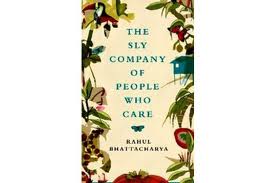
‘The Sly Company of People Who Care’ by Rahul Bhattacharya

2011, 281 p

Two things attracted me to this book.  First, the title.  Second, the fact that it is set in Guyana, the country formerly known as British Guiana.  And my interest in British Guiana?  Well, Judge Willis spent several years there as a judge, and I’ll be dealing with this period of his life in my thesis.  I approach the British Guianan section of my thesis with excitement mixed with a degree of trepidation.  Judge Willis was there at a fascinating time, just as the abolition of slavery was actually implemented, albeit fudged somewhat by the imposition of a long ‘apprenticeship’ on erstwhile slaves to protect the plantation-owners’ interests.  But then I think – I know Port Phillip intimately- its layout, its weather, its smells, its air, and I have at least been to York (Toronto) for a month and can start to imagine in my mind’s eye what it might have looked like- helped no end by a small scale model of 1825 York that I saw at William Campbell House in Toronto.  Does it matter that I’ve never been to the Caribbean?

Fortunately, it’s as if this book has been written just for me.  The narrator is a 26 year old Indian journalist who had briefly visited Guyana to cover a cricket tour, and he decides to return to be a “slow ramblin’ stranger”.  It took me a little while to realize that this book is, in effect, a travel book in three almost self-contained parts and that the plot, such as it is, meanders slowly.   The first section was rather disorienting: the narrator’s sharp ear catches the patois, and like him, you need to guess your way through. I was beginning to wonder whether the book was going anywhere and whether I was unable to detect, let alone remember, the plot until I realized that I was approaching it the wrong way. Like the narrator, I just had to watch and listen, and go where-ever it took me.

There is a lot of travel in this book- boats into the jungle, buses, taxis and small planes.  He accompanies some ‘porknockers’ into the rainforest jungle where they sluice illegally for diamonds on the edge of the dank watercourses; he travels to Brazil and Venezuela; he moves from place to place. He is the quintessential observer, he watches carefully and captures images and voices deftly, and he travels light both physically and emotionally.  It is only in the last section that he fleshes out into a character in his own right as he travels to Venezuela with the sensual and demanding Jan, and as their brittle relationship fractures in the traveller’s bad dream of cheap accommodation, poor planning, inadequate language and little money.

There’s a lot of history and politics in this book.  A note on the very first page explains that the term ‘Indian’ in Guyana refers to the descendents of the indentured labourers from India who were brought across to work on the sugar plantations after the abolition of slavery, and who now comprise 43.5% of the population.  The Africans comprise 30.2%, Mixed Race 16.7%, Portuguese 0.20, Chinese 0.19 and Whites 0.06.  The indigenous people at 9.2% are called Amerindians.  Indians from India are referred to as Indian nationals- and this is what our narrator is.  He is well-placed to see and feel the mutual incomprehension that the East Indian and Indian National have of each other, despite the vaguely recognizable physical appearance and the smell of Indian food that they hold in common.  He thinks about the wound that is left behind when someone leaves a village, their family, their country, and yet the inconsequentiality of that leaving for India as a whole.

The mind goes back to the wound.  To the East Indian the wound has been profound, in ways he knows and does not.  But in the geographical India, that pitiless, unceasing land which bothers not for whom it crushes or expels, there has not been the slightest cut.  The numbers have been undramatic, the impact negligible.  The people have been of the unimportant kind: nobodies whom nobody remembers, nobody knows of and nobody can be asked to care. (p. 99)

He observes, too, the racism of these groups, forced to co-exist with each other. Racism is everywhere; race is everything.

His descriptions are drenched with colour, and given that I’m not ever going to set foot in Guyana, they have sated my yearning to experience the weather, the sky, the smells, the air, for myself.

We put on shoes and gathered our things and began walking.  The trail was fresh squelch and the trees were still swaying apocalyptically though the rain was now beating slower.  The immense wetness of the rainforest made one feel submerged, but for the smells.  The smells were many, mud and leaves, heart of trunk and rotten fruit; the rustle of small animals, the slither of lizards, they all came scented.  It was soggy underfoot, thick squelch or big drenched leaves, brown, red and green, twenty or thirty deep.  It was walking on marshmallow. (p. 62)

Or the sight of the city awakening:

The bliss of the city is when it awakens- not the dawn hours haunted by the middle-aged shedding fat or burnt out adolescents returning home, but a little after, when the cleaning machines have brushed away yesterday’s evidence and the fresh day is falling crisp as golden wafers, when reasonable people with reasonable habits are coming out of their holes to dot the world with their strange faces, their gestures, costumes, voices, until bit by bit, by living magic, the grand tapestry is made. (p. 221)

And the title?  Well I’m not sure if I know what it means.  The India that expelled its people didn’t care, but I’m not sure that the Guyana that he describes here cares much either- for all the good will, there is also brutality, venality and suspicion. There is this cryptic aside:

Once I found a curious paean to the Dutch civilizing mission.  It was a four-page fine-print pamphlet, organized in sections, composed by an apparent descendant.  It extolled the courage of the pioneers- ‘who risked life and limb for the sake of the generations to come’. It lamented the passing of the Dutch Reformed Church- ‘which had given the people moral organisation for prosperity’. … The enterprise of the Dutch West India Company itself was honoured with its own subsection.  Here the first three words had been struck out by a blotted, once garish, purple nib.  They had been replaced by a single word. SLY.  In the margin a sentence had been started,  they think like they care- and abandoned there due to excessive blotting.  (p. 90)

Inscrutable.  Like many fragments, it hints at meaning but it’s hard to capture it. The whole book felt hard to capture, and yet by the end of it you realized that it had somehow captured you.

Fashion outlook April 1842

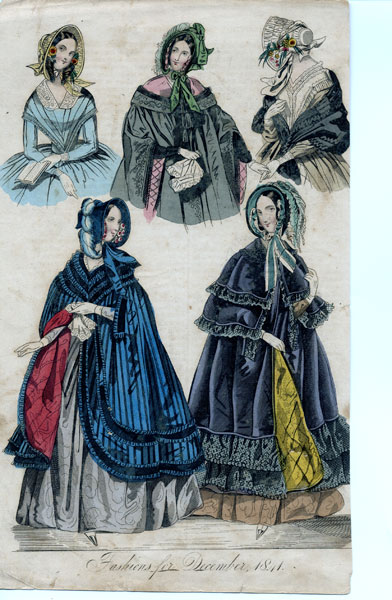
Here’s a heads-up for the new fashions for December 1841, taken from the New Monthly Belle Assemblee and reproduced in the Port Phillip Herald of 22 April 1842. Of course, the news was already outdated by the time magazines reached Port Phillip, although I guess that it was fortuitous that descriptions of winter fashion (if indeed there was such a thing) reached Melbourne as it was moving its its own, much milder winter.   I’m not sure how the fashion described in a magazine like the New Monthly related to the clothes that people actually wore. I think of the catwalk fashion that we see  from the major designer houses todayand it seems to bear little resemblance to ‘real’ clothes that ordinary people wear.  As you can see- I am no expert on fashion at all- not then, not now!

FASHIONS FOR DECEMBER

London Public Promenade Dress- Violet satin robe; a high corsage, tight to the shape, trimmed with three rows of cord and tassels to correspond; a single row is continued down the centre of the skirt.  Long tight sleeve, ornamented from the elbow to the wrist with a succession of knots to correspond.  Drawn bonnet, of deep orange-coloured satin; the brim edged with a ruche of dark green ribbon, and the interior and exterior trimmed with flowers.  Embroidered muslin collar.  Grey velvet scarf, bordered with sable fur.  Sable muff.

Demi-Toilette. Pink pou de soie [sic- should be peau de soie] robe; corsage en gerbe, and long tight sleeve.  White satin chapeau, a round open brim; the interior trimmed with small pink flowers; the exterior with a torsade of white satin ribbon, and a bouquet formed of the tops of white curled ostrich feathers. Green velvet mantelet; it is of a large size, sits close up to the throat, with a falling collar, trimmed with green fringe of a light pattern; a heart lappel, edged with fringe, forms it to the shape of the bust; it falls low behind, descends in front in long and very full scarf ends, and is bordered with fringe.

The promenade dress sounds very colourful, with deep orange, violet and dark green.  I’m finding it hard to shake the image of a rainbow lorikeet.

I’m not sure if the picture below relates to the description or not. It apparently came from the New Monthly magazine, but I’m finding it hard to match the illustration with the description. (I think it embiggens if you click on it).

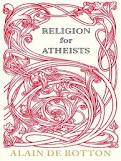
‘Religion for Atheists’ by Alain de Botton

312 p. 2012

I very much identify with de Botton’s motivation in writing this book about reclaiming the rituals and cultural practices of religion, without actually subscribing to its doctrines.  I have had a rather varied religious history.  After a childhood of Sunday School and youth group at my local Church of England, I still describe myself as culturally Anglican, with a deep love of the language of the old Book of Common Prayer, stained glass and hymns.  A dalliance over several years with born-again Christianity in my adolescence petered out into indifference in my mid-twenties.  My interest in Unitarianism was kindled in my fifties with none other than Alexander Downer (of all people) simpering that our treatment of East Timor over oil revenues could be balanced out by foreign aid “because that’s what aid is for”.  I heard a radio program about Unitarianism and its long history of trying to balance social justice with reason and commitment, and somehow or other that led to the Unitarian Church in East Melbourne, where I have attended somewhat sporadically ever since.  I very much enjoyed the more spiritually-attuned Unitarian services that I attended last year in Canada. They seemed  to capture my longing for community, time and space to think, social justice, music and reflection in a  ritualized setting.  So what do I believe in?  I believe in being human, in fallability, in good will, in humility at life’s trajectory, in community, in goodness, in beauty. God doesn’t really come into it.

Alain de Botton starts his book with the declaration that

To save time, and at the risk of losing readers painfully early on in this project, let us bluntly state that of course no religions are true in any God-given sense.  …the real issue is not whether God exists or not, but where to take the argument once one decides that he evidently doesn’t.  The premise of this book is that it must be possible to remain a committed atheist and nevertheless find religions sporadically useful, interesting and consoling- and be curious as to the possibilities of importing certain of their ideas and practices into the secular realm (p. 12)

And so, he identifies nine contributions that religion – any organized religion- can make to being human and considers them in their own right as human activities, rather than as expressions of spiritual belief. Community, kindness, education, tenderness, pessimism, perspective, art, architecture and institutions are each considered in turn, although there are overlaps between them – especially kindness and tenderness.  In particular he looks at the rituals and settings of religious activity, and suggests secular appropriations of them: museums organized around human traits, ritual sharing of food as a form of community, architecture designed to elicit awe, and art that evokes a sense of awareness of our own fleeting, fragile but precious lives.

His book is not an attack on Christianity, Judaism or Islam, and while it puts some suggestions on the table, it doesn’t really give any guidance on how they are to be achieved.  When he was going through his 9 contributions of religion, he could easily have included “ritually mark life’s transitions”.  It’s interesting that already people have developed their own secular ceremonies for namings, marriages and memorial services, without any need for a god to be involved in them, and without de Botton’s exhortations.

I know that critics have been derisive of his suggestions, but they very much appeal to me, and I think that already in my own way I’m seeking to find them already in my own life.  It’s paradoxical that he ends his discussion with the “visionary, eccentric and only intermittently sane sociologist” Auguste de Comte, who developed his own Religion of Humanity during the nineteenth century, because I feel that de Botton himself has made similar errors:

Comte’s greatest conceptual error was to label his scheme a religion.  Those who have given up on faith rarely feel indulgent towards this emotive word, nor are most adult, independent-minded atheists much attracted to the idea of joining a cult…Comte’s legacy, nevertheless, was his recognition that secular society requires its own institutions, ones that could take the place of religions by addressing human needs which fall outside the existing remits of politics, the family, culture and the workplace. p. 307

Sometimes I wonder if there’s not an element of self-indulgence and preciousness in a search for a non-religious religion.  I hope not.  I’m looking for something bigger than I am, but I want it grounded in being human, with all that entails, and embracing that humanity as something to be celebrated and cherished.

Scrambling for the dictionary

In my mind’s eye I can see streams of puzzled Age readers heading to their bookshelves this morning and dusting off their dictionaries. The headline  “Dignified, tasteful epithets for hero” over a report of Jim Stynes’ funeral yesterday certainly jarred me. Doesn’t ‘epithet’ describe a term of abuse? Did they mean ‘epitaph’ instead?

Apparently not, according to the Oxford English Dictionary, which defines it as:

a. An adjective indicating some quality or attribute which the speaker or writer regards as characteristic of the person or thing described.

2. A significant appellation

3. A term, phrase or expression (obsolete)

And ah! there it is- under “Draft Additions 1993”

b. An offensive or derogatory expression used of a person; an offensive term; a profanity.

Well, well- there I was thinking that the headline was just plain wrong and inappropriate.  Do newspapers still have an educative function in teaching us the precise meanings of words (if indeed they ever did)? I’d like to think so, but given the sloppy proof-reading dished up in issue after issue, I wouldn’t hold my breath.

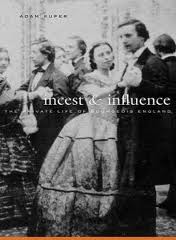
‘Incest and influence: the private life of bourgeois England’ by Adam Kuper

2009,  256 p. & notes

This book is nowhere near as kinky or Marxist as the title suggests.  Neither of the two forms of ‘incest’ described (cousin marriage and in-law marriage) are viewed that way today, and the ‘bourgeoisie’ is defined not so much in economic terms but as a network  of influence.  So if you’re going by the title, you may be led astray.

Cousin marriage, according to the Attorney-General’s web is not illegal in Australia (although it is in some states in the US), and there is no prohibition on in-law marriage with a dead partner’s sibling.  Yet both these relationships have been controversial in the past, with a mismatch between legal regulation, practice and literary depiction.   Cousin marriage, for example, occurs repeatedly in Victorian novels but its legal status was uncertain for many years, and the first chapter of the book explores the literary depiction of cousin marriage in some detail.   In-law marriage was even more legally contested, with even the Bible providing contradictory examples.  There were many examples of in-law marriage in the Old Testament, and Deuteronomy 25:5-6 made it the duty of a younger brother to “raise up seed” with the widow of an older brother, at least in certain circumstances.  An alternative theological stance, however, was that in the act of a man and wife becoming ‘one flesh’, one’s in-laws therefore became blood relatives.  This was the argument that Henry VIII used in seeking to annul his marriage to Katherine of Aragon, but then several marriages later had to wriggle in the opposite direction in order to marry Katherine Howard who was Anne Boleyn’s cousin (and hence under the ‘one flesh’ scenario, also his cousin).  While the technicalities were of crucial importance to the king and hence the succession, it was of less importance to the population at large.  In fact, it suited everybody’s purposes to have the law about in-law marriage  left rather ambiguous until Lord Lyndhurst ushered through an act of Parliament that made in-law marriages  illegal after August 31, 1835.  The deadline was crucial.  Lord Lyndhurst was acting to assist the seventh Duke of Bedford who had married his dead wife’s half-sister.  The inheritance of the son born from this second marriage could be challenged, and hence the cut-off date to ensure that it did not apply to him.  The law lasted for 60 years until it was repealed, largely because the colonies allowed this form of marriage.  Many people were caught up in the legislation, and it made illegal a form of marriage that had arisen quite naturally in many situations.  It was common for a sister to take over the care of her motherless nieces and nephews after a death in childbirth, and such a marriage could be seen as an act of fidelity on the part of both the husband and the sister.

Kuper then goes on to examine three different constellations of  marriage among three prominent circles of influence:  the Wedgewood/Darwin Lunar Men group, the Clapham Sect of Wilberforces, Thorntons, Stephens etc who were influential in the abolition of slavery, and finally the Bloomsbury circle.  This last group jarred a little because, not only was it set chronologically and hence historically in a different era, but also because bonking each other did not carry these same weight of marrying each other in order to cement family interests.  The book here relied on a fair bit of prior knowledge, and the genealogical details became rather tedious- almost as eye-glazing as the ‘begats’ in the first books of the Bible.

Darwin is a crucial figure in this study because, not only was his family thoroughly enmeshed in the tangled web of cousin and in-law marriage, but his own theory of sexual selection and inherited characteristics led to a re-evaluation of the dangers of cousin marriage, although members of the wider Darwin family took opposing views on the dangers of first-cousin marriages. The book closes with a fast-forward description of legislative and demographic changes over the course of the nineteenth and early twentieth centuries.  It points out during the 1920s the eugenics movement condemned cousin marriage and these scientific concerns passed into the general culture, leading to a decline in cousin-marriage numbers in both middle and upper class families.  However, even more influential may have been changes in business legislation which made limited liability a useful option for medium-sized firms who no longer had to keep marriage (and hence the money) ‘in the family’ in order to protect their assets. The imbalance of the sexes after WWI also affected cousin marriage, and the reduced size of families meant that there were fewer marriagable cousins to choose from anyway.

It does come as a bit of a jolt in the final demographic chapter, then,  to realize that the proportion of cousin marriages that he has been describing was always very small to begin with.  The figure of around 8-12% for bourgeois families is used early in the book, but then modified downwards to between 3-5 and 4.5 among the aristocracy and upper middle class half-way through.  It seems to have remained steady at between 4-5% throughout the nineteenth century and no percentage figures are given for the 20th century so it is hard to compare.  It would seem, then, that the convoluted marriage patterns that he describes in the three family constellations were rather more exceptional than he suggests, and that a more important question might be why nineteenth-century novels emphasized cousin and in-law marriage so much as a plot device when the statistical reality was so different.

Sourced from: Queensland University of Technology

Read because: I saw it at the new Readers Feast bookshop in the city, and thought it looked interesting.