Author Archives: residentjudge

‘The Memory Keeper’s Daughter’ by Kim Edwards

2006, 414 p.

I’ve seen this book in bookshops for several years now, but I must admit that I wasn’t particularly tempted to read it.  Perhaps it was the pink back cover, the book-group questions at the back, or perhaps it was the shelf-company it kept… oh, alright, call me a literary snob.  I do read and like Anne Tyler and Sue Miller who write American family-based fiction similar to this one, but you’re probably better off classing this with Jodi Picoult.  It was selected for my face-to-face bookgroup (so its marketing strategy of the bookgroup questions at the back was probably spot-on), and I probably wouldn’t have read it left to my own devices, but I have to admit to being thoroughly drawn in right from the opening pages.

It probably speaks volumes about the plot-driven nature of this book to say that it’s impossible to review it without spoilers.  So I won’t, other than to say that structurally, it makes decade-wide leaps as it traces through a decision made in the in 1960s as it unravels through the lives of two different families.  It is a fairly long book at over 400 pages, and particularly near the end I felt it dragged a bit with just a few too many plot-lines introduced and a heavy reliance on reminiscence to develop her characters.  I realized in reading this book how rarely I read a book that relies so heavily on plot (I’m not, for example, much into crime books or murder-mysteries) and I found myself raising questions like “But what about…?” and “I don’t believe that….”

Still, I must admit rather grudgingly that it generated a good book-group discussion (as no doubt it was intended to), and whatever frustrations I may have felt about length or plausibility did not stop me from reading it to the very end.  But I still kept wondering, rather guiltily, (and as I often had cause to say to my children when I perceived that they were wasting their time) “Is this the best use of my time?”  Probably not, but I enjoyed it anyway.

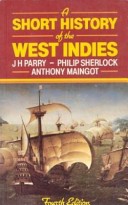
‘A Short History of the West Indies’ by J.H.Parry, P.M. Sherlock and A. P. Maingot

1987, 306 p.

One of the things that I love about doing my thesis on the colonial career of a 19th century judge- and yes, I did just (still?) use the word ‘love’- is that it has taken me to three and a half very different colonial settings in my research.  [Three and a half because Port Phillip was officially part of New South Wales, but I see it as a qualitatively different type of society to Sydney.]  The self-imposed need to knuckle down to start to write thematically has prodded me to turn to the West Indian aspect of my judge’s career- and so, where to start other than a Short History of the West Indies?

In 1968 the New Zealand historian Keith Sinclair wrote a cheekily-titled article called “On Writing Shist”.  No, it’s not a typo- ‘Shist’ is an abbreviation for “Short History”: all countries have them (often with “Short History” in the title), and many eminent historians tackle them.  Even though, as Keith Sinclair points out, a short history is written for an “educated non-specialist”, the reality is that often they’re read by people wanting an overview of their own history, and especially by other historians coolly interested to see how their colleagues, already known by their other work, tackle the task.  It’s a quite different readership when the reader is a complete outsider who knows very little about the topic beyond a vague idea of the country being “over there somewhere”.

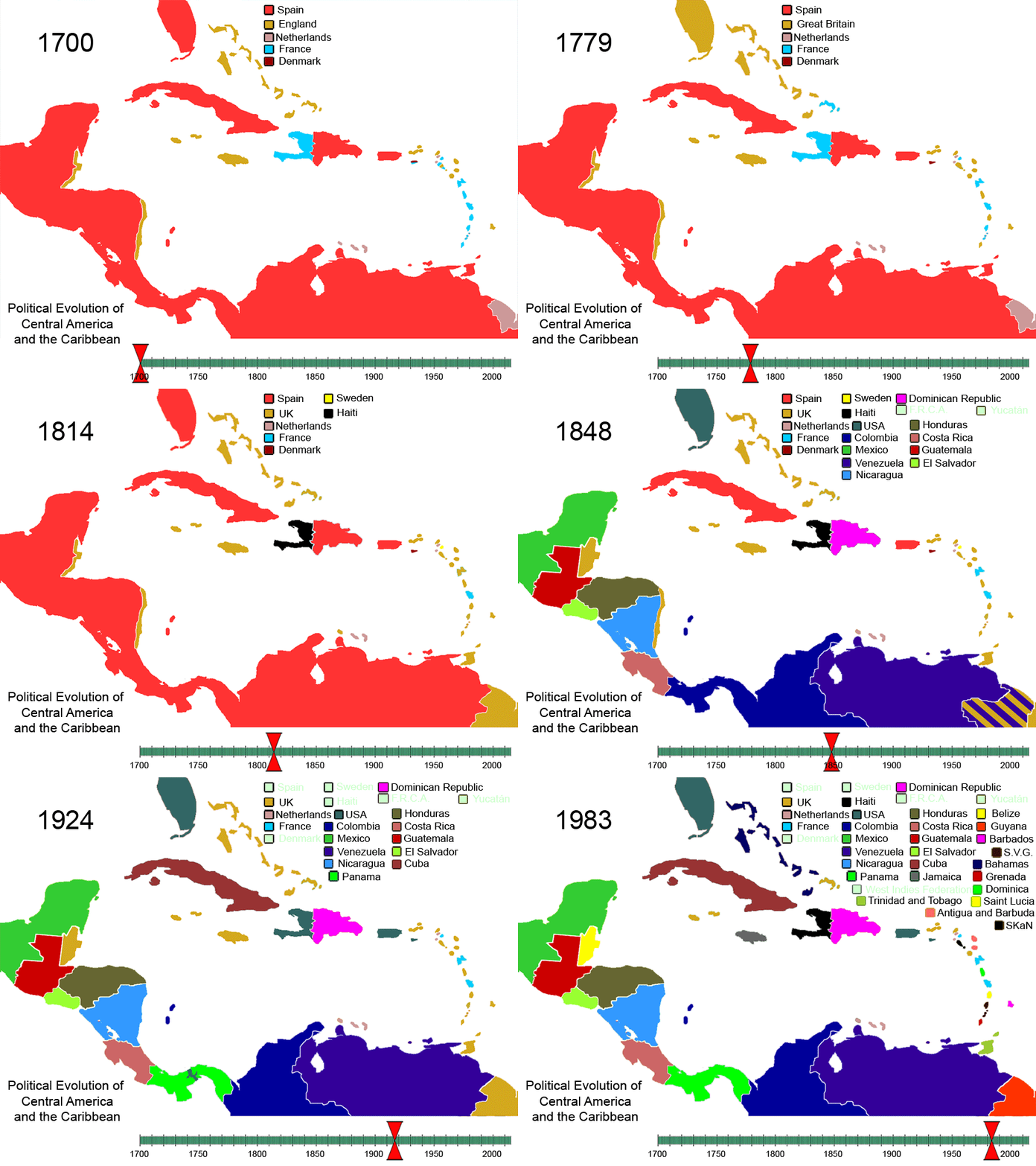
For this reason, it’s a good thing for a Short History to have a map or two. In this regard A Short History of the West Indies  fails dismally with not one single, solitary clear map beyond a picture of an antique map as artefact that was illegible.  I found myself craving a good series of historical maps showing which European nation owned what, which port towns were important when, and how and when locations changed their names.  Thank heavens for Lord Wikipedia, which provided this fascinating animated map here.  I am embarrassed to confess how long I spent, playing this over and over, watching islands swapping from one nationality to another, and moving in and out of significance. (How clever- it seems to run by itself!)

Political_Evolution_of_Central_America_and_the_Caribbean_1700_and_on.gif

Keith Sinclair described  Shist as a “summary interpretation of a topic, intended to make it understandable… an extended kind of explanation”.  In such a book, facts form a “very thin hard skeleton…[ selected]… in relation to the pattern of the whole book”.  The tag cloud in the Google books description is quite pertinent here because it emphasizes that the book is largely concerned with places (Jamaica, Cuba etc) rather than people or events.  The book is arranged chronologically, as you might expect, and as the first edition was published in 1956, it would appear to have had extra chapters added as it spawned its second edition in 1963, third in 1971 and this final one in 1987.   Given that the book has been reprinted so many times with 16 reprints and 4 editions, it has been disconcerting and rather confidence-sapping to find so many typographical and date errors in the text.

In a Shist, Sinclair said, the problem is not so much what to include, but what to leave out.  Themes are established, dropped, and picked up again.  Authors have to deal with the twin narrative problems of shape “the over-all pattern of ideas, facts and prose, woven into a unity” and span- “how one chapter, one hill, will roll gently into the next.  How to present, now and again, an unexpected or dramatic vista”.

In this regard, what I gleaned from this book- which may or not be what the authors intended, and may or may not be what someone more familiar with the topic might detect- is first, that West Indian history didn’t really begin until the fifteenth century. The indigenous Arawak people are dispensed with in a couple of pages. Second, that this is very much a sea-based history, both in terms of the geographic sprinkling of islands across the West Indian basin, as well as in the maritime prowess of the European powers that plied their influence there. Third, that the history of the West Indies is completely wound up in the machinations of these European powers- the Dutch, the Spanish, the French and the English- and their wars, treaties and truces.  Fourth, that the monoculture crop of sugar profoundly affected the history of the region as a whole in terms of slavery, social structure and power relationships and the economy.  Fifth, that a history of the West Indies needs to be seen within the context of U.S. history of power. Sixth, that even though the islands tended to see themselves in a closed loop tied to their metropolitan power, it is important to look across these different historical metropolitan affiliations to see the rhythm and pace of change across the region as a whole.

I don’t know enough to detect what is new or different in this short history compared with others that have been written before and since. Nonetheless, it had me thoroughly engrossed, with many ‘aha!’s as the pieces fell into place, especially in regard to the Dutch influence in European history.  I note that the authors describe the slave rebellions in Haiti, Jamaica and St Vincent as “The Second war of American Independence”.  I liked their use of the cassia tree as an emblem for West Indian history following emancipation- the leaves and bark are lost, then suddenly it bursts into golden flower.

I suspect that the maritime emphasis reflected the enthusiasms of the historian J.H. Parry in particular, and that there is a political thread running through the commentary on seeing the region as a whole, and on the relationship with the United States.  It is probably a history of its time in terms of the sidelining of indigenous history and women. This is a history of big powers and big forces, rather than individuals. I’m full of enthusiasm to wade further into the mud flats of British Guiana history!

References:

J. H. Parry, Philip Sherlock and Anthony Maingot  A Short History of the West Indies London, Macmillan, 1987 (4th edition)

Keith Sinclair ‘On writing Shist’ Historical Studies, Vol 13 No. 51, 1968 pp.426-432

A pleasant Sunday drive to….The Portable Iron Houses

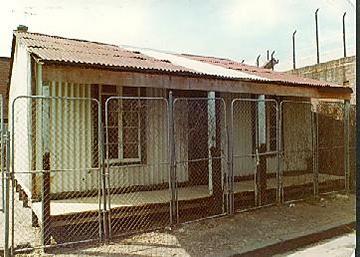
Do people do Sunday drives anymore? We did- across the Yarra and down to South Melbourne to look at the Portable Iron Houses in Coventry Street South Melbourne.

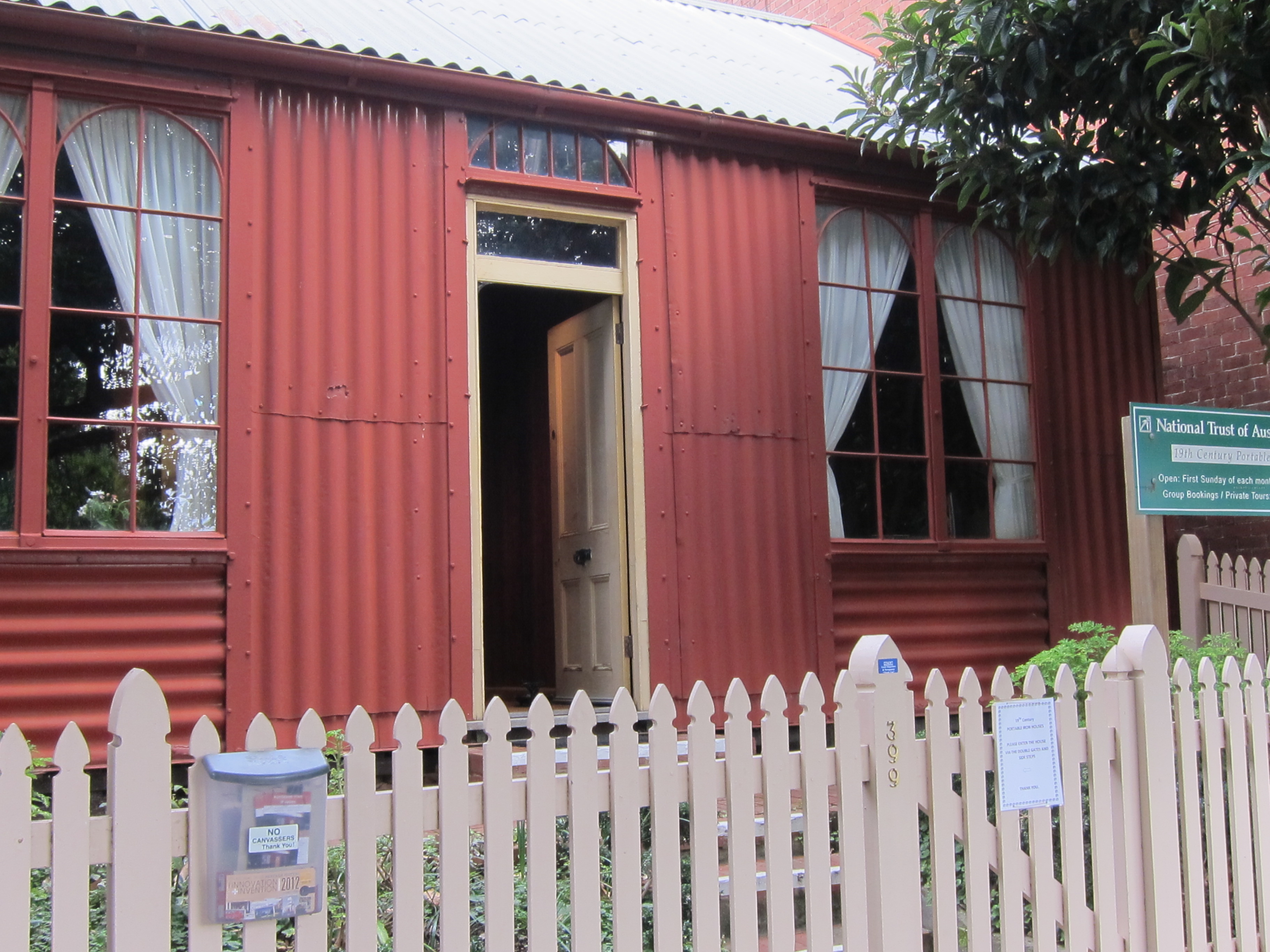
Patterson House, Coventry St South Melbourne

There are three galvanized iron houses on the South Melbourne site.  The one facing Coventry Street, shown above, is still in its original position where, in 1855 it was one of nearly one hundred portable buildings in the vicinity that included cottages, two-storey houses, shops, stores and a coach house.  It was valued at 60 pounds when it was erected in 1853/4.   Portable iron houses were packed in wooden cases (which could be used to line the internal walls) and easily transported by ship or cart.  They were quickly erected and could be unbolted and dismantled to be taken elsewhere for re-erection as a practical and enterprising solution to the dire housing shortage in gold-rush Melbourne.  The house above contained four rooms on the ground floor, with two attic bedrooms that are reached by a precipitous stairway.  I found it hard to envisage negotiating these stairs- barely more than a ladder really- with a babe in arms.  The temperature of the attic rooms in summer must have been fearsome too.

The second house on the side, Bellhouse House, was originally built at 42 Moor Street Fitzroy.

Bellhouse House, South Melbourne

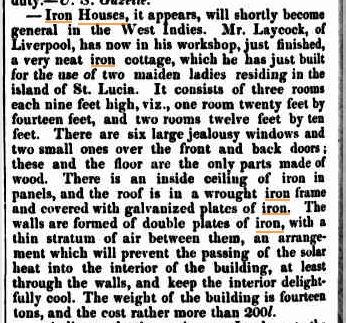
It is believed to be the only remaining example of the work of Edward T Bellhouse of Manchester England.  In 1851 he displayed his portable houses at the Great Exhibition, where they exemplified the practical use of new technology, especially for an imperial context.  There had been iron houses available previously- say for example, this house designed for St Lucia in the West Indies, but the cost and the weight were prohibitive

The Courier (Tasmania) May 8, 1845

(by the way, it should be ‘jalousie’ window, which apparently is just a louvre window).

There had been timber pre-fabricated houses as well (La Trobe’s cottage is a good example) but with these iron houses we are talking mass-produced, cheap, urban housing that could be manufactured in Britain and shipped to colonies throughout the world.  The iron on the Bellhouse House runs horizontally, and it would have originally contained three rooms.  I must admit that I found it rather charmless.

The house that I was most intrigued by was Abercrombie House, which faces Patterson Place at the back, where there were originally fourteen houses of a smaller size erected by the entrepreneur who erected the Coventry Street House.

Abercrombie House, Patterson Place South Melbourne

This particular house was moved from its original location at 59 Arden Street, North Melboune in about 1980.  You can see a picture of the house still in North Melbourne here  and it being shifted by semi-trailer after being cut in half here. They must have had their hearts in their mouths while they were moving it, because it is certainly in a very precarious condition.  It was last occupied in 1976, and standing there looking at the single light bulging hessian-covered ceiling and the layers of wall paper, it’s hard to credit that such primitive living conditions still existed in the middle of Melbourne forty-odd years ago.  But conversely, on a wet and cold winter’s day, it’s also important to recognize what a vast improvement this house would have been on the canvas tents that were the alternative.

Abercrombie House from Patterson Place

The Portable Iron Houses are presented by the National Trust, and they are open on the first Sunday of the month 1-4 p.m.

‘Bunyip Aristocracy’ by Ged Martin

Ged Martin Bunyip Aristocracy: the New South Wales constitution debate of 1853 and hereditary institutions in the British Colonies, Sydney, Croom Helm, 1986, 198 pages & notes.

To understand the past in its full roundness, the historian must acknowledge that the ideas and plans which did not come to fruition are sometimes as significant as those which did.  Any other approach is tantamount to accepting that what has happened had to happen, it which case there is really no point in writing history at all. (p. 197)

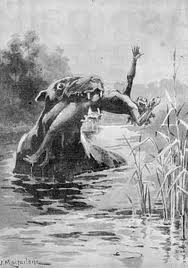
“Bunyip aristocracy”- what a delicious phrase! It was coined by Daniel Deniehy to describe the squatters and pastoralists who, if they got their way in the constitutional debates of the early 1850s,  would style themselves as earls and lord it over the rest of the people. He was speaking  at a protest meeting held at the Victoria Theatre (in Sydney) on 15 August 1853, on the eve of the Select Committee of NSW’s debate about a hereditary aristocracy.

People may have laughed at the idea of a jumped-up bunyip aristocracy  but, as Ged Martin points out

From the standpoint of modern Australia the scheme is exotically bizarre. To men who saw themselves as a resident outpost of a British world, it was eminently appropriate… In many ways, New South Wales and 1853 were the logical place and year for the idea to surface.  As a colony of large pastoralists it had a superficial similarity to landed society in Britain. Its convict past had accustomed its landowning and conservative classes to equate the defence of political control with social exclusivism.” (p. 195, 196)

The idea of a hereditary colonial aristocracy that could sit in an upper house was not new, however, and nor was it confined to New South Wales alone.  In the early chapters of this book, Martin examines the idea of hereditary institutions across the empire.  Hereditary honours for Canadian colonists were mooted in the British parliament during the debate over the 1791 Canadian constitution, but the suggestion was not acted upon.  The governor of British Guiana, Sir James Carmichael Smyth, urged the establishment of a colonial order of knighthood in 1831 and again in 1837.  It was an idea that bubbled up from time to time, only to subside again when derided or frowned upon at either the London or colonial end.

In its favour was the argument that as British subjects, colonists should be able to be considered for imperial honours.  It was felt that by instituting a framework of honours, not-quite-aristocratic-but-close-enough families would be encouraged to migrate to the colonies, where they would improve the temper of society.  An upper house composed of hereditary peerages, with perhaps the odd lifetime peer thrown in to give people something to aspire to, would act as a brake on democratic excess. After all, the colonial lords would have the long-term interests of their families and their dignity at heart, and so could be trusted to do the right thing.

But should they be ‘proper’ titles, that had good standing back home? What if England was flooded with newly minted lords, flaunting their new titles when there was such demand for titles in Britain itself?  Was it possible to invent an instant aristocracy, or was it the outcome of centuries of slow growth?

These problems were never really resolved, and by the time the British government considered the new constitution for New South Wales, the proposal for a hereditary upper house had been withdrawn at the colonial end.  Not that it was envisaged that it would be an instant House of Lords in New South Wales: instead, it was envisaged that an order of baronets, uniting wealth and merit, would be established by nomination, which over time would become an electoral college for the upper house.

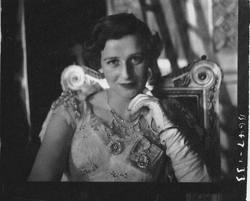
As Martin points out, it turned out that Australian politics ended up with a number of legislators styled ‘Sir’ and a number of families that developed a tradition of political service anyway : Sir Robert Menzies, Sir Richard Casey and political dynasties like the Anthonys, the Downers, the Jenkins, the Cains and the Newmans.   It was sobering to remember the occasional re-emergence of quaint ideas of Australia as a cadet monarchy with suggestions that Prince Charles might become governor-general, or a rather weird suggestion that Princess Alexandra might become Queen of Australia.  Sir Robert Menzies was her first son’s godfather, and his middle name was Bruce (after Sir Stanley Bruce, I assume, and not because the name ‘Bruce’ summons up a broad-shouldered farmer with big hands?)

Queen Sandy of Australia?

Apparently this idea was treated with derision, with critics suggesting that Sir Robert Menzies or Sir Richard Casey could be appointed governor-general of Great Britain instead.

In many ways this book is a good counterpart to Peter Cochrane’s Colonial Ambition, although it lacks the rollicking characterizations of Cochrane’s book. The typesetting is of its time and awful: dense, single-spaced, typed pages with footnotes jammed up against the lines of text.   It’s not a what-if history, but it does finish by noting the things that could have brought a hereditary honours system or a cadet monarchy into existence, had they fallen differently.  And had a more systematic association with the royal princes developed,

Historians would still have gently derided the whole thing, because historians are usually good-humoured progressives.  But historians are also very good at being wise after the event.  If the persistent rhetoric of transferring British institutions to the colonies had actually led to an attempt to imitate the distinctively hereditary features of Britain’s constitution, no historian today would express much surprise. (p. 198)

Vote 1 Joseph Hawdon!

As you may recall, I am interested in the history of Banyule Homestead, one of the few pre-gold rush mansions still standing in Melbourne.  My sister blog, BanyuleHomestead is exploring different aspects of Banyule Homestead’s history.  Joseph Hawdon, who built the homestead in the 1840s, was one of the candidates for the first election to the Legislative Council of New South Wales.  You can read about his election tilt here.

Oven poached teeth

I had to go to the dentist this morning for a 9.00 a.m. appointment.  I had originally thought that at least I wouldn’t have to wait for long, but then I started to wonder if maybe I would have a longer wait than anticipated.  Why? Because in my mind’s eye I can see hordes of Sunday Age readers, all sitting desperately in dentists’ waiting rooms, with their teeth clamped shut.

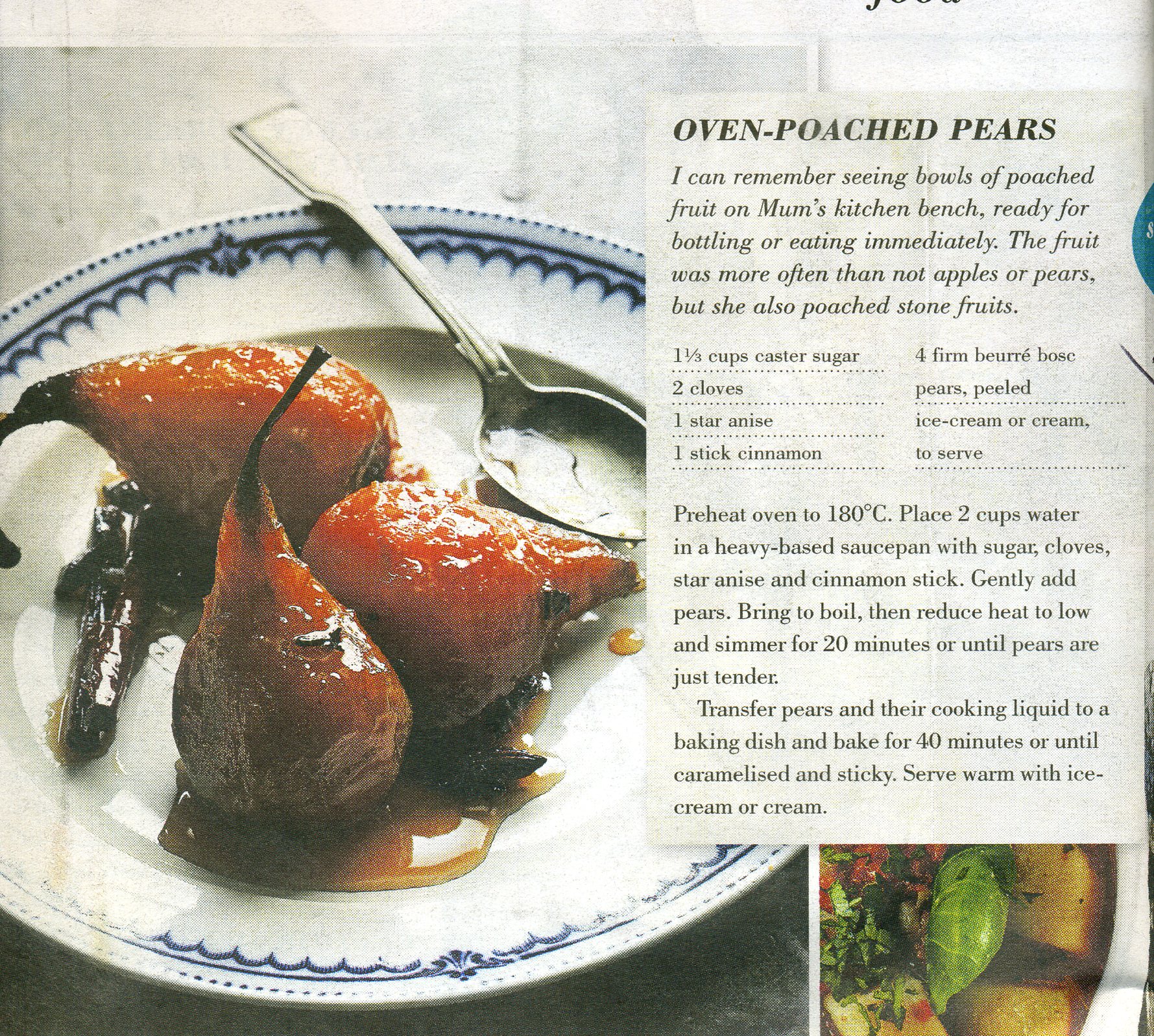
I blame Guy Grossi’s oven poached pears, featured in yesterday’s Sunday Age.


Beurre bosc pears?- check.  Cinnamon stick?- check.  Star anise?- no, but  I bought some. In went the pears to cook in the saucepan for 20 minutes or until the pears were just tender.  Well, it was a good 30 minutes before I could persuade myself that perhaps they were slightly more tender than when I put them in half an hour earlier.  Into the oven, 40 minutes, 50 minutes, 1 hr 15 minutes- ye gods, they still looked like albino walruses wallowing in barely coloured syrup and as hard as rocks.  So, in desperation, back onto the stovetop to somehow make them “caramelized and sticky.”

Well, that worked.  So well that once they hit the bowls, they clamped immediately onto the bottom, only to be shifted by multiple applications of boiling water and soaking over night.  “Mmmm” we said, taking a mouthful of pear, only to realize that the caramel set like cement between our teeth.  “Mmmm” was all we could say, really. That, or “mmnnnngggttttsssshhhh”.

You can keep your oven-poached pears Mr Grossi.  Dentists throughout Melbourne and Sydney (and anywhere else the Sunday Life is published) thank you.  I don’t.

‘Forecast: Turbulence’ by Janette Turner Hospital

2011, 232

I find it hard to review a collection of short stories.  Usually the stories themselves have been written over a period of time and published in multiple journals, rather than written with a themed collection in mind.  If there is a theme, it is detected more in the act of collecting than in the act of writing.  That said, writers often work out a theme in a variety of ways, as if they are circling it, coming at it from different directions.  It’s also difficult to talk about stories that themselves only take up about 10 pages or so, especially if the reader of the review hasn’t read them.

This collection is somewhat easier to talk about, because the title ‘Forecast: Turbulence” is such a strong theme that emerges from these stories.  They are all about family members in turmoil, and nearly each one makes reference somewhere to the weather which in many ways reflects the pain and turbulence inside.  In many ways, it is a blessing that these ARE short stories:  ‘Weather Maps’ in particular, about a young woman cutting, is so intense that you wouldn’t want to extend for much longer.  The most memorable of them for me is ‘Afterlife of a Stolen Child’, which revisits the kidnapping of a child many years previously, from the perspective of the family members and a man who believes that he is the missing child.  The narrative revolves between the main protagonists, and it leaves the reader just as unsure and ambivalent as the characters find themselves.

I felt as if there were flashes of her other work in some of these stories.  ‘The Republic of Outer Barcoo’, for instance,  reminded me of her book Oyster for its outback setting of a cult.  Several of the stories involve fathers.

The final story ‘Moon River’ is a memoir, and here the author speaks in her own voice.  It is the most Australian of the stories, set in and around Brisbane.  It is attached almost as a coda, and it does change the feel of the rest of the stories.  It’s as if the author has stepped out from behind the curtain.

These are tight, well-written stories.  She’s good.

Sourced from: Yarra Plenty Regional Library

My rating: 8.5/10

Read because: it was our April read in the Australian Literature online group and as part of the 2012 Australian Women’s Writing Challenge

Duelling lads

The district of Port Phillip seems an overwhelmingly Victorian city. [There’s a little pun there, for those of you not familiar with Melbourne, because the Port Phillip District later came to be known as ‘Victoria’.]  Queen Victoria ascended to the throne in 1837, when Port Phillip was in its infancy, and the influx of immigrants which became a tsunami in the 1850s gold-rush, embedded the ideas and mindset of Victorian Britain along with the foundation-stones of many Gold Rush era buildings.  But there is one manifestation of an older, Georgian-era mindset in Port Phillip during the late 30s/early 1840s – duelling.

There had been a late 18th century revival in duelling in Britain, especially amongst army officers.  In 1777 at the Clonmel Assizes a group of Anglo-Irish gentlemen drew up the ‘Clonmel Code’ which comprised 26 rules for duelling. Although it was becoming less popular in Britain in the early decades of the 19th century, it continued in the colonies for longer, especially in Upper Canada, Sydney and Hobart which could perhaps be explained by the heavy presence of army officers in those locations.

It existed alongside, and was often inter-twined with the legal system.  Indeed, lawyers were frequent participants.  It was both a supplement to the legal system, and was supplemented by it, with disputes involving duelling often being played out through placards, newspaper letters and court cases as well.  Hence, while he was serving in Upper Canada in 1828 Judge Willis heard a court case that emerged from a duel that had occurred more than ten years previously, that had been reignited by a letter published in the newspaper.

There were several duels in Melbourne.  One famous one involved Peter Snodgrass (good name, eh?) and Redmond Barry who was later to become Chief Justice, and famously acted as the judge in the Ned Kelly trial.  Peter Snodgrass had been involved in an earlier duel as well.

As Edmund Finn tells it in The Chronicles of Early Melbourne (p. 776)

On the evening of the 1st January 1840, a select dinner-party assembled in one of the club-rooms to bid hearty welcome to the newly-arrived year, and here gathered as choice a dozen of exuberant spirits as could well be found from that day to this. They sat round a table of “full and plenty” where no stint was imposed upon the animal enjoyment of eating and drinking; and after dinner there was no disposition to bring the convivialism to anything like a premature termination, so there they stayed without giving a thought to an early breakup….When the wine, or rather the brandy, was in the wit flew out.  “A cup difference” arose between Mr Peter Snodgrass and Mr. William Ryrie, and heated words and offensive insinuations followed.  Snodgrass was the son of a Lieutenant-Colonel of distinction, and may be supposed to have inherited a martial ardour, which , which he was never reluctant to suppress when any occasion arose to excite it, and accordingly, a circumstance not surprising to those who knew his temperament, he forthwith challenged  Ryrie to mortal combat.  The verbal cartel was accepted as willingly as it was offered…

The shooting match was fixed for daybreak the following morning, on the western slope of Batman’s Hill, now the site of the Spencer Street [Southern Cross] Railway Station, and there was not much time for effecting the preliminary arrangements.

But an unexpected and formidable difficulty interposed…Strange and unaccountable omission! The Club was not provided with such gentlemanly indispensables as duelling pistols; and worse too, it was impossible to procure any in town without exciting a curiosity which might spread the matter abroad, and conduce to its interruption by police or other interference.

What to do?  Then someone remembered-

Mr Joseph Hawdon, of Heidelberg, was the possessor of a splendid case of hair-triggers, which could be got, if only their owner could be got at; but he was enjoying the pleasures of his peaceful home, and that was eight miles in the country.  This was a gloomy and disheartening look-out…Fortunately, there was present a man worthy of, and equal to the occasion.  H-lt-n, Ryrie’s second, had a good horse in the Club stable, and fresh from the “land of green heath and shaggy wood” was an expert plucky rider, as firm in the pigskin as on the solid ground, and jumping up, proclaimed his readiness to ride… to Heidelberg, storm the Hawdon domicile, and either return with the pistols, or never show his honest face amongst them.  The offer was rapturously applauded…

And so off he rode-

Arriving at his destination, the dreaming Hawdon was broken in upon, the pistols obtained, and the eight miles back were thundered over again in a double-quick time never out-paced since.  It was about 1 o’clock when the courier galloped up Collins Street, flourishing a pistol in each hand…

Lack of ammunition was the next problem, again solved by the enterprising second Mr H-lt-n, who sweet-talked the Military Commandant into handing over the needful.  On the way back to the club, he called in on Mr D. J. Thomas the surgeon, who agreed to accompany them.

Every obstruction now removed, the party moved off to the convincing ground, a grassy common on the verge of the swamp northwardly adjoining Batman Hill.  By this time it was clear daylight, as fine and fresh a summer morning as could be decided.  The distance was measured, the pistols primed, and the men placed; but just as the fatal signal was about to be given, Snodgrass, who was always a victim to over-impatience, or ultra excitement on such occasions, so mismanaged his hair-trigger that it went off too soon; so, instead of slaying his antogonist, he wounded himself in the toe, and came to grief.  Ryrie, as a matter of course, could not think of behaving so unhandsomely as to shoot a man down, and forthwith flared up in the air.  Thomas was immediately at work with the wounded patient, who, though literally prostrated, was found to have sustained no serious injury…

And what became of the Hawdon Duelling Pistols? As Garryowen tell us, Hawdon had a contract with the New South Wales government to convey the mail overland to and from Yass.  The pistols were placed in the hands of the first mailman, John Bourke, one of Hawdon’s employees, to be used as a means of defence against “possible bushrangers and probable Aboriginal assailants”.  Garryowen did not know if the pistols were ever deployed, but as Bourke was a good marksman, he was sure that he wouldn’t ‘toe’ himself as the first duellist did.

Sources:

Edmund Finn (Garryowen) The Chronicles of Early Melbourne

Penny Russell Savage or Civilized? Manners in Colonial Australia

Cecilia Morgan ‘In Search of the Phanton Misnamed Honour’: Duelling in Upper Canada Canadian Historical Review , Vol 76, No. 4 Dec 1995 pp 529-562

Crossposted (partially) at BanyuleHomestead because the aforesaid Joseph Hawdon later lived at Banyule Homestead in Heidelberg

‘I Succeeded Once: The Aboriginal Protectorate on the Mornington Peninsula 1839-40’ by Marie Hansen Fels

There is a somewhat elegaic, wistful tone to this book, hinted at by its title. It is a quote from the journal of Assistant Protector William Thomas as he was about to re-locate his Protectorate for the second time in three years under official instructions.  He had been forced to shift from the Mornington Peninsula in 1840 to Nerre Nerre Warren, then forced again to shift to Merri Creek in 1843.  There were many reasons that he had failed, he said, but there was one time when he could have been said to have succeeded- and that was at Arthurs Seat between 1839 and 1840.

In the Afterword to the book, the author admits that there is “no conclusion, no grand summing-up” in her work.  She evokes the late Greg Dening, who taught that “the historical effort was to understand and to explain: not to judge, not to label, not to take sides.” (p. 397).  In many ways, it would have been helpful to have her afterword as a preface, because I found myself somewhat puzzled about what this book actually is. It is part of ANU’s Aboriginal History Monograph series, which presents “studies on particular themes or regions, or a series of articles on single subjects of contemporary interest.”  In this case, it focuses minutely on a relatively small area of land, over mainly a one-year period, although it does spill out of this chronological limit at times.

The book won the ‘Best Community Research, Register, Records’ category of the Victorian Community History Awards in 2011. The typographic layout of the book is more suited to a records-based document than a narrative history: it has the appearance of a work-book or training manual, and the headings and boxed biographies of individual aboriginal people feel as if they are the product of a word-processor rather than a commercial print layout.   It is thoroughly commendable that the book is available free as a download through ANU e-press here.  I suspect that I might have felt short-changed had I paid $29.95 for a print-on-demand copy (although, admittedly that is not a high price).   The rather thin covers of my book are already curling.

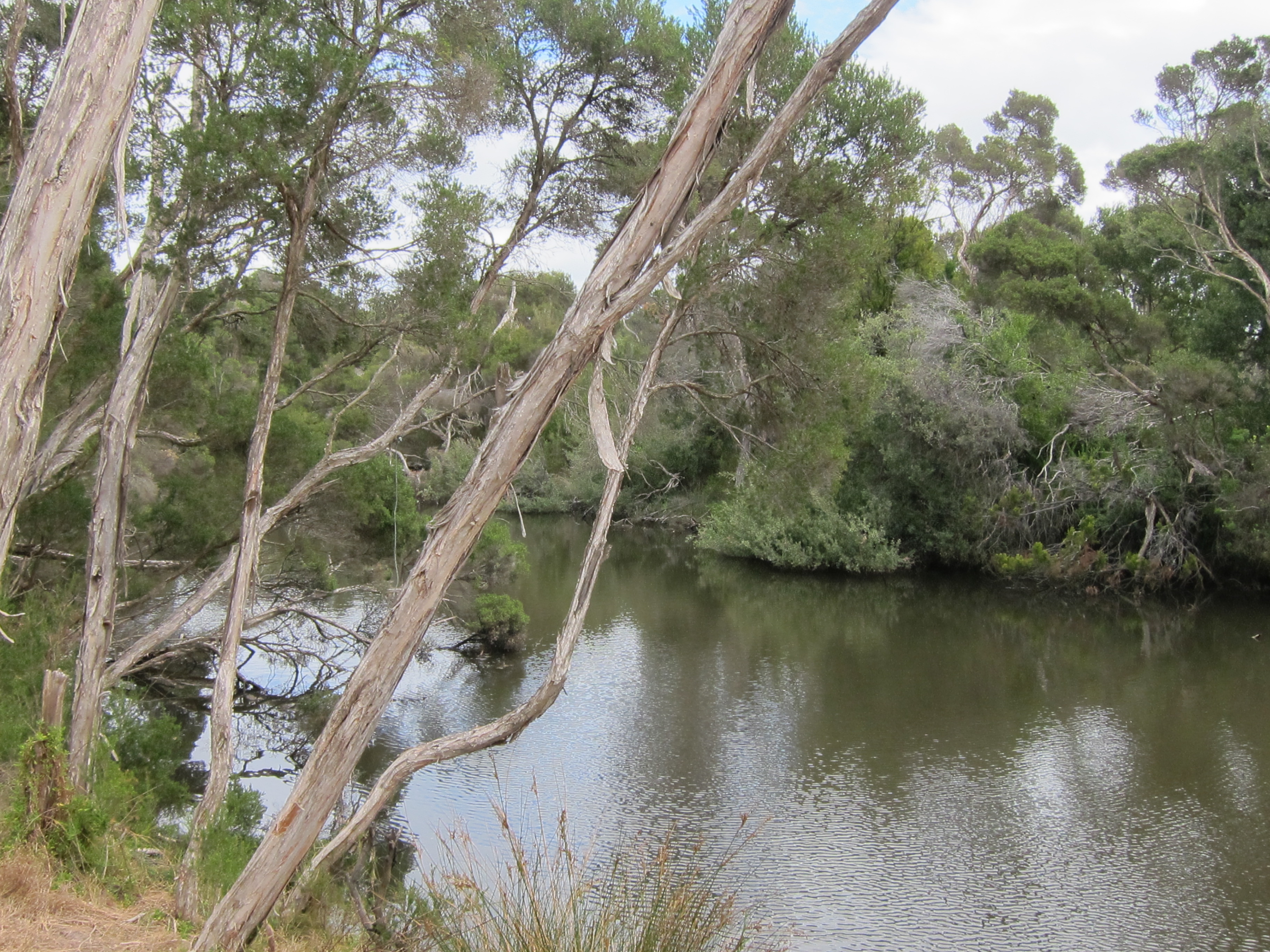
But the value of this book lies in its contents, not the layout.   As a Melburnian, and one who holidays on the Mornington peninsula side of the bay (rather than the “other”, western side), it was as if my January canvas of caravans and holiday houses had been stripped back to another, earlier frontier time.  Names were familiar, but distorted (like Moody Yallock for what I assume is now Mordialloc, and Kullurk for Coolart).  Although I was of course aware of McCrae Homestead, it had never occurred to me that there were other pastoralists down on the peninsula as well. I hadn’t thought of my caravan site down at Capel Sound as part of a squatter’s run, but I think that I sensed, just a little, an older history of the peninsula when I was down at Balcombe Creek a month or two back.
Her book is, as she admits, a contrarian view to the prevailing orthodoxies of confrontation, massacres and victimhood.  Instead, hers is a story of an “amiable, intimate, non-violent coexistence”, but this is not explained by the facile “our lot were a peaceful lot” with “mild and inoffensive” men. Instead, she argues:

That there was no conflict at all on the Mornington Peninsula is to be explained in the same terms as conflict is explained in other regions of Victoria, that is, in terms of individual leaders, of social and political agendas of groups, of the tone of relationships between both Indigenous and European. (p.177)

And this is what her book is- an exploration of the tone of relationships between Assistant Protector William Thomas and the squatter farmers of the Mornington Peninsula, and the men and women of the Bunurong people who ranged over it as their traditional lands.  Just as she did in her earlier book Good Men and True: The Aboriginal Police of the Port Phillip District, Fels delineates, names and gives a life trajectory and agency to aboriginal people who otherwise remain as the shadowy ‘other’. In text boxes headed with the variations of their names- both aboriginal and conferred-  (e.g. Nunupton/Nunuptune/Nalnuptune/Naluptune/Nunnapaton/Nunupthen/Namapton/Billy Langhorne/Mr Langhorne p. 266), you sense the white informants grappling with unfamiliar sounds, trying to render them into writing and to somehow capture individuals within a bureaucratic report and a census system.  She traces the appearance of individuals at different locations throughout the district as recorded in musters, reports and official letters, their family connections, and their all-too-often premature deaths.

She brings Assistant Protector William Thomas to life for us as well.  The Protectorate scheme was devised in Britain in response to humanitarian concern over the decimation (a term that under-estimates) of indigenous people across the empire.  The Protectors were greeted by many settlers with disdain and derision, and by humanitarians with frustration and annoyance at their various shortcomings.  Rather than being mobile, single men able to follow tribes ranging across country, they were family men operating on a model of establishing a mission in a central location.  I’ve mentioned Robinson before here and here, and Sievewright here.   Assistant Protect William Thomas was a family man as well, and shared with his fellow protectors the curse of execrable handwriting, although the depth and range of his private and public writings has been invaluable for historians (especially now that someone else has grappled with the handwriting!)

And so we see Thomas trying (not always successfully) to enforce Sunday observance; we see his powerlessness to stop a raiding party; the pettiness of Protector Robinson and the futility of railing against bureaucracy, and his sense of bewilderment and sinking disappointment as he returns to the Peninsula after the enforced and much-resented shift to Narre Narre Warren, only to find the peninsula deserted.

Although the focus of the book is on 1839-40, this one year did not happen in isolation.  Actions which took place in this focal year had antecedents, and when the Bunurong men took off on a raiding party towards Gippsland, it was yet another episode in a long-running distrust between the two nations that long predated white settlement.  She works hard to uncover the context and rationale for this feud, exploring a number of hypotheses that take her beyond tribal and cultural factors into a consideration of geological and archaeological evidence of sedimentation, inundation and earthquakes in millenia past.

Moreover, there had been contact between the Bunurong people and white sealers and timber gatherers along the coast and the Bass Strait islands in the decades before Fawkner/Batman claimed possession of the district.  Fels devotes a considerable amount of time tracing the kidnapping of particular individuals, both men and women, who ended up in the Bass Strait Islands, South Australia and even Western Australia,  far from Bunurong country.  This is important: as we speak, there are competing custodial claims from the Boonwurrung Foundation and the Bunurong Land Council based on the status and identity of Louisa Briggs, one of several women abducted.  The contentiousness of such issues is highlighted by the heavily censored and blacked-out reports generated by archaeologists and ethnographers as part of this twenty-first century dispute.

There is a sense, too, of the clock ticking over several of the sites that she describes here.   A footnote questions the expertise of the author of the archaeological report for the Martha Cove development, and a planning permit has been granted on a mission site, extended to 2013, for a Holiday Resort incorporating a winery, function centre, restaurant, hotel, camping park and golf driving range. Another mission site has been identified on private property, but she does not disclose the location.

This is not a ‘straight’ narrative history.  She rebuts a number of local history myths, and she challenges other written histories, for example Bruce Pascoe’s The Convincing Ground.   There is not a smooth narrative flow and it is certainly no coffee table book (and I’m sure was never intended to be).  It is history with its sleeves rolled up.

‘Imperial Communication: Australia, Britain and the British Empire c1839-1850’

Simon J. Potter (ed) Imperial Communication: Australian, Britain and the British Empire c1830-1850 ,London, Menzies Centre for Australian Studies, 2005

Growing up in the early 1960s, I am old enough to remember thinking of myself living in an empire, even if by then the proper terminology was ‘commonwealth’.  Although I am a fourth (?) generation Australian, there was still a sense that if you were going to travel anywhere overseas (by ship, naturally), then you’d go to England and ‘the continent’. Cars were made in England; your crockery was made in England; Enid Blyton WAS England; coats came from England; the Beatles and Carnaby Street came from England, and I was inordinately proud of my Mark Shaw three-piece pillar-box red pants suit made in England.  I didn’t realize it at the time, but I very much thought of England as ‘the centre’ and Australia, New Zealand and Canada as ‘the periphery’.  I don’t know that I really thought about the other red bits on the map at all, except to acknowledge them perhaps as a family of cultural political step-siblings who also received visits from our hatted and gloved Queen.

Academically, this centre/periphery model of the British Empire has been challenged by a number of views.  One of these is that, instead of  being pre-eminent at the centre of the empire, Britain was itself changed by the two way flow of wealth, information and political innovation from the colonies.  The second is that the British Empire is best seen as an intersecting, overlapping network or web, of personnel and information that flowed in circuits between and across the metropole and peripheries.  People are an important component of this- the waves of emigrants who circulated between locations, and the corps of officials and bureaucrats whose career took them from one placement to another.  My own work fits very much into this view of empire, and so, too, do the papers in this book.  It’s an approach that appeals to me because it combines the personal and fine-grained element of biography within a broader overarching structural model.

The first paper by Damen Ward from New Zealand is entitled ‘Colonial communication: forums for creating public opinion in Crown Colony South Australia and New Zealand’.  He has chosen these two colonies because they were both associated with Wakefieldianism and prided themselves that they were ‘free’ colonies rather than penal, and that their colonists were fully entitled to their legal and constitutional rights as free-born, active, independent British subjects.  He examines  this language of constitutionalism as it played out through settler-initiated public discourse, most particularly in public meetings, petitions and memorials, the press, and Grand Jury presentments where jurors themselves raised issues of concern to the population at large.

Zoe Laidlaw, in ‘Closing the Gap: colonial governors and unofficial communications in the 1830s’ examines the more personalized communication channels that governors and lobby groups carved out for themselves to ensure that their viewpoints were heard back ‘home’.  Although governors seemed to be in a privileged position in terms of official communication and access to the movers and shakers, they were much more vulnerable than they appeared.  Political parties moved in and out of office, particularly during the 1830s and 1840s, and the career-enhancing coup of naming a city or a river after a particular politician didn’t look quite so wise when that politician was bundled into the opposition.  Governors were under financial pressure and they were reliant on gossip or slow and often outdated information, and so they were reliant on ‘friends’ of like political persuasion who could represent their interests in person to the Colonial Office.  Unfortunately for them, though, their opponents and lobby groups could play this game too, and sometimes, as in the case of Sir John Franklin, the ‘friend’ turned out to be anything but.  Laidlaw illustrates this scenario through the example of Governor Bourke, who enlisted his son Dick as his envoy.

Finally, Alan Lester’s paper furthers the concept of the British Empire as a network by examining the rival humanitarian and settler circuits of communication that operated between and within sites in the Empire. The humanitarian networks reached a peak of influence with the anti-slavery and then aboriginal lobby-groups that held sway over the Colonial Office.  They, and their local branches, were challenged by settler groups, in differing degrees of formal organization, which strongly resented the imposition of a morality from afar.  This transcended national borders. Governors like Bourke were execrated as “liberals” by settler groups in South Africa,who later greeted news of his downfall in NSW  with glee.

These essays work well as a collection.  They spring from a similar historical approach, and their length is sufficient for their authors to develop and support an argument in some detail.  The layout of the pages is generous, leading to an easily-read and rewarding exploration of people operating as best they can and with differing degrees of awareness within the larger structure of empire within a tightly-focussed timeframe..