Author Archives: residentjudge

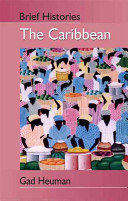
‘The Caribbean’ by Gad Heuman

2006, 184 p. & notes

This is the second short history of the West Indies that I have read- so any comments I make about this book will be in reference to a grand total of TWO books!  However, reading two similar books within a short period of time does allow some comparisons to be made, and the very act of comparison highlights the differences in approaches that can be utilized in writing a short history.

This book forms part of a “Brief Histories” series published under the Hodder Education umbrella. Other books in the series cover Modern Greece, Czechoslovakia and Eastern Europe 1939-2000. I strongly suspect that it has been written as an undergraduate introductory text by its layout, level of generality and in the reference section which is divided at a chapter level into primary and secondary sources.

The Perry, Sherlock and Maingot book that I reviewed earlier focused on  political and economic forces, particularly those emanating from Europe, and their effect on the West Indies.  They highlighted the island nature of the West Indies, and heavily emphasized the maritime nature of the West Indian economy, and the place of the Caribbean within the jostling for naval supremacy between empires.   This book is almost a polar opposite.  It focuses on the topography of land on these islands, rather than the seas that separate them, and is largely a social history of the plantation system and the slave and coloured community that arose in response.

It is, of course, a far more recent book than Perry et al , which came out in first edition in 1956.  Recent scholarship is reflected in Heuman’s book in terms of indigenous people, resistance, agency and women. He devotes a chapter to  the Tainos people, the Amerindian people who moved to the Caribbean c 2000 BC to establish a relatively sophisticated, hierarchical agricultural society- a group largely dismissed in a couple of pages in Parry et al’s book.  Heuman highlights the resistance to plantation conditions and the apprenticeship system conceded grudgingly in the wake of the abolition of slavery, especially among women.  This book explores the nuances of colour, especially among the Free Coloureds who, despite the legal equality with whites  granted just prior to the abolition of slavery, always found the social and economic  line between slave and coloured more permeable than that between coloured and white.

The book does not have a strict chronological order, and it takes the Caribbean as a whole rather than carving out separate French, Spanish and Dutch spheres of influence.  As Heuman notes in the preface:

All these territories have experienced similar histories of slavery, colonialism and exploitation and share a common history, despite their linguistic cultural and geographic differences (p. xii)

He argues that although they developed at different times and under different European powers, slave societies in the Caribbean followed a similar trajectory.  What happened in Barbados was repeated in Jamaica and Saint Domingue (Haiti) in the 18th century, and Cuba and Puerto Rico in the 19th century.  Likewise, the planter class structure was largely replicated across different settings, despite the different nationalities represented.

Slavery, emancipation, resistance and revolution take up the body of the work, and form the narrative skeleton of the book.  I must admit to skim reading the latter parts of the book dealing with the twentieth century,  which  in terms of page numbers alone is less detailed than the eighteenth and nineteenth centuries.  The book draws on primary sources and visual representations as a way of providing a far more human perspective than Parry et al’s book.  It does not particularly engage with the historiography of the Caribbean, beyond the fairly recent challenge to Eric Williams’ reappraisal of slavery and abolition through his Capitalism and Slavery published in 1944.

There are only limited footnotes in each chapter, although a ‘further reading’ list is provided at chapter level as well as a more general bibliography.  And it has a beautiful, clear, well-labelled map!


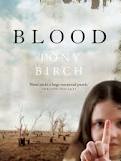
‘Blood’ by Tony Birch

2011, 264 p.

Every Friday night we settle down in front of the TV for the ABC Friday night splatter-fest.  I’m usually quite nonchalant about the gore except when it depicts eyeballs (a long standing phobia), torture and violence to or about children.  These things are likely to propel me out of my chair to quickly escape to the kitchen to make a ‘hot drink’, calling out “Is it over yet?” before I return.

Reading about (as distinct from watching) torture and violence about children upsets me too.  I found Rocks in the Belly a difficult read, and while it’s not so much about violence to a child (mmm…maybe?), it seems that most people who have confronted the book  We Need to Talk About Kevin shudder at the thought of watching the movie as well.

Blood by Tony Birch fits into this category as well.  It is told from the perspective of  a thirteen year old boy, who along with his younger half-sister, is falling through the welfare and schooling gaps largely through the weakness of his drunken, dissolute mother Gwen.  They move between caravan parks, motels and sleeping in the car, ricocheting between country towns, cities and states as Gwen takes up with one dropkick after another.  There is a brief hiatus of normality when she dumps the kids with her  own father, himself a recovering alcoholic with the rigidities and stripped-down asceticism of a life dominated by poverty and AA meetings.    “Is it realistic that two kids could be so invisible to the authorities like this?” I asked Mr Resident Judge who knows about such things.  Ah yes, he replied.  The  transience opens up too many questions that are too hard to address. Should these children be taken into care? Are they being abused? (I think I’d answer ‘yes’ to both questions)

Birch sustained the voice of thirteen year old Jesse well, with short sentences and a mixture of naivete and knowing too much.  You sense that Jesse is turning, no longer pretending that he doesn’t know how his mother earns her money, and becoming hardened to the wrecks of masculinity that she is drawn to. It is only his sister Rachel who anchors him.  There’s a lot of dialogue in the book, and it would transfer well onto the screen.  The descriptions of  blasted, tawdry broken-down landscape are  evocative- rather too evocative.  It’s a little bit like the world of Tim Winton’s ‘The Turning’, viewed from a child’s perspective.

Jesse and Rachel see ‘To Kill a Mockingbird’ at a theatre (a rather implausible scenario- surely a late night cable movie in one of the tatty motel rooms that they’d been left in would have been more likely?)  Birch uses the film as a motif, and the two children draw comfort from the characters of Jem and Scout.  But Gwen is certainly no Atticus, and this book has little of the redemption or sense of community in TKAM.   I’m not sure whether the allusion to the movie adds much to Birch’s narrative: while it throws up a strong contrast, there is an element of riding on the coat-tails of a much more nuanced book as well. There is the theme of blood, too, from which the book draws its title: the shared blood of commitment, the blood of  family ties, and the blood of violence.  And yet another motif is the tarot cards that the feckless Gwen plays with, that provide as much (or little) direction as anything else in her life.

Despite the plaiting together of these motifs, there’s nothing tricksy about this book.  It is straightforward and simple, with few flashbacks and a single narrative voice.  I found myself wanting to know what happened, but I knew within one or two pages that it wasn’t going to end well.  I found it easy to put down after each of the five sections, and was almost reluctant to pick it up again because it was painful and raw.

It is short-listed for the Miles Franklin. While I reacted at an emotional level to the book- grief for these children, anger and an element of self-righteous disgust at their mother- I’m not really sure whether the book carries the complexity sufficient for the Miles Franklin.  And I cringe at the thought that it might represent ‘Australian Life in all its stages.’

My rating: 8/10

Sourced from: Yarra Plenty Regional Library

Read because: It is short-listed for the Miles Franklin

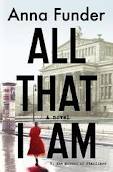
‘All That I Am’ by Anna Funder

2011, 363 p.

No wonder this book is garnering award after award.  So far it has won the Indie Award Best Debut Fiction and Book of the Year Award, the Australian Book Industry Award for best literary novel and Book of the Year, the Barbara Jefferis Prize for “the best novel written by an Australian author that depicts women and girls in a positive way or otherwise empowers the status of women and girls in society”  and it has been shortlisted for the Miles Franklin and the Prime Ministers Prize .

This is Anna Funder’s first foray into fiction, but she does so with one foot still in the non-fiction camp.  Her earlier, much acclaimed non-fiction book Stasiland explored individual lives within the pervasive and intrusive panopticon of  East German communism.  This book traverses similar territory in a fictional mode by imagining the lives of real-life socialist dissidents who sought refuge outside Germany during  Hitler’s rise.  Ernst Toller, Dora Fabian, Hans Weserman, Berthold Jacob and Ruth Becker are all real-life historical characters, and indeed Funder herself knew, and was friends with, Ruth Becker (by then Ruth Blatt) in Sydney before her death in 2001.

But the book is most certainly fictional in terms of its structure and in its exploration of the emotional space of love, fear and betrayal.  It uses the device of two alternating narrators.  The first is the elderly Ruth in Sydney, whose memories of the 1930s are bleeding into her present-day life as an increasingly frail post-war immigrant who has had a successful career in teaching, but is sliding towards a lonely and regretful death.  A week earlier she had received a manuscript from an American university that had acquired a box of documents written by Ernst Toller, the poet, in 1939  that had been addressed to her.  The narrative swings between the present-tense description of an old woman in the drug-induced half world of pain and confusion, and the past-tense reminiscence evoked by this manuscript, received from a time fifty years earlier.

The second narrator is Toller himself, in 1939, in the act of writing that very same manuscript in a hotel room in New York.  His narrative, too, swings between the present-tense in describing the act of rewriting an earlier autobiographical manuscript to acknowledge the impact of Dora Fabian and other dissidents in his life, and the past-tense narrative that was to become the document delivered in Sydney  sixty years later.  He dictates to a young female notetaker, herself wracked with fear for her brother, marooned on the refugee ship the St Louis which was denied entry to Cuba, America and Canada.

This narrative quadruple act is complex, and throughout the book I found myself marvelling at how deftly she managed it.  I found her characters thoroughly convincing at the emotional level: in fact, it was only an epigraph by W. H. Auden that marked Part II that stopped me in my tracks with the realization that it was very much based on real-life people.  I resisted the temptation to rush off to Google the characters; indeed I have not yet done so (and probably will not do so) because I’m happy for them to exist in the rounded, fleshed out fictional form in my mind.  Somehow, to see them rendered into black-and-white again will flatten them somehow.  I note, however, that Simon Schama the historian in his review of the book in the Financial Times  felt that the “knottily knitted time line snags the narrative at every turn” and that there were “points where the research somehow clots the blood flow of the plot rather than transfusing it with vitality.”  Yet he suggested that the real-life Ruth’s later life story, which is sketched only briefly in Funder’s book, is even richer with fictional possibilities, thus wanting to draw her back to real-life again.  I don’t agree with him.  Schama warns that “the ball and chain of history can hobble the gait of the imagination if the novelist isn’t ruthless about knowing when to cut it loose” and yet I feel that Funder has been completely disciplined (in both senses of the word) by restricting her focus to the political and emotional claustrophobia of the time, instead of paying homage to the historical ‘afterwards’ of her real-life characters.

Yet her book is very much about the historical issue of memory and forgetting.  “I am a vessel of memory in a world of forgetting” says Ruth the narrator. “Most people have no imagination. If they could imagine the sufferings of others, they would not make them suffer so” wrote Ernst Toller. But as Ruth the narrator (and I suspect, Funder the author) says:

   Imagining the life of another is an act of compassion as holy as any….But Toller, great as he was, is not right.  It is not that people lack an imagination.  It is that they stop themselves using it.  Because once you have imagined such suffering, how can you still do nothing? (p. 358)

It is also a book about the weight of an individual against the wider scale of history.  At a personal level,  we grapple with our measure of those we love-

When you are in love with someone, you cannot see around them, you cannot get their human measure. You cannot see how someone so huge to you, so miraculous and unfathomable, can fit, complete, into that small skin. (p 150)

And yet we ourselves have to think about our own value in the world:

Though it is the hardest thing, to work out one’s weight and heft in the world, to whittle down all that I am and give it a value. (p. 299)

This is a beautifully written book, although there are the odd jarring notes.  The awkwardly introduced date of Toller’s narrative was clumsy and heavy-handed, and  I don’t think that she handled the authorial problem of bringing her two first-person narratives to a close very well because she had painted herself into a narrative corner.

But in other places, her descriptions are crystal sharp, as for example, in this description of a Weimar nightclub-

The doors of the TicTacToe opened into a floor-length leather curtain drawn against the cold.  We parted it.  The entry level was on a mezzanine; below us lay a vast, ornate room hollowed out into the earth.  I moved to the balcony rail.  Pools of light shone on a hundred tables, bright circles into which hands moved, gloved or ungloved, for a drink, to ash a cigarette, touch an arm.  The air was filled with trumpet notes and smoke, the chinking sounds of cutlery, laughter, something smashing at the upper bar.  At my shoulder a vase of lilies breathed, open-tongued.  P. 105

I’m not sure whether this book will win the Miles Franklin, even with the slightly widened criteria that allow an ‘Australian’ sensibility without necessarily being set in Australia.  I’m not sure that the Sydney section of the book is a sufficiently sturdy anchor to describe it as ‘Australian’, but I am not cynical enough to  think that the Australian section was included only with the Miles Franklin in mind.   It’s a beautifully written opening up of the imaginative space around real-life people, and it should be celebrated as such.

Read because: It is short-listed for the Miles Franklin Prize.  Also posted on the 2012 Australian Womens Writing Challenge

Sourced from: La Trobe University Library

My rating: 9/10

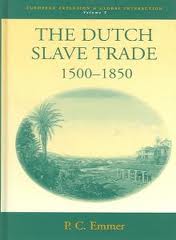
‘The Dutch Slave Trade 1500-1850’ by P.C.Emmer

2006, 153 p. & notes. Translated by Chris Emery.

One of the things that surprised me when looking at the history of slavery in the West Indies (and the map of Caribbean slavery I showed in a recent blogpost) was the involvement of  countries that I don’t readily associate with slavery or the West Indies for that matter-  Sweden and Denmark for example.  I was aware of the English, French and Spanish involvement, the long classical history of slavery, and the participation of Africans themselves, but I didn’t think of Scandinavian countries  which somehow seem so ‘white’ and Northern European.

In reading this book, it seems however, that the Dutch people themselves do not suffer any widespread moral malaise about slavery. As the author, P.C. Emmer of Leiden University writes:

The Netherlands was clearly guilty. Between 1600 and 1860, almost without exception, the Dutch allowed Africans to be bought and traded, and they would never have treated each other or any other Europeans in such a way.  Admittedly they share that guilt with some of their Europeans neighbours.  But, if we start from the premise that the Dutch, both past and present, see their country not just as any country but as a particularly moral and principled oasis in the middle of a wicked world, then their guilt has surely incurred a debt of honour. (p. 147)

This slim book examines the Dutch slave trade as a historical event, but the book itself is firmly located within the current historiography that deals with memory, commemoration and reparation.  In his foreword, the author mentions:

Incidentally, several scholarly observations about the slave trade have aroused high emotions in the past, as indeed have some conclusions in this book.  Twenty years ago I had to climb onto a table to make myself heard among students, who accused me of falsifying history and of being a reactionary and a racist. (p. ix)

In reading this book, I was reminded of the response to John Hirst’s Convict Society and its Enemies, a similarly punchy book.  Hirst argued that right from the planning stages of the First Fleet there were slippages in the intent and practice of New South Wales as a penal colony, and that the system had freedoms and rights designed into it from the start.  It’s a prickly argument to run: Hirst admitted that there were cases of brutality, but that the extreme had become seen as the norm, and that the historical record of a more prosaic, adaptable system had been obscured.   Likewise in this book, Emmer clearly states that slavery was wrong, but that it was never as large, politically influential, or financially lucrative as in other European countries.  For both historians, the major point is conceded, and rather than spending time reiterating it, the argument moves to the nuances of a more complex treatment.  It’s not so much down-playing, as moving to a different line of argument, but their opponents might see this as dismissal or special pleading.

Emmer points out that the Dutch used few slaves on their own holdings in the Dutch Antilles, which were not suited to large-scale plantation agriculture, or in what was to become New York. They first became involved supplying slaves, purchased in Africa from African slave traders, for the Spanish gold and silver mines, but this expanded over time to a market in supplying slaves sourced from the African slave-traders for the Dutch plantation colonies of Berbice, Essequibo, Demerara and Suriname.  The first three of these were later to become British Guiana in the territorial merry-go-round after the Napoleonic Wars (and hence my interest in them).

The middle part of this small book focuses on the trade itself: the crossing from Africa to the West Indies, then the nature of plantation slavery in the Dutch colonies.   However, unlike the English and French colonies, the West India Company and Dutch plantations were not profit-making enterprises, and formed only a marginal part of Dutch commerce.  When the end of slavery came, it was with a whimper because the trade itself was unsuccessful, and any reparations to slave-owners were easily covered by a system of forced-farming in Java, where villages were forced to pay a tax of coffee and sugar, thereby bolstering the coffers of the treasury in the Netherlands.

The relative economic insignificance of slavery to the Dutch economy (especially compared with the English situation) raises the question of why the Netherlands did not take a strong lead in the abolition of the slave trade, and then slavery itself.  The reality is that slavery did not end in the Dutch colonies until 1863, long after the other slave-trading European countries had done so, and that it was only English pressure that led to half-hearted acquiescence to the abolition of the slave trade in the early 19th century.  Emmer attributes this to a defensiveness on the part of Dutch politicians, who did not share the English openness to change but instead adopted a shield of conservatism and self-preservation.

Emmer locates the slave trade among other ‘debts of honour’ that the Netherlands owe- a phrase that he thinks particularly apposite given the Dutch emphasis on finance. These debts revolve around treatment of Dutch Jews during WWII; about actions in Indonesia; and the Dutch slave colonies.  He raises a number of difficulties to the question of reparations, but suggests instead that 1 July should be commemorated as the date in 1863 when slavery was finally abolished in Dutch colonies.

I have no idea how the politics of this plays out in the Netherlands, and how and if the situation has been complicated by the increase in far-right politics in Europe.  You can find a good review of this book, and Emmer’s response to the review at Reviews in History.     There’s also an article available here online that gives a taste of Emmer’s approach.

Judge Willis and Mabo

Australia is celebrating this week the twentieth anniversary of the Mabo decision that rejected the doctrine of terra nullius and recognized native title. The ‘Mabo Case’ findings did not mention Judge Willis by name, but it would have been entirely appropriate to have done so because in many ways, he anticipated Mabo by 151 years in a case called R. v Bonjon.  However, for a number of different reasons, the Bonjon case remains a mere footnote in history.

In 2010 I gave a paper at the Australian and New Zealand Law and History Conference about the Bonjon case, and you can read it here.

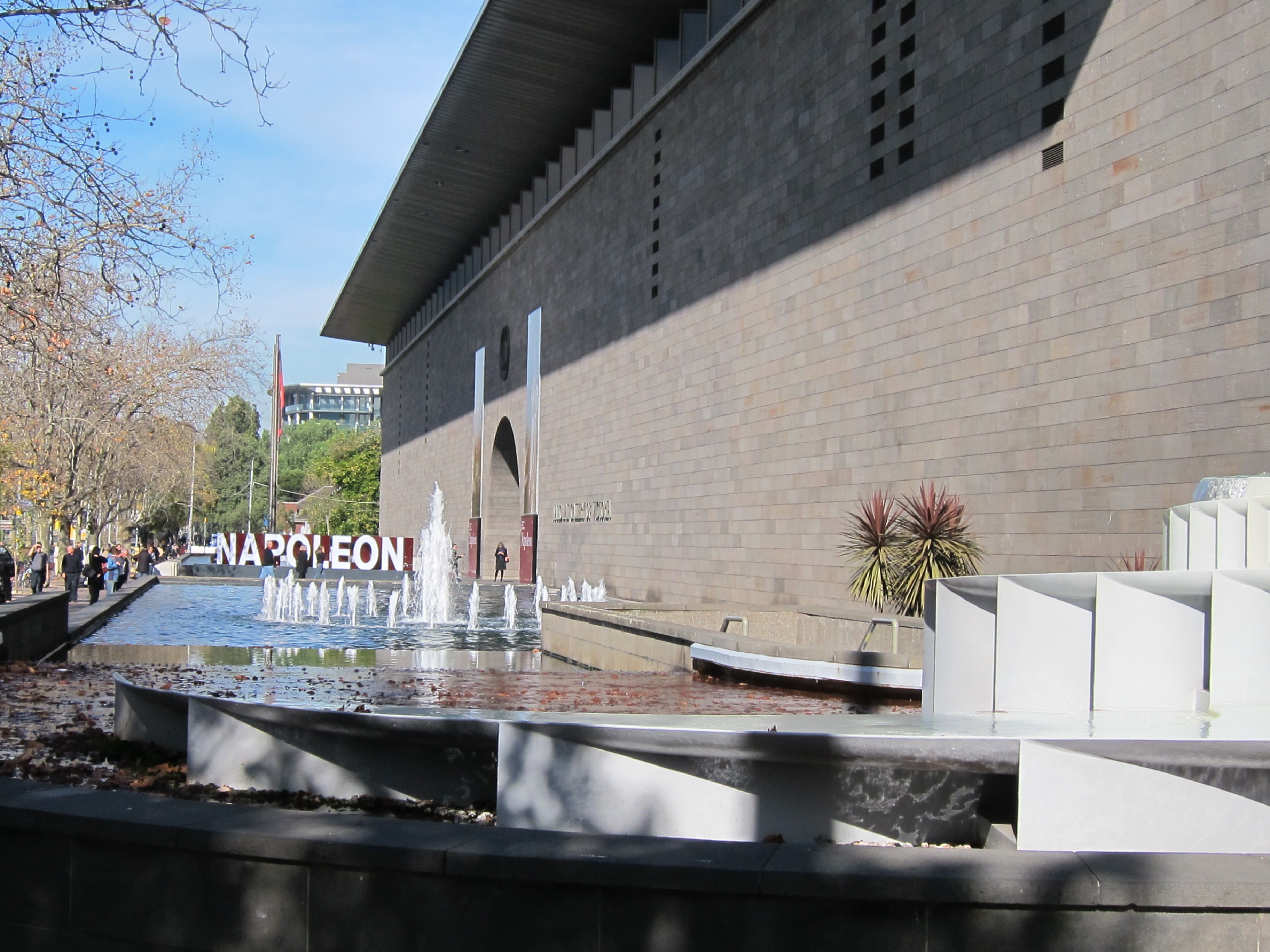
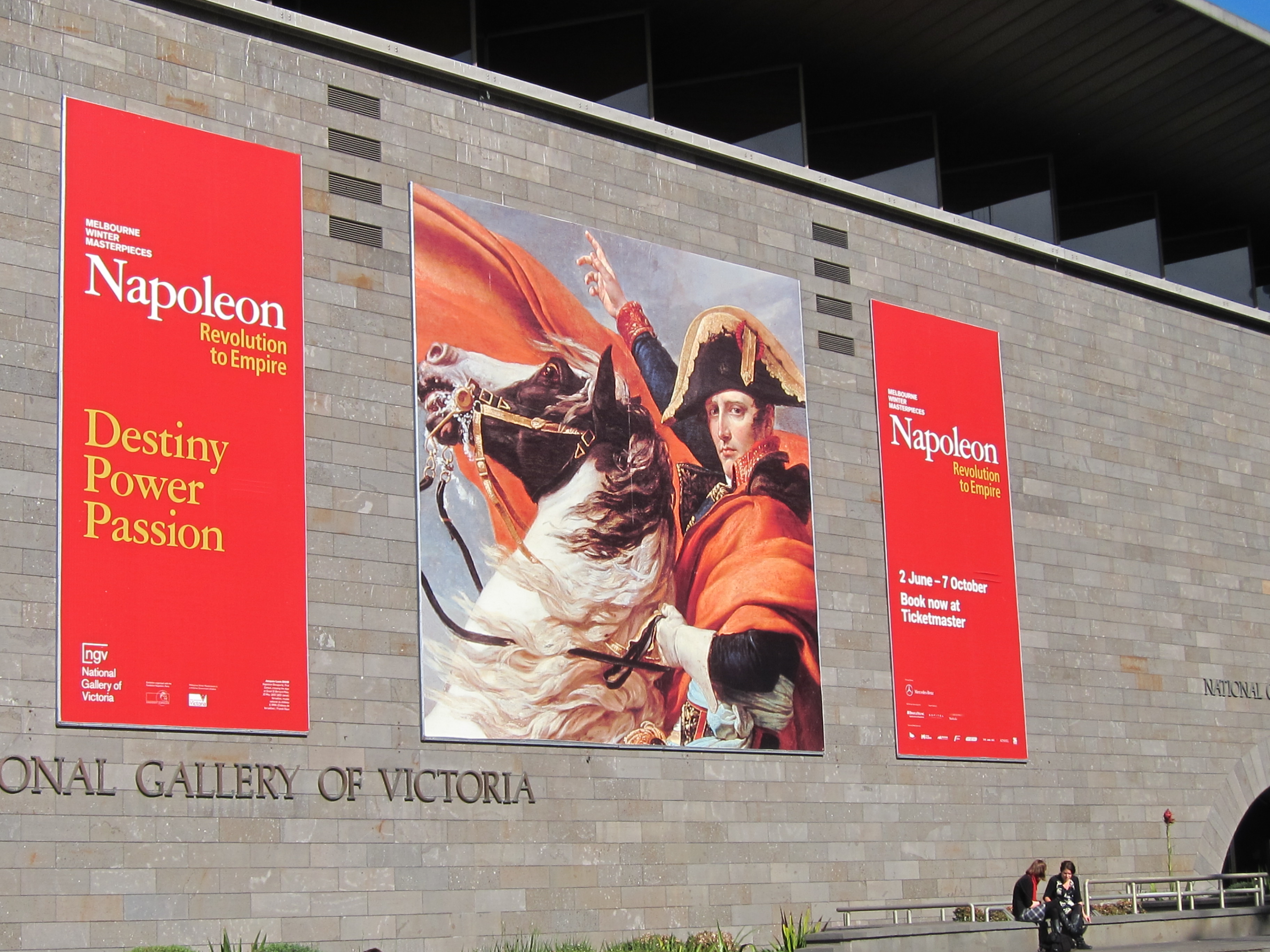
Napoleon at the NGV International

Stop press: Napoleon invades Melbourne! Well, not really.  The National Gallery of Victoria’s Winter Masterpiece exhibition this year is an exhibition focussing on all things Napoleonesque, with a bit of an Antipodean twist.

This exhibition differs from recent exhibitions in that it could just as easily be mounted in a museum as in an art gallery, because it encompasses history, artefact, literature, the visual arts, the decorative arts, music and costume.  And it’s very, very good.

If you’re not familiar with the French Revolution and its connection to Napoleon, the exhibition has a strong chronological narrative in its explanation panels- and I think they may have used a slightly larger font because they are legible from some way back.  The exhibition starts with the Ancien Regime, Louis XVI and Marie Antoinette and spends quite a bit of time on the cultural milieu and decorative fashions of their era. It then moves on to a brief explanation of the rapid swings of political fortune leading up to the Terror, then focusses on Napoleon himself.  When you stand before pictures of Napoleon’s coronation, you are struck by the similarity in excess and symbolism of Napoleonic Imperialism and that of the Royal Family just two tumultuous, exhilarating, blood-soaked decades earlier.  I spoke to a woman who was waiting outside the exhibition  “Is Napoleon a goodie or a baddie?” she asked.  It’s very hard to say.

For there is blood here.  The revolutionary pike was chilling in its simplicity, and the towering height of the Revolutionary Army soldier uniforms reminded me that this was politics through blood and warfare.  Then you see a small, red-covered printed copy of the French Constitution in a slip cover that reminded me of a little prayer book.  Words and blood.

Napoleon, just like the Royal Family before him (and indeed the Royal Family we are witnessing at the Diamond Jubilee today) knew the power of branding.  Painters manipulated history in creating the most dramatic images possible, as all painters of historical portraits are wont to do.  Napoleon and his revolutionary predecessors reached back into classical history to align themselves with Roman emperors, and bedecked themselves, their furniture, their clothes with classical symbols- the fasces (the bundle of rods with an axe) to denote power,and the bee to indicate immortality and resurrection, and -most significantly for a Corsican army general of rather unprepossessing lineage- royalty.

The exhibition has a particular emphasis on Australia, which may seem surprising at first blush.  However, in the earliest pages of white British possession of Australia, there is a strong ‘what-if’ thread that challenges the overwhelmingly British nature of our history.  On January 24 1788 the French frigates La Boussole and L’Astrolabe, commanded by the Comte de la Perouse arrived off the coast of Botany Bay, in the same week that Capt Arthur Phillip arrived there.  Bruni d’Entrecasteaux explored the coast of Tasmania in 1792 and his presence lingers in the naming of many places along the Tasmanian coast. In the brief period of cessation of hostilities after the Treaty of Amiens in 1802, Nicolas Baudin mapped the western and southern coasts of New Holland- and there it is in the exhibition- a clearly depicted and labelled map of our southern coast with familiar landmarks with unfamiliar French names (although I note that Port Phillip was still labelled as such).  Instead of being an exclusively British possession, Australia could so easily have included French territories- and how both our internal and international politics and history would have been different as a result.  Louis XVI was obsessed by the disappearance of La Perouse when he sailed out of Sydney after that initial, friendly six-week meeting between British and French navies at the extremes of southern exploration, never to be seen again.  Empress Josephine encouraged the introduction of Australian plants and animals into the gardens of Malmaison, and Napoleon took with him to his exile at St Helena his copy of James Cooks’ journals of explorations.

I happily spent two hours in this exhibition that is much more than just paintings.  Several of the exhibits were already owned by the NGV and I’ve probably swept past them before, not realizing their significance or context.  Well worth a visit.

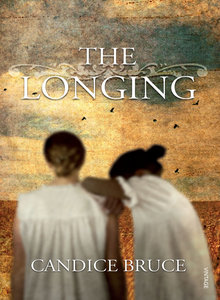
‘The Longing’ by Candice Bruce

2012, 354 p.

In her acknowledgments at the back of this book, Candice Bruce names Jan Critchett’s book A Distant Field of Murder (see my review here) as one of the sources that deeply influenced the writing of this book.  I suspect that I know exactly the paragraph in Critchett’s book that encapsulates what Bruce is trying to do in her book:

The frontier was in fact a very local phenomenon, the disputed area being the very land each settler lived upon.  The enemy was not on the other side of neutral ground.  The frontier was represented by the woman who lived near by and was shared by her Aboriginal partner with a European or Europeans.  It was the group living down beside the creek or river, it was the ‘boy’ used as guide for exploring parties or for doing jobs now and then.  The ‘other side of the frontier’ was just down the yard or as close as the bed shared with an Aboriginal woman.

Jan Critchett, Distant Field of Murder (p. 23)

It is this shared domestic frontier that Bruce examines in The Longing: a paradoxical space that was intimate in terms of physical proximity and yet at the same time also a yawning gulf.  Ellis MacRorie is a young Scotswoman, who had been shipped off to marry the older, dour Alexander MacRorie, a pastoralist in the Western District of Victoria.  The homestead is one of the grand mansions described by Margaret Kiddle in her wonderful (if flawed) Men of Yesterday, where shearers and workers mingled with the aboriginal servants and farm labourers.  Leerpeen Weelan, known as Louisa, is one of these domestic servants, and in her loneliness and unhappiness, Ellis believes that Louisa is a confidante and friend.  Leerpeen keeps her distance, impassive and silently mourning the loss of her daughter, her tribe, and her country, and rather derisively judging the infatuation that develops between Mrs MacRorie and the American artist Sanford P. Hart who comes to stay at Strathcarron homestead.

And here we run headlong into one of the narrative dilemmas of twenty-first century narrative writing: presenting the aboriginal voice.  Kate Grenville felt that it would be inappropriate to “step into the heads” of her Aboriginal characters in The Secret River; Tom Keneally has said he wished that he had had a greater sensitivity to the ownership of words and worldviews when he wrote The Chant of Jimmy Blacksmith and that he would be more “diffident”  about writing from the Aboriginal perspective today. But the author of this book, Candice Bruce, in an interview with the SMH does not seem to share their qualms:

Surely we have all moved on from then and can see the value in having multiple voices?…We have a shared history, which is not the preserve of only one group, and so to go back to a time where political correctness decrees who is allowed to write from particular points of view is anathema.

I’m not sure that it’s the preserve of one group alone to make this decision.  I personally am not comfortable with the glib ‘move on’ attitude that this quotation (which may well be out of context) suggests. Perhaps, as Kate Grenville found with The Secret River, Candice Bruce may find the commentary that a writer generates as part of the publicity round can overtake the work itself.  But does it matter what an author says about how they approach their work? After all, works of art existed before and long outlive all this publicity flummery that is frothed up by modern marketing.  In the final analysis, a book should stand or fall in its own right, (shouldn’t it?)  irrespective of the author’s intentions or personality- although I’m not sure that the two can always be disentangled.

I am, however, aware that trepidation over the presentation of Aboriginal characters in some ways maintains “otherness” and that fear of causing offence causes the Aboriginal presence in Australian historical fiction to be sidestepped altogether. I don’t know how you get over that- or indeed whether it is possible or presumptuous to attempt to do so.  I’m mindful of Paul Keating’s exhortation in the Redfern speech about “our failure to imagine” the murder, child theft, discrimination and exclusion faced by Aboriginal people if it happened to us. Perhaps this book is what this “imagination” looks like.  The author says that she was encouraged to write this book by Vicky Couzens, a well-known Gunditjimara author from the Western District in which this book is set, who assured her that any controversy would be short-lived if she wrote with accuracy and respect.  I think that Bruce does both these things, but the wariness that she dismisses as “political correctness” exists on both sides, and for good reason.

Leaving aside the question of the wisdom of adopting an aboriginal narrative perspective, how well does she do it?  As well as giving her encouragement, Vicky Couzens also gave Bruce a copy of the Dictionary of Keerray Woorong and Related Dialects, and perhaps this exemplifies the approach that she takes in presenting Leerpeen’s voice.  There are words, naming and labelling, but there’s none of the rise and fall and flow of Kim Scott’s language in That Deadman Dance, or Alexis Wright in Carpentaria.  Words, but not language.

The second narrative arc of this story involves the young art curator Cornelia Bremer who, 150 years later, is researching an exhibition on S. P. Hart for the National Gallery of Victoria.  When the lead researcher is involved in a car accident, she is dispatched to Strathcarron to evaluate the suitability of an S.P. Hart painting in the possession of the MacRorie  family who still live in the family homestead, which is falling into disrepair.  She stays with the family for a couple of days,  learning of the jealousies and rivalries among the remaining family members, and uncovering art work and provenances that are completely unknown to the art world at large.

Here Bruce is on surer ground, because she is herself an art historian who curated the Eugene von Guerard exhibition at the National Gallery of Australia in 1979-80 and contributed to the catalogue of the more recent ‘Nature Revealed’ touring exhibition at the National Gallery of Victoria in 2011 (currently on show at the National Gallery in Canberra until July 2012).  On Candice Bruce’s own website, she shows the images in particular that inspired her, most especially the paintings of Lake Purrumbete and the homestead.  In this regard, I was reminded of Robert Dowling, who also worked as a travelling artist, moving from property to property painting homesteads and livestock as a way for settlers to celebrate their good fortune. When Bruce writes about the excitement of hunting down and reading handwritten correspondence and diaries, and uncovering artwork unknown to the academy, you know that she is writing from first hand experience.   I recognize the wealth of research that underpins this book, because I’ve read much of it myself, but it weighs the book down.  There is a slightly didactic tone to the present-day section, especially in relation to issues over aboriginal artwork and heritage. The  addition of a thwarted extramarital affair added a discordant, even somewhat chick-litty note that made me squirm a bit.

The juxtaposition of these three stories- Leerpeen and her stolen daughter and lost country, Ellis MacRorie and the painter, and Cornelia the art investigator – traverses 150 years.  Bruce emphasizes common humanity and the universality of love and loss, but in so doing hits a few false notes. I found myself becoming tired of the frequent flashbacks, and some of the dialogue, particularly in the present-day section was weak. I enjoyed the section written as Ellis’ diary, and overall enjoyed the historical 1855 thread more than the present-day one.  As a piece of historical fiction, it works well.  It fleshes out those images of the past that are so often formed by film and television, and in this case it draws our attention to colonial domestic relationships that are often overlooked completely. There was, after all, a market for those mission-trained Aboriginal girls (for example, the Cootamundra Domestic Training Home for Aboriginal Girls), yet there is little acknowledgement of their presence.  The imaginative space that historical fiction provides can be one where the imagination that Keating called for can work on us.  In this regard, the book succeeds admirably.

What Bruce does really, really well is landscape, and here her art historian strengths come to the fore.  Her descriptions of landscape are so evocative that you can see it as a painting in your mind’s eye. It’s as if she helps you to ‘frame’ the country yourself, while at the same time reminding us of the aboriginal sense of country, exemplified by the Deborah Bird Rose quote at the start of the book.

Vicky Couzens told her to be accurate and respectful. Candice Bruce gives us accuracy in spades: the depth of research in this book is prodigious, and she brings a wealth of professional experience to the present-day component of the book.  Respectful- yes, I think that she is, but I don’t know that I’m the person who can make that judgment.

My rating: 7.5 -8/10

Sourced from: Yarra Plenty Regional Library

Read because: Lisa at ANZLit Lovers reviewed  it, and I like books set in Colonial Victoria.

‘How to Live’ by Sarah Bakewell

Sarah Bakewell How To Live or A Life of Montaigne in one question and twenty attempts at an answer. 2010, 331 p. & notes

I think that all readers have their own literary bucket list of books that they want to read before they die.  Mine are all big baggy things that I want to gorge myself on: James Joyce’s Ulysses,  Anthony Powell’s Dance to the Music of Time, Frank Moorhouse’s ‘Edith trilogy’, Eleanor Dark’s Timeless Land trilogy, and Proust’s À la recherche du temps perdu (I’ve read two, but I’d like to read them one after the other).  I did have on this list Montaigne’s Essays, but it has occurred to me that Montaigne doesn’t require the big Christmas holiday commitment like these other books do.  He’s better read in small snatches, and is indeed tailor-made for an e-reader because, after all,  who’d want to cart that hefty volume around on the off-chance of the quick dip?

In fact, it occurs to me that Montaigne would have made a fantastic blogger, because his Essays are quirky and digressive, just as a good blog is. [An aside- one of my favourite, digressive, informed and very Montaignesque blogs is Historians are Past Caring] This book, How to Live, is a biography in the quirky and digressive spirit of Montaigne too.  It, like Montaigne, takes the question “how to live?” and distills twenty answers that Montaigne might have given, as prisms onto Montaigne the man and his work.

The twenty  attempts at an answer? Don’t worry about death; pay attention; be born; read a lot, forget most of what you read, and be slow-witted; survive love and loss; use little tricks; keep a private room behind the shop; be convivial, live with others; wake from the sleep of habit; live temperately; guard your humanity; do something no one has done before; see the world; do a good job but not too good a job; philosophize only by accident; reflect on everything but regret nothing;  give up control; be ordinary and imperfect; let life be its own answer.

As you might sense from these chapter headings, this is a biography, but it doesn’t read as such.  At the end of the book the author includes a chronology of Montaigne’s life- even the placement of this chronology at the back of the book rather than at the front is surprising- and I was comforted to find that I had somehow gleaned the major trajectories of Montaigne’s life, even though the author had zig-zagged chronologically throughout the book. The book is generously peppered with artwork- black and white, unfortunately- but in good Montaignian spirit it is not captioned, leading you to wonder what it is, and why it’s there.  The notes at the back provide the details, as well as full footnotes and references.  This is a well-researched book, but it wears the research lightly and plays with it in good humour, just as Montaigne himself might have done.

Bakewell places his life within the political and cultural milieu of the time, and locates it within a broader philosophical palette. I particularly liked her exploration of  Montaigne as a Phyrrhonian Sceptic- someone who is happy to suspend judgment, as a sort of mental calm and openness to uncertainty.

We, and our judgment, and all mortal things go on flowing and rolling unceasingly.  Thus nothing certain can be established about one thing by another, both the judging and the judged being in continual change and motion. (Essays, II,  12, p552 Frame version)

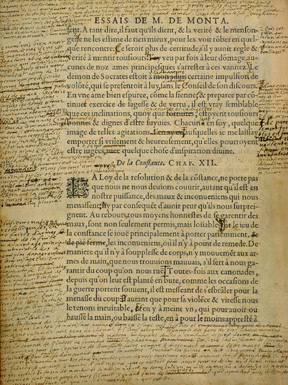
It is this diffidence and openness to question that makes Montaigne such delightful company.  In a world of braying certainty from the media, fundamentalist religions and partisan politics, it’s refreshing to watch someone walk around a topic, trailing off into tangents and viewing it from different angles.  In good blogger fashion, Montaigne was willing to go back to adjust his ideas, modify his stance and raise questions with himself- much as bloggers often go back to tweak a post.  Of course, this wrought havoc with the different editions of his essays as they were released, as he changed words, qualified his opinions and inserted paragraphs.

Montaigne’s annotations, corrections and insertions to his own text prior to republication of a new edition, Bordeaux copy.

She also traces the history of the Essays as an artefact through its different editions and translations.  In a very Montaignian spirit, it seems that there is no absolutely definitive edition, and that each has its drawbacks and advantages, and might have been changed yet again had Montaigne had opportunity to publish yet another edition.

So Montaigne’s Essays have moved up the menu on my e-reader for the quick dabble.  Somehow, I think that’s just the way he’d like them to be read, too.

Read because:  I felt like it

Sourced from: Yarra Plenty Regional Library

My rating: 9/10

A rainy day at the NGV

It’s cold and wet, in the way that winter days used to be.  Three years ago, in the midst of drought, I was wondering if I’d ever see one of these wet days from my childhood again- the ones where you wake up to the sound of rain that just goes on and on.  But here a rainy day is back, although I note from the weather segment that once again this rain is courtesy of low pressure troughs moving down from the north, quite unlike the across-the-Nullabor weather patterns that I’ve been used to all my life.

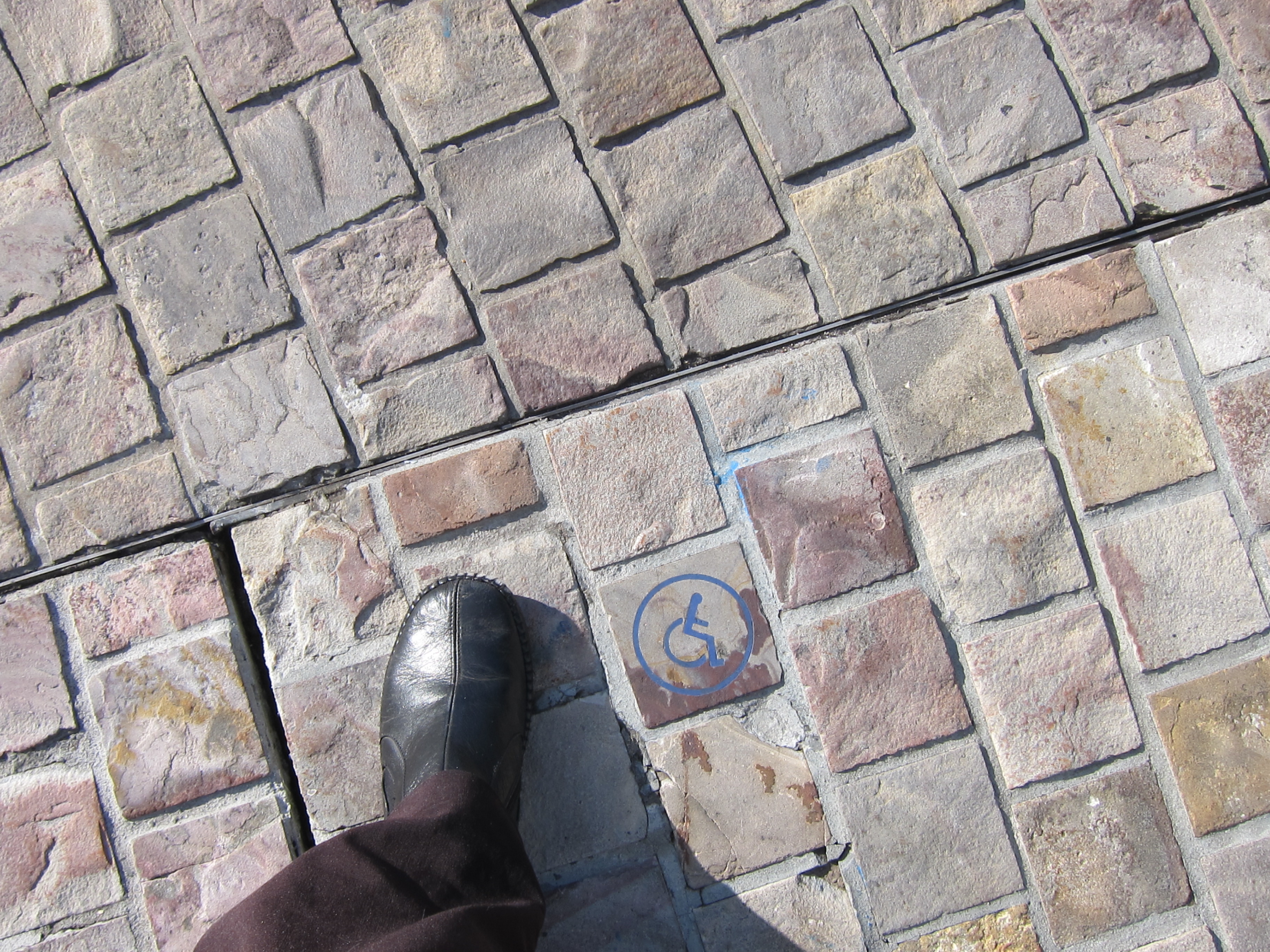
Weather notwithstanding, off we toddled to the National Gallery of Victoria to take advantage of the members’ free entry today to the Fred Williams exhibition. I really don’t know why I keep going back to the Fed Square gallery (other than being forced to if I want to see particular exhibitions) because it always enrages me.  My chagrin starts with the cobbled, windswept forecourt. It is bleak in winter and baking in summer, uneven, and slopes upwards onto an artificially created hill that ensures that the whole Federation Square complex completely blocks any sight of the river.  It amuses me that the so-called ‘accessibility’ markers that denote a slightly smoother path  are themselves virtually indistinguishable from the rest of the cobblestones.

Then, how to get into the damned gallery?  You’ve got to hand it to the NGV- in both the Fed Square and the International Galleries, the doors are squirrelled away out of sight- I mean, you wouldn’t want anyone to come IN would you?

Having solved the mystery of getting in to the gallery, and having passed the highly prominent and clearly-sign posted shop (the only thing, along with the ticket box, that is clearly signposted in the whole building)  your next task is to work out how to get upstairs, as the exhibition you want is most certainly upstairs.  Ah- there’s the escalator- a little single-file, one-way escalator tucked away in a corner.  You want to go down again? I’m yet to find the down-escalator, but I have found the wooden staircase that has the steps sawn off at an angle like spiral steps, but in a squared, boxlike structure.  Or there’s another staircase that just goes on and on and on upwards- oddly I’ve never found how to get down again.  Isn’t there some regulation about landings in staircases??

Exhibition seen, now for coffee! There’s the cafe with a narrow window that looks out onto the river- well, it would if it weren’t covered with artistically hung black mesh.  What goes in, must come out-so where ARE the toilets? Ah, there’s a subtle little sign over in the corner, virtually indistinguishable.  The door opens into a stygian darkness, which lifts slightly over the cubicles, but barely enough to detect the flush buttons that are mere engravings on the stainless steel walls.  The whole place is so damned impractical and must break every possible regulation in terms of accessibility and safety.  I have no idea how they could evacuate the building in an emergency. It’s architectural pretension run amok.

Am I in a bad mood today? Perhaps I am.  Let’s just say that I’m glad I had free entry to the Fred Williams exhibition.  I’m with Robert Nelson on this one- his review Dogged dabs of a blobby dazzler pretty much sums it up for me.

Fortunately my rainy day at the NGV was saved by “Intimate Landscapes”, the Fred Kruger exhibition of photographs– no, not the Nightmare on Elm Street Freddy Krueger, but instead the German photographer who worked in Victoria between 1860s-80s.  He was a travelling commercial photographer who was contracted, among other things, to photograph the Aboriginal people living at Coranderrk mission, near Healesville for the Aborigines Protection Board.  His photographs, intended to highlight the industry of the inhabitants, and the success of the mission, are freighted with all the “dying race” and “clean and useful” philosophies of the time.  He also took photographs of bridges, reservoirs, and rivers, often with small human figures alongside.  In a feat of organisation, he took a large group shot of literally hundreds of school children outside Flinders Primary School in 1880- you can see it here.   There are street shots of Queenscliff, Geelong and Ballarat as well. Fascinating, and well worth the cobblestones and steps, clammy umbrellas and wet socks.

Uplifting Quotes for the Uninspired Historian #14: Keith Sinclair

Pardon the gendered language- it was written 35 years ago.

In biography, in other respects probably the most difficult form of historical writing, there is at least in principle a clear guide to what is relevant.  Biography is about a man, and the ideal data is that which seems to take us deepest into his or her personality, like Florence Nightingale’s Notes from God, or Alfred Deakin’s prayers.  Since he knows what is central, the author should know what  is peripheral.

Keith Sinclair ‘On Writing Shist’ Historical Studies Vol 13, No 51, 1968 pp. 426-432

Easy, huh?