Author Archives: residentjudge

Movie: Rams

The setting is often a powerful force in a movie and this is certainly the case in ‘Rams’, set in a small rural town in Iceland.  The local economy and community identity revolve around sheep. When scrapie is diagnosed among one of the flocks, it spells ruin for everyone, including two estranged brothers.  Although they live next door to each other, conscious at all times of each other’s movements, they have not spoken for decades. The bleak, unforgiving environment is an unlikely but memorable setting for an  unexpected love story.

‘Victoria at War 1914-1918’ by Michael McKernan

mckernan3

2014, 221 p.

I always think it’s interesting when a writer returns after many years to something that they had created much, much earlier in their career, and takes up the topic again with the benefit of years of experience, reading, and later research.  This is the case in Michael McKernan’s book Victoria at War which was commissioned by the (then Liberal Party) Victorian Government of Victoria to mark the centenary of the Gallipoli campaign in 2015.  McKernan had written Australians at War over thirty years earlier (which I reviewed here), a book that had been reissued unchanged in 2014 albeit with the author’s own awareness of its inadequacies, but no major rewriting.

However, with this 2014 book, McKernan had the opportunity to revisit his earlier book, within the specific context of Victoria and in the wake of the deluge of World War I research that has been undertaken in recent years, especially leading up to the Gallipoli centenary.  Not only was the scope and purpose of the book different, but he himself as a historian and writer would have been influenced- as have most of us- by the trend of using smaller stories to tell larger ones and the emphasis on emotions.  I finished this book with a deep sense of what a good writer McKernan is; something that did not particularly strike me with the earlier, more utilitarian, book.

McKernan starts this history by reminding us that, at the time war was declared, Melbourne was the capital city of Australia.  The parliament sat  here; the governor lived here and the federal bureaucracy was based here.  This, perhaps combined with early twentieth century ‘liberalism’, may have contributed to  a deeper commitment to the war effort in Victoria than in other states- something McKernan hints out but does not state definitely. Certainly the school effort was strongest here, and Victoria did vote ‘yes’ at the first conscription referendum (alongside Western Australia and Tasmania) although it rejected it by a small majority in the second 1917 referendum.  Melbourne was also the home of Archbishop Mannix, the most prominent anti-conscription voice.

Although Victoria may be more closely settled than other Australian states, with the seat of political power based in  Melbourne, McKernan places much emphasis on small Victorian towns and the impact of enlistment on the emotional and economic life of small country towns.  In particular, he looks at Casterton as a microcosm.  He brings forward the stories of specific families where several sons enlisted, or where older men left several children.  There are urban vignettes as well, but it is probably the country ones that seem most plangent. He notes the role of the local clergy who were charged with delivering the telegrams bearing bad news, and your heart sinks at the thought of families receiving two, three, four such visits.

It hadn’t really occurred to me that battalions were broadly geographically based, most particularly the 14th Battalion.  He follows Victorian volunteers to the army camps surrounding Melbourne, most particularly Broadmeadows, and across to the theatre of war. His book does trace the progress, or lack thereof, of the Victorian battalions, but most particularly in regard to how the news was received back home.

He places much emphasis on the role of the Red Cross, which was organized through Government House, and for some reason I found this description of ‘comforts’ brought me to the verge of tears:

How a man living in the barbaric conditions of the dugouts of Anzac responded when he received a parcel from one of these groups can only be imagined.  His normal food was hardtack biscuits, bully beef and tea- when there was water available.  Imagine opening a parcel from the Red Cross or the Australian Comforts Fund, to find clean, hand-knitted socks, a couple of lice-free, for the moment anyway, pairs of underpants, a fruitcake, possibly some tobacco or cigarettes, some dried fruit and ‘sweeties’, and writing paper for a letter to the folks at home.  The love and commitment that was poured into these parcels would have provided, to even the hardest lag on the Gallipoli battlefield, the whiff of home and of peacetime civilities, the gentler ways of life. (p. 121)

This is a beautifully presented book.  The idea of a coffee-table WWI book seems a bit glib, but the beautiful layout of the book and the large, crystal clear photographs that adorn nearly every page are a form of tribute in themselves.   The end of each chapter is marked by a khaki-coloured,stand-alone reflection on an individual or a specific theme.  Most of all, this book is marked by its respect for individuals, some of whom we have encountered several times in various places throughout McKernan’s narrative.  Their sacrifice is noted with humility and a sense of shared humanity, but not ‘celebrated’ with chest-beating or overt sentimentality.  It is a mature, thoughtful, appropriate response.


This Week in Port Phillip 1841: April 15-22 1841

OFF TO THE RACES

While the serious work of opening the Supreme Court was under way, there was another more lighthearted occasion unfolding during the post-Easter week in Port Phillip: the District Races!  The three-day racing carnival, held under the auspices of the Port Phillip Turf Club was held on 13th, 14th and 15th April “on the same course as last year”, ie. along the banks of the Maribyrnong River in what would come to be known as Flemington.  This was the fourth time the autumn races had been run, after initially being conducted on the swampy ground at the base of Batman’s hill in what is now Southern Cross Railway station. In 1840 ‘The Melbourne Racecourse’ shifted to what would become Flemington, which continues as a racecourse to this day.

Flemington racecourse 1867

Flemington Race Course 1867 Artist: Thomas Hamilton Lyttleton. (Note that this painting depicts the raceourse 25 years on). Source: State Library of Victoria [http://slv.vic.gov.au]

http://handle.slv.vic.gov.au/10381/298477

The Melbourne newspapers (and most especially The Port Phillip Herald) and that wellspring of all things Port Phillipian,  The Chronicles of Early Melbourne (available online here) by ‘Garryowen’ devoted many paragraphs to the races.  We tend to forget that until about 20 years ago television newscasts did too, before yielding the racing time-spot to financial news instead when we all found ourselves to be investors instead (another form of punting, perhaps?)  I won’t bore you with the details of the race, but the report of the weather on the first day is rather poetic:

Day broke on Tuesday, the Fourth Anniversary of the Melbourne Races in a remarkably ‘skittish’ humour, a strong north-wester scoured the streets at a ‘hard gallop’ while a heavy fall of rain completed the unpromising aspect.  As the day advanced, Sol drew his curtains, and plucking off his night cap, inbued himself in his most gorgeous robes, and mounting his car, smiled propitiously as he touched up his steads. This change of affairs caused sundry of the good folks of Melbourne to rub their hands, look very knowing, and giving their collars the extreme altitude, sagely remark there was a prospect of a very fine day’. PPH 16 April 1841

It seems that a good day was held by all, particularly on the more numerous attended first Tuesday of the racing carnival:

The course exhibited a gay appearance from the numerous pennants fluttering from the booths lining one side of the course, while cheering strains poured forth at intervals from two band, one at the grand stand, and the other in the William Tell booth, all of these receptacles of good cheer contained the usual quantum of viands and fluids, the latter of which must have been poured forth copiously, judging from events towards the end of the day. (ibid)

Well, yes. Obviously the ritual of finding oneself tired and emotional at the racetrack has a long history and this 1841 racing carnival was no exception.  One of the Border Police became drunk and “drawing on his butchering knife, [cut] one person through the hat to the skull, until the blood flowed in torrents”.  One unfortunate man was trampled and later died.

RETURN OF THE GIPPS’ LAND OVERLANDERS

You might remember that after the wreck of the Clonmel in January 1841, a number of men returned to Gipps’ Land to scope out the potential. In late March   three of the men returned by sea, bringing early positive reports, leaving the others to return overland. The Port Phillip Herald of 16 April 1841 carries news of their return in a day-by-day description of their journey.

They started off on March 23rd , where they encountered a tree marked by Mr Macmillan in his expedition, before camping the night at a swamp in extremely barren land. On 24th they followed the treeline to a hill where they could see Wilson’s Promontory and a portion of 90 Mile Beach. On 25th they reached a peak from which they could see the fertile plains forming the interior of Gipps’ Land before travelling to the La Trobe River. They followed the La Trobe on 26th where they found yet another marked tree and a carved message “this is the Ross River, a north-east course will bring you to the plain”. From here they could see the peaks of the Snowy Mountains, before reaching the Maconochie River. On 28th (was 27th a day of rest?) they crossed the Maconochie and reached Count Strezlesci’s encampment on the Barney River, which they crossed, later arriving at the Dunlop river where they camped. On 29th they perceived Lake Wellington,  a large inland lake which received the waters of the La Trobe, Maconochie, Barney, Dunlop and Perry Rivers. On the 30th they began their journey to Melbourne, tracing back and encountering the same rivers, encountering the Kirsopp River on 3rd, and finally arriving home in Melbourne on 13th April.

Their summary of what they found was:

The general character of the new country which the party explored is, that it is well watered, the banks of the rivers are lined with the finest of every description of timber, and the intermediate land either gently undulating or quite level plains of rich alluvial soil, supposed to be in consequence of the deposits of the numerous rivers from the ranges of the Snowy Mountains. Throughout the whole of Gipps’ Land scarcely a rock was visible.

THE ‘RULES’

One of the early tasks that Judge Willis undertook was defining the ‘rules of the debtors’ prison’. In a small town with severely limited prison facilities, it was not practical to lock up all debtors,and it became even less feasible as the District plunged into widespread insolvency over the next few months. Instead, people were ‘confined to the rules’ by being restricted to a defined part of town. They were not allowed to visit any hotels or houses of ill-repute that might be in that area.  Willis defined the Rules as follows:

The rules of the debtors’ prison in Melbourne shall be comprised within the bounds following, that is to say, all that part of Collins’street which lies between Spencer-street and the north east side of William’s street, so much of William’s Street as lies between Collins Street and the north west side of Little Collins street, so much of Little Collins street as lies between Williams street and the north east side of Queen street, so much of Queen street as lies between Little Collins street and the north west side of Lonsdale street, so much of Lonsdale street as lies between Queen street and the south west side Spencer Street, and that part of Spencer street which lies between Lonsdale street and the south east side of Collins street, together with the area comprised within and bounded by the portions of streets aforesaid; and all the houses (except as hereafter is excepted) on each side thereof.  Provided that all taverns, victualling houses, ale houses, or houses licensed to sell spirituous liquors, houses of public entertainment and also all disorderly houses, and houses of ill fame shall be excluded out of, and form no part of the said rules.- JOHN WALPOLE WILLIS, Resident Judge, March 31st 1841.

Here’s a rather wonky diagram drawn onto a present-day map:

Rules

Although today this area is dominated by offices, at the time most of the settlement was located in this area so it was not necessarily a hardship to be ‘confined to the rules’.

A CHILD ABUSE CASE

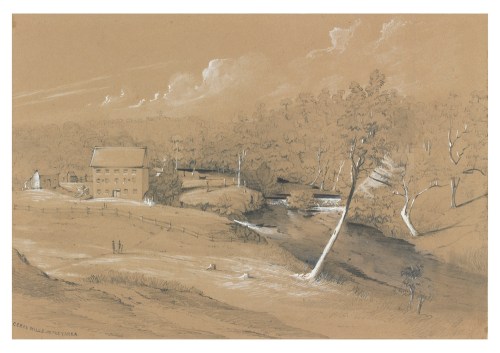
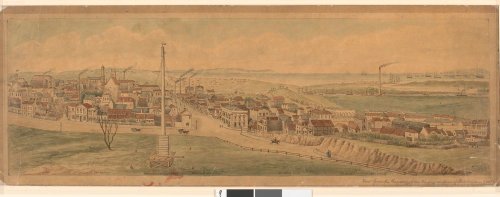
With our present-day attention drawn to the Royal Commission on Institutional Responses to child abuse, it is interesting and sad to read of a child abuse case in 1841. In this first week of Supreme Court hearings, Henry Watson was indicted for an assault with intent on seven-year old Imogene Liardet, the daughter of the publican and artist W.F.E. Liardet, whose illustration heads this blog.In hearing the case, Willis, like all other judges, had to determine the fitness of the child to take the oath, a decision based on the child’s understanding of God and truth.  In this case, Willis decided that the case could not proceed. The papers reported the case delicately:

There can be little doubt but for the tender age of the child, who could not understand the nature of the offence brought forward, that the charge would have been brought home to the miscreant, and that an exemplary punishment would have followed. His Honor himself felt morally certain of the fellow’s guilt.  We cannot pollute our columns with details so disgusting.  The prisoner was acquitted and discharged. (PPH 16 April)

Judge Willis’ casebooks, available at the RHSV Judge Willis site, give more information. http://www.historyvictoria.org.au/willis/book%2011.html#4

Her description of the offence is poignant in her innocent retelling:

The Pris’r took me into the Stable after the time of the Regatta & pulled up my Petticoats, put his in mine – his – Cockadoodle – he lay on my person – he was long on me ab’t half an hour – after that he took me out of the Stable I told Mama wh’t had happened – When I went out I told Mama directly –

On 30th April the Port Phillip Herald reported that Henry Watson was captured again “endeavouring to commit a similar assault on a woman at the wharf”.

EARTH-SHAKING NEWS!

Quite literally. An earthquake was reported at about 3.00 a.m. on 21 April. It’s an interesting thought that in these early years of white settlement, people wouldn’t really know what could be expected in terms of earthquakes, floods, droughts etc.

AND SPEAKING OF THE WEATHER…

During the week there was a light wind, freshening at times with generally dull weather and occasional rain. The top temperature for the week was 74degrees (23.3C)

Other references:

Lemon, Andrew ‘Inventing the Melbourne Cup’ La Trobe Journal 88, Dec 2011

Macdonald, Judy, ‘James Watson and ‘Flemington’: a Gentleman’s Estate’, pp.1-25. Latrobeana Vol 8, No 3 November 2009

‘The Natural Way of Things’ by Charlotte Wood

wood1

2015, 313 p.

As it happened, I was exactly half-way through Charlotte Wood’s book The Natural Way of Things when I learned that it had won the Stella Prize.  I was already engrossed in it: staying up way past my bedtime to read just a few pages more. After it won the Stella I felt that the noble thing to do was to stay up until 1.00 a.m. this morning finishing it so that I can return it to the library for others to enjoy.

Although is ‘enjoy’ the right word? Probably not, because this is a bleak book set in outback Australia where young women who have been publicly shamed through the media and corporate power networks have been incarcerated and ‘removed’ from society’s gaze and conscience.  Real-life parallels spring to mind: Monica Lewinsky, the St Kilda School Girl, women on reality TV.  In its depiction of the paradox of bleak openness and yet claustrophobia, it reminded me a little of Janette Turner Hospital’s Oyster ( a book that I felt didn’t receive sufficient recognition) and of course has resonances with Lord of the Flies and other such books.

What would people in their old lives be saying about these girls? Would they be called missing?…Would it be said, they ‘disappeared’, ‘were lost’? Would it be said that they were abandoned or taken, the way people said a girl was attacked, a woman was raped, this femaleness always at the centre, as if womanhood itself were the cause of these things? As if the girls somehow, through the natural way of things, did it to themselves. (p. 176)

The book is divided into three parts, tracing the progress of the year Summer, Autumn and Winter, and the book is so grueling in places that it felt as if the action took place over a much longer period. There are no numbered chapters as such, and the sections vary between present and past tense.  The book opens from the drugged, disoriented point of view of one of the captives and this confusion takes some time to clear for the reader as well, as the reason for their incarceration emerges.  There is throughout the sense of suspended menace- not enough to make the book unbearable, but sufficient to compel you to keep reading in horrified fascination.  It’s no coincidence, I’m sure, that it’s this horrified fascination that we often feel when watching a public shaming occurring throughout media.

In awarding the Stella Prize, the Stella Prize judges described it as ‘a novel of – and for – our times’ and ‘a riveting and necessary act of critique.’  I’m mindful that this book has been awarded in a climate of heightened awareness of domestic violence and misogyny, but I don’t think that topicality is its only virtue. I’ve found myself thinking about the book all day, and I think that its bleakness and power will make it memorable and uncomfortable in the future, much as Cormac McCarthy’s The Road does in a different genre.

It’s good, and it deserves the acclaim it’s receiving.

aww2016

I’ve reviewed this as part of the Australian Women Writers Challenge 2016.

Movie: The Lady in the Van

A very British movie which I doubt could be made anywhere else, combining as it does that English reserve with a similarly English tolerance of eccentricity. The technique of double narrators captured well Bennett’s ambivalence and archness. I was disappointed that it descended into whimsy in the last scenes, though. Perhaps I should have left three minutes before the end.

‘Their Eyes Were Watching God’ by Zora Neale Hurston

hurston

(1937), 1987 reprint, 286p.

One of my resolutions this year is to read more of the books I already have on my shelf (I even committed to the TBR challenge!). So far, I have failed miserably because this is, I think, the first book I’ve read from the groaning shelves.  I must have bought it secondhand at some stage because I’d heard of Zora Neale Hurston, although I was under the mistaken impression that she was a historian in the 1960s.

So the first surprise was  that Their Eyes Were Watching God was a novel. The second surprise was that it was written in 1937 and not in the 1960s as I had supposed.  The third surprise- and the one that discomfited me most- was the use of dialect in the dialogue. Let me give you an example, drawn at random:

“Ah often wonder how dat lil wife uh hisn makes out wid him, ’cause he’s uh man dat changes everything, but nothin’ don’t change him”

“You know man’s de time Ah done thought about dat mahself. He gits on her ever now and then when she makes mistakes round de store.”

“Whut make her keep her head tied up lak some ole ‘oman round de store? Nobody couldn’t git me tuh tie no rag on mah head if Ah had hair lak dat.” (p.79)

The book is very dialogue heavy, and it’s all like this. How, at a time when ‘black-face’ is now unacceptable, should a modern reader react to this? Actually, not just a modern reader: many African-American activists at the time found it confronting too.  Here’s Richard Wright reviewing her in 1937:

Miss Hurston voluntarily continues in her novel the tradition which was forced upon the Negro in the theatre, that is, the minstrel technique that makes the “white folks” laugh. Her characters eat and laugh and cry and work and hill; they swing like a pendulum eternally in that safe and narrow orbit in which America likes to see the Negro live: between laughter and tears…In the main, her novel is not addressed to the Negro, but to a white audience whose chauvinistic tastes she knows how to satisfy.  She exploits that phase of Negro life which is “quaint”, the phase which evokes a piteous smile on the lips of the “superior” race.  (http://people.virginia.edu/~sfr/enam358/wrightrev.html)


However, Hurston, as an anthropologist, rejected this characterization of her work. She was intent on documenting and celebrating black culture through its language, humour and speech patterns, and some thirty years after its publication,  it is this aspect of the book that has inspired feminist and Afro-American women writers in particular. For myself, I found that I could let go of my misgivings about the way the dialogue was depicted once I ‘heard’ it in my head like a film soundtrack, rather than reading the words on the page.

Janie, the main character of the novel, has three husbands. She was encouraged to marry the much-older Logan Killicks by her grandmother, who as a former slave feared for a grand-daughter unprotected by a man. In a flush of infatuation, she leaves him for Jody Starks, a pushy entrepreneur, intent on developing a black community under his own leadership as mayor. But when Jody belittles her, she leaves him too for Tea Cakes, a younger man who she sees as the love of her life and soulmate, although he draws her into a peripatetic life far below that she had enjoyed as the mayor’s wife. Over time, though, this relationship also becomes an emotional rollercoaster, but she does not waver in her love for him.

I can see why writers like Toni Morrison and Maya Angelou have been influenced by Hurston’s writing, because Janie is a full-realized, nuanced female character, far beyond the stereotype that the dialogue evokes in my mind.  The book is strong in its structure, with a frame story within which the plot moves confidently.  It is a book entirely within a black and female consciousness, with hints of magical realism.  No wonder it has been designated a ‘modern classic’ and well worth taking off the bookshelf.

A beautiful autumn day

I love summer. Once the weather turns, I grab hold of every warm autumnal day and try to make the most of it, fearing that it might be the last warm day we have  (although with our unusual weather at the moment, who knows what the weather will be like next week). Today had a forecast top of 27 degrees and looked beautiful, so off to the beach we go!

Over the last few years there’s been a new bus service that runs the semi-circle around Melbourne from Altona in the west to Mordialloc in the east.  Heidelberg Station is in the middle, so that’s where we started the journey.

IMG_2255a

We needed coffee before we started of course, so we stopped at a new little coffee shop in the Fred Laslett Reserve near the station. And very nice coffee it was too!

IMG_2257a

And within ten minutes, the bus arrived.

I’ve been curious about this bus line for a while.  When you see the buses at Heidelberg they never seem to have many people on them, but it certainly filled up and emptied several times on the two hour and ten minute ride to Mordialloc. Shopping centres and railway stations are the main drawcards, and the bus made many stops to pick up people from rather closely distributed bus stops.  Still, when the bus runs as often as this one does (approximately 15 minute frequency), the whole purpose is not so much to get to Mordialloc as a destination bang on time, as to act as a service that passes the major shopping centres along the way.  The bus driver was very good, watching carefully to make sure that the many elderly people using the bus (us excepted of course) were seated before the bus took off.

Finally we arrived- and isn’t it beautiful. If I’d had my bathers, I would have been tempted (although I note that not many other people were indulging).

IMG_2258a

The water was pearlescent and completely still.

IMG_2260a

“The sea wall and boulevard was erected from funds raised by Mordialloc Carnival Committee 1925-6” There were sea baths from 1886, but they were demolished in 1934.

We walked along the pier and marvelled at a huge stingray which looked to be about one metre across.  The creek is lined with small boats. The carnival that yielded the funds for the sea wall was held on the land beside the creek for many years.

IMG_2265a

Small boats moored along the creek

IMG_2261a

Mordialloc Creek

IMG_2263a

An interesting mural in the park where the carnival used to be held

Time for lunch out in the open, overlooking the creek. Flathead tails, calamari and chips- and very good they were too.

IMG_2262a

Now for some serious historic walking. Indigenous people from the Boon Wurrung (Bunurong) people often camped alongside the creek in what is now Attenborough Park, on the edges of the Carrum Swamp.  Their territory lined Port Phillip Bay, the Mornington Peninsula, Western Port Bay and Wilson’s Promontory. In 1852 they were allocated 340 hectares along the creek as a distribution depot, but it was revoked ten years later because it was now considered too close to Melbourne.  The Boon Wurrung people were sent to Coranderrk near Healesville instead- how different it must have been to their coastal territory.

IMG_2268a

These rather hacked conifers are on the Signficant Tree register. I’m pleased that they’ve planted new replacement trees nearby because I suspect that these are on their last legs.

IMG_2266a

A WWI memorial. Interesting that it only commemorated WWI and not later wars

IMG_2267a

A Bills Water Trough. Over 700 Bills Troughs were constructed for working horses throughout Australia, funded through a trust established by Annis and George Bills who made their fortune through mattress manufacturing. You can find out more at https://billswatertroughs.wordpress.com/

IMG_2271a

The Masonic Hall, built 1926 and used in 1926 as a courthouse. It was sold in 2008 with the buyer intending to use it as a family home, but was sold to the Council in late 2011

IMG_2272a

I peeped through the letterslot, where you could see the hall, probably much as it was left

And what is THIS?  It’s the Mordialloc Railway Water Tower, built in 1910 with a capacity of  20,000 gallons.  It has a National Trust rating but we couldn’t read the plaque because it was surrounded by scaffolding.

IMG_2270a

We could hear a train approaching and even though we enjoyed the bus trip, the train seemed much more appealing.  So we bid farewell to the water and headed back to Macleod, hoping that it’s not the last warm day we have this autumn.

It’s been a big week…

Well, the 175th anniversary of the opening of the Supreme Court has been and gone. There’s an exhibition at the RHSV until 7 June; there was an excellent one-day conference at VU in the city; and then last night was the official launch of the book Judging for the People at the Supreme Court library.  Given that ‘my’ judge, as the first Supreme Court Judge for the district, had a foundational role,  I feel a little bit like I did as a child on Christmas night, realizing that everything’s over.

Judging-for-the-People-264x307

But just like Christmas time, there’s a present for the good people of Melbourne in the form of illuminations of the Supreme Court until 22 May 2016.


IMG_20160412_181952a

IMG_20160412_181740a

This Week in Port Phillip 1841: April 8-14 1841

BIG NEWS! THE OPENING OF THE SUPREME COURT 12 APRIL 1841

The opening of the Supreme Court in Melbourne WAS big news- not just for this blog (which is named for the First Resident Judge of the District of Port Phillip) but for Port Phillip itself. The creation of a permanent branch of the Supreme Court of New South Wales in Melbourne (as distinct from a regular circuit court) was both a way of marking the significance of the district, and also solving a personnel problem for Governor Gipps who was having to deal with conflict amongst the judges on the bench when they were all together. In a practical sense, it meant that substantial civil cases could be heard in Melbourne rather than the parties travelling up to Sydney, and that criminal cases no longer had to wait in jail until there was a sufficiently large number of prisoners to be escorted by ship to the Supreme Court in Sydney.  From a community and social point of view, it meant that barristers and other professionals would be attracted to the Port Phillip district, and that there was a focus for public and political discourse.

I hadn’t realized previously that Good Friday was on April 9 in 1841 and that therefore the court opened immediately after Easter. Devout Melbournians could have had a glimpse of their new judge in all his regalia on the preceding Sunday, because he and Edward Brewster had attended church at St James’ Church of England in their legal robes. The other ‘gentlemen of the long robe’ must have wished that they were wearing theirs too, but they were not.

The court opened at 10.00 a.m. on what we would know as Easter Monday in the small building that had been repurposed from its former incarnation as a Works building.

courthouse

William Liardet, ‘The Opening of the Supreme Court’. State Library of Victoria (www.slv.vic.gov.au)

The Clerk of the Court read the Queen’s Proclamation for the Suppression of Vice to open the court. He then read the Queen’s Commission appointing Willis as a judge, followed by Governor Gipps’ proclamation appointing a judge to the Port Phillip District, then finally Willis’ commission from Gipps that appointed him to the position.  After taking the oath, Willis then swore in James Raymond as Sheriff and James Croke as Crown Prosecutor. He then admitted five gentlemen to the bar: Croke, Brewster, Barry, Holme and Cunningham.

I’ve written about the opening of the Supreme Court previously, so I won’t repeat it here. But, I will give you a little taste of Judge Willis’ opening speech, which both captured the essence of his in-court persona and also foreshadowed his dismissal just over two-and-a-half years later:

I am well aware, however, of the peculiar position of a sole presiding judge, and more especially of his liability to the suspicion of local prejudices and partialities. I have always been of opinion with a learned writer “that the less local connexion a judge may have with the place in which he exercises his jurisdiction, the more he will be exempt from the unconscious and danger influence of any collateral motives; and that even being a stranger in a particular set of advocates, otherwise than by the general intercourse of the profession, has a favourable influence on the administration of justice. Particular partialities may exist, and are much more frequently imputed, among those with whom there is a regular and constant intercourse; and although no person worthy of a judicial appointment, will purposely and knowingly act in opposition to his duty, it is certain that habits are said to have arisen of some individual with greater attention and complacency than others, and thus to have induced a feeling of freedom, and even dictatorial familiarity in the one case, and of oppression and embarrassment detrimental to the interests of justice on the other.” (See letter from Sir. W. D. Evans, late Recorder of Bombay to Lord Redesdale, anno 1812).

Lord Brougham in his speech in the House of Commons in 1823, on the administration of the law in Ireland, thus addressed himself “that if a judge be bound at all times to maintain the dignity of his exalted office; if partiality be the very essence of judicial duty, and without which no judge can be worthy of the name- any mixture in party dissensions- any partnership in religious or political disputes- anything like entering into the detail of class difference and arrangements- anything approaching, however distantly, the tool of a particular faction would be a sort of stain from which above all others the Ermine ought most immediately be purged and cleaned.  For 1st; such interference touches a judge’s dignity; 2ndly, it renders his impartiality suspicious; and 3rdly, it goes to shake that respect which is due to every just and dignified magistrate, that respect, which if a magistrate forfeit by his misconduct, the sooner he vacates his office the better; the sooner the balance is wrested from him which he can no longer be expected to hold fairly- the sooner he drops the sword, which none will give him credit for wielding usefully- the better for the community and the law.  When once he has rendered it impossible for the public to view him with confidence and respect, he cannot too soon lay down an authority the mere insignia of which are entitled to veneration.”

I thus candidly avow my knowledge of the dangers to which a Resident Judge is exposed, and I do so, trusting that this knowledge will enable me to avoid them.  But should the Resident Judge of this district ever afford just cause of suspicion, or complaint, the act whence he derives his authority by enabling his Excellency the Governor from time to time to appoint one of the judges of New South Wales to reside within this district provides an effectual remedy for any of the evils incident in this office.


The speechifying and swearing-in over, the court began hearing cases.  In this inaugural sitting, there were three cases: two of stealing and one of embezzlement.  All were found guilty.

And so this year (2016), the Supreme Court in Victoria is celebrating its Dodransbicentenary (now there’s a term to conjure with!)  Strictly speaking, it was still the Supreme Court of New South Wales, but it was the start of the Supreme Court in what was to become Victoria.  It was  such a big occasion that I’ll just let it sit here, dominating the events of the week 8-14th April.  Happy Dodransbicentenary, Supreme Court!

Movie: The Danish Girl

I caught this just in time, after declaring months ago that I wanted to see it.  I read the book several years ago and you can read my review here.  At the time, I was rather dubious about Nicole Kidman in the main role, although now having seen it, I think it could have worked.

It certainly is beautifully filmed, with almost every shot self-consciously framed as art in its own right. The real story (complete with photographs of the original Lily Elbe) can be found here.  The film felt somewhat too much like a costume drama with a sad ending and  that  a final scene that seemed too ‘storied’.  Excellent acting from both main characters, but when I re-read my review of the book, the film seems to have had much of the complexity stripped out.