Author Archives: residentjudge

This Week in Port Phillip 1841: April 1-7 1841

AGILITY AND DISRUPTION ON THE RIVER

Even in these days of international jet travel, we always tend to under-estimate the time that it takes to get from the point of disembarkation to our actual home or hotel.  Sometimes it takes almost as long to traverse the last thirty kilometres as it did the previous thousand.


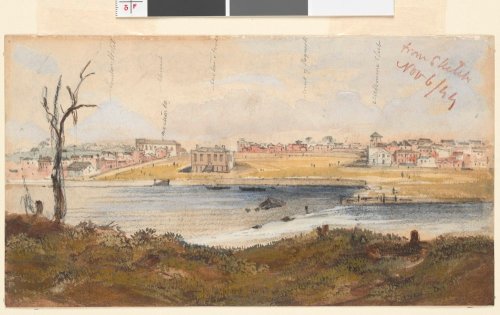
Sandridge from Hobsons Bay

Sandridge from Hobsons Bay 1852, Painter unknown, State Library of Victoria , http://www.slv.vic.gov.au [http://handle.slv.vic.gov.au/10381/78418]

Emigrants and travellers to Port Phillip found a similar problem, although no doubt after the weeks spent on board ship from Britain, the messiness of the final leg of the trip was less noticeable and frustrating. Nonetheless, it was not possible to gaily trip down the gangplank of an incoming ship onto the streets of Melbourne.  Ocean-going ships could not navigate the shallow tidal Yarra River and so they moored out in the Bay or at Point Gellibrand near Williamstown. From there, there were several options. Passengers and their cargo could be brought to Williamstown by boatmen, or could be ferried across directly to Sandridge (later Port Melbourne).  From Williamstown they could catch a ferry to Geelong, Melbourne or Sandridge, or could travel by road up through Footscray to Melbourne.  If they took the Sandridge option, they could take a shallow-hulled steamship up the Yarra, or could walk or drive across the drained swamps along St Kilda Road.  The steamships and lighters would tie up at the wharves at Queens or Coles Wharf at Queens Street, where access further up the Yarra was blocked by a rocky outcrop generously called ‘The Falls’.

The early settlers of Port Phillip didn’t need Prime Ministerial encouragement to be ‘agile’ or ‘disruptive’ : anyone who had a small boat could see the opportunities to be had in offering their services to take weary travellers straight up the river to the wharf. The Yarra River was lit by beacons and stakes that marked the deepest channels in the river.  The larger steamships relied on them to navigate the river but smaller ‘agile’ boats steered by water-men had little need of them. The Port Phillip Herald fulminated at the pushiness and competitive trickery of the water-men, calling for the Water Police to control the Uber-Taxis of the day.

As respects the beacons in the river and on the bar at its mouth, self interest on the part of the lighter and barge men often operates seriously upon the trading vessels which have to proceed to the Queen’s Wharf.  Scarcely a vessel comes up the river that does not experience detention owing to the destruction or removal of the stakes which have been inserted to mark out the proper channels and although it is well known that there is a heavy penalty for the offence, yet interested motives and the uncertainty of detection and conviction encourage the continuation of the practice.  If it be known by masters or agents that these beacons are either removed or misplaced they will not run the risk of bringing up their vessels, and the small craft trading between the Queen’s Wharf and the shipping in the bay will consequently reap the advantage; or should masters venture up and get aground, a thing of almost daily occurrence, they must perhaps have to the discharge part of their cargo, and thus in all probability pay the very men who were the cause of their misfortune, thus holding out a bribe to treachery. (PPH 2 April 1841)

IMPOSITION: CAUTION

This article was issued as a caution to unwary benefactors, but it serves just as well as a caution not to approach the church for charity:

For the last few days a female representing herself as the wife of a man called Boucher, now confined in the Gaol for sly grog selling, has been travelling through the town and extorting sums of money from our generous fellow townsmen, on the plea of extreme destitution.  She yesterday morning called on the Rev Mr Thomson, who immediately had her taken before the Police Magistrate, who severely reprimanded her, and cautioned her how she followed such courses in future. To add to the grossness of her offence, it was proved that the wretched woman was Boucher’s concubine, and not his wife. (PPH 2 April 1841)

THE FIRST CORONER


Dr. B. Wilmot.

Dr. W. B. Wilmot. State Library of Victoria, [http://handle.slv.vic.gov.au/10381/261616

One of the very first things that Justice John Walpole did in his legal capacity was to officially swear William Byam Wilmot as Coroner. Wilmot, who had a small dispensary in Collins Street called the Melbourne Medical Hall, had applied for the position in 1840, and was appointed, on La Trobe’s recommendation to Gipps, on 1 February 1841. The position of coroner combines both legal and medical aspects, and so Willis swore Wilmot in as Coroner immediately, even before Willis’ own court was open.  For that momentous occasion, we’ll have to wait for the following week.

AND THE WEATHER…

A wet week, with 4.7 inches of rain. The total for April was 5.8, so it seems that nearly all the rain for the month fell in this first week. The 1st April was the hottest day for the week at 78 degrees (or 25.6 C)


John Walpole Willis’ exciting week ahead

Justice John Walpole Willis and his biographer-of-sorts (i.e. me!) are about to have an exciting few days.  Tonight (Friday 8th April) is the opening of the new exhibition at the Royal Historical Society of Victoria 175 Years of Judging for the People, which is on show between 11 April and 7 June 2016 (details here) .

Then tomorrow, Saturday 9th April is the RHSV Conference marking the publication of a new book Judging for the People: A Social History of the Supreme Court in Victoria 1841- 2016 at Victoria University in the city.  I’m giving a short paper on the Bonjon case and its relationship to the Mabo judgment 151 years later.

Finally, on Tuesday 12th April, the book Judging for the People is being officially launched by the Chief Justice of Victoria on the very day of 175 Anniversary of the opening of the Supreme Court of New South Wales in the district of Port Phillip.  I wrote the first chapter of the book which starts off with the Resident Judges, who were the forerunners of the Supreme Court here in Victoria.

So, JWW and I had better both frock up for a few days of commemorative excitement!

VPRS 19 online!

What a wonderful world we live in!  The Public Records Office of Victoria (PROV) has now digitized and made available VPRS 19, the inward correspondence to Charles La Trobe, the Superintendent and later Lieutenant-Governor of Port Phillip.

To see an interactive introduction to the letters, see PROV’s site here.

“What would I want with La Trobe’s  Inward Correspondence?” you may ask. Well- there’s just so much here.  There’s reports from civil servants, letters of complaint, petitions, queries- in effect, anything formal that the people of Port Phillip wanted to convey to Governor Gipps in Sydney had to go through La Trobe here in Melbourne.  Although La Trobe had very little scope and authority to act independently, all requests had to go through him.  Family historians might find letters by or about their forebears; the plans for the newly-established organizations and buildings for the new Melbourne settlement are all here; the debates and controversies in the public sphere are funnelled through here as well. It’s an incredibly rich resource.

I really can’t start to describe how excited I am that these letters have been digitized and made available in this way.  Oh that they had been available five years ago when I was spending hours at PROV, although I think back on that stage as my favourite time in writing my thesis. You still have to dig around to find what you want (and I must confess that it’s taken some fiddling for me to find the transcripts) but oh! this is fantastic! Fantastic, fantastic, fantastic!  [You probably gather that I’m rather excited….]

Postscript

Thanks to Lenore Frost who has alerted me to an index to VPRS 19 which can be found on the Royal Historical Society of Victoria website under its ‘Collections‘ link.  You can get directly to the index  here.

‘Maximum City: Bombay Lost and Found’ by Seketu Mehta

maximumcity

2004, 497 p.

Good grief.  What on earth was my son thinking when he suggested that I (a middle-aged, inexperienced world traveller) read this book before visiting Mumbai?

The author Sekutu Mehta was born in Calcutta, and moved to Bombay where he lived for nine years. He left Bombay to move with his parents to America in 1977 at the age of fourteen. In the intervening twenty one years, he lived in New York, Paris, London, Iowa City, New Brunswick and New Jersey.  He  returned in 1998 with his wife and two young children to find that he was viewed as American rather than Indian. After struggling to find accommodation and to have services connected and after an altercation with his neighbours over his parking space he explodes:

This f*cking city. The sea should rush in over these islands in one great tidal wave and obliterate it, cover it under water…Every morning I get angry. It is the only way to get anything done; people here respond to anger, are afraid of it…Any nostalgia I felt about my childhood has been erased.  Given the chance to live again in the territory of childhood, I am coming to detest it. Why do I put myself through this? I was comfortable and happy and praised in New York… I have given all that up for this fool’s errand, looking for silhouettes in the mist of the ghost time. Now I can’t wait to go back, to the place I once longed to get away from: New York…I am an adulterous resident: when I am in one city, I am dreaming of the other.  I am an exile, citizen of the country of longing.  (p. 28-9)

A working journalist, he is drawn to the Muslim/Hindu riots of 1992-3 that followed the destruction of the Babri Masjid mosque in Ayodhya, leading to over 2000 deaths, 900 of which occurred during the gang-led Bombay riots.It is this event, and the networks of power that spread web-like from it, that are explored in the first two-thirds of this lengthy book. In  Part I, ‘Power’, he talks with both members of Shiv Sena, the far-right Hindu political party, and with members of D-Company led by gangmaster Dawood Ibrahim, who orchestrated a series of  retaliatory bombings on March 21 1993.  He interviews Ayay Lal, the policeman charged with solving the 1993 bombings who walks (and perhaps falls over) a very fine line between justice and criminality himself.  This is nasty, violent stuff that made me ashamed to feel compelled to keep reading. In Part II, ‘Pleasure’ he explores the world of bar-girls and Bollywood, transvestism and prostitution.  It, too, is a nasty,  violent, squalid world.  It is only in Part III ‘Passages’ where he focuses on individuals who skirt these worlds without being swallowed into them, that I felt somewhat less voyeuristic and complicit.

This is a very long book of nearly 500 pages. Its journalistic structure means that it could, theoretically, be any length by adding or culling yet another interview.  Despite its three parts and 500-odd pages, I found it hard to find any particular argument in it, except perhaps the rather limp view that

A city is only as thriving or sickly as your place in it. Each Bombayite inhabits his own Bombay. (p. 493)

For a good 2/3 of the book, I felt annoyed by the book’s bagginess and self-indulgence. I resented the time it was taking to read it, but I couldn’t stop doing so either. Yet while in Mumbai I found myself constantly citing this book and small things that I had learned through it. My travelling companion Jesse must have inwardly sighed as I started “In that book I was reading…” because I did so, often.

But I didn’t want to see the Mumbai (Bombay- his choice of ‘Bombay’ in the title is significant) described in this book. It frightened me.  To use a bland local example, it was like advising a visitor to Melbourne to watch the full series of Underbelly.  Yes, you would learn quite a bit about the Melbourne criminal culture, but you might view the Victoria Market, St Kilda and the Western Suburbs quite differently.  I doubt if it would add to your enjoyment of Melbourne.

So my recommendation? Yes, read Maximum City but do it long before you go there, or soon after- but just don’t read it while you’re there!

This Week in Port Phillip 1841: 23 March-31 March 1841

You might remember than in January  the Clonmel was wrecked along the Gippsland coast, necessitating a 65 hour rescue mission as D.C. Simson and Mr Edwards and some unnamed ‘men’sailed to Melbourne to raise the alarm.  Captain Lewis, who travelled to Gippsland to rescue the unhappy passengers, reported that he had observed what could be access to an inland sea.  On 3rd February the Singapore cleared out, bearing Dr Steward, Messrs Kinghorne, Orr, Rank, Brodribb, McLeod, Kirsopp and McFarlane to investigate this rumoured waterway and to assess  the pastoral potential of the country, which had already been designated ‘Gippsland’ by Count Streslecki in his overland explorations.

The Port Phillip Herald of 23 March 1841 carried a lengthy report of taken from Mr Orr’s notes on his return to Melbourne. John Orr was employed with the firm of Turnbull, Orr and Co, and exemplified the entrepreneurial spirit that drove these heady, pastoral boom days of the early 1840s.  He reported that it took seven days to get there (much longer than the 65 hours that Simson and Edwards had taken to return by small boat to raise the alarm), a reminder should we need it of the difficulty of negotiating the Heads and Bass Strait. Their first efforts were directed towards finding an entrance to Gipps’ Land (which was how it was written) from the north-west side of Corner Inlet, but they soon abandoned this plan.  By travelling along the beach they located the wreck of the Clonmel and noted and named two rivers: the Tarra River (named after their indigenous guide) and the Albert River (after Prince Albert). They erected a storehouse on the beach, and ensured that it was guarded at all times with a ‘sufficient’ number of men.

Then unfolds one of those beach-side encounters,  that liminal space so evocatively described by historian Greg Dening, that could have gone either way and for which we have only the settlers’ side of the story.

During these operations a tribe of natives approached the encampment, when only two of the men and Mr Orr were present, and commenced seizing upon the various articles landed.  Mr Orr, however, and the two men succeeded in driving them off by discharging their guns loaded only with powder.  While riding in the vicinity a few days afterwards, Charlie, the black native lately in Melbourne with Count Strezlecki, discovered the recent footmarks of a large party of natives in the direction of the encampment.  The party immediately galloped back but found that they had not then arrived. In the afternoon, however, two of the gentlemen perceived a spear moving at a short distance, when it was resolved to advance and ascertain their intentions.  To avoid creating unnecessary alarm, only one half of the party proceeded to meet them, and they were discovered to the number of about thirty drawn up ready to receive the advancing party with their spears, which they flourished in the manner customary upon such occasions. Charlie approached them, making at the same time all manner of signs of peaceful intentions, and inviting them to advance.

After a very noisy interchange of salutations they laid down their spears and accompanied the party to the encampment, at a short distance from which they kindled a fire and held a coorobora [sic]. They departed the following morning with a few trifling presents, and were not again seen or heard of until the day the Singapore sailed, when nine of them in three canoes again made their appearance seemingly anxious to get on board.  The ship, however, being then under way, they were obliged to return, but the party despatched a boat after them to their camp, and gave them a few articles of different descriptions at which they were highly pleased. (PPH 23/3/41 p.2)

Messrs  Stewart, Rankin and Orr returned by ship, while the other five gentlemen, accompanied by Charlie, returned home overland in an exploratory journey that took over a month. Highly enthused by the potential of the land, John Orr applied to purchase land on the west bank of the Tarra River in April 1841 under special survey, while John Reeve, a recent arrival in the colony, made an application for a special survey on the east bank.  You might remember that Henry Dendy had recently arrived in Port Phillip from England, bearing a special survey entitlement arranged from London. Not only was the local government fearful that special surveys would pre-empt the best land in the colony, but Gipps was concerned about the cost of administering (and more importantly, policing) settlement in such a remote area.  It was to take the local administration two years to gazette the special survey.

It was not a particularly successful undertaking and Gipps and La Trobe’s fears about the remoteness of the region were justified. By 1843 there were about 200 people in the region, living in five small scattered settlements.  On Orr’s survey, there were 17 men, 6 women and 13 children, while there were 29 men, 14 women and 23 children on Reeve’s survey at Tarraville.  The area did not prosper as much as they hoped. Five years later, there were only an extra hundred settlers, bringing the total to 300 and 75,000 animals.  (Shaw, A History of the Port Phillip District  p. 162)

STATISTICS

The Port Phillip Herald of 25 March had some interesting statistics about the free settlers arriving in Sydney and Port Phillip respectively.  I’m not sure how they compile the figures or how heavily they can be relied upon.  Perhaps more significant is the sentence at the bottom of the table that indicates that almost as many bounty immigrants had arrived in Port Phillip in the months 1 Jan-25 March 1841 as had arrived during the whole of 1840.

Government ships
  Men Women Children Total
Sydney 444 412 481 1367
Port Phillip  58  51  44  153
Bounty Ships (i.e. commercial emigration schemes)
Sydney 1471 1611 826 3908
Port Phillip  541 628  99 1268
Unassisted (i.e. self-funded)
Sydney 824 285 188 1297
Port Phillip 299 114 130 543
TOTAL
Sydney 2739 2338 1495 6572
Port Phillip  898 793  273 1961

P.S. There have already arrived in Port Phillip since 1 Jan 1841, 1847 immigrants on bounty in addition to a large number who arrived on their own resources. [PPH March 25, 1841]

HOW’S THE WEATHER?

The highest temperature for the period was 86 degrees (30C) on 23rd and the lowest was 43 (6C). There were strong winds on 23rd and 26th, and the weather was dry but mostly dull and cloudy. The coldest days of the month were between the 27th and 30th March.

Movie: The Big Short

Some of the reviews that I’d read of The Big Short criticized it for being overly-didactic. “Didac away!” I say, because I found the details of the Global Financial Crisis rather mind-numbing and- as any of you who have met me will testify- I’m really no good with numbers.  And so, this film is a bit “GFC for Dummies” but hey- that’s me.  It’s told in a furiously fast, deliberately self-mocking fashion with lots of thrash metal music and swooping camera shots, but it was a very accessible way to approach something that could be as dry as dust.  My repugnance for the moral hazard that these men (and it is overwhelmingly men) exposed themselves to in betting that the whole financial system would crash was soon sidelined by my repugnance for the power structures that allowed the bankers to get away with it.

This Guardian review discusses the historical accuracy of the film, and gives it a thumbs-up. Combined with the film 99 Homes (which I reviewed here), you’d get a pretty rounded history of recent events.


A Capital Idea Day 2

The other drawcard that lured us to Canberra last week was the Encounters exhibition at the National Museum of Australia which was also slated to close on 28 March 2016.  Once again, to my regret I find myself writing about an event that has already concluded but I wanted time for my thoughts to percolate about it before putting fingers to keyboard.

IMG_2248a

Encounters presents a large, beautifully curated exhibition of artefacts sourced from the huge British Museum collection, supplemented by current-day responses crafted by living indigenous artists and craftspeople from the regions where the artefacts were originally ‘collected’. I use the inverted commas deliberately: some were given as a sign of respect; some were purchased, and others were quite clearly stolen and appropriated.

It is a very well-mannered exhibition.  As you enter, there is a large video welcome and introduction by representatives of the many tribal groups who have been involved, and it has truly been a continent-wide consultation process (as you would hope it would be). The artefacts come from twenty-seven communities right across the country, reinforcing the ‘national’ nature of the museum.  The explanatory panels surrounding the artefacts are very well done, describing the mobility of the object and explaining the means by which it came into the British Museum’s collection. In many cases, artefacts are accompanied by a video with a present-day community member explaining the importance of the artefact as a reaffirmation of identity or as prompt to new learning about production techniques that had been forgotten or changed in the generations since the object was first collected.  Several of the speakers expressed gratitude that at least the object had survived to be seen by later generations, an ironic consequence of its appropriation and removal to the museum environment.  Others expressed joy at the continuity of knowledge within their community, despite a policy of repressing traditional language and crafts. Others again mourned for the loss of the object and yearned to have it literally re-placed and brought back to where it came from.

The most discussed item in the exhibition is the shield collected by Captain Cook in 1770, dropped by a Gweagal man after the ‘encounter’ on the beach turned sour. The hole in the middle of the shield was caused by a spear, generations of White custodians and curators told themselves.  I’m not convinced.  That hole speaks volumes.  The sight of it literally made the hair on the back of my neck stand up.

Much of what this exhibition did was done very, very well. But what of my comment that it’s a ‘well-mannered’ exhibition?  Many questions bubbled under the displays: how many of the people of the community are going to see this artefact?  Why does it belong to the British Museum? Why does it have to be returned?  The questions were asked sotto voce but the exhibition was too polite to ask them out loud.

One of the exhibitions is the Dja Dja Wrung bark etchings which were last seen in Australia in 2004 as part of the Etched on Bark exhibition under the auspices of the Museum of Victoria.  As that exhibition drew to a close, activists Gary Foley and Gary Murray launched a series of emergency declarations under the 1984 Aboriginal and Torres Strait Islander Heritage Protection Act in an attempt to keep the etchings here in Australia.  Eventually a court decision found in favour of the British Library and the etchings returned to London.   There’s an interesting article written by the curator of that exhibition in 2007 here.

It comes as a surprise, then, to see the Dja Dja Wrung etchings back in Australia again, just over ten years later. An act of good faith on behalf of the British Library perhaps?  Or a provocative gesture now made from within the safety of the Protection of Cultural Objects on Loan Act of 2013? This Act was initiated at the behest of Australian cultural institutions that wanted to be able to give a water-tight guarantee to their international counterparts that items would unequivocally return to the lending institution. The etchings have travelled here because the British Library knows that they will be returning to London.

In an article in Overland (21 March 2016), Eve Vincent reflects on the display of the Dja Dja Wrung etchings:

Also on display are the Dja Dja Wurrung bark etchings that last visited Australia in 2004. They were on display at the Museum of Victoria when Dja Dja Wurrung activist Gary Murray joined with Gary Foley and others to prevent them from leaving the country. The fact that Dja Dja Wurrung representatives ‘unsuccessfully’ sought to stop the return of these objects to England is carefully acknowledged. Press a button and Murray’s soft voice starts talking about his aspiration to have the bark etchings stored in Melbourne, closer to home. ‘We beg the British museum to return our cultural materials.’

And then the visitor moves to the next exhibit.

This exhibition is actually one half of a matching exhibition called Indigenous Australia: Enduring Civilisations  which was on show at the British Museum in London between April and August 2015. An excellent article by Penny Edmonds in The Conversation in 2015, reviewing the British exhibition,  highlights the curatorial challenges faced by in the British exhibition for a British audience. The British Museum is not unfamiliar with disputes over provenance and custodianship – after all, they’ve been fighting over the Elgin or Parthenon Marbles for decades and decades.  While the issues of collection and colonialism, ownership and custodianship were discussed in the abstract in London, there was an expectation (fear?) that the conversation would be more pointed when the Australian exhibition opened.

But it hasn’t happened in this strangely decontextualized exhibition which says little about the international politics, or the emotional and intellectual motivations in act of ‘collecting’ that lie at the heart of this particular display. I think that it is an opportunity lost. It was almost as if we were on our best behaviour, not wanting to cause a fuss. I’ve read a few articles about the “conversation” that is being had here about such issues, and it evokes for me the insistence by the Irish government on the “maturity” of the discussions surrounding the commemoration of the centenary of the Irish Rising this week. No-one wants to seem “immature” and the  insistence that things are kept within the bounds of “conversations” and “dialogues” are curbs that can only be made from a position of power.

So, my response to the Encounters exhibition? Beautifully curated and thought-provoking but at its core timid and polite.

But maybe I speak too soon? Now that the exhibition is being packed up and taken away again, the whispered question is being voiced aloud- see a recent article in the Guardian here;  on The Conversation website here and an ABC report from the very day I am writing this here.  Perhaps, now that it’s finished, we don’t have to be on best behaviour any more.

Other articles:

Quentin Sprague The Monthly Bringing Them Home’


Movie: Eye in the Sky

UK and US armies are co-operating in drone surveillance of suspected Al-Shabab terrorists in Kenya.  When it seems that an attack is imminent, the decision needs to be made whether or not to make a pre-emptive drone strike.

Yes, it’s taut and on-the-edge of your seat. But it also feels a little bit like a simulation game in Ethics 101, with the ethical dilemmas being racheted up, bit by bit.  At first I was sceptical, thinking that there wouldn’t be any question that the attack would be made ( a feeling reinforced by seeing the attack on the Pakistani playground on tonight’s news). But then the film reminded me of the propaganda value of YouTube videos of a drone attack, like those released by Edward Snowden, and the challenge made to unthinking obedience when the military environment is more reliant  on computer experts than grunts laden with weaponry.

A film about a Kenyan terrorist attack is all a bit close to the bone for me, given my son’s presence there, but I reassured myself that it wasn’t really filmed in Kenya but in South Africa- and I’m very proud that I deduced that myself from minor infelicities in the film (the airport; the lines on the tarmacced road; too few people in the market).

Nonetheless, a solid 4/5 for me although I did come out feeling exhausted and as if I’d been coerced into participating in a very unpleasant hypothetical exercise.

This Week in Port Phillip 1841: 16-23 March 1841

HAPPY ST PATRICK’S DAY!

March 17, of course, was St Patrick’s Day. As Ken Inglis points out in Australian Colonists, recognition of the day in Sydney dated from 1810 when Governor Macquarie provided entertainment for convicts employed by the government, and the annual St Patrick’s Day dinner at a Sydney hotel was a fixture on the social calendar attended by the most respectable Irishmen- both Catholic and Protestant (p.103). Melbourne in 1841 was not yet so organized, and the occasion passed quietly.

We are glad to be enabled to state that Patrick’s Day passed over without the least infringement upon the public peace. We are almost sorry to have to record the fact that scarcely an additional glass was drained or shillelagh flourished in commemoration of the anniversary of Ireland’s general jubilee, as such might have been done without offence to the Powers that be, a little licence being always conceded on such occasions and a miniature representation of Donnybrook fair would have minded many of what they seem here to forget, that they are Irishmen. Perhaps, however, it is better that the dull monotony of money gathering should have remained uninterrupted than that occasion should have been given Ireland’s enemies to say that her sons in every quarter of the globe are fond of a “row”. Patrick’s Day has now passed over in peace and unmarked by any national display and so much the greater shame for Irishmen say we.  (PPH 19/3/41 p.3)

The day did not go completely unrecognized, though, as twenty to thirty of the men of the Port Phillip Club sat down that night to “a most sumptuous collation”. (PPH 19/3/41 p.3)

SHIPPING NEWS

Perhaps it’s because I’ve only recently finished reading Roslyn Russell’s High Teas and High Seas (review here) but I find myself reading the Shipping News on page 2 of the Port Phillip papers with a little more interest than previously.  Not only does the Shipping News detail the ships that have arrived and departed from Port Phillip and Sydney, but it conveys the communications that were conveyed between ships as they passed each other.  For example, the Port Phillip Herald of March 20 reported the arrival of the Christina  from Sydney. The Christina “spoke” the ship Victoria from Salem (USA) which it encountered off Bateman’s Bay, describing her as “deeply laden” (possibly with its whale catch?). The next day she “spoke” the barque Susan, sailed by Captain Neatby , off Ram Head (which I assume is Rame Head near Croajingalong National Park). The Susan was 92 days out from Plymouth, taking emigrants to Sydney. (PPH 20/3/41 p.2)

Recent emigrants, with their own voyage still vivid in their memories, might have taken a “there but for the grace of God” interest in hearing of other ships following in their wakes. The Port Phillip Herald  of 19 March carried a report from  Lisbon dated October 15 (i.e. nearly six months earlier) that the English ship John Cooper, bound from Greenock to NSW with a general cargo of 98 emigrant passengers, had arrived at Lisbon after being struck by lightning. A passing merchant vessel reported that he had seen her trying to reach Lisbon but, “owing to her crippled state, she appeared to make very little way”. On hearing this, Her Majestys ship Trimlemo was dispatched to go to her assistance, but returned the same day to report that although the John Cooper was close to the bar, she was in such a poor condition that a steamer should tow her into port. Even then, her troubles were not over, as when towed into port at the cost of £350 sterling, it was “found unprovided with a bill of health” and put under four days quarantine. [The John Cooper finally arrived in Port Phillip on 4th April via Adelaide. She left again for Sydney on 3rd May with a passenger list that included 1 corporal, 3 privates, 28th Regiment, 1 constable, 17 male and 2 female convicts. http://www.oocities.org/vic1840/41/jc41.html]

Melbourne itself was still in a state of excitement about the arrival of the Argyle in early March with its load of bounty emigrants, ready for the picking as employees.  The enterprising auctioneer and commission agent  Mr J. C.King established an agency office for Servants at his premises in Elizabeth Street, offering – for a trifling remuneration- to board the emigrant ships immediately after the official inspection of the emigrants and to engage servants for settlers who were unable to get to the ships to do so personally. (PPH 12/3/41).

By 16 March Mr King was able to issue a weekly list of unemployed servants:

WEEKLY LIST OF UNEMPLOYED SERVANTS AT MR KING’S AGENCY OFFICE: Overseers of sheep stations 3; shophands 3; woolsorters 1; hutkeepers 1; watchman 2; overseers of cattle stations 3; stockkeepers 2; bullock drivers 1; overseers of forming establishments 2; ploughmen 2; farm servants 4; Groom and inside servants 1; Gardeners 1; Bricklayers 1; House carpenters 2; Hut builders and fencers 4; female servants 3; Wet nurse 1 (PPH 16/3/41 p.3)

However, a small article in the Port Phillip Herald of 19 March headed ‘DROWNING’ reminds us that the journey to Port Phillip was not necessarily the bright new start that emigrants may have anticipated.  A body was observed floating on the water by the watermen of Williams Town. The body was salvaged. He was very young, dressed in a blue coat and striped cloth trousers and found to have needles and pins in parts of his dress, a few papers and a smelling bottle. He was later identified as a Mr. Macfarlane, who had arrived in the Argyle just a few weeks earlier.

He had been employed by Mr Rucker as a farm servant, and resided on his estate, about two miles from town, but since his arrival he appeared greatly depressed in spirits, and it is supposed that in a fit of temporary insanity the wretched man put a period to his existence. The deceased was a native of the county Tyrone, Ireland, and was respectably connected.

VERY EXCITING NEWS!

The Christina came bearing the London newspapers which carried detailed reports of the birth of Queen Victoria’s first child, Victoria Adelaid Mary, the Princess Royal on November 21 1840.  It was such momentous news that the Port Phillip Herald published a special edition on 20th March, to follow the issue that had appeared on 19th.  Even though this is, strictly speaking, not Port Phillip news, it strikes me as strange that Her Majesty’s subjects, so far away on the other side of the globe, would be reading a report of a birth that seems so intrusive to modern eyes.

On Friday her Majesty and Prince Albert walked in the garden of the Palace and again did her Majesty take her seat at the dinner table, and continued apparently in her usual health till eleven o’clock, when she retired to rest, no suspicion being then entertained of the near approach of those sufferings, which providentially have terminated in a manner so satisfactory to every branch of her august family as well as to the delight of her loyal and devoted servants. At two o’clock yesterday morning the first symptoms of uneasiness were indicated, and at four her Majesty with great firmness directed that her attendants should be summoned; among these was Mrs Lilly, who, we have heard, was formerly nurse to the Duchess of Sutherland, and whose experience at once forewarned her of the propriety of immediately summoning her Majesty’s professional advisers. Sir James Clarke, Dr Locock, Mr R Ferguson and Mr R Blagden were instantly sent for and were quickly on the spot. No doubt now existed that Her Majesty was in labour, although certainly some days sooner than had been anticipated, as the impression was that she would have remained convalescent till early in December.

Once labour had been established, all the protocol of a royal birth swung into place. Good grief- ding!dong! the gang’s all here!!

Such preparations as the suddenness of the emergency would permit were made without delay; and by command of Prince Albert, whose conduct was distinguished by the most affectionate solicitude, combined with firmness, the Hon. W. Murray, the comptroller of the household, roused the inmates of the Palace and special messengers were dispatched to her Royal Highness the Duchess of Kent, the Archbishop of Canterbury, the Bishop of London, the Lord Chancellor, Lord Melbourne, Lord Palmerston, Lord Errol, Lord Albemarle, Lord John Russell and other Privy Councillors, whose constitutional duty it was to be present at the birth of an heir to the throne…. In her Majesty’s chamber were the Duchess of Kent, Prince Albert and the medical men with Mrs Lilly and some of the ladies of the bedchamber; while in an adjoining apartment, the door of which was open, were the other distinguished individuals mentioned. As the day advanced the Palace was kept in perfect quietness, while all noise from without from the passing of bands or otherwise was interdicted. From those who had the best means of information, we learn that her Majesty evinced a firmness and composure almost incredible- at intervals exhibiting a cheerfulness and patient submission to her sufferings, in all respects consistent with the well-known attributes of her character. The near approach of that interesting moment which was to give to these realms an heir to the throne at last arrived and precisely at ten minutes before two o’clock Mrs Lilly entered the room where the Privy Councillors were assembled, with the “Young Stranger”, a beautiful, plump and healthful Princess, wrapped in flannel in her arms. She was attended by Sir James Clarke, who announced the fact of its being a female. Her Royal Highness was for a moment laid upon the table for the observation of the assembled authorities; but the loud tones in which she indicated her displeasure at such an exposure, while they proved the soundness of her lungs and the maturity of her frame, rendered it advisable that she should be returned to her chamber to receive her first attire. PPH 20/3/41

Apparently, ministers and privy councillors and ladies-in-waiting continued to attend royal births until 1894 when Queen Victoria decided that for the birth of her great- grandson, the future Edward VIII, the home secretary would be enough. Home Secretaries attended until the birth of Prince Charles in 1948, when it was announced that the practice would be discontinued.  Jolly good thing too.


1916 Irish Rising: Australian Impact

EasterRising

On this Easter Sunday, I’m going to be at the Melbourne Unitarian Peace Memorial Church to hear Dr. Val Noone speak on ‘1916 Irish Rising: Australian Impact’. It starts at 11.00 am. on Sunday 27th March, 2016.

This year is the centenary of the Rising, and the University of Melbourne is conducting a two-day international conference on 7th and 8th April to commemorate and interrogate the event. There’s details about the conference here– it looks excellent.