
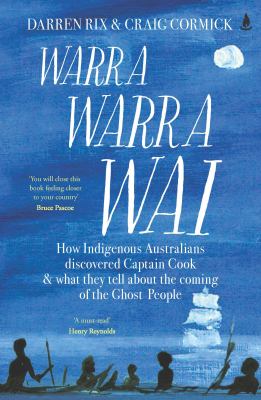
When I was young, it was an article of faith that Captain Cook ‘discovered’ Australia, along with a few Dutch adventurers on the west coast. Since then, the story has been made more complex, and this book subtitled ‘How Indigenous Australians discovered Captain Cook & what they tell about the coming of the Ghost People’ adds a First People’s perspective to the original ‘discovery myth’.
Each chapter of the book starts with a traditional welcome from each different language group, an action that we now encounter regularly at public occasions and an incredibly generous act, in my opinion, considering what happened later. But the title of the book is more complex and less welcoming. When the sailors and passengers of the Endeavour finally disembarked at Botany Bay after sailing up the east coast for about six weeks, two men – an older man and a young man- came down to the shore and shouted “Warra warra wai”. For years, this was believed to mean ‘Go away!’ but it is now known more accurately to mean ‘You’re all dead’ – a warning to others that they had encountered the spirits of the dead. Family descendants of the older man claim that it meant ‘Go away, we don’t want dead people here’. Whatever the exact meaning, the encounter did not end well: there were several musket shots and spears and thrown rocks (p. 65-67).
This book describes itself as a “blackfella-whitefella collaboration”. White historian Craig Cormick drew on the archives and First Peoples historian Darren Rix drew on oral interviews, conducted during a 4000 km trip through Victoria, New South Wales and Queensland in 2023. The two historians followed Cook on his journey, and book carries two maps: the first Cook’s map showing his map of the coastline and the titles of the bays and capes he named, and a second hand-drawn map of the same east coast, showing the language groups countries on the left, and significant landmarks (most of which Cook renamed) on the right. Starting at Munda Bubal/Tolywiarar (Point Hicks), claimed to be Cook’s first sighting of mainland Australia, they travel from south to north along Australia’s east coast, ending at Thuined (Possession Island) where Cook wrote that he took possession of the whole Eastern Coast which he named ‘New South Wales’.
News of the appearance of Cook’s Endeavour spread quickly up the coast through smoke signals and so, while not knowing exactly what they were looking at, for the First Peoples, the sight of the ship, its sails and its crew were not a surprise. I hadn’t realized that Cook spent as little time as he did actually on dry land, rather than just sailing past. All Australian school children learned about Botany Bay, but he also disembarked at Gooragang (Bustard Bay) in Queensland for a day, then was forced to stop for about seven weeks at Whalumbal Birri (Endeavour River) to repair the hull of his ship which was damaged on the reefs. His final stop was at Thuined (Possession Island) where he took possession of the coast he had observed from his ship.
As a result, the section of each chapter headed ‘Contact’ is not so much First Peoples contact with Cook himself, but more with the waves of settlers who followed years later: pastoralists, convicts and increasingly as he heads into far north Queensland, miners who came in search of gold later in the 19th century. Eventually, only sad things came in their wake -illness, dispossession, Native Police, incarceration on Palm Island- although the exact nature of the contact and its implications followed. Several escaped convicts and shipwreck victims who had been adopted by various tribes emerged as these later waves of settlers rolled in.
In each of these four stops, he was oblivious to the protocols Cook was breaking by not seeking permission. First Peoples would not approach him: they were waiting until he came to them to receive permission to enter their lands.
There is an element of alternative history at play here. When Cook sailed into Botany Bay, he was not to know that the First Peoples he saw on the north shore were a different people to those on the south shore. The people on the northern shore came armed with ‘long pikes and a wooden weapon made something like a short scimitar’ which they brandished at the boat which preceded the ship. As a result, the Endeavour sailed to the southern arm of the bay where they encountered four men fishing with spears in a canoe, and an old woman with several children., and disembarked there. Had Cook and his men landed on the north shore, they may well have been attacked, with crew members killed. How would things have unfolded then? As it was, Cook took two boats to the southern shore, with about 40 men aboard and threw beads and nails onto the shore from the boat. Two men came onto the shore each armed with a long 3 metre spears. Thinking that the men were beckoning to them, Cook and his men headed ashore. Big mistake. The two men threw stones at them, then threatened them again with the spears; as a result Cook’s marine fired at them, first into the air, then at the men with small shot. But what would have happened if they had landed on the north shore? Would Cook’s perception of the First Peoples have been different?
At the second landing at Bustard Bay, they saw no-one, even though they found campfires that had been recently deserted. They were being watched, though.
It was on the third, forced and extended landing that Cook stayed long enough to both offend and then appease the First Nations on Country. Cook’s journals recorded the places, sightings, contacts and exchanges, including Cook’s attempt to record the names of the men, use of the throwing stick, demonstrations of spear throwing, exchange of food and use of plants. After offers of gifts of cloth, nails, paper and beads – none of which was of much interest – a small fish was thrown to the First Peoples and without knowing it, Cook’s men had enacted part of a customary offering of peace that would demand reciprocity. The next day, both groups examined each other’s bodies, and a fish was brought to the sailors in return. The newcomers saw a kangaroo, which they shot and ate. But then, shortly before getting ready to leave Endeavour River, Cook’s men netted a dozen or more large sea turtles. It was not the right time for hunting turtles, and taking so many would deplete the resources. As a sacred animal there were proper protocols for hunting. As a result, the following day, ten or more men approached the ship carrying a large number of spears, and indicated by signs that they wanted some of the turtles. When they tried to drag them off the ship, the crew stopped them. The First Peoples returned to the shore and tried to burn the goods and fishing nets that had been left on the shore. Guns were fired, hitting a man, and spears were seized. But the next day, even though the British had broken one of the strictest taboos in shedding blood, one of the elders walked out with a broken spear and wiped the sweat from his armpits, blowing it towards Cook. Cook had the presence of mind to realize that this was an act of peace, and he returned the confiscated spears. Cook named the place Reconciliation Rocks. You wonder if Cook had stayed longer at his other stops, he might have gained more understanding of the people he was seeing from the side of his ship.
The final stop was at Thuined (Possession Island) and the authors dangle their feet into the controversy over whether Cook’s proclamation of sovereignty over the east coast was legal or not, given that he had disregarded the part of his instructions that ordered him to take possession “with the Consent of the Natives”. They also question whether Cook documented it at the time, given that there could have been alterations to the records after the event, and that Joseph Banks did not mention it in his own journal. Sydney Parkinson, the third major journal keeper on board, wrote about Cook hoisting a jack and firing a volley from the top of the hill, but this has been interpreted as a signal to the men still on board that a clear passage was visible. It’s a moot point, as far as I am concerned, because Governor Phillip’s flag-raising at Sydney Cove 18 years later would have sealed the British claim of sovereignty anyway.
This book highlights the similarities and differences between the groups that Cook described as “the natives”. Following his journey up the coast, we read of the creation stories of the different groups, all of which are based on physical landmarks but many of which involve two or more ancestral beings who for some reason flee across the country to the sea. All the groups shared a belief that the Europeans were in some way related to dead men, and all the groups expected- and failed to receive- a ceremonial greeting. It is a long litany of broken protocols. The book reinforces that the descendants of the First People who saw Captain Cook, and those who didn’t, have their own stories to tell, and that they still have links to Country, despite the ravages of colonialism. It’s a completely different way of looking at the east coast, and makes sense of the Acknowledgements and Welcomes to Country that we witness today, in a belated attempt to do what should have been done then. Bruce Pascoe’s blurb on the front cover says that ‘You will close this book feeling closer to your country’, and I think he’s right.
My rating: 8/10
Sourced from: Yarra Plenty Regional Library
Read because: Sue at Whispering Gums reviewed it


Thanks for the link Janine. I enjoyed reading your historian’s take on this book, which I thought was beautifully structured to tell a story that’s both universal to all the peoples up and down the coast, which also preserving their difference – then and now.
Like you I think First Nations Australians are incredibly generous with their welcomes.