
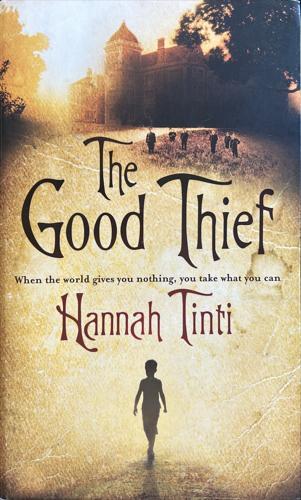
If you’re after a good 19th century Dickensian romp, then this is your book! It has it all: a gloomy orphanage, grave robbers, kindly landladies, a bluestone hospital surrounded by a high fence, a ‘dwarf’ and dark satanic mills (or rather, mousetrap factories). But it wasn’t written in the 1850s: instead it is Hannah Tinti’s debut novel, written in 2008, leaning heavily and gleefully into the Dickensian serialized novel genre.
Set in 19th century New England, Ren is an orphan with only one hand who has lived his whole life in St Anthony’s orphanage, run by Catholic brothers. It is a meagre and colourless childhood, marked by want and cruelty, and the only forlorn hope is that somebody might adopt a boy before he is drafted into the army and used as cannon fodder. He knows nothing of his parents beyond the small collar of the clothes in which he is left with the hand-sewn letter ‘R-E-N’ which he carries as a talisman. With only one hand, the other having been amputated as a baby, there is little chance that Ren will be adopted.
So it comes as a surprise to him when a handsome young man, Benjamin Nab arrives one day, claiming to be Ren’s brother, with a lurid story of murder and scalping of their parents by Indians. Benjamin takes Ren with him, and is delighted to learn that despite Ren’s Catholic upbringing, he is a light-fingered young fellow who, along with the pathos engendered by his missing hand, can assist Benjamin in the crime spree on which he embarks, young Ren in tow. Along with Ben’s accomplice, the alcoholic schoolteacher Tom, they steal a horse and strike a deal with a hospital surgeon at the small town of North Umbridge to provide bodies for dissection, disinterred from deserted graveyards. Benjamin spins ever more lurid tales to explain their journey and Ren’s absence of a hand, to the hard-of-hearing but good-hearted Mrs Sands WHO SPEAKS ONLY IN CAPITAL LETTERS. Mrs Sands accepts them into her boarding house, largely out of sympathy for Ren, and they share the house with the ‘mousetrap girls’ who work at McGinty’s mousetrap factory and Mrs Sands’ brother, a dwarf, who moves back and forth from his rooftop lair via the chimney. The mismatched group accumulate more and more people- a not-quite-dead assassin, twin escapees from St Anthony’s who were Ren’s only friends- and find themselves pursued by the ‘hat men’, hit-men employed by Silas McGinty, the mousetrap entrepreneur, who has tracked both Benjamin and Ren in order to extract information from them.
In good serialized fashion, each chapter ends on a cliff-hanger, and people who appear dead somehow come back to life, and appearances are deceptive. As a person with a cleft lip and palate herself, I found the designation of a young woman as ‘The Harelip’ confronting, but along with its depiction of dwarfism, authentic enough for the genre Tinti is reproducing. The book is tightly if rather fantastically plotted, and has just the sort of Victorian conclusion that one might expect. Actually, I couldn’t put it down.
My rating: 8/10
Sourced from: a friend.

