
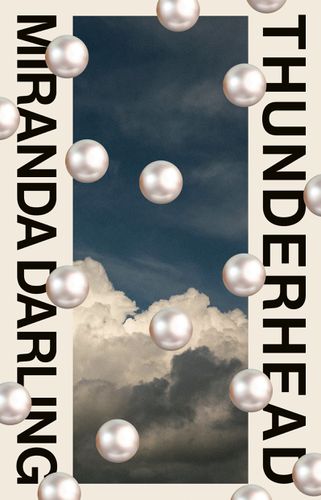
A thunderhead is a dense, towering cloud that often presages a thunderstorm. The sky can be blue but the thunderhead glowers on one side, building up power and energy until it blots out the sun. That feeling of rising tension pervades this short 76 page novella as its protagonist and narrator Winona Dalloway tiptoes around her controlling husband, referred to only as ‘He’ and ‘Him’ -always capitalized- trying to practice Transcendence over her small daily challenges while trying to summon the courage to make bigger changes. Dalloway? where have you heard that name before? Ah- Virginia Woolf’s Mrs Dalloway, and this book makes many references to Woolf’s book, and even more, I think to Michael Cunningham’s riff on Woolf in The Hours, most particularly the character Laura Brown. As with all the women in both Woolf’s book and Cunningham’s tribute to it, there is a rupture between the interiority of the characters and the outward image that they are trying to project.
I mentioned the Laura Brown character in Cunningham’s book in particular, because both women are negotiating around an oppressive husband, trying to anticipate his needs and running to fulfil them. In Winona’s case, ‘He’ manifests for much of the book through a series of commanding SMSs and calendar entries. As with Clarissa Dalloway in Woolf’s book, there is a dinner party to be held that night, and both women are apprehensive. ‘He’ is directing her preparations through SMS, while structuring her activities during the day: peering into her appointment with a psychiatrist, ordering her to be present when the plumber comes before 2.00 p.m.
Winona, a frustrated writer, is surrounded by voices: both ‘His’ SMSs and instructions, and her own inner voices differentiated by bold text and italics. These voices cause her to second-guess herself, and we- and she- only gradually realize that He is gas-lighting her as well. Her confidence and autonomy is so fragile, and she tries to guard it by the writing of lists and the ticking off of small achievements while negotiating domestic life.
For such a short book (only 79 pages) there is a lot packed in, and the tension is almost unbearable: so much so that I was glad that it is only short. I’m bemused by the publicist’s description of it as ‘black comedy’. There’s no comedy here: there’s coercion, oppression and tension- all within 79 pages. I enjoyed the allusions to Woolf and Cunningham, but the book stands on its own without knowledge of the other two books. It’s a very accomplished piece of compact writing.
My rating: 8/10
Sourced from: YPRL e-book
Read because: Kim’s review at Reading Matters
 The Resident Judge of Port Phillip