Tag Archives: Politics

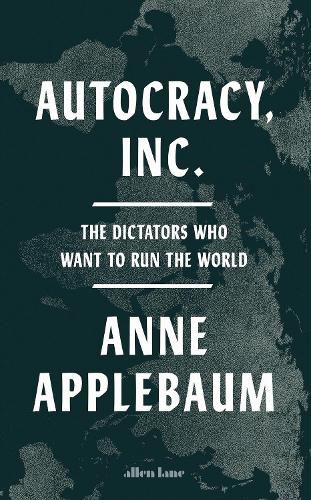
‘Autocracy, Inc: The Dictators Who Want to Run the World’ by Anne Applebaum

2024, 240 p.

I’ve had this book reserved at the library for some time, and when I finally received it I was disappointed that it seemed to be a rehash of the excellent podcast series that I mentioned back in November 2024, before this whole Trump 2.0 nightmare began. But it isn’t. Her podcast was called ‘Autocracy in America’, and in the podcast she applies the principles that she spells out in this book Autocracy Inc to the American context, with much prescience, I’m afraid.

She notes that the old cartoon image of the ‘bad man’ autocrat is outdated.

Nowadays, autocracies are run not by one bad guy but by sophisticated networks relying on kleptocratic financial structures, a complex of security services- military, paramilitary, police- and technological experts who provide surveillance, propaganda, and disinformation. The members of these networks are connected not only to one another within a given autocracy, but also to networks in other autocratic countries, and sometimes in democracies too. Corrupt, state-controlled companies in one dictatorship do business with corrupt, state-controlled companies in another. The police in one country may arm, equip, and train the police in many others. The propagandists share resources- the troll farms and media networks that promote one dictator’s propaganda can also be used to promote another’s- as well as themes: the degeneracy of democracy, the stability of autocracy, the evil of America. (p.2)

In this book, she sweeps her searchlight onto the strongmen who lead Russia, China, Iran, North Korea, Venezuela, Nicaragua, Angola, Myanmar, Cuba, Syria (possibly outdated), Zimbabwe, Mali, Belarus, Sudan, Azerbaijan in particular- although she mentions some three dozen others. What a depressingly large list! Autocracy Inc, as she calls them, collaborate to keep their members in power by ignoring multiple international agencies, buoyed by a conviction that the outside world cannot touch them.

Her opening chapter ‘The Greed That Binds’ looks particularly at Putin, and the schemes he established to enrich oligarchs in the breakup of the Soviet Union. These oligarchs have invested in America and Britain.

Her second chapter ‘Kleptocracy Metastasizes’ turns to Chavez’s Venezuela, where Autocracy Inc. stepped in after Chavez’s death in 2013, where Russian and Chinese money poured into the country to enable Chavez and then Maduro to postpone any kind of financial reckoning as they destroyed the economy. Cuba joined with Venezuela in an anti-American agenda, and Maduro and Turkey’s Recep Tayyip Erdogan share a dislike of democracy and anti corruption movements in their own countries. Improbably, Venezuela and Iran, despite their many differences, relate on the basis of shared grievance, with Iranians buying Venezuelan gold, and sending food and gasoline in return and assisting with the repair of Venezuelan oil refineries. She looks at Uebert Angel, an evangelical pastor and British-Zimbabwean businessman who is involved in gold-smuggling schemes, some associated with Zimbabwe’s ruling party and its president Emmerson Mnangagwa. The ruling party has a long standing relationship with the Chinese Community Party and Putin’s Russia.

Chapter 3, ‘Controlling the Narrative’ looks at cybersecurity and firewalls as a way of rewriting history, as for example, in China with Tiananmen Square. Spyware and surveillance is a way of autocracies justifying their abuse of electronic technologies. Domestic propaganda in Russian state television devotes huge slabs of time to America’s culture wars. China has made an enormous investment in international media, which makes possible the spread of misinformation internationally, and RT (Russia Today) has sites which writes material, is translated into other languages, and published on ‘native’ sites to make them seem local. Yala News, run by a Syrian businessman for example, has taken material from Russian state media and spread it through Arabic news sites. As we know, websites and videos can be fake.

Chapter 4 ‘Changing the Operating System’ looks at the ‘rules-based order’ (something that powerful countries feel themselves exempt from) and the removal of language that constrains Autocracy Inc from the international arena altogether. Instead of ‘human rights’, China wants to prioritize the ‘right to development’. The term ‘sovereignty’ is used in different ways. ‘Multipolarity’, a word preferred by the Russian information networks, is meant to be fair and equitable, but is now the basis of a whole campaign systematically spread on Russia Today in English, French, Spanish and Arabic, and repeated by information-laundering sites such as Yala News. Alternative institutions in a ‘multipolar’ world agree to recognize each other’s ‘sovereignty’, not to criticize each others’ autocratic behaviour and not to intervene in each other’s internal politics. Not every member of BRICS and the Shanghai Cooperation Organization is an autocrat, but she asserts that

…if the old system was designed to inculcate the “rule of law”, these new institutions are meant to promote “rule by law”- the belief that “law” is whatever the current autocrat or ruling party leader says it is, whether inside Iran, Cuba, or anywhere else in the world. (p. 107)

She looks particularly at the Syrian Civil War and the Russian-led campaign against the White Helmets, and the involvement of the Wagner Group.

Chapter 5 ‘Smearing the Democrats’ looks at ways that the people have fought back in Poland, Venezuela, Burma and Hong Kong- although this is a very discouraging list (except for Poland). The response of autocratic government to challenge is to mount smear campaigns and make accusations of foreign interference. More sophisticated autocracies have moved beyond just killing their opponents, and now prepare legal and propaganda campaigns in advance, designed to catch democracy activists before they gain credibility or popularity.

Applebaum’s book is dedicated “for the optimists” but it’s hard to find much cause for optimism here. Her epilogue ‘Democrats United’ brings the book even more up to date by looking at Ukraine and Israel. She emphasizes that in no sense is the modern competition between autocratic and democratic ideas and practices a direct replica of the 20th century cold war. Many countries do not fit neatly into the category of either democracy or autocracy and divisions run inside countries as well. She urges a reconceptualization of the struggle for freedom as not against specific states or countries, but against autocratic behaviours, where-ever they are found- in Russia, China, Europe and the United States. She spells out a number of steps

  1. Put an end to transnational kleptocracy through ending the whole financial system that makes it possible e.g. in real estate transactions and money-laundering and through an international anti-kleptocracy network.
  2. Don’t Fight the Information War- Undermine it by challenging the information systems at a government level (fat chance, with Musk in power) and joining forces to make Reuters, the Associated Press and other reliable outlets the standard source of global news instead of Zinhua (China) and R.T. (Russia)
  3. Decouple, De-risk and Rebuild – ensure that countries do not remain dependent on other autocracies

She finishes by noting that:

There is no liberal world order any more, and the aspiration to create one no longer seems real. But there are liberal societies, open and free countries that offer a better chance for people to live useful lives than closed dictatorships do. They are hardly perfect. Those that exist have deep flaws, profound divisions, and terrible historical scars. But that’s all the more reason to defend and protect them….They can be destroyed from the outside and from the inside,too, by division and demagogues. Or they can be saved. But only if those of us who live in them are willing to make the effort to save them (p. 176)

I feel as if much of this book has been superseded by recent events in America, which is really demonstrating where these links between autocracies are operating. There is one serious omission. Until the afterword, she is largely silent on Israel (I think that she herself is of reform Jewish heritage) and its provision of surveillance and military technologies to autocracies, that was described in Antony Loewenstein’s The Palestine Laboratory (which I see is now a documentary). There are other chapters earlier in the book when she could have looked at Israel earlier.

However, particularly since Trump’s inauguration, her articles in The Atlantic, bring her analysis to current events at both the American and international level, and she is an active and articulate participant in current political commentary. This book ranges over a huge number of countries and their leaders, and she told us quite clearly how Trump fits into the Autocracy Inc. model in her recent podcast. Americans can’t say that they weren’t warned, and the whole word is bearing the consequences.
I hear with my little ear: Podcasts 24-31 January 2025

Rear Vision (ABC) For about a fortnight after Trump’s victory, I couldn’t bear to listen to any news about America at all. I’m glad that I didn’t realize the inauguration was even happening so I missed that completely. But now, even though I’m horrified, I can bear to listen, watch and read again. Rear Vision replayed an episode from 2015, before Trump won his first term. It’s called A Tsunami of Trumpness, and the little wave then is nothing to what we have seen now. Trump’s grandfather arrived in 1885 – an immigrant, eh? – and made his money from North West mining. His father Fred built the family wealth further by taking advantage of the New Deal to become a builder and mortgage guarantor. Donald made his money from real estate and casinos, starting by refurbishing a hotel with his trademark glitz, using the political connections and credit from his father. He wasn’t particularly successful, but he knows the power of his own celebrity to gain free publicity because he is too big to fail.

The Rest is History The Nazis: Hitler’s Triumph (Part 3) This episode starts off with Horst Wessel. I’d heard of the song, but nothing about who Horst Wessel was. He was a streetfighter and member of the the SA, the original paramilitary wing of the Nazi Party. He was shot by 2 communists in 1930 and virtually deified by Goebels. The German economy was crippled by the withdrawal of US banking from Europe, something that happened gradually but inexorably. It was estimated that 1/4 of the population was living in a house with unemployment (actually, I think that the figure in Australia was even worse at 1/3 unemployment). Both the Communist and Nazi parties were increasing their members. The Weimar Republic virtually committed suicide as the governing coalition collapsed and, spurred by their fear of communism, Hindenburg and the army decided to rule by decree. Chancellor Heinrich Bruning cut spending and worked on evoking deflation and the first of a string of elections was held. This was the Nazi’s big moment, going from 12 seats to 107. They weren’t fringe any more. The violence of the streets and language was brought into mainstream politics. Electors had to hold their nose to vote for Hindenburg, who was the mainstream candidate. He won 53% of the vote, while Hitler won 37%. The very conservative Von Papen became Chancellor, and he called another election. This time the Storm Troopers were not banned, and the Nazis won 230 seats, against the 89 held by the Communists. Hindenburg refused to make Hitler Chancellor because of his violence. Von Papen wanted to dissolve Parliament and rule by decree but Von Papen lost a vote of no-confidence and so they had yet another election. This time both the Communist and Social Democrat parties improved their share of the vote, but they refused to work together. On 30 January 1933, Hindenburg appointed Hitler as Chancellor to head a coalition government with Von Papen as Vice-Chancellor.

The Rest is Politics (US edition). Trump’s Insurrection: The Fall of the Capitol I listened transfixed on the radio while driving down to the beach, unable to believe what I was hearing. I saw the photographs in this most widely-photographed event. Anthony Scaramucci and Katty Kay go through the day, hour by hour, discussing what Trump was doing, what the politicians in Congress were doing, what the crowds outside were doing. For me, the most telling phrase was Trump saying “Now, it is up to Congress to confront this egregious assault on our democracy. And after this, we’re going to walk down, and I’ll be there with you, we’re going to walk down, we’re going to walk down.” (see transcript of Jan 6 speech) For me, the WE is fundamental. Anthony and Katty speculate about what the rioters thought they were doing, and what I think they were doing is they were supporting Trump, who was going to march down there with them. It’s really important that we don’t forget the shock of this day, no matter how much Trump wants to rebrand it a “day of love”. We saw it, we heard it.

The Daily (NYT) The episode today is a long read from the NYT magazine: Opioids Ravaged a Kentucky Town. Then Rehab Became Its Business. The former coal-mining town of Louisa, Kentucky was at the heart of the opioid crisis, but then a Christian-based rehabilitation service Addiction Recovery Care moved into town. It was able to access Medicaid for rehabilitation services, and it formed a whole network of services and enterprises for recovering addicts including coffee shops, schools, panel beaters, aged care. This, of course, attracted more addicts which has changed the profile of the town. Many of the recovering addicts are ambivalent about Tim Robinson, the CEO and himself a recovering alcoholic, and his power, while at the same time acknowledging that he has changed their life. The story traces through two women working as aged care nurses who share a trailerhome, and it highlights the precariousness of addiction recovery.

I hear with my little ear: 16th -23 January 2025

History Extra How Roman Roads Transformed Europe. You know, I don’t think that I’ve ever been on a Roman road, although would I have recognized it if I was? (I haven’t travelled much in Europe, just in England and a bit in the south of Spain). Catherine Fletcher, author of The Roads To Rome: A History notes that there were eight main roads heading out of Rome itself during Roman times, and that they weren’t always straight if there was a big geographical problem in front of it. Romans could travel 30 miles a day on a Roman road, and they were later used in the Crusades as a way of quick army deployment. Napoleon dreamt of a road to Moscow, and Fascists were rather attracted to them too.

The Coming Storm Season 2: Episode 5 The Photocopier. Somehow or other Gabriel Gatehouse gets an invitation of a meeting of a start-up called Praxis that is full of all the tech-bros who are planning to start up a new state, with no bureaucracy but governed by block chain. Praxis, and other groups like it, draw on the book The Sovereign Individual by William Rees-Mogg in the 1990s which predicts the fall of the nation-state and the rise of the cybereconomy. (Yes, the father of the politician Jacob Rees-Mogg). There’s a connection with Jeff Giesea (former Trump supporter but no longer) and Peter Thiele, both tech entrepreneurs- this is all rather scary stuff.

The Rest is History Episode 295 The Rise of the Nazis: The Beer Hall Putsch Nazi Germany haunts all popular leaders in a democracy. Hitler didn’t win outright- he was given power because he was the biggest party in a systerm of horse-trading. How far back do we have to go to find the origins of Nazism? Historian Richard Evans looks to Bismarck in 1871, who built force, violence and the army into the German constitution. There was the theory of ‘germandom’ where Germans had the right to be united under the one Reich although Germany was a late-comer to imperialism. A sense of pan-Germanism arose, expressed through a ‘Band of Brothers’, Boy Scout sort of mentality. The Social Democrats were the biggest party but were never really trusted. During the 1880s and 1890s Darwinism had emphasized life as struggle and weakness, and this fed into a disdain for weakness. Judaism came to be seen as a racial rather than religious category, and antisemitism increased. The Germans didn’t think that they had started WWI. and they didn’t believe that they were defeated as such, even though they had lost the war. In 1919 Hitler was still in the army and started giving lectures for the National Socialist Workers Party, which he was good at, and he became their star speaker. In particular he used medical imagery for his anti-semitism (e.g. poisoning the blood etc). The Weimar republic at that time was headed by a monarchist but the fear of revolution, heightened by the Spartacist Uprising, helped to unite a society that might otherwise fractured. Germany had borrowed heavily to fight the war, because they assumed that they would win, and when they defaulted on their French loans, the French govt took over the Ruhr. All groups in German society, both left and right, had their own militias, and there was a general anti-government sentiment. At the Beer Hall riot, Ludendorf was influential but Hitler, who did not at this stage see himself as a leader, took the rap. The court case was manipulated in that Hitler had a choice of location and judge, and it provided an opportunity for Hitler to give a four-hour speech. At this stage there was a capitulation of all of the forces that should have been guardrails against Hitler. The President died, and there were elections at which the Nazi party received 3% of the vote. It started to work on increasing its presence amongst farmers and northerners but no one really thought that the Nazi Party could take power unless there was an unforeseen calamity. And then the Depression hit.

Rear Vision How to end conflict- the art of peacemaking Peacemaking is front of mind in Gaza and Ukraine (neither of which I have high hopes for). The current day UN and United States definition is that peace = not fighting, however, in many other traditions peace is seen as a way of living together so that each has dignity. In medieval times, war was a way of settling rights, and it always ended in negotiation and compromise- but without blame between Christian nations. This changed with Versailles, when the idea of war guilt was introduced (which arguably, led to WW2). After WW2 there was the creation of the United Nations, and the idea of mediation between warring parties either through the UN or a sponsor nation. This doesn’t always work, especially as it tends to involve the imposition of democratic structures prematurely e.g. Rwanda. South Africa and Ireland are examples where good leadership was able to bring about peace, where it was recognized that you are negotiating with your enemy (not your friend) and that risk and compromise is inevitable. Some of the speakers spoke about the need to include people who have been designated ‘terrorists’ into the peace negotiations, otherwise they will just act as spoilers.

In the Shadow of Utopia In rounding out his first season after THREE YEARS of broadcasting- what a long-term commitment!- Lachlan Peters gives a roughly one-hour summary of everything that has gone before, both as a form of revision for those who have been listening to the whole series, and as a quick catch-up for those who are joining it here. Season One Recap: Cambodian history from Angkor to Independence is a really good episode, although I do wonder whether it moved too quickly for those who weren’t familiar with it. He has been talking throughout about the concept of a ‘hurricane’ leading to Pol Pot, with pressure coming from foreign pressures, combining with internal patterns. In going through his quick chronology, which he does very well, there are three underlying themes (i) geography with Vietnam on one side and what would become Thailand on the other (ii) the style of leadership stemming from God Kings and patronage and (iii) external factors like the Enlightenment in shaping French colonialism, Marxism and the Cold War. Well worth listening to.

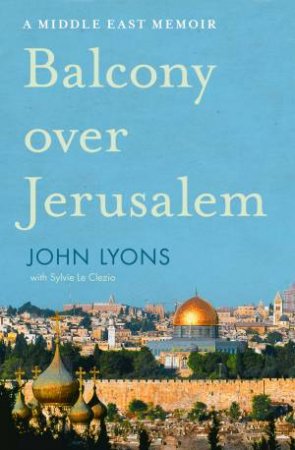
‘Balcony Over Jerusalem’ by John Lyons

2017, 376 p

This book, co-written with his wife Sylvie Le Clezio in 2017 was another amongst the selection of books handed to Australian MPs by a number of prominent local writers. It is a memoir of the six years that Lyons spent based in Jerusalem as Middle East correspondent for the Australian, not a newspaper that I read often. He has worked for most of the media groups in Australia: Murdoch with the Australian, the Sydney Morning Herald and now for the ABC as their Global Affairs Editor. I must say that I will now watch his reports from the Middle East in the wake of October 7 with added interest because, not only does this book deal with the swirling constellation of Middle East politics between 2009 and 2015, but also it highlights the heavy influence of the Israel lobby in Australia in shaping the news for an Australian and Jewish/Australian audience to reflect an even harder line here than in Israel.

The book is named for the large balcony in their apartment that overlooked a vista which encapsulated Palestinian/Israel history: Old City of Jerusalem, modern Jerusalem, the headquarters of the United Nations, and the concrete wall that separates Israel from the occupied West Bank. In front of their balcony was the ‘peace park’, where six days of the week Israelis would place their picnic baskets on the upper parts of the park, and the Palestinians would picnic on the lower parts. Except for Friday evenings, when on the sound of a siren announcing Shabbat, Israelis would leave the park and walk home for their Shabbat dinners. On cue, the Palestinians would appear carrying plates of kebabs and tabouli and move to the higher parts until, on Saturday evening, the Israelis returned, taking up their place on the top of the hill, and the Palestinians would move back down again.

In his opening chapter he declares that

As for my own perspective, I approach reporting of Israel from a ‘pro-journalist’ stance. I’m neither ‘pro-Palestinian’ nor ‘pro-Israel’. My home is in Australia, on the other side of the world. To use an old Australian saying, I don’t have a dog in this fight. (p. 12)

This is not, however, the conclusion that he comes to by the end of the book, which has documented the pervasiveness of Israel control, particularly in the West Bank, and trenchantly criticized the role of Benjamin Netanyahu in particular for making a two-state solution impossible. In spite of Israeli finessing to obscure the fact by withholding and withdrawing Palestinian residency status in the West Bank, the demographic tipping-point between Israelis and Palestinians has been reached: during Lyons’ stay the number of Palestinians in Israel, the West Bank and Gaza equalled (or, depending on your sources, passed) the number of Jews in Israel and the West Bank. As he sees it, in coming years, there will be tragic consequences of this policy.

This tragedy now seems inevitable. Almost 3 million people in the West Bank cannot be denied all civil rights for more than 50 years without dire consequences and almost two million people in Gaza cannot be locked forever in the world’s largest open-air prison. One day many of those five million people will rise up. (p. 357)

As Middle East correspondent generally, his brief extended to countries beyond Israel. He was there to witness the Arab Spring uprisings and subsequent crackdowns in various countries and the political permutations in Iran, Egypt, Libya, Lebanon and Syria. His conclusion was that the Arab Spring failed because the step between dictatorship and democracy was too large, especially without the in-between establishment of independent institutions like police forces and civil services (p.355).

However, his major emphasis is on Israel, and the politics that have shaped the United States response, which flies in the face of world opinion which is gradually hardening against Israel (and, I would suggest, has hardened even further in the last year). He writes honestly and persuasively about the power of the Israeli-lobby group, particularly the AIJAC (Australia/Israel & Jewish Affairs Council) headed by Colin Rubenstein, in pressuring the Australian media and targetting particular journalists (including him) in their reporting. He writes about its influence on politicians, especially through the generous ‘study’ tours that are provided to MPs – several of whom have attended on multiple trips hosted by Melbourne property developer Albert Dadon- which give a one-sided view of the Israeli/Palestinian situation. He particularly focuses on Labor politicians- Rudd, Carr, Gillard- because of the mismatch between party policy, the views of party members, and Government policy- and the way that Israeli policy became caught up in the leadership ructions during the first decade of the 21st century. He highlights the importance of language used in reporting- for example, whether East Jerusalem is described as ‘occupied’ or not and whether ‘occupied’ has a capital ‘O’ or lower case ‘o’; or whether SBS should use the word ‘disputed’ territories.

As might be expected, this book was criticized by politicians and commentators who take a different line to him. But, as he says

…those who’d read my reports over these six years could have been confident that they were reading facts, not propaganda….That, in the end, is what journalists should do: report what’s in front of them. Then it’s over to the politicians and the public to decide what they do with that information. But without facts, they cannot know what they are dealing with (p.356)

Having read this book, and knowing his own personal and professional opinion, casts a different light on his dispassionate, fact-based reporting for the ABC, reporting that saw him named Journalist of the Year at the 2024 Kennedy Awards. On the one hand, it fills me with admiration that he’s even able to report so calmly and authoritatively. On the other hand, though, I’m now aware of the editorial pressure and careful vetting that would have gone into his reports- and no doubt, for this book. It stands the test of eight years well, especially the last 18 months, and is a sobering analysis of not just the ‘facts’ of Israeli/Palestinian conflict day after day, but the political and public relations filter that screens and shapes what we receive as readers and viewers- and our responsibility to question it.

My rating: 8/10

Sourced from: Yarra Plenty Regional Library

Read because: it was one of the 5 books given to MPs, but I have had it on reserve at the library for months previously.

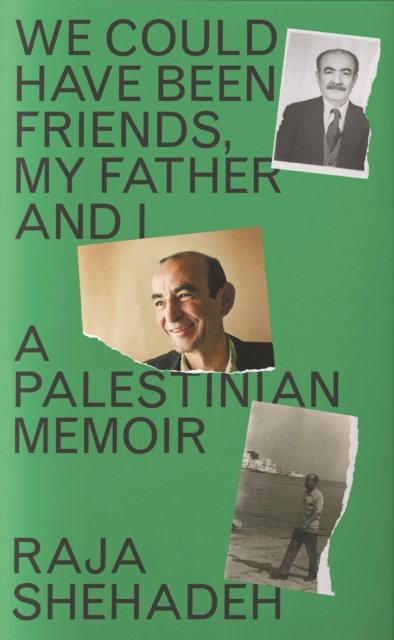
‘We Could Have Been Friends, My Father and I: A Palestinian Memoir’ by Raja Shehadeh

2022, 152 p

As we get older, we approach the ‘senior’ category that covers adults from 60-100, a forty-year age range. It would be unthinkable to conflate, say, a 10 year old and a 50 year old, but somehow after 60 all ‘old people’ are lumped in together. I wouldn’t be the first person, I’d wager, to regret that there were conversations that I didn’t have with my parents as a ‘senior’ myself, and questions that I didn’t ask about their earlier lives..

Palestinian Human rights lawyer and author Raja Shehadeh has even more regrets. When his 73-year-old father was assassinated outside his own home by a disaffected litigant in 1985, Raja was 34 years old and working in his father’s law firm. The murderer was a squatter on land belonging to the Anglican Church, and his father was handling the case for his eviction. The Israeli police closed the case, assuring the family that they were doing everything they could to find the murderer, but they knew who the murderer was and did not want to charge him. (p. 13) After his mother nagged him into going and collecting his father’s papers, Raja ended up with a cabinet of papers, which he stored on the bookshelf. He opened them, and found everything meticulously arranged, but felt overwhelmed by it all. The last case they worked together on involved plans for roads to be constructed throughout the West Bank. His father directed him to the documents he should consult, but showed only moderate enthusiasm for the case, which he left mainly in his son’s hands. Still smarting from this rejection, for many years he viewed the documents as nothing more than “a source of years of hardship and trouble”. (p. 17)

It was only when a friend brought him a photocopy of the Palestinian telephone directory for Jaffa-Tel Aviv dated January 1944, a city to which his father could not return after 1948, that his father’s long history of activism became real to him.

When I began reading, I realised with what impressive clarity my father had set forth his thoughts, and how his pioneering ideas were deliberately distorted by Israel, the Arab states and even some Palestinians. For so long his written attempts at setting the record straight had met with failure. I felt guilty that all these years had passed before I could spare the time to study the files in the cabinet and finally do what I had failed to do during his life: understand and appreciate his life’s work. (p. 17)

This book, then, is the story that was revealed through those documents. It is a history of the years immediately surrounding the Nakba. It illustrates the perfidy of Great Britain and Jordan in the establishment of Israel, the intransigence of the PLO and the whole generational cycle of Palestinian history that existed before the author’s birth. His father and other Palestinians at the time, rejected the creation of UNRWA (which is currently in the news now because Israel wants to outlaw it) because it made the Palestinian cause one of humanitarian response rather than justice.

His father took up the cause of Palestinian savings, which were frozen by the banks leaving Palestinian refugees unable to exchange their Palestinian pounds into pounds sterling or any other Arab currency. In February 1949 the Israeli government ordered that Barclays Bank in Britain and the Ottoman Bank formally transfer all ‘frozen’ Palestinian funds to the Custodian of Absentee Property, which after a while proceeded to liquidate the assets as if they belonged to the State. His father mounted a legal challenge against Barclays Bank at the District Court in Jerusalem, which was part of Jordan at the time. He won.

He decided to run as a candidate in the Jordanian parliament, but found himself arrested instead. He proposed the establishment of a Palestinian state next to Israel along the 1947 partition borders, with its capital in the Arab section of Jerusalem. This put him at odds with the PLO, which wanted a secular democratic state over the whole of Palestine, not a Palestinian state alongside Israel. His father was clear-eyed about Israel’s deceptions over various peace initiatives, and always believed that it was preferable for the Palestinians themselves negotiate with Israel, rather than have Arab states negotiate on their behalf ( as occurred during the Trump-inspired Abraham Accords, and is still occurring over any possible ceasefire in Gaza).

Too late, there was so much that the Raja of today could have discussed with his father, had he lived. It’s revealing that, despite their shared interests and objectives, the emotional tenor of the father/son relationship overpowered their intellectual one. He was intimidated by his father and he resented his dependence on him in the office.

For years I lived as a son whose world was ruled by a fundamentally benevolent father with whom I was temporarily fighting. I was sure that we were moving, always moving, towards the ultimate happy family and that one day we would all live in harmony. When he died before this could happen, I had to wake up from my fantasy, had to face the godlessness of my world and the fact that it is time-bound. There was not enough time for the rebellion and the dream. The rebellion had consumed all the available time. I turned around to ask my stage manager when the second act would start and found that there was none. I was alone. There was no second act and no stage manager. What hadn’t happened in the first act would never happen. Life moves in real time. (p. 12)

The language in this book is a little stilted, but any adult child can feel this same remorse for lost opportunities, and the jolt of being alone on the stage, once one’s parents have died. This book gave me a good sense of the generational injustice that is still being fought out in Gaza and the West Bank today, and the pettiness and duplicity of many of the main actors. Colonialism up-close, and without the patina of centennial celebrations and ‘age-old’ traditions is an ugly, ugly thing.

My rating: 8/10

Sourced from: Yarra Plenty Regional Library

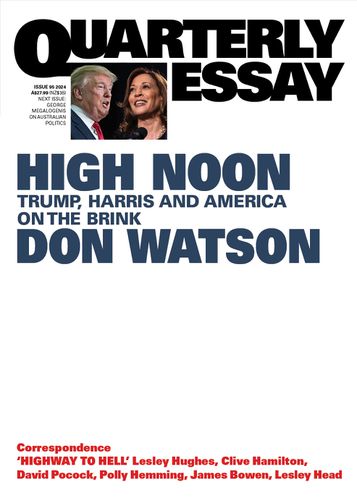
‘Quarterly Essay No. 95: High Noon: Trump, Harris and America on the Brink’ by Don Watson

2024, 90 p

As my son could no doubt tell you, I have a bad habit of leaving journals and magazine unread and wrapped up in their plastic for months…well, years… but with the US election bearing down on us next week, I thought that I’d better read Don Watson’s most recent Quarterly Essay before it was completely out of date.

Don Watson has been writing about America for some time, and he wrote his Quarterly Essay 63 ‘The Enemy Within’ in 2016, deploring the prospect of a Trump victory the first time around. In fact, how ironic that Trump is using the phrase ‘The Enemy Within’ during this campaign to describe the people he will target after becoming president.

In this most recent Quarterly Essay he adopts a similar methodology to the one he used in his earlier essay, and in his book American Journeys where he travels to American cities to talk with voters of both Republican and Democratic persuasions. In Enemy Within he focussed on Wisconsin, and in this most recent iteration he focusses on Detroit and Kalamazoo. The essay is dated 23 August, and the narrative moves as events unfold, including the assassination attempt and Joe Biden’s withdrawal from the candidacy, opening the way for Kamala Harris. Just as in his earlier essay, he has nothing but contempt for Trump, but recognizes that people’s motivations for supporting him have to be at least acknowledged.

Could there possibly be anything left to say about Trump? Probably not, at this stage of the game although events continue to highlight some of the points that he makes in this essay, most of which have been also made by other people. Most particularly, he talks about Trump’s connection with wrestling:

Trump has turned Republican politics, and therefore much of American politics, into the wildly adversarial and addictive world of TV wrestling, an entertainment he used to make money and forge his public persona…TV wrestling involves a lot of boasting, posturing and abusing, as well as body slamming. The wrestlers are real, but not real…. Fans enter the world of TV wrestling as they enter any other fiction, knowing it’s make-believe but open to its seduction. They boo and hiss and shout, much as kids used to at Punch and Judy shows, much as we all do during elections. By making politics like TV wrestling, Trump created a fictional setting for his fictions. He can be as abusive and as untruthful as he likes. In a fictional world, to lie and keep on lying is a requirement…You can sound demented, might even be demented; the more demented you are the more you blend with the environment. (p. 4)

When I saw Trump at Madison Square, with the audience brandishing their signs behind him on cue, it certainly evoked a wrestling match. Not just the presence of Hulk Hogan on stage with him, but also the booing and braying of an audience looking for goodies and baddies and enjoying the ‘show’. Don Watson is not the only person to note the Trump/wrestling connection, but it certainly sprang to mind after reading his essay so recently.

It’s rather discouraging to think that by the time the next Quarterly Essay hits the shelves, with the correspondence responding to this essay, we’ll know the outcome. For better or worse.

Rating: 7/10 (I’ve read it all before….)

Sourced from: own copy from subscription