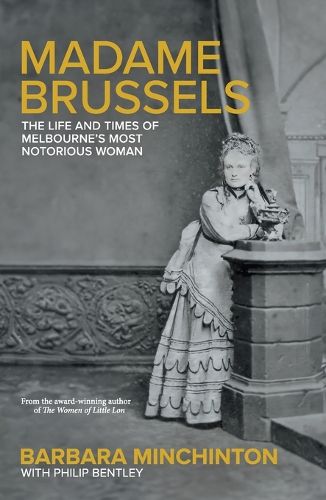
This book is both companion and expansion of Barbara Minchinton’s The Women of Little Lon (my review here) which looked at the sex work industry in nineteenth century Melbourne. Madame Brussels is one of the brothel keepers that Minchin described in the earlier book as part of the ecology and economy of Melbourne’s brothel precinct, but here she deals with Madame Brussels as biography, rather than one name among others.
Madame Brussels is probably the best known of Melbourne’s ‘flash madams’, now immortalized with her own lane and roof-top bar. She was certainly well known in the late 19th century, too, through her political and policing contacts that largely shielded her from prosecution, court appearances and notoriety. Caroline Hodgson nee Lohmar was born in Germany, married in UK and arrived in Melbourne with her husband ‘Stud’ Hodgson in 1871, shortly after her marriage. She rode the exhilaration of the ‘Marvellous Melbourne’ land boom, suffered the 1890s recession, and was increasingly hemmed in by the ever-tightening moral strictures of the early 20th century.
Soon after her arrival in Melbourne her husband left her to work as a policeman ‘up-country’, returning twenty years later in the depth of the 1890s depression in poor health. Left in a strange city as a deserted wife, she opened a boarding house in Lonsdale Street and gradually began accumulating property adjoining her original purchase, later purchasing property in South Melbourne, Middle Park and Beaconsfield Parade in St Kilda. She presided over her brothels, but there is no evidence that she worked as a sex worker herself. Her brothel attracted politicians and magistrates and there were rumours that Alfred Plumpton, then music critic for The Age and composer, was her lover. Although she appeared in court several times, she was always well represented and almost magically the magistrate’s bench filled up with worthy JPs who were not otherwise active in the courts (but may well have been active in her brothel). She remarried after her first husband’s death, but this marriage to fellow-German Jacob Pohl was no more successful than her first, as he soon left her to live in South Africa for several years. After a couple of years’ absence from the brothel scene, she started up again but times and politics had changed.
In the years preceding the turn of the century she became increasingly name-checked by moral reformers, particularly Henry Varley, and became a regular object of scandal in John Norton’s Truth newspaper (which had plenty of the former, and little of the latter, despite the name). In April 1907, after appearing in court charged under new laws with “owing and operating a disorderly house”, she closed her brothel in Lonsdale Street, and died soon after in 1908. Despite an extravagant funeral, she had little to show for the wealth which had passed through her hands.
As might be expected of a notorious entrepreneur, the sources for her life are skewed by real estate transaction documents and court appearances reported breathlessly by the newspapers. There is a genealogical record, although it is patchy: for example, it is not clear whether her ‘adopted’ daughter Irene was actually her own daughter. There are the annual ‘in memoriam’ notices that she placed in the newspapers after her first husband’s death, as was the practice in the early 20th century. But in terms of letters, diaries etc, there is nothing.
In an afterword Phillip Bentley, who is credited as co-author writes:
…we have remained resolute our desire for all conjecture to have a basis in fact and so have resisted the temptation to speculate on how she overcame her early education towards ‘moral earnestness, humility, self-sacrifice and obedience to authority’ in order to become Melbourne’s most famous brothel madam of the nineteenth century (p. 253)
I’m not absolutely convinced that the authors fulfilled this resolution. There are many times that they raise questions which they leave hanging in the absence of evidence, but the questions are raised nonetheless, couched in “may” and “could” statements. The chapter ‘A Curious Gentlemen’s Club’ I found particularly unconvincing, where the question of flagellation is raised, largely on the basis of her first husband’s uncle’s involvement in the ‘Cannibal Club’ and the presence in Melbourne of journalist George Augustus Sala, who was said to have coined the phrase ‘Marvellous Melbourne’ as well as being the anonymous author of flagellation pornography. As the final paragraph of the ten-page chapter says:
In all the records and writings and newspaper reports examined to date there is no suggestion that Caroline’s establishments offered anything other than ordinary common-or-garden variety male-female sex. There are no wild rumours, no snide passing remarks from journalists or parliamentarians under privilege, in fact no hints at all of anything alone the lines of the ‘fladge brothels’ in London. That does not mean it was not happening of course: it means that if it was, we simply can’t see it. (p. 82)
Likewise the chapter where they raise the question of whether her first husband Stud was homosexual raises the question but then admits “There is no way we can know for certain whether Stud was gay” (p.140). I’m not sure that raising questions, identifying parallels and possible networks is sufficiently rigorous, although surely a temptation when writing a life of such notoriety which provided relatively barren and biassed documentary evidence.
This book stands on its own two feet, but I think that I appreciated it more for having previously read The Women of Little Lon, a book which has firmer evidentiary foundations than this one. But I guess that’s part of the challenge of biography: finding the individual person while confronting the dearth of evidence. Even Phillip Bentley admits that perhaps they have not unpacked her personality as much as they would have liked (p. 253), but certainly the authors have succeeded in bringing out the person behind the name now adopted by popular culture with such glee.
My rating: 7.5/10
Sourced from: Review copy from Black Inc.