‘An Australian Son’ by Gordon Matthews

matthews_australianson

1996, 230 p.

There are spoilers in this review

In his short disclaimer about” changed names to protect identity etc.” at the start of this book, Gordon Matthews writes:

This book was an act of catharsis. I wrote it to make peace with myself.

The motivations for writing a memoir are many and varied, and I suspect that ‘catharsis’ is quite a common one. However, I’m not sure that all catharsis needs to be put into print. I closed this book feeling complicit and somewhat sullied, and I wondered why Gordon Matthews published this book.

At one level, I can understand it. Identity, or the search for it, is one of the touchstones of modern life. In Australia,  there is heightened awareness of the Stolen Generations of indigenous children after years of Royal Commissions. In this book, with the small black and white photograph on the back cover of a cheeky, curly-haired boy who certainly looks aboriginal, we think that we are reading the story of an adopted child who learns later in life that he is part of the Stolen Generation. But that’s not what happens (and here’s the spoiler, so look away now!). Adopted by a middle-class white family; teased by his private school ‘friends’ who call him ‘Abo’; conscious always of his difference, he is encouraged by an Aboriginal Liaison Officer to apply for a university scholarship and eventually gains a designated position as Australia’s first indigenous diplomat. Then he finds out the truth: that his father is Sri Lankan, not Aboriginal, and his whole identity falls apart. Although his Aboriginality was not a deliberate hoax, he knows that he cannot continue to claim an indigenous identity that he does not hold.

I was slightly surprised by his telling of how he came to embrace  and be embraced in what he thought was his own Aboriginality.  It seems at one remove from the broader Aboriginal community, seeming to be based mainly within the university and bureaucracy. Is this because he is in Canberra, perhaps? I’m not sure quite when the actions in this book took place, and maybe things have changed. As I understand it, indigenous identity involves both family connections and genetics (rather ironic given how ‘blood’ ratios have historically been used as such a weapon) and acceptance by the community. It is only near the end of the book, when he has admitted that he is not indigenous, that his relationships with the community come into sharper focus.

Secure and happy enough with his adopted parents, it is his search for racial identity in particular that impels his search to find his birth parents. He is curious about them, but not as individuals in their own right, but as the key to his racial understanding of himself. He eventually finds them in America. After giving him up for adoption, they married and went on to have other children. Gordon finds  not only both parents grieving their relinquished first child, but also blood siblings who have been completely unaware of his existence.

The relationship with his birth mother was tense, despite his parents’ joy at finding him and embracing him as part of their family. Contact between him and his family cooled. His birth parents did not want him to publish this book, and it was at this point that I felt I wanted to drop the book from my hands. This was such a fragile relationship, and he was asserting his right over his own story at the risk, I suspect, of alienating and losing this new family that he had found on the way to discovering his racial identity. Pigheaded? Self-sabotaging? Selfish?

The book raises complex questions about identity, race and family. There is a distance in the telling, both at an emotional level and in the slightly stilted language. Whatever he might have been as a diplomat, Matthews is not a ‘natural’ writer.

I can find nothing on the internet about what happened next to Gordon Matthews, or his family.  The silence is a little unnerving. I have no idea how the publication of this book was received by his family at the time, and I wonder if, more than 20 years later, he would say that it was worth it. I guess I will never know.

My rating: 7

Sourced from: Council of Adult Education. It was the June book for my bookgroup.


Article: Artists in Society 1850-1880

I enjoy reading essays and articles and so I’ve decided to briefly review them here. My criteria for selection is that they are available online, either freely or through membership of one of our State Libraries (in my case, the State Library of Victoria). Membership of a State Library is free, and it often gives you access to online journals that you would not otherwise have. Not the most recent edition, admittedly, but free nonetheless.

Caroline Clemente ‘Artists in Society: a Melbourne circle 1850s- 1880s’ Art Bulletin of Victoria, 30,  (2014) freely available online here.

The focus of this article is on three colonial artists whose works can be found in the NGV’s collection of colonial period art: Edward La Trobe Bateman (1815-97), Louisa Anne Meredith (1812-95) and Georgiana McCrae (1804-90). Although the works discussed in this article were all created during the period 1850-1880s, the networks and family/friendship connections between the artists reach back into 1840s Port Phillip.  The Howitt family are the linch-pin here as the centre of cultured Port Phillip society, in their large house at No 1 Collins Street and  at Barragunda, their retreat at Cape Schank. [See a photograph of their Collins Street residence here in 1868, showing the presence of large residences and gardens in what is now the centre of the city.]

At the same time, the links between these artists and their works and the cultural influences in the metropole are clear.  Bateman‘s work featured at the Pre-Raphaelite exhibition held in Melbourne in 2015 and Louisa Anne Meredith’s books and illustrations attracted attention in London as part of the empire’s fascination with the flora and fauna of ‘the colonies’.  Even Georgiana McCrae, whose professional life was largely stifled by her emigration to Port Phillip,  was trained by some of the best masters in England and, thankfully, continued her work within her family circle even though it was deemed unseemly for her to work commercially.

This article takes each of the three artists in turn, highlighting the links between them. As the closing sentence of this essay notes:

This circle of friends and artists thus provides a unique insight and testifies to the breadth and vigour of the cultural life of early Melbourne.


I hear with my little ear: Podcasts 1-8 June

Russia if you’re listening (ABC).  ‘The Night at the Wine Rooms’ is the final episode of the series, this time featuring our very own Dolly Downer . This series seemed to run out of puff a little after the Mueller Report, but the new series sounds good – talking about Russia’s attempts to shape political reality over the last decade, not just the last few years. I’m not sure when it starts again.

Staw_angelofdeathConversations (ABC) Richard Fidler’s interview The ‘Angel of Death’ of Sydney’s Underworld with historian Leigh Straw is a good one. She has specialized in Sydney true-crime in the late 19th-early 20th century, and her most recent book is about  The ‘Angel of Death’ underworld figure Dulcie Markham, whose lovers kept dying.


BBC World – Outlook The Amateur Sleuth and the Lost Babies. Another middle-of-the-night program, this time about amateur historian Catherine Corless who uncovered the truth about the Mothers and Babies home in Tuam, Ireland, where hundreds of children disappeared without trace and where a septic tank in the back yard revealed many human remains. There has since been an enquiry and apology.

In Bed With an Assassin tells the story of Jason P. Howell, a photographer who specialized in conflict zones, who falls in love with a Colombian woman. He gradually realized that she was deeply involved with the paramilitary forces. He has to readjust his moral compass in his response to what he learns about her activities.

99% Invisible The Tunnel is about a tunnel built underneath the Mexican border, connecting the small Mexican town of Agua Prieta and Douglas Arizona on the other side. Sophisticated in its construction, it was used for smuggling drugs and was a prototype for other such tunnels built by the Sinaloa Cartel crossing the border. (Actually, the website link is so informative that you don’t really need to listen to the podcast!)

Movie: Peterloo

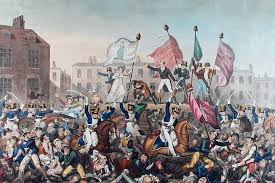
I was rather disappointed in this film. It felt like a clunky, poorly-written stage show, with  buffoonish parodies of the villains. It was a very wordy film, probably because much of the speechifying was taken from the orations at the time and, as one of the characters says, “I don’t know what you’re talking about”.  Many of the working-class characters felt like parodies- as if they were in a Monty Python movie.

However, it wasn’t all bad. The approach towards the protesters was more nuanced, picking up on the differences of political strategy and levels of education, and the tension leading up to the Peterloo massacre was well held. It was odd that there was no explanation of the fall-out from the massacre – perhaps because only 18 died? – and the consequences were political in terms of more repression, which doesn’t fit well into a “what happened next” paragraph?

I think I just expected more from a director of Mike Leigh’s stature.

My rating: 3/5

‘Samuel Pepys: The Unequalled Self’ by Claire Tomalin

Tomalin_Pepys

2002, 380 P plus notes

There are some biographies where you think that there’s no point in anyone else even picking up their pen to write another one. Claire Tomalin’s biography of Samuel Pepys falls into that category.  This isn’t the first time I have read this book, because I read it in 2005- certainly long enough to have forgotten much of the details. That was before I had been to London myself, and before I had started my own academic work in biography. I very much enjoyed it in 2005 and enjoyed it even more fourteen years later.

I think that I first became aware of Samuel Pepys in a school reader, where his eyewitness report of the Great Fire of London was reproduced. I’d always associated him more with the events that he wrote about (the fire, the plague etc) rather than as a person in his own right. But as Claire Tomalin points out, perhaps his most striking and original achievement was to see himself, his actions and his motivations, as a topic in themselves. One of the most opaque things over time and culture is to sense how people saw themselves, especially when such a question was so often overlaid with religious language. In Pepys we have a man holding himself up to his own scrutiny, laughing at himself, and at times writing what he knew could be used against him politically.

Pepys’ diaries covered only nine of his seventy years. It’s not really clear why he started writing them, but it was a very deliberate act when he purchased a notebook and carefully ruled up each page – all 280 of them- and drew 20-30 evenly spaced lines on which to write. He wrote in shorthand, with some proper nouns written in English, and breaking into pidgin Spanish when he wanted to describe some of his (all too frequent) amatory adventures.

Although Pepys’ diaries of course provide the richest source for Tomalin’s work (and indeed, the work of any Pepys scholar), this biography devotes about 1/3 of its length to the 1660-1669 period of the diaries. The other 2/3 deals with his life before beginning the diaries, and then after the diaries. This seems a judicious weighting, and one which placed the journals, important though they are, into the context of his whole life.

The book starts with a lengthy list of ‘who’s who’ which I found myself turning to frequently. As Tomalin highlights, when Pepys was starting out on his career, contacts were everything in making it possible for this son of a tailor to end up as a high-level civil servant and Member of Parliament. Even though I’m not in the habit of taking my history from Academy Award winning films, the recent film The Favourite exemplified the trails of patronage that could bring distant cousins into orbits far beyond their expectations.

What struck me particularly on this second reading, and particularly in days when watching the so-far unsuccessful attempts at political change in Venezuela, is just how dangerous it is when a country undertakes a huge political change. I’m not talking about elections, which in our case are just variations on the same, but the big political about-faces. Pepys experienced a number of such changes, at an uncomfortably close quarter to royal power, but without the means or patronage to have any influence at all on events. He saw the execution of Charles I; he supported Oliver Cromwell when he was a young man; he managed to switch to Charles II in time; he escaped suspicion (just) after the Popish plots; and he acquiesced when William took the throne. The people he aligned himself with survived, and so he did too.

Although the book is largely chronologically arranged into 3 parts (Part I pre-diaries; Part II 1660-1669 diary entries; Part III 1670-1703), its chapters are thematic as well e.g. work, marriage, science. She does not cite at length from the journals themselves, choosing to comment on them instead of reproducing them.

At times Pepys seems like us: at other times, not. His infidelities and what now reads like rank sexual harassment are uncomfortable reading; his domestic violence to his wife and servants is not endearing. But I found myself laughing when his enraged wife threatened his manhood with red-hot fire tools when she found out about his affair with the maid, and his own awareness of his hypocrisy, failings and weakness keeps him human.  Tomalin has given us a fully rounded man, and I just can’t imagine anyone else doing it better.

By the way, the first time I read this book, I was fascinated by the Pepys Diary page, which is still going. Each day an entry from the diaries is posted in full and people, who have a wealth of information about Pepys and London, annotate the entries.  Another site which I’ve enjoyed, although it’s aimed at children is an interactive site  fireoflondon.org.uk

My rating: 9.5/10  This is biography at its best

Sourced from: CAE bookgroups.

I hear with my little ear: Podcasts 26-31 May 2019

Background Briefing: The sexual abuse scandal nobody’s talking about.  Putting someone you love into aged care is such a hard thing for everyone. The current commission into aged care and this Background Briefing program must make it even harder. The sexual abuse in this program is not from other patients but from the ‘carers’ in a system where providers seem to have all the clout. Carers are not registered, and there’s no mandatory reporting. What a terrifying situation to be in for people in aged care who realize what is happening.

eustace_hamilton_miles

Eustace Hamilton Miles Source: Wikimedia

Arts and Ideas (BBC) Healthy Eating Edwardian Style. This program tells the story of Eustace Hamilton Miles, an Olympian  real tennis player (yes, real [royal] tennis was an Olympic sport in 1908 only) who promoted many different fad diets over his career. He started a vegetarian restaurant in Charing Cross, (even though he eschewed the term ‘vegetarian’), which became notorious for its links with the suffragettes, who regularly ate their. Although his restaurants and health food stores prospered during WWI, his ideas went out of fashion and he died leaving only 175 pounds. His ideas were at their most popular in the first two decades of the 20th century, a time when sleeping in the fresh air on a verandah was very popular.

New Books in History  This is pretty hard-core history which assumes that one is on top of all the historiographical debates that surround the book being featured. In this case, it was Jeremy Black’s The World at War 1914-1945.  My word, what a productive historian Jeremy Black is, with 100 titles to his name – five in 2019 so far: no wonder he’s known as “the most prolific historical scholar of our age”. Anyway, he snipes at other historians, refutes the idea that the first and second world wars replicated each other, and argues that the Germans started it. This episode, steeped in military history, is very bloke-y and combative and this article, from the centre-right Standpoint magazine, tells more about this historian I’d never heard of.  This is not entertainment-light by any means, and I think you’d have to be interested in military and world history to really enjoy this.

Conversations (ABC)  Felafel and Fatherhood a rather lacklustre conversation with John Birmingham  who wrote He Died with a Felafel in his Hand (which I’ve never read) and has recently released On Father, one of those small ‘On…’ books. Not one of the better interviews.

Movie: Destroyer

Counting up on Wikipedia, Nicole Kidman’s filmography comes out at more than 60 movies.  She can be forgiven, then, for the occasional dud. But Destroyer isn’t a dud, and she is brilliant. Told in present day, where Kidman plays haggard, dysfunctional cop Erin Bell, the film flashes back where she plays that same cop some 30 years earlier, operating undercover in a gang that holds up a bank with tragic consequences.  There’s a fair bit of violence in the film, both in the present day and flashback sequences, and rather too much of ‘old’ Kidman staring impassively at the camera. The makeup is excellent, as ‘young’ Kidman doesn’t look all that different to how she looked 30 years ago in her early films.  Certainly, there’s little of the cool sophistication of many of the characters she tends to play now.

My rating: 4 stars

‘The Glad Shout’ by Alice Robinson

The-Glad-Shout-Alice-Robinson

2019, 310 p

This book opens right in the middle of the action, with Isobel clutching onto the arm of her husband Shaun, with her daughter Matilda clamped to her hip. They are in what reads like the MCG in Melbourne, which has been turned into an emergency evacuation centre after Melbourne has been lashed by a destructive storm. Set in a near future, encroaching sea levels have poisoned bayside gardens and lap the boulevards along the bay, and with storm damage making places uninsurable, the suburbs have become increasingly derelict and dangerous.  We have seen flashes of this in our news already: the Louisiana Superdome stadium after Hurricane Katrina, the huge waves crashing onto the Malecon in Havana Cuba, people sitting on their roofs in Queensland floods, awaiting rescue. In The Glad Shout, Robinson sets her story after the consequences of climate change have come crashing, literally, into Melbourne. Tasmania, which has heeded the perils of climate change, is still safe; Western Australia has finally seceded, and the other states are closing their borders against the climate refugees who want to join family members interstate and escape this climate nightmare.

The book has two narratives, told in alternating chapters. The present-day chapters, written in the present tense, have Isobel having to fend for herself in the stadium and finally making the decision to leave, putting her own life and that of her daughter into the hands of people-smugglers. We’ve seen this scenario too: people crammed onto dinghies with insufficient food and water, the lifejackets and the oil slick of dysfunctional engines.

The other narrative is flashback to Isobel’s tense relationship with her mother Luna, her sometimes ambivalent love for her husband Shaun, her guilt over her own mothering of Matilda. Her mother Luna, who had purchased the house that was swamped by floodwaters, was a real-estate agent and property investor. She placed great store on possessions and wealth, and she grieved intensely when Isobel’s brother, Josh, left home. Much of the flashback sections is involved with the nuances and Isobel’s sense of grievance over the people who surround her, and her conflicted relationship with motherhood, both as daughter and mother herself.

There’s always a risk in having double narratives running through a novel. Too often, as in this case, one is more compelling than the other, and so the reader feels a sense of impatience at having to wade through this section before reaching the next. I tired of the flashbacks, which bordered on the banal, and rather implausibly, they increasingly found their way into the present-day-disaster section as well. I suspect that the author herself has young children, and perhaps its my middle-agedness that makes me impatient of her obsession with her birth-experience with Matilda: something that is only a small part of the relationship between mother and child, in the long run. I wouldn’t presume to know what those exhausted, bedraggled mothers we see on television stumbling ashore from refugee boats had been thinking on the journey. But I suspect that they haven’t been mentally rehashing the slights and annoyances of their relationship with their mother, or castigating themselves for their ambivalence over their own motherhood.

On the other hand, I liked her celebration of  women’s strength in an emergency. I liked the politics of climate change and refugee policy being brought into the personal realm, and her exploration of the instincts of maternity, survival and communality in the midst of disaster.  I think that these will be the things that I take away from the novel, and that will keep it memorable. I just wish that there had been less of the emotional angst over relationships and human frailty.

My rating: 8/10

Sourced from: Yarra Plenty Regional Library.

AWW2019I have included this on the Australian Women Writers Challenge database


I hear with my little ear: Podcasts 16-25 May 2019

sausagesizzle

Bunnins Sausage Sizzle Wikimedia

History Listen. We’ve just had an election here in Australia, and just about the only commentary that I can bear to listen to at the moment is the History Listen’s ‘Unauthorized history of the sausage sizzle.’ More than just the democracy sausage, it includes Lions and Bunnings sausage sizzles and a brief history of the humble snag.


Somewhat more serious is their episode ‘Escape from Iran‘ where the narrator tells her mother’s story of escaping from Iran after the revolution on account of her Baha’i faith, and the family’s life in Australia.

Grenfell_Tower_fire

Grenfell Tower Fire Source: Wikimedia

The Documentary (BBC) This is a wonderful trove of podcasts! Flat 113 at Grenfell Tower is a wonderful (if rather distressing) piece of story telling about the fire that engulfed the 14th floor of the Grenfell Tower building in London. Taking just one floor (and yes, I know that Flat 113 was on the 14th floor, even though the numbering suggests otherwise- just a symptom of the questionable renovation of this public housing), the podcast traces through the sequence of events and mis-steps that led to several deaths in Flat 113.

Order!Order! is a look back at the Brexit question. Somehow 31 October is drawing closer again and still the whole sorry saga goes on.

Bolivia’s Mennonites, Justice and Renewal tells the story of the extremely conservative Mennonite communities who have established themselves in Bolivia since the 1920s. Almost Amish in appearance, they speak a form of low German, and they eschew modernity (although, as the documentary points out, there are now break-away communities which take a more liberal and modern approach).  In 2009 more than 100 women and children reported rapes within the community, for which a group of men were convicted, but within the traditional Mennonite groups there are attempts to have the sentences overturned.

Slavery’s Untold Story. Did you know that the Cherokees held slaves? After the Civil War, these slaves were liberated as ‘freemen’, but in recent years as people of Cherokee origin are encouraged to reconnect with their culture, a document from the 1860s is crucial in establishing claims to be admitted as full members of the Cherokee tribe. The waters are muddied by the casino money and entitlements that attach to Cherokee identity, and prejudices against African American appearance amongst people who also hold Cherokee heritage.

99% Invisible. From the 1950s up until the collapse of Communism, Russian theatre-goers were exposed to a steady diet of Bollywood movies. Part of it was that the Russian government wanted an alternative to Hollywood, but this documentary suggests that there might have been cultural affinities between Russia and India as well.  From Bombay with Love is well produced and interesting.

New Books in History  The podcasts here are very low-tech, and involve a historian talking about their recently released book. In Reforming Sodom: Protestants and Gay Rights, Heather R. White looks at both the liberal, reforming Christianity in the UK and US of the 1970s onwards (think: Unitarian Universalism and ‘Love Finds a Way’; the churches’ response to Stonewall etc) , and conservative Pentecostal Christianity of more recent decades (think Israel Folau), and their differing responses to homosexuality.


‘ Lost Children Archive’ by Valeria Luiselli

Lost+Children+Archive

2019, 400 p.

Hailed as “a vital work for the Trump era”, Lost Children Archive is a thinly-veiled fictionalization of Valeria Luiselli’s non-fiction essay Tell Me How It Ends. In both her essay and this novel, there is a road-trip across the states of America: a genre familiar to Australian readers through American film and television and explored in our own films (think Mad Max, Priscilla Queen of the Desert) and literature (think perhaps Rabbit Proof Fence, and most recently Carrie Tiffany’s Exploded View). Both Luiselli’s essay and the novel are concerned with the fate of unaccompanied children crossing the Mexican border into America, an issue thrown into the author’s own personal spotlight after volunteering to act as an interpreter for young Central American migrants seeking entry to the U.S. and writ large by Trump’s mantra of Building the Wall.  The essay Tell Me How It Ends was named for her daughter’s pleading to know how the story of these unaccompanied children ends, and already the crossover between the fictional and nonfictional works is blurred. It combines the personal and the political, and among other things, is about story-telling and story tellers.

The Lost Children Archive has resonances of W. E. Sebald’s work, with its integration of photographs and documents. The narrative is structured as an archive in itself. The book is divided into four parts. Its chapters reflect seven archive boxes that stowed in the boot of a car that is carrying an unnamed woman and her husband, and their two children, across the southern border of the US. The two children are not related by blood, each coming from their parent’s previous relationship, but they are considered “our” children and despite (and perhaps because of?) the difference of five years in their ages (10 and 5) they are very close. Sitting in the back seat of the car, day after day, the older boy in particular is aware of the tension between his father and his step-sister’s mother. They had met during a project to document the soundscapes of New York, he as a sound engineer and she as a journalist/producer, or as they distinguish it, one a documentarian, the other a documentarist.  The father wants to embark on a project capturing the lost sounds of the removal of Geronimo and the Apaches, while the mother has been drawn into looking for two little girls sent across the border with only a phone-number written onto the collar of their dresses. The son is aware, without being told, that this will be their last trip together as a family and he and his stepsister decide to run away and become like the lost children that Mama is so driven to find.

The first half of the book is narrated by the mother, and it comes as a surprise to have the narration taken over by her son half way through, and to revisit events and conversations from his perspective. Each section starts with an inventory of one of the boxes, listing  the books and articles, maps and CDs that have been gathered together, and the book itself ends with a series of Polaroid photographs that have – supposedly?- been taken on the trip.

This is a very clever, self-aware book that echoes influences as diverse as Virginia Woolf, Cormac McCarthy’s The Road,  Golding’s Lord of the Flies, and David Bowie’ Space Oddity. There is a long, twenty-page sentence near the end of the book that echoes Molly Bloom in Ulysses. A type of bibliography at the end references the resonances in the book, not direct quotations, many of which are translations of translations. Such reflexivity could be clunky and derivative in clumsier hands, but it’s not: it’s confident and deliberate, and a book of the heart and head.  All of my mental contortions that I’ve had  about a narrator inserting herself into the text dissolve here, with her very clear sense of what she is doing as a creator in a piece of autofiction , as distinct from memoir. As soon as I started reading it, I knew that I was in the hands of a very talented, intelligent writer. It’s been ages since I enjoyed a book as much.

My rating: 10/10

Sourced from: Yarra Plenty Regional Library