Movie: Red Joan

Usually I rail and rant when a film ostensibly ‘based on a true story’ makes changes, but I didn’t feel this way with this film. ‘Red Joan’ is based on the true story of Melita Norwood, who used her position as secretary at the innocuous-sounding Non-Ferrous Metals Research Association to pass nuclear secrets to Russia. The film has shifted the action to Cambridge University, and made ‘Joan’ a brilliant student, rather than a secretary. But in this case, I didn’t mind. It’s usually the most dramatic scene of the film that prompts the most egregious truestory-to-film changes, and in this case it’s the scene of an elderly woman giving a press conference in her garden. There was a fidelity both to this event and the impetus behind it, so if the producers decided to go for Cambridge scenery and a bit of a feminist nudge, that’s okay with me.  Judy Dench doesn’t appear much in the film, which is a series of present day/ flashback sequences, and really the film belongs more to Sophie Cookson, who plays the young Joan. The two actresses are well cast because it didn’t strain credulity to believe that they were playing the same character.

My rating: 4 stars.


I hear with my little ear: Podcasts 1-7 July 2019

Who Runs This Place? (ABC) Another very good episode –the States– this time looking at the states of Australia and the power networks that operate in that state. Think NSW- pokies, Alan Jones and Peter V’Landys and the racing industry; think Tasmania – Federal Hotels (pokies); think Western Australia- mining; think Victoria AFL etc.  I feel like having a good hot shower to wash off the grunge.

Earshot (ABC) With the one year anniversary of Ireland’s referendum result that overturned the constitutional ban on abortion, ‘A Sense of Quietness‘ looks at four women who spoke out – a journalist, a radio producer, the founder of a woman’s clinic, and a woman travelling from Ireland to the UK –  and the consequences of their stance. Very sobering.

Karl_Marx_001

The man himself: Karl Marx (Source: Wikipedia)

Revolutions Podcast. We’re heading towards the Russian Revolution, but Mike Duncan is taking pains to really lay the foundations of Marxism first, and these podcasts are excellent.  Episode 2 The Adventures of Karl Marx and Friedrich Engels is just what the title says- a biographical sketch of the different lives of these two men, drawn together by ideas.  In Episode 3, The Three Pillars of Marxism, (i.e. classical German philosophy, classical English political economy, and French socialism and revolutionary theory) he explains really clearly the Labour Theory of Value. Excellent.

Conversations (ABC) In Australia’s Romani Gypsies, the ever-interesting Richard Fidler interviews Mandy Sayer who wrote   Australian Gypsies: Their Secret History. It sure is secret- I had very little awareness of the Romani community in Australia. The interview was first broadcast in September 2017.

Duolingo Podcasts  These are just the right level for me, and I can understand them without the transcript, which is very conveniently placed on the Duolingo website. This episode El Regalo (the Gift) is about a young Colombian boy who accompanies his parents on a bus trip to the coast to share Christmas with the extended family. But when three young men board the bus, there is trouble as they steal all the possessions of the passengers.  The transcript has enough English for you to follow along, even if you don’t speak Spanish

‘On Identity’ by Stan Grant

grant_on_identity

2019, 95 p.

This essay is published as one of Melbourne University Press’ Little Books on Big Ideas  series. The essays, all of which are titled with “On….” have stellar authors, sometimes writing in their areas of expertise (e.g. former Race Discrimination Commissioner Tim Soutphommasane ‘On Hate’ or Germaine Greer ‘On Rape), sometimes not (e.g. David Malouf ‘On Experience’, Anne Summers ‘On Luck’).

Stan Grant, journalist and commentator, has dealt with the themes on this ‘On Identity’ essay through his other recent publications as well with Talking to My Country in 2016 and Australia Day in 2019. The biographical outline at the start of the book (which I assume he approved) describes him as a “self-identified Indigenous Australian who counts himself among the Wiradjuri, Kamilaroi, Dharrawal and Irish.”

In this book, Grant pushes back against being asked to tick the box which appears on so many forms asking ‘Are you Aboriginal or Torres Strait Islander?” By ticking the box, he writes, he is forced to deny the other parts of his identity- most particularly his white grandmother who was exposed to the virulence of the racism of the 1940s when she married his indigenous grandfather.

It is so simple I can say it in plain English and in one sentence: I will not be anything that does not include my grandmother. I don’t wish to be anything that sets me apart from my wife, or any of my ancestors, long lost to history, but whose blood still flows somewhere in me.  I will not put a mark in a box that someone has decided contains me. That box shrinks the endless mystery and possibility of the universe. I will always choose the side of love. (p.83)

As he points out, the question ‘Are you Aboriginal or Torres Strait Islander’ is one that the nation pushes back onto the individual (p. 16).  John McCorquodale, the legal historian counted sixty-seven definitions, and Grant cites a series of statements from the High Court of Australia in the 1980s and 1990s that tried to definite Indigenous identity. He writes of the author Kim Scott, whose book Kayang and Me traced his own search for Noongar identity.  While claiming to be captivated by Scott’s work, Grant admits that he reads him now “with both eyes open and I realize that we are worlds apart” (p. 40)  Grant writes he has been long troubled about identity:

…how easily it morphs into tyranny. Scott is being asked if he is black or white, he can’t be both…It comes with the same assumptions of power: we will tell you who you are and whether you belong; we will determine your identity; you will answer to us. (p 26)

Instead, he claims love and freedom- something that he doesn’t find in Scott’s work.

This is a very poetic book, woven through with allusions to various writers and philosophers – none of whom are cited directly or referenced, so you just have to take his word for it. There is certainly the resonance of The Preacher in his writing, which I find rather off-putting.  Paradoxically, I read this book because I was preparing a talk to my Unitarian-Universalist fellowship on the theme of ‘identity’, a topic that I’m even more confused about now than when I started.  The book reads out loud beautifully (particularly for a spiritually-inclined gathering), but then I found myself wondering “but what does that actually mean?”

None of us likes to be defined by one thing only, and we are all aware of our own complexity and contradictions. Perhaps identity, and its attractions at various stages of the life cycle, is a malleable thing that is useful in different senses at different times. It has a personal meaning, but at certain junctures its political and historical uses are more pertinent.  Sometimes identity has a ‘conversion’ aspect, as when someone ‘comes out’, ‘comes to Jesus’  or discovers an indigenous heritage of which they had been previously unaware.  At such times, it is understandable that one aspect of identity overshadows the rest. Moreover, often the simplistic tick-the-box questions of indigenous identity or having a disability have funding and political implications that have been hard won.

As you can possibly tell, I found myself confused by knowing what to do with this book. Janna Thompson in ‘The Identity Trap’, at Inside Story, has done a much better job than I could ever do of grappling with this small, slippery volume.

My rating: 7/10 ?

Sourced from: Purchased at Readings.


I hear with my little ear: Podcasts 25-30 June 2019

The Minefield (ABC). This episode was recorded in the wake of the AFP’s raid on a NewsCorp journalist and the ABC’s offices. The preceding week the presenters discussed the raids, but in this excellent episode “What if the greatest threat to a free media was from within?” they discuss instead the avalanche of the trivial, which allows important questions to hide in plain sight. I’ve found myself thinking about this episode a lot.

Root of Evil Episode 1 Saved by the Ghetto. This is a true crime series about the Hodel Family and their connection with the 1947 murder of Elizabeth Short, known posthumously as ‘The Black Dahlia’. Do I really want to listen to another series about a dysfunctional American family? I’m not sure that I do.

Revolutions Podcast. We’re off and running again- this time with the Russian Revolution. But before Mike Duncan gets to Russia, he’s taking the scenic journey but starting off with Karl Marx and the International Working Men’s Association.

Onate

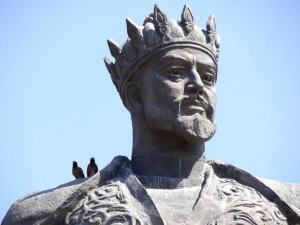
Onate’s statue. Source: Wikimedia/Flickr Mario 1952

99% Invisible. This is a really good episode! I’ve had Onate’s Foot on my phone for ages, and I finally got round to listening to it, and then wished I’d done so earlier.  In 1998 an envelope landed on a journalist’s desk containing a photo of a bronze foot sawn off a statue in New Mexico. The statue was of the Spanish conquistador Onate, whose 400th anniversary was coming up, a matter of great pride to the Hispanic community, especially in the face of discrimination by the European community  (I’m worried that I’m using the wrong terminology here, and if I am, I’m sorry.) But Onate’s arrival had had more sinister ramifications for a group of New Mexico’s native people four hundred years back when he ordered all men to have one foot cut off – hence the envelope. What ensued when planning a new statue was another battle- this time about statues and commemoration. The webpage gives the gist of the podcast- but why not just listen to the podcast?

Saturday Extra (ABC) Geraldine Doogue is away at the moment, so Saturday Extra is in the very capable hands of Hamish Madonald. In Boris, Brexit and the British ruling class, Simon Kuper, a columnist with the Financial Times draws links between the major British politicians (on both Tory and Labour sides) who attended Oxford University, and the varying influence of History and PPE degrees on  their later careers. Absolutely fascinating.

And on the same program, Is immigration a form of reparation? is a challenging listen. And while you’re there, you may as well learn a lobby group who are not as quiet as they used to be, after Scott Morrison’s victory, in Who is the Australian Christian Lobby?

‘Estates: An Intimate History’ by Lynsey Hanley

hanley_estates

2007 1st edition; revised edition 2017, 247 p.

It seems that somehow every British police drama you watch ends up in a council estate. To antipodean eyes, they look terrible places: bleak, cold-looking and bare against a leaden sky. Growing up in a country that provides little state-owned housing – and then, generally only for the poorest – it seems strange that local governments in Britain would have (or more correctly, used to have) such large holdings of housing, and  that it had such popular, cross-class support. Interwar housing  did not have the stigma that we attach to it here in Australia, and the Blitz gave state-owned housing added emphasis. But by the second half of the twentieth century, all that had changed in Britain too, and this is the story that Lynsey Hanley tells from her own personal experience.

She grew up in Chelmsley Wood, an overflow scheme built in the mid-1960s in what had been woodland and farmland in Birmingham’s greenbelt,  when post-war demand for housing soared. It combined low-rise housing with tower blocks, in an estate largely isolated from the city centre. You can see a gallery of pictures of Chelmsley Wood in the 60s, 70s and 80s here. By this time, living in a council housing estate meant that children grew up with a “wall in the head” that separated them out from the aspirations and experiences of children living in the central city, and as a bright girl from the estate, she had to consciously work at scaling that mental wall to fit in with her university friends.

But it hadn’t always been that way. Between the two World Wars, there was a concerted effort to clear the privately-owned slums from British cities, and “…to be given a council house in the 1930s, was in many ways, comparable to winning the lottery.” (p.65) Influenced by the Garden City movement, council housing was protected by what was known as the Tudor Walters standards, which mandated minimum room sizes, the number of windows and density.

It is hard to overstate the importance of the Tudor Walters standards: backed by the state, they expressed a commitment to building mass council housing of the highest quality. They did not extend to the two million private homes built by speculative builders between the wars, meaning that council houses built around this time were likely to be larger and of a higher quality than many of the suburban homes you could buy (p. 66)

Aneurin (‘Nye’) Bevan, of the British Labour Party, was most famous as Minister for Health, who introduced the NHS. But he was also responsible for housing policy, and he insisted on good quality public housing. Even the Conservatives, when they defeated Labour in 1951  continued, and indeed increased, the construction progress that Bevan had instituted. But the emphasis on quality was sidelined, and private building was encouraged.

And even though council housing tenants were insistent that they did not want to live in high-rise flats, that’s exactly what they received, with the building industry pressuring the government to adopt pre-fab high-rise designs citing a shortage of tradespeople (who, ironically were the very workers sidelined by the emphasis on factory-created prefabs). Corners were cut, leading to the actual collapse of a high-rise at Ronan Point in 1968, just two months after it was opened, due to construction faults. (The television series ‘Endeavour’ worked this into one of their plot lines recently).

Ronan_Point_collapse_closeup

Ronan Point Collapse  1968 Photo: Derek Voller Creative Commons Wikipedia

Council housing was further decimated by Thatcher’s ‘Right to Buy’ scheme, where tenants were encouraged to buy their house, but councils were not allowed to replace the now-purchased housing with new rental stock. As a result, the existing estates became increasingly run-down, and like Australian public housing, became stigmatized as ‘social’ housing for people unable to be housed elsewhere.

Like much non-fiction at the moment, this book combines the political and the personal. The notes in the back, more in the form of further reading than footnotes, show that the author has read widely, rather than academically. It is also interwoven with the author’s own story, but not just as memoir but also from a present perspective. At the time of writing the book, she was living again in what had been an estate, in a house she had purchased as part of the ownership push. But under the Housing Choice program,  being rolled out across the country, there were plans (with which she concurred) to demolish her house and redevelop the estate.  Her afterword, written in 2017 and ten years after the book’s first publication saw a decline in the number of home owners, an increase in homelessness and a sustained attack on  the housing security of non-owners. Her afterword was written too soon for the Grenfell Tower fire.

I enjoyed this book, particularly the first 3/4 which took a more historical approach. I liked the way that she drew on her own experience, and interwove the personal and political. I admit that the present-day politics of the last chapters of the book largely went over my head, but I could find parallels with our own government’s drive for public/private development of former housing estates which somehow always seems to be short-changing the public system. I wish that there was some way of recapturing the idea that public housing was not a stigma, but a right, and part of being in a good society.

My rating: 8/10

Sourced from: purchased

Movie: The Heiresses (Las Herederas)

Chela and Chiquita are a lesbian couple who have lived for decades in Chela’s crumbling family home. When Chiquita is sent to jail for fraud, Chela continues living in the home, selling off furniture and paintings, and gradually carving out her own life without the enveloping presence of Chiquita, who is far more gregarious and assertive. Set in Paraguay and spoken in Spanish with English subtitles, it’s a good exploration of power within a relationship, and the slow flowering of independence and identity in middle age.

My rating: 4/5 stars.


I hear with my little ear: Podcasts 17-24 June 2019

Who Runs This Place (ABC) I’m enjoying this series. This time, Richard Aedy looks at The Lobbyists, those groups who use contacts in government and the lobbying miasma that surround it, in order to get what they want. Of all of the flaws of our democracy, it’s the power of lobby groups that disconcerts me the most.

The History Listen (ABC) Two programs this week. The first, The War We Forgot was really good. It examines the loss of Australian civilian life in Rabaul in 1942. I knew that New Guinea was an Australian protectorate after WWI, but I hadn’t realized how ‘Australian’ in was, in a very colonial sense. For example, did you know that people living in Rabaul were listed in the Queensland telephone directory? The mental image of an eleven year old boy holding the hands of his parents as he was shot as a spy by the Japanese stays with me. Well worth listening to.

But I was less enamoured of The surprising story of Wong Shee Ping. He lived in Australia after the gold rush and wrote the first Chinese-Australian novel, which gives a sympathetic insight into the predicament of Chinese women in traditional family structures. However, the author’s life seemed to fly completely in the face of his enlightened attitudes. A bit too Who-Do-You-Think-You-Are- ish for me.

‘Elizabeth Macarthur: A Life at the Edge of the World’ by Michelle Scott Tucker

elizabeth-macarthur

2018, 339 p.

I am old enough to remember when Australia’s wool trade was a source of national pride. Primary school children would send off to the Wool Board (or whatever it was called at the time) to receive a project pack that included samples of wool at different stages of processing: straight off the sheep’s back, washed, combed, and carded, right through to a piece of woven material, all in a big envelope. John Macarthur was on our $2.00 notes, with a whopping great merino beside him, with William Farrer on the other side with his wheat, symbols of the importance of the pastoral industry and agriculture to Australia’s history and economy.

But it was all very male-dominated. I first heard of Elizabeth Macarthur when I visited Elizabeth Farm in Parramatta about twenty years ago. It struck me then, listening to the guide, that much of the glory that attached to John Macarthur more rightly should be shared with her, given that he spent so many years overseas. In this book Michelle Scott Tucker brings Elizabeth Macarthur to centre stage as businesswoman, wife and mother, dealing with a difficult and eventually mentally ill husband.

The book opens with a premature childbirth at sea on a convicts’ ship, where Elizabeth Macarthur, a gentleman’s daughter, is the only woman on board.  She, her husband John  and her infant son were sailing as part of the Second Fleet to Sydney Cove where he would take up his position as a commissioned officer in the New South Wales Corps.  As was common right up to the 20th century, Elizabeth kept a ship board journal, and Tucker contextualizes this journal well in explaining what shipboard life was like in the Second Fleet, and the social distinctions and rigidities within the hierarchy of the passengers. There were tensions, slights and confrontations and even here we see John Macarthur’s hair-trigger sense of honour which was to blight and shape the social life of his family within the colony.

I must confess that even though I’ve read about the early days in Sydney Cove, I didn’t realize the significance of the navy/army distinction as the basis of much of the dissatisfaction at the elite level within the colony (and come to think of it, probably in the other colonies I have read about as well).  Macarthur quickly moved into the centre of the social life of ‘good society’ and was deeply implicated in the Rum Rebellion against (Navy) Governor Bligh led by the (Army) New South Wales Corps. Macarthur’s involvement in local politics at a time when official power was exercised through the Colonial Office meant that he spent many years overseas, clearing his name and honour, and then in a sort of political exile that in effect split the family. As was common at the time, young boys were sent ‘home’ for their education, and for many years Elizabeth kept the properties going, soothed the local politics as much as she could and built up the family enterprise on this ‘edge of the world’, while her husband and a number of sons did the same back in England. When a son went off ‘home’ as a seven year old schoolboy, sometimes he never returned to Australia. Instead, opportunities brought about through extended family connections and marriages kept him back in the’ old country’.

Colonial histories in the past, tended to focus on the world of men. In recent years there has been more attention on the networks of influence, opinion and behavioural constraints that operated in colonial societies. While John Macarthur had his own political involvements, so too did Elizabeth Macarthur within the women’s networks of early Sydney. His behaviour directly impacted on her own friendships and status, and Tucker describes this well.  Although aimed at a popular, as distinct from academic audience, the bibliography at the back of the book shows that she has read widely on early Sydney, although I’m surprised that she doesn’t reference Kirsten McKenzie’s Scandal in the Colonies which would have fitted in so well here.

The family correspondence has been kept, and it is through this lens that Tucker shapes her reading of Elizabeth Macarthur. Family correspondence has its limitations, of course, and these were exacerbated by distance and slow communications.  For letters to  friends, who had never -and would never- see Australia, there is an ‘other-worldliness’ to her situation. In letters to her sons, who did not need to have things explained, the maternal relationship still held. In letters to and from her husband John, beyond reporting events and business, the politics of their relationship was interwoven with the family mores of the time.

In several places, Tucker notes that Elizabeth Macarthur has not commented on particular events or people. This is always frustrating, perplexing and yet these silences often reflect something of the personality and times of the writer. Sometimes Tucker surmises “she must have….” which I found myself resisting. One of the questions of biography,  is how much we can claim a common worldview at the emotional level with people of the past, especially in the light of recent work in this field.

In this regard, the book reminded me of another biography of a ‘colonial wife’: that of Anna Murray Powell, wife of the Chief Justice in Upper Canada in the 1820s in Katherine McKenna’s A Life of Propriety: Anna Murray Powell and her family 1755-1849 (my review here).  A more academic text than this one, McKenna uses the family correspondence of the Powell family to examine how as matriarch and wife, Anna Murray Powell grappled with a young daughter whose very public and unseemly infatuation with the future attorney-general was the talk of the community.  As with Elizabeth Macarthur, there are silences and omissions about the things we are most curious about as 21st century readers, particularly when dealing with a socially unacceptable situation – for Anna Powell, the behaviour of her daughter, and for Elizabeth Macarthur, her husband’s mental illness.

Elizabeth Macarthur was a mother, with her love stretched between ‘home’ and this new life very much on the edge of the world. She was a wife, displaying affection, but also exasperation and diffidence when dealing with a difficult husband. Within her own family relationships, she dealt with distance and madness.  She was an astute businesswoman, handling a large enterprise in the colonies while her husband had all the financial power. Tucker has given us a rounded picture of Elizabeth Macarthur, one that is faithful to the times and also to the sources.

My rating: 8.5

AWW2019I have included this review on the Australian Women Writers challenge

Article: ‘The Snub:Robert Menzies and the Melbourne Club’ by Sybil Nolan

I enjoy reading essays and articles and so I’ve decided to briefly review them here. My criteria for selection is that they are available online, either freely or through membership of one of our State Libraries (in my case, the State Library of Victoria). Membership of a State Library is free, and it often gives you access to online journals that you would not otherwise have. Not the most recent edition, admittedly, but free nonetheless.


‘The Snub: Robert Menzies and the Melbourne Club’ by Sybil Nolan Australian Historical Studies, 2017, Vol 48, Issue 1 pp.3-18  (Available for Victorians through SLV)

MelbourneClub

Commander Keane: Melbourne Club 2012 Source: Wikimedia

I’d always assumed that Robert Menzies, founder of the modern Liberal Party and Prime Minister for what felt like all of my childhood, was a member of the Melbourne Club. It’s a very august institution in Collins Street Melbourne, to which Establishment men belonged (and indeed, may well still do so). However, as Sybil Nolan’s essay shows, Menzies was never a member of the Melbourne Club, even though he belonged to other clubs like the Savage, Australian, Atheneum clubs etc. both in Melbourne and in ‘the mother country’. But why not the Melbourne Club?

Ah- don’t mention the war! Because, even though Menzies’ name was put forward as a “clubbable” chap in 1939 after he became Prime Minister, he demurred. In the invitation letter, one of the club’s oldest members said that Menzies should have been invited years earlier “but three or four returned soldiers kept up the always stupid yowl and I couldn’t propose to a man in your position to take a sporting risk.” Menzies had not served in WWI (he was at university, and two older brothers went to war) and in the post-war years, the Melbourne Club did not admit men who had ‘shirked’.

But as Nolan points out, there are other forces at work too. A number of Melbourne Club men, along with the Argus newspaper, had campaigned to clear the way for anyone but Menzies – favouring instead Richard Casey- to rise to the position of Prime Minister. Menzies had been at the head of a group of conservatives called the Young Nationalists, and many Melbourne Club men disapproved of his thrusting political style and his appeal to the middle class. The fact that he had not served in WWI was yet another reason to spurn him, even though in popular memory today Menzies seems to typify Empire Loyalty.

Still, perhaps it was just as well. As Nolan points out, being a member of the Melbourne Club would have sat at odds with Menzies’ ‘Forgotten People’ speech, which appealed to the middle class and is still cited by members of the Liberal Party today. And Richard Casey didn’t miss out- he ended up being Governor General.

I hear with my little ear: Podcasts 9 – 16 June 2019

BBC Outlook  Born the Wrong Colour So I had to Die. A young South African girl is adopted and grows up in the UK. Sneaking around her mother’s room, she find the truth of her birth and what her birth mother was prepared to do to cover the shame of having a mixed-race child in Apartheid-era South Africa. Very good

New Books in History.. Amy Murrell Taylor’s “Embattled Freedom: Journeys Through the Civil War’s Slave Refugee Camp” is really cleaning up the awards, and the interviewer here is obviously a big fan. During the Civil War – when the outcome was still uncertain- slave workers took their families into the encampments of Union soldiers. Many of the men were sent to fight with the Union, while the women and children lived in often makeshift quarters in the encampment. However, there were differences between their experiences, and this book traces through different camps and how these slave women and children (not yet Emancipated) were received. You don’t have to have read the book, or even have a very good understanding of the Civil War- I found it really interesting.  It’s a shame that the book is so expensive (even the e-book is $32.00!)  and I’m not likely to find it in a library in Australia. You can find the interview here.

The History Listen (ABC) Waterloo Bay: that word “massacre”. At the small farming and surfing town of Elliston, on the remote west coast of South Australia, a memorial has been erected to the massacre of indigenous people that occurred in 1849. The use of the word “massacre” on the memorial has split the community.

Who Runs This Place (ABC). This four-part series presented by Richard Aedy started today. In this first episode The Triangle, he looks at the roles of Prime Minister, the Prime Ministers Office, the public service and the security agencies.

Rear Vision (ABC). I’ve had these two podcasts on my phone for ages, and finally got round to listening them. They’re a pair, one (Brexit, British Labour and Jeremy Corbyn) dealing with Brexit and the Labour Party, and the other The Conservative Party and Brexit exploring the Conservative Party’s introduction and fraught relationship with Europe . They take a long-term historical view of the relationship between these political parties and the EEC and EU. There was a lot that I either never knew or had forgotten (a distinction which is becoming harder to be sure about these days). For example, did you know that Britain’s first referendum was over whether to stay in the EEC during the 1970s? These podcasts might be three months old, but they’re still very relevant. What a right stuff-up.