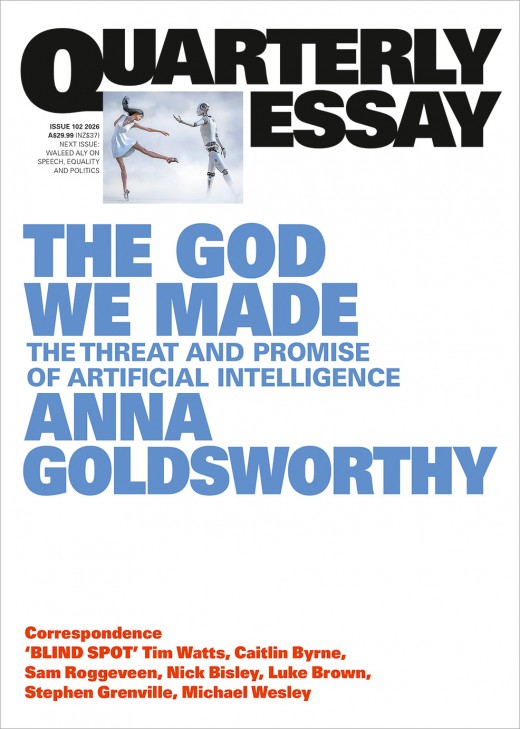
It’s notable how often in discussing Artificial Intelligence (AI) we reach for theology. Anna Goldsworthy, in her Quarterly Essay subtitled ‘The threat and promise of Artificial Intelligence’ starts off with the warnings we have had from antiquity: Prometheus stole the fire; Eve ate the apple; curiosity killed the cat and Oppenheimer built the bomb.
And now, in a moment as much theological as technological, we are birthing our most persuasive god yet. But what sort of god is this? It is not an Olympian, freighted with the flaws of our corporeality: lust, greed, wrath. It is, instead, forged from the raw material of our minds, and bears their imprint. So man created God in his own image, in the image of man he created Him. (p. 1)
Anna Goldsworthy is not a computer scientist: if anything, she couldn’t be further from computer science, as she is a concert pianist and chamber musician, as well as working in academia. If you are an AI user who only dabbles around with a bit of Gemini and Claude, that works to your advantage because she explains things in a very clear, non-technical way. Her concern is not with the specifications and scripts of AI, but instead with the question of what AI does to us as humans- and that, I think, is the more interesting question.
As you might expect from a musician, she particularly looks to the humanities and way we express ourselves in writing and through music and the arts. Art, she suggests, is a deliberate source of friction (p.29). I like this idea of friction, because that’s what AI doesn’t have- instead it is quick and confident and apparently produced without effort (if you ignore the data factories churning away 24 hours a day).
Creativity flourishes under limitations. I have devoted much of my life to the somewhat ludicrous problem of making the percussion instrument of a piano sound like a voice or an orchestra, of attempting to press human experience through an imperfect machine of hammers and strings and levers. But if the awkwardness of the machine were eliminated, my spirit would not be freer. We set ourselves rules- for sestinas, sonnets and even soccer- in order to fly within them. (p. 29)
She returns to the idea of friction that we receive from other people, in particular people who have their own limitations, who are transient, who are creatures of time and entropy and finally death (p. 56) :
… we need the friction of other people- stubborn, surprising, opaque- to challenge us in our thinking. We need the socialisation and testing of ideas, not just against algorithms but against other minds (p. 75)
She ranges over a number of issues that have arisen in relation to AI: the predictions of annihilation; the number of computer scientists who have ‘walked’ from the big companies once they realize the power of what they have created; the obsolescence of whole swathes of work and how to make meaning in its absence; the effect of AI-speak on our own writing style, and the cheapness of AI replicating a writer’s style; the phenomenon of people ‘befriending’ their chatbot; the sycophancy of chatbots and situations where chatbots have encouraged people into harm.
She intersperses her own hesitations against the adolescent superciliousness of her children and their friends R. O and Z who actually, I found rather insufferable and could have done without. I think I’d rather spend time with the author and her uncertainties and fears than the bumptious heedlessness of her children.
Essentially, she comes down to the body – even while raising the spectre of embodied AI- and the limitations that it imposes upon us, and the meaning it gives us. I think that this is where I land too, especially as I grow older and recognize the effect of time and experience on something so resilient and yet transient.
The first and last of all our problems is the body: this thing that aches and laughs and bleeds and experiences pleasure. It is the source of our vulnerability and our delight. It is also our trump card, the one thing we have that AI does not: our only true property, 60 per cent water, vulnerable to sharp objects, subject to time (p. 30)…the thrillseekers among us may still want to try human: to reinsert ourselves into the cradle of AI civilization, into that crucible that is flesh, to see what a body feels like- with all the risk that entails, with all its unique pleasures and knowledges (p. 83)
I heard this author speaking on a podcast (can’t remember which one) where he highlighted parallels between the 1930s and the current situation. Certainly by the subtitles that surround the main title (‘From the Fractured 1930s to Today’s Crisis Culture’ and ‘How to Avoid a World on Fire’), I expected more of a historical approach than an economic one. I didn’t realize that he is actually Macquarie Group’s investment strategist, and I may have approached the book differently had I known that.
This is a historical approach, relying on a generational approach (i.e. the idea that different generational cohorts behave particular ways) but it didn’t start with the 1930s. Instead his argument starts more with the Baby Boomers and the consensus of the late 1940s to early 1970 that the government was there to provide guardrails against chaos. Certainly there was conformity and repression, and life wasn’t as sunny for minority groups, but it led to two decades of economic progress and the rebuilding of societies that had been destroyed during World War II.
However, Baby Boomers did not have the experience of two World Wars and a Depression, and could not understand their parent’s acquiescence to stricter societal and moral rules as part of the ‘guardrails’ of the post war decades. Protests broke out and demands were made for ‘freedom’; economies were hit by stagflation in the 1970s, and by the early 1980s there was a new consensus that the private sector was more efficient, leading to privatization and a more mobile job market. This consensus lasted for more than two decades, until it was challenged by the Global Financial Crisis in 2008-10, followed by the COVID pandemic.
What I expected this book to be- a comparison of the 1930s with today- does not appear until half-way through. He identifies a number of similarities:
Both the 1930s and the last 15 years have witnessed financial crises and recessions at a time when income and wealth inequalities were at historically high levels
In both periods, investors and governments were haunted by the prospect of stagnation- that it would be impossible to grow and recover.
The 1930s witnessed significant societal polarization- Hitler, Franco, Mussolini, Stalin Mao and Huey Long- just as we are witnessing today
Culture and race wars were present in both. There were and are calls for a return to ‘traditional values’ and, just as today, freedom of speech was/ is contested.
During the 1930s the world was divided into camps (i.e. democracies vs. fascists and communists). Today, for the first time since then, there are radically different alternative political, economic and social models being proposed to replace democracy
Both in the 1930s, America’s refusal to join the League of Nations undermined its legitimacy, and it ceased to exist. Today, the United Nations is likewise rendered impotent by larger powers
Both the 1930s and the last 15 years have been turning points. The 1930s marked the beginning of a major phase of government intervention which would last nearly 40 years. In the last 15 years we have seen the breakdown of neoliberalism, but no one really knows what is coming next.
He speaks of the Fujiwara effect, a meteorological phenomenon where two nearby cyclones orbit around a common center, often leading to one storm absorbing the other or changing their paths. He applies this term to our current situation, where Financialization and the Information Revolution, super-charged by externalities like demographics and climate (p. 148) will disrupt our economies, societies and politics.
He cites economic Dani Rodrik’s concept of the ‘Political Trilemma of the World Economy’ that argues that it is not possible to have deep economic integration (i.e. globalization), nation-states and local democracy. You can have two of the three, but not all three together.
He suggests that the Chinese economy might stagnate, as Japan’s did from the 1970s onwards, and that Russia may become more dependent on China, even though that will be resisted in the Kremlin. African nations, with their very young populations will not be able to follow the path of trade and manufacturing out of the Third World because of technological change. Migration will be impossible to stop, with the best option of a higher investment of First World money into Africa to blunt the desire for mobility.
There’s an element of prediction that runs through this book. He predicts that the next decade will be dire indeed, but that by the 2040s as the Millenials and Gen Z take political power, there will be a turn to an enlightened form of communism, with more government intervention and a renewed role for trade unions. However, he notes, both Gen Z and Millenials are more likely to support extreme political parties. Paradoxically, they will want government to provide guardrails again, while distrusting governments and institutions.
This book was published prior to Trump’s Second Coming, and it reinforced for me just how disruptive this second term has been. He seems to have in this book a now-discredited faith that the United States would not abandon democracy- something I’m not so sure of.
The book is far more economic-y than I anticipated, with many tables and figures. I did tire of him referring back to his previous book, and it did have just a touch of the thesis about it with quite heavy-handed scaffolding of chapters, introductions and conclusions. It hasn’t been particularly well edited in terms of grammar, and I wondered (but have no way of knowing) whether the facts and figures were likewise poorly edited- I should hope that they are not. I regretted the lack of an index, although it does have footnotes.
I’m not the right market for this book, given my aversion to numbers in any form. However, I did enjoy the historical and generational aspects of the book. I am fearful enough of the next decade, and it’s a little bit reassuring that perhaps there’s some sense of calm at the end of that… should I live long enough to see it. My children’s children will.
My rating: 7/10
Sourced from: Yarra Plenty Regional Library
Read because: I think that historians have much to contribute to how we look at the present day
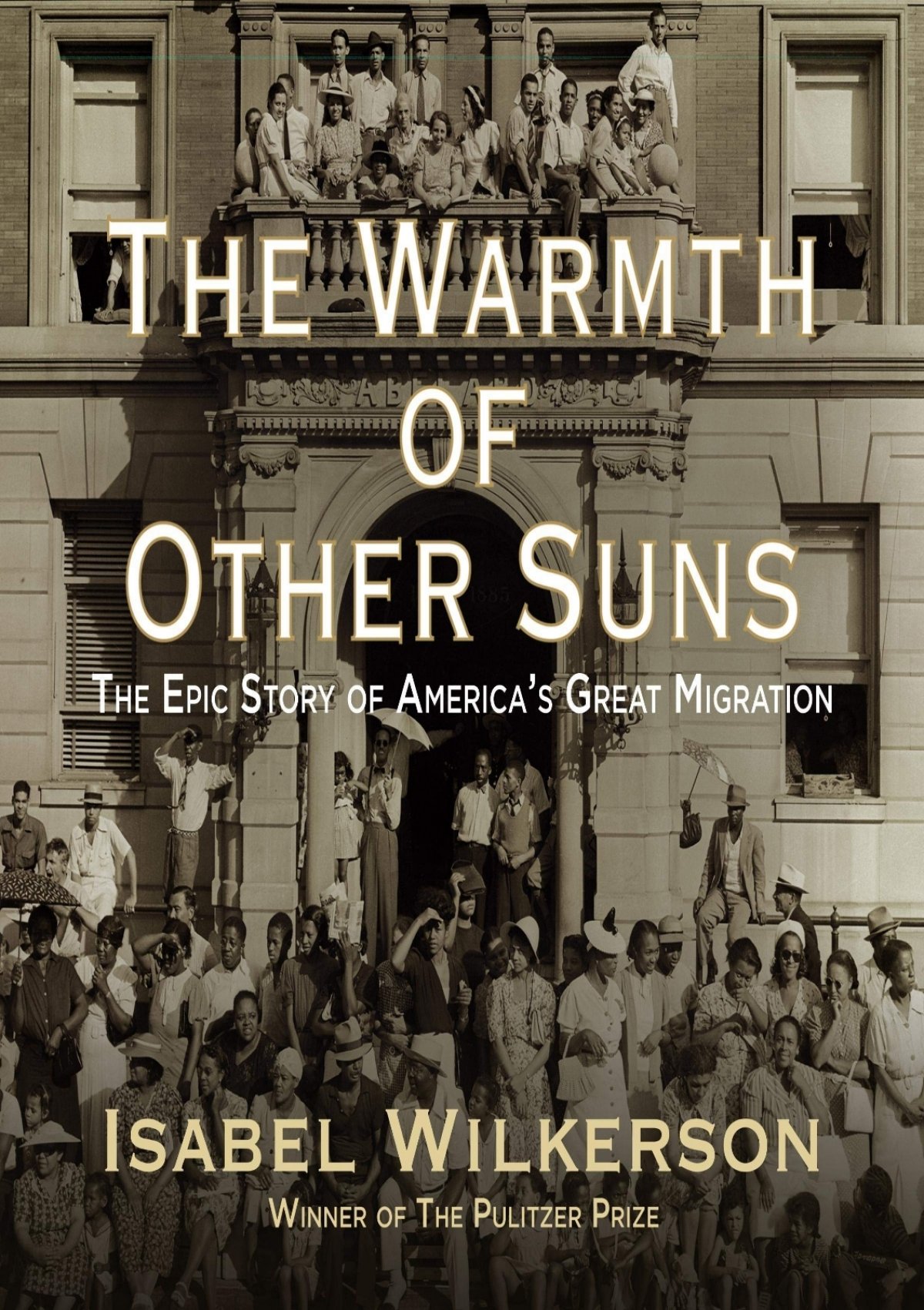
With my embarrassingly shaky sense of the geography of the United States, it hadn’t really occurred me to wonder, when I saw Black Lives Matter riots throughout America, why there were so many African-Americans in northern states. Neither, it would seem, do many Americans.
Starting during the First World war and over the course of six decades, a wave of some six million black southerners left the south and fanned out across the country, transforming urban America and recasting the social and political fabric of every city it touched. By the 1970s, nearly half of all black Americans -some 47%- would be living outside the South, compared with 10% when the migration began (p.10)
Historians would come to call it the Great Migration. It would become perhaps the biggest under-reported story of the twentieth century. It was vast. It was leaderless. It crept along so many thousands of currents over so long a stretch of time as to be difficult for the press truly to capture it while it was under way….Yet for all its influence, the Migration was so vast that, throughout history, it has most often been consigned to the landscape, rarely the foreground…. This book addresses that omission. (p.9, 13)
This is a very long book – 538 pages of very small font- but it is very easy to read. The author interviewed more than twelve hundred people (!!) in New York, Chicago, Los Angeles, Milwaukee and Oakland, all of whom had journeyed from the South during the Great Migration. To interweave 1200 stories would be impossible, and so she focuses on just three main characters, Ida Mae Brandon Gladney, George Swanson Starling and Robert Joseph Pershing Foster. Other people appear too, fleetingly, but she signals from the start that Ida, George and Robert are going to be the main protagonists.
They each set off in a different decade. Ida Mae Brandon Gladney was the first, leaving a sharecropping form in Chickasaw County, Mississippi in 1937 with her husband George for Chicago, after the family was threatened by a lynch mob that came in search of her husband’s cousin over the loss of some turkeys- which, as it happened, had just wandered away.
George Swanson Starling was a fruit picker from Florida who fled to Harlem in 1945 when his union activities brought him into the sights of vigilantes. He had hoped to go to college, but when he sensed that his father was blocking his ambitions, he married Inez, a girl his father did not approve of, just to spite him. The marriage was always unhappy, and George spent years working on the railways, charged with ushering Black passengers through the nuances of policies governing who could sit where.
Robert Joseph Pershing Foster, objectively the most ‘successful’ of the three, was a doctor from Louisiana who moved to Los Angeles in 1953. Despite working as an army medic, he always struggled break through the barriers which, although (purposefully?) invisible to white doctors, kept him sidelined from the career he could have had. Having married the daughter of a prominent Black educationalist, he was always insecure about his status in the eyes of his in-laws, and he threw himself into gambling while maintaining a large practice amongst the Black immigrant community.
She moves from one character to the other, often interspersed with chapters which give the context in each of the three locations (Chicago, Harlem and Los Angeles) that mark the destinations of Black immigrants as they fanned across the north. The book moves chronologically, and she gave much-appreciated ‘plot summaries’ when she picked up one of her three characters again.
She juxtaposes the truly appalling stories of lynchings and cruelty against the smaller injustices that burned strongly enough to compel these three people to move north, under varying degrees of danger. Your heart is in your mouth as Ida and her husband George tell Mr Edd, who owns their sharecropping farm, that they are leaving, unsure whether he is going to allow them to go. You sit rigidly with George Starling as he catches the train north, a train that he will spend years of his life working on. A wave of exhaustion sweeps over you, too, when Robert Foster drives his big flash car to Los Angeles, turned away from one hotel after another even though he has ostensibly left the Jim Crow South.
The North is not the escape that they thought it would be. There are no Jim Crow laws, but there is a thicket of unwritten standards and practices that limit work opportunities and, as a result, their life chances. We see ‘white flight’ in action, as suburbs change and gangs and crimes take over, affecting Black neighbours as much -more- than the white population.
By the end of the book, which takes us right up to the 21st century, you have sat with these three storytellers and you feel a real sadness as they die one by one, as they must, because this history and not fiction. It’s beautifully written history, well-researched, compassionate and human. Well worth every one of its 500-odd pages.
My rating: 10/10
Read because: a friend told me about it
Sourced from: Yarra Plenty Library- I had it reserved for over six months.
Past Present Future This program, which I have only just discovered, is undertaking a series on The History of Bad Ideas. In this first episode they look at Hysteria. Hysteria has a very long history, described differently at different times- sometimes as an expression of saintliness, other times as a form of possession or madness. It only tends to be applied to women, especially ‘unwomanly’ women. Men don’t want the diagnosis of hysteria, and men were instead described as melancholic or neurasthenic, or in later times shell-shocked. Men may be described as being hypochondriacs, but they still have agency: they are asking ‘what is wrong with ME?’ and distinct from ‘what is wrong with HER?’ French neurologist Jean-Martin Charcot saw it as a form of epilepsy, with hypnosis as a form of diagnosis. Freud actually listened to his hysterics but he imposed his own narrative on what he heard. But might not hysteria be a reasonable response to sexual trauma. Later in the 19th century feminists embraced the term for a woman who didn’t fit in. The DSM removed ‘hysteria’ as a category, now using the term ‘conversion disorder’ or ‘histrionic personality disorder’. But how much grace do we give people if there isn’t a clinical disorder?
The Rest is History678 : Britain- God Save the King Continuing on with their series on the national anthems of World Cup contenders, Dominic and Tom turn their attention to God Save the King. (All my life it has been God Save the Queen). Unlike the French and American anthems, God Save the King does not celebrate revolution, clinging instead to an image of King and God. An anthem is strictly speaking a musical setting for a biblical text, sacralizing the idea of a national song. No-one really knows who wrote it. It was thought for a while that it was written by very British composer Purcell, but in the 16th century it was said to be written by the appropriately-named John Bull. It has been thought that it might have referenced Bonnie Prince Charlie’s arrival off the coast of Scotland in 1745, bringing into conflict the Stuart vs. Hanoverian visions of monarchy. God Save the King erupted on the national stage in Drury Lane. It went viral, but people still didn’t know who wrote it. Was it a Jacobite anthem? But how to explain the Hanoverian spirit of the 2nd verse? The melody was adopted by other European states. However, it has fallen out of favour somewhat. In 1941 Orwell was ashamed of it, and the Sex Pistols had their own version. People sneer at it because it is a boring dirge, and Republican and secular politics see it as problematic. And how about the World Cup, where Scotland and Wales compete in their own right? Scotland could have the song ‘Flower of Scotland’ and perhaps ‘Jerusalem’ might be a good song for England (as distinct from Britain).
The War Game The Grey Zone Episode 5 Cyber Power (Part II) Hacking ISIS Well, after all these episodes about Russia hacking us, it was almost a relief to hear about how ‘we’ (i.e. Western democracies) are fighting back. ‘Cyber power’ is not something online or ‘in’ your computer, but instead it is the use of the online environment to change things in the real world. The line between cyber attack and information attack is a blurry one. The problem is that the West is legally and ethically constrained, but our enemies are not. In a Cyber War things stop rather than escalate. Russia is viewed as an acute threat; China is more of a chronic threat. ‘We’ (i.e. US and UK) were able to disrupt ISIS recruitment and battlefield communication, and even though they are no longer ‘dark’, they are less available on platforms.
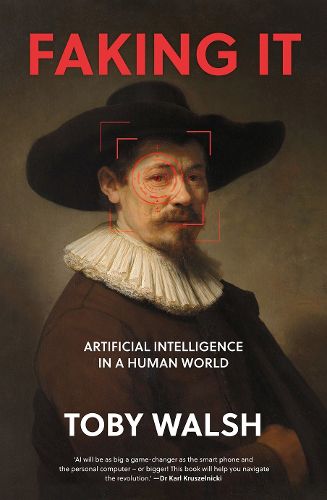
In his very first sentence of the preface, Toby Walsh warns us “This book is out of date”. He’s right- it was published in 2023 and it does already feel out of date. In 2018 Walsh wrote a book called 2062, which was the year that he predicted machines would be as intelligent as humans. I wonder if he still feels that way. In reading Faking It in 2026, three years after it was written, it feels as if things are moving much more quickly than he has described them. But, also as he says in the preface
I am confident, however, that the issues raised in this book will not be out of date. Indeed, they will be even more pressing. And this book will be even more useful, as a guide and a warning.
Toby Walsh is Scientia Professor of Artificial Intelligence at the University of New South Wales in Sydney and CSIRO’s Data61. He is a scientist who embraces the potential of AI but has been warning the government of the dangers of unregulated AI for some time as, indeed, he also does in this book. I feel that he takes a balanced approach, neither warning of impending doom but neither is he cavalier about the potential dangers that it could bring.
As suggested by the title, he is adamant about the ‘fake’ nature of AI.
In understanding artificial intelligence, it is also easy to be misled by our own human intelligence. We have a very personal experience of our own human intelligence, so it is hard not to fall into the trap of thinking that artificial intelligence might be somewhat similar.
Much of this turns on how we describe intelligence.
What, then, is intelligence? Loosely speaking, intelligence is the ability to extract information, learn from experience, adapt to the environment, understand and reason about the world. So what, you should ask, is artificial intelligence? Most AI isn’t embodied and situated in the world like our human intelligence, adapting and learning from the environment. How, then, can the intelligence of machines be identified and measured when it is so fundamentally different to human intelligence?
AI researchers do not completely agree on how to define artificial intelligence. But most of us will agree that it is about getting computers to do tasks that, when humans do them, we say require intelligence. These include perceiving the world, reasoning about the world and learning from the world.
His main argument throughout the book is that the artificial intelligence we are building only simulates human intelligence, – in other words ‘faking it’.
This fakery existed right from the start. The Mechanical Turk, a chess playing automaton which debuted in 1770 and toured Europe and the Americas until its destruction in a museum fire in 1854, actually had a person concealed within its metal chest. Mephisto, another chess-playing machine from 1876, was directed from another room using an electro-mechanical connection. Even Alan Turing faked his first chess-playing program, simulating the calculations of the program with pen and paper. And when Elon Musk announced the yet-to-be built Telsa Bot in 2021, it featured a person dressed up in a white full-length bodysuit pretending to be a Tesla Bot and fooling nobody.
He identifies many situations where artificial intelligence is much less impressive than it appears, and where it is designed to deceive us. He starts by looking at the hype and false claims about artificial intelligence; then looks to how AI has tried to fake human intelligence; to create fake real people, and to emulate human creativity. He notes that the technology companies that are developing AI are often indulging in fakery themselves, often indulging in ‘ethics-washing’ that makes them sound more responsible than they are.
In describing ‘the artificial in AI’, he reminds us that psychologists distinguish between intellectual, emotional and social intelligence. AI has the first one covered, but the other two intelligences are less easily replicated. AI machines, as strictly electrical devices, do not have the biochemistry that drives our emotions. Of course, they could be programmed for a level of anger, disgust or fear but our emotional intelligence is informed by our lived experiences: we understand other people’s emotions because they are like our own. Social intelligence, he suggests, is perhaps our greatest superpower. We can empathize with other people because we share the same biology. This, too, can be programmed, but that assumes that people act rationally and in self-interested ways, ignoring the complex, often irrational and sometimes altruistic behaviours of real people.
He urges those working in the field to stop anthropomorphizing the technologies they are developing:
We talk about a chatbot ‘understanding’ a sentence, a ‘self-driving’ car, the computer-vision algorithm ‘recognizing’ the pedestrian, and the possibility of robot ‘rights’. In reality, chatbots don’t understand language. There is no self– no person, no sentient, self-aware intelligence, driving the car, even if the car is driving itself. Algorithms don’t actually recognize objects. And robots need rights about as much as your toaster does.
His final conclusion is that the human in human intelligence is perhaps the most important distinction between us and the ever more capable and artificial machines we are building. He reminds us of the COVID times, when we so much missed physically meeting people, and walking in the real world. It was the real world we craved.
This is a very convivially-written book that is packed with information, and yet it rarely feels overwhelming (with the exception of his examples from mathematics which challenged my non-mathematical human brain). His footnotes are quirky and humourous and he has a wealth of examples and anecdotes drawn from his long history in the field. He is enthusiastic about the potentials of Artificial Intelligence, but adamant that it is not the same as human intelligence and in this I think that he finds the right balance.
My rating: 8/10
Read because: I’m thinking a lot about AI and being human. And it both excites and frightens me (probably more of the latter) because I want to hold on to the human.
Sourced from: purchased Kobo book (hence the lack of page numbers to the quote- a very annoying feature of Kobo)
I really can’t remember the last proper letter I received from a real person, as distinct from an optometrist reminding me to make an appointment or a real estate agent encouraging me to put my house on the market. It has been a very long time. For a while, the Christmas catch-up letter included with a Christmas card was popular, and I really quite liked receiving them. But as for receiving a letter from a friend for no particular reason – I haven’t received one for a long time.
As a historian who worked mainly with Colonial Office papers, it was always a bit of a thrill when you came across a personal letter as distinct from the “I remain your humble and obedient servant” type letters. It was as if, suddenly, a file has come to life and a real person has stepped out behind the platitudes. Certainly, some of those 19th century letters to and from ‘home’ in Great Britain followed a template as well, with an inordinate amount of time spent on the weather, given that the letter was going to traverse half the globe. Cross-hatched letters were infuriating, and much time was spent puzzling over a word or an abbreviation that a new pair of eyes would pick up in seconds.
Postscript is a selection of letters from the National Library’s huge collection of letters. In the introduction, Lauren Smith from the National Library explains their selection criteria:
The letters we finally selected, which span almost 200 years, are not necessarily the most famous or life-changing or emotional. What they do each contain is something human and real, something that gives us a sense of how much we have in common with those that came before, that gives us a sense of our own history. (p.v)
The letters were then taken up by present-writers, who were asked to choose one of those selected letters and, in response, write a new letter, addressed to whomever they chose, in some way inspired by the original letter from the Library’s collection. Most of the original letters are Australian- although there is a letter from Jane Austen to her sister Cassandra- and the majority of them date from the 20th century. Of course, there’s an imbalance here in that the authors of the original letter could have had no idea that their letter would survive to appear in a book decades later, whereas the current-day authors are quite consciously crafting a letter for publication. Each dyad or triad of letters has a short introduction, explaining who the authors are, and giving a little bit of context to the letter.
Several of the letters are linked by the original and present-day letter-writers sharing the same profession. Sometimes three letters writers are involved. For example, there is a to-and-fro of letters between children’s authors Mem Fox and Morris Glietzman, who are joined by winner of the Children’s Book Council of Australia (CBCA) award, Daniel Gray-Barnett who writes his own imaginary letter to a fellow CBCA award winner Andrea Rowe. Historian Frank Bongiorno writes a letter to the now-deceased Manning Clark, a prominent historian who would have been long retired from academe by the time Bongiorno embarked on his own academic career. In writing to Manning Clark, Bongiorno copied the lead of fellow historian Bill Gammage who also wrote to Manning Clark in 1984- the letter which is in the collection.
Sometimes there is a shared experience. Ranjana Srivastava, oncologist and writer whose column regularly appears in The Guardian writes an imaginary letter to the daughter of one her patients, remembering the recipient’s father and his kindness to her as his specialist. For Srivastava, the prompting letter was written by historian John Barrett, who wrote to his neighbours eight months before his death, telling them of his cancer diagnosis but encouraging them to just “tuck this knowledge away in the back of your minds”.
For me, not all of the letters were equally engaging. The ones that didn’t work for me were more intent on transferring knowledge of ‘what happened next’ to the deceased original correspondent, rather than responding to the emotion of original letter.
Sometimes the chosen recipient mirrored the relationship in the original letter. For example, Jane Austen’s letter to her sister Cassandra (which apparently the National Library holds) is mirrored by Kate Forsyth’s letter to her sister and co-writer Belinda Murray. Just as John Flynn (he of the Royal Flying Doctor Service) writes to his father as he’s about to embark on a new phase of his life, so in turn writer Michael Winkler writes to his sons about his own father.
But the letters I enjoyed most were from Sir John Monash to his 13 year old daughter Bertha where he writes a very detailed letter giving a run-down of what to expect on the railway trip from Spencer Street station to Windomal, a station over the Murray in rural New South Wales. This was matched by letters from poet Judith Wright to her husband and father after having a baby; and then by a letter from historian and author Maggie Mackellar writing to her daughter Arkie as she travels from Manchester to Doha. I’m not really sure why the Judith Wright letters are included here, but the Monash and Mackellar letters are full of the vicarious excitement and sorrow of letting a child move on to the next phase of their life.
When I first heard about this book, I was a bit ambivalent about it, thinking that it would just be a collection of letters. But I really enjoyed it: working out what the links were between the two letters chosen; quite touched by the emotion, often quite repressed, in the older letters that is more openly expressed in the current-day ones; and gaining a sneak peek into the behind-the-scenes life of a famous person. What worked best for me was that it is the perfect book for dipping into, perhaps last thing at night, when you want something to read but don’t want to embark on something lengthy that requires concentration. It’s a very human book, showing communication in an intentional but not self-conscious way in the original letters, and the imagination and emotional sensitivity of the current-day writers in responding to them.
My rating: too difficult to rate, because the letters were all so different. 7/10?
Sourced from: Review copy from NLA via Scott Eathorne, Quickmark Media
The First Saturday of the month is Six Degrees Day. This meme, hosted by Kate at Books Are My Favourite and Best involves her choosing a starting book, then you linking the titles or themes of six other books. This month she has chosen Maggie O’Farrell’s Land. I had borrowed this from the library, anticipating that it would be on the Booker Prize Longlist for 2026, but not so. Needless to say, I haven’t read it yet. But all of my links are related to the idea of land in some way.
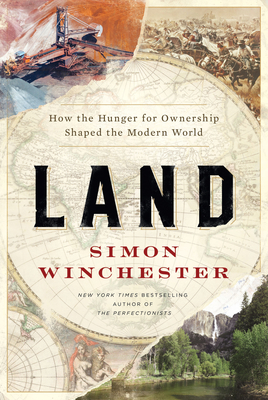
How odd. Simon Winchester’s book Land has the same title as the one we are starting off with. Winchester’s book, however, is non-fiction. The subtitle of his book is ‘How the Hunger for Ownership Shaped the Modern World’, and this is a global history of the mapping, ownership, division, preservation and restoration of the land. To be honest, I haven’t read this yet- but it’s on the pile.
Dave Sornig’s Blue Lake is about a specific piece of land, or more properly swampland, that has been completely engulfed by Docklands and the development of what used to be the West Melbourne Swamp. Previously known as Batman’s Swamp, the North or West Melbourne Swamp, and Dudley Flats it has always been a liminal place. This book won the Judges’ Special Prize, Victorian Community History Awards, 2019. My review is here.
James Boyce’s Imperial Mud: The Fight for the Fens takes us to England where he traces the unique, watery, changeable geography of the marshes of the Fens from 4000 years ago- possibly an area not unlike the swamp in Sornigs’ Blue Lake. The Fens, he explains, are not a precise location, given that the creeks and waterways that constitute them have always been an ever-changing phenomenon, and for much of their history they remained common land until they were drained in the 1950s, only to be inundated again. My review is here.
Storyland by Catherine McKinnon is a series of stories set in the same geographical location: around Lake Illawarra (south of Sydney Cove and Botany Bay, near Wollongong). The stories are in a sort of pyramid structure, set in 1796, 1822, 1900, 1998 and 2033-2717 before reversing and going back again. You can read my review here.
One of the most influential Australian history books I have read is Bill Gammages’s The Greatest Estate on Earth. Gammage’s argument is that, instead of being marginal hunter-gatherers, ‘people’- for that is the terminology he has chosen to distinguish aborigines from ‘newcomers’- farmed prior to 1788. They were not farmers, which is a lifestyle; but they did farm – the activity of tending and shaping landscape. They developed what he calls a ‘template’ of landscape, a mosaic comprising open pasture with few trees, strips of scrub and stubby trees, other plains, then clearly delineated forest. It is an argument that forces us to change our view of the landscape around us. The bushland that we prize as ‘native’ landscape is often not that at all- instead it is product of neglect as the custodians of the country could no longer farm it. My review is here.
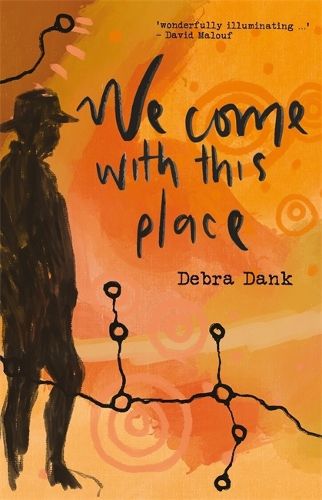
Where Gammage’s book talks about settler blindness to what had been wrought on the land by the First People, Debra Dank’s book We Come With This Place looks at Country from an indigenous perspective. It is a family history telling of the lives of her grandparents (and further back) and parents but she does not necessarily help the reader by giving a straight-forward chronological account. Violence and dispossession seeped through the generations, as did the love and knowledge of Country. It’s a love and knowledge that she is giving to her children, and to us too as readers. My review is here.
Even though O’Farrell’s Land is fiction set in Ireland, I seem to have branched off into non-fiction, and mainly here in Australia, which is not surprising really.
The History Bureau Putin and the Apartment Bombs 6: The Trial In 2003, four years after the apartment bombs, there was a trial of the suspected bombers. Mikhael Trepashkin, who believed that the ‘Chechnyan terrorists’ was a cover-up for FSB involvement , went to a journalist at the Moscow News before planning to appear at the trial to present his evidence. A few days before the trial he was arrested. The trial went ahead without him; the two ‘terrorists’ were found guilty and the case sealed for 75 years. Trepashkin was tried for possession of FSB material and two bullets (which he claims were planted on him) and sentenced to four years jail. Putin was elected for a second time with 70% of the vote. The template for Russian coverup was established: move fast; flood the media; and then seal any investigations. Ten years later Scott Anderson wrote about the bombings in an article called ‘Vladimir Putin’s Dark Rise to Power’ but GQ spiked the story and would not allow it to be published online although it did reappear later.
Short History Of…The Silk Roads (broadcast 23 Feb 2026) Note that ‘s’ in Silk RoadS because there were multiple silk roads, forming a lattice of networks over about 1000 years, spreading from the steppes in the north, Afghanistan in the south and reaching across to Persia and later the Mediterranean in the west, and China in the east. We know of the roads from 9th century BCE with trade between the Greeks and Persians, and in 4th century BCE Alexander the Great travelled along them. Coming from the opposite direction, in 2th century BCE the Han dynasty in China sent an envoy to see what was beyond the steppe horsemen who were blocking their progress, and he came home with tales of wealth and plenty. Now the Han knew that they were just one corner of a global path. Because of danger, traders would form caravans, stopping at pluralistic way-stations along the way. In the 2nd century CE there was a rare period of peace when the Romans, Parthians, Kushans and Han all wanted peace. Trade and goods moved across the Silk Roads, but so did ideas, particularly religious ideas – for example in the depiction of the Buddha. Maths, cartography, artistic systems, astrology all moved across west and east. In late antiquity (approx 550 to 1000 CE) the Sogdians from modern-day Uzbekistan and Tajikistan began operating over huge distances, instead of the small relay-like journeys that had been undertaken in the past. By 610CE the rise of Islam brought new political and social networks, as Arabic became the lingua franca and as pilgrims moved along the silk roads. By the 11thcentury CE the Crusades brought a new age of war fuelled by faith. In the 13th century the Mongols sought to impose the world’s largest contiguous empire. In 1279 Marco Polo traversed the road to meet with Kublai Khan. In the mid 14th century, the Black Death travelled along the Silk Roads. By the 15th century, under the Ottoman Empire, ships linked ports between Europe, Asia and Africa and the dominance of the Silk Roads faded. In the 19th century European explorers and archaeologists rediscovered them. Today, there are new versions of the silk roads, with trains traversing the land, and modern versions like China’s Belt and Road Initiative, or India’s Cotton Route replicating the crossing of the original Silk Roads. Features Peter Frankopan, Professor of Global History at Oxford University, and author of The Silk Roads.
A collection of essays is a strange beast. In Australia’s relatively circumscribed literary/commentary scene most essays seem to orbit around a small number of journals: Griffith Review, The Monthly, Meanjin, ABR. Nine of the essays in this collection have appeared in such journals between 2007 and 2019, and this is Mahood’s third book. The first, Craft for a Dry Lake (2000) was written in the wake of her father’s death and the second Position Doubtful: Mapping Landscapes and Memories (2016) covered similar material to that found in several of these essays.
‘To essay’, as her very first sentence announces:
means to try, to endeavour, to attempt. It implies risk and failure. It is also the only way to find out whether something is possible. These essays are a sort of written equivalent of hunting and gathering with intent. They are the product of my own wandering among the conundrums and contradictions of the cross cultural world I’ve chosen to inhabit, and of my intent to understand and honour it.
She is aware of the perils of a white woman writing about her engagement with the black world.
The essays in this collection were written over a period of more than fifteen years, during which time the attitudes and sensitivities around who has the right to speak and write about Indigenous issues have become increasingly charged and complex. This has left me wondering about what the implications of cancel culture and identity politics might be for me. Some of the previously published essays would likely not make it into print in today’s cultural climate, but I have chosen not to edit out what might now cause offence and attract criticism. To do so would be disingenuous, and a betrayal of my endeavour to understand and communicate as honestly as I can, something of the unique cultural interface I’ve been enmeshed in and witness to for much of my life…. That I exercise cultural privilege when writing about desert Aboriginal people is a given. The question is whether I exercise this privilege in a way that can be justified. I have been grappling with this conundrum since I began writing, and it never gets any easier.
It this humility and honesty about her own limitations and the ‘conundrums and contradictions’ that bestows on her an authority to speak from the position she is standing on, not pretending to be more than she is. She grew up on a pastoral station in the 1960s- a situation in the pre-WalkOff days that evokes the depiction of outback pastoral life in Ann McGrath’s Born in the Cattle – and she grew up with Aboriginal children. In the essay ‘Flowers for Evelyn’ she attends the funeral of Evelyn, whose brother worked as a stockman on their station back in the 1960s. Although part of the white pastoralist’s family, for the aboriginal people gathered there, “I am family and this is something I have to do” and she is asked to speak first. The funeral, and the people attending it, are all familiar to her and yet she is on the edge as well. At another funeral, she hesitates to speak, and she can feel the waves of disapproval – another whitefella has let them down again.
For me, the stand-out essay of the collection is ‘Kardiya are like Toyotas: white workers on Australia’s cultural frontier’, an essay that ended up being included in the induction material of many indigenous organizations. She calls it straight. As she points out, a new worker heading to Antartica would undergo physical or psychological assessment of their ability to stand up to the stresses of isolation, the extreme environment and intense proximity to other people. Yet there is no criteria to weed out the “mad, bad and incompetent who prowl the grey zone of Indigenous service delivery”. Like the ubiquitous white Toyota ute provided to organizations, white workers (kardiyas) break down, are abandoned and in the fullness of time another one will be delivered to commence the cycle again.
There are many reasons why kardiya break down. Some break themselves, bringing with them baggage lugged from other lives, investing in the people they’ve come to help with qualities that are projections of their own anxieties and ideals. Eager and needy, they are prime material for white slavery, rushing to meet demands that increase in direct proportion to their willingness to respond to them. They create a legacy of expectation and dependency, coupled with one of failure and disappointment.
This is heightened by the constant and demanding interaction with Aboriginal people themselves, and fact that ‘blaming the kardiya is the lubricant that smooths the volatile frictions of community life.”
There are the good people, who are overworked and undervalued; and there are the sociopaths, the borderline criminals, the self-righteous bullies and the mentally unhinged, who gravitate to the positions that no one else wants, entrench themselves, and contribute in no small degree to the malaise that haunts Indigenous communities….The famous quip about mercenaries, missionaries and misfits has a lot of truth to it, and each type covers a spectrum, from highly functional through incompetent to downright destructive.
It’s interesting that she writes this chapter in the third person, whereas many of the other essays are written in the first person. She tells a fable of New Kardiya who is taken in hand by one or more friendly Aboriginal people, given a skin name, regaled with stories of the incompetence of the first kardiya, co-opted into becoming driver to take people hunting in the ubiquitous Toyota or troop carrier, becomes romantically involved with another worker, ends up being assaulted by a community member and finally terminated, only for another to take her place. Or the fable of Super Kardiya and his Super Nyupa, he a self-righteous bully and she a self-righteous protector of the helpless Aborigines. It’s interesting that she stands outside observing this when we often see her at the wheel of the troop-carrier, or frantically trying to appease a key player in a consultation over a project in which she is involved in ‘Trapped in the Gap’. However, when she moves into working on a project with urban community groups, she finds herself out of place and uncertain how to proceed.
She is largely sidelined from capital-letter Aboriginal Politics, beyond noting that the revelations about child sexual abuse provided an opportunity to “speak aound truths that would previously have seen the speakers branded as racist and their voices neutralized”. She criticizes the Northern Territory Invention which she claims
…exposes the government’s unerring capacity for wrong action under pressure, and its default response of coercive control
Based on Emma Kowal’s academic work in ‘Trapped in the Gap: doing good work in Indigenous Australia’, she dares to raise the tendency of ‘white anti-racists’ (i.e. white, left-wing middle-class professionals who work in indigenous affairs) to identify structural rather than cultural issues as the cause for any of the string of ‘problems’- poor health, poor education, unemployment, high crime rate domestic violence etc. etc. This sets up a dilemma for white professional health workers (although it could be extended to any of the other ‘problems’:
That Aboriginal people might not want the things that will make them healthier throws into question the purpose of the work the white professional is doing. It also raises the spectre of differences that run much deeper and are cultural rather than structural in their origins. And if the difference is cultural, and achieving better health outcomes means changing cultural attitudes, the white health professionals must participate in social engineering, which is the antithesis of what they believe in. Kowal’s protagonists are confronted with the irreconcilable contradiction that, in order for the frequently cited ‘gap’ to be closed, Aboriginal people must surrender or dilute their aboriginality, thus relinquishing or diminishing their power and their identity. This is their crippling moral dilemma: in their attempt to do good, they may in fact be doing home. In a situation desperate for resources and support, the most highly skilled and scrupulous people are paralysed by the effects of this contradiction.
Much of her own work in the community involved map-making. In ‘Where Words Don’t Have Edges’ she describes facilitating a writing workshop among participants many of whom were illiterate and for whom standard English was a second language. She describes a national museum exhibition Songlines: Tracking the Seven Sistersin which she was heavily involved, and gives a far more sexualized account of the Seven Sisters songline than I was aware of! In other projects she is drawing out traditional stories of the land, many of which map closely to multi-layered digital maps. I found some of these chapters a bit repetitive- in fact, I’m sure that some paragraphs appeared more than once- and I find myself allergic to ‘gallery catalogue’ art-speak with its tendency to complicate everything with words. As it happens, I’m reading quite a bit about AI and Large Language Models at the moment, and these chapters about indigenous ways of knowing, shorn of their ‘gallery speak’, give some hope that there is still knowledge that can’t be hoovered into a LLM because it does not exist in words. Juxtaposed against this is her chapter ‘Lost and Found in Translation’ where she discusses the literary attempts by Australian writers to capture ‘country’.
And as a bird-watcher myself, who could resist chapters on the Night Parrot?
While reading all these chapters, I was interested, but did not feel particularly emotionally invested in the author herself. It was only in the last chapters, most particularly ‘Looking for Mushrooms’ that I gained some sense of her own life-story, and that of her mother. From what I have read, it seems that this third book balances out her first one, where she looked back at her father and his story, by taking her mother’s writing and holding it up against the mother she remembered- that some mother to whom she dedicates the book. Why did she wait so long to bring her own story forward because it is her life story and experience that gives her the authority (author-ity) to write the way she does? I’ve since realized that the chapters are more or less chronological in order of publication, but I think that this is an editorial choice that mis-fired.
Nor did I do myself (or the author) any favours in reading the book through Libby, the library app for borrowed books. In this case, I needed to know how far through I was, or how long this essay was going to be, and although I could work that out, it was clunky. This forced me to read it on my tablet rather than my Kobo which I find better approximates the experience of reading a book, and hence my inability to locate any of the quotes I have used on a designated page, not altered by the size of font I have chosen. I’ve enjoyed the book even more dipping back into it while writing this review, supplemented by an excellent discussion at the Ivanhoe Reading Circle.
My rating: 8.5 (an increase, on re-reading for this review, on what I would have given it previously)
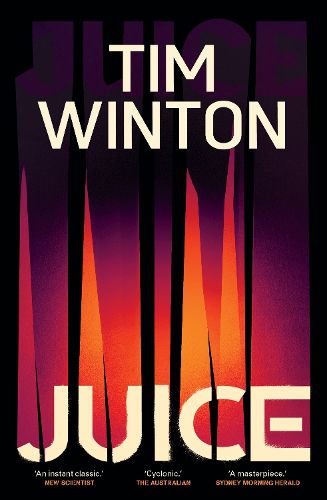
An unnamed man and a young girl are driving in a truck through a blighted stony landscape, surrounded by ash. When they draw into an abandoned mine site a man armed with a crossbow forces them from the truck cab and into a deep hole. The unnamed man does not trust the intentions of their captor towards the girl, and Scheherazade-like he tells his story to ‘the bowman’ both as a way of staying awake to protect the child and to gain the co-operation of his captor.
Set at some time in the future, the world has endured a horrific ratcheting-up of climate change and political breakdown. Temperatures regularly breach fifty degrees, and summer is spent underground in dark, stifling conditions, waiting out the months until winter, when it is finally safe to venture out into the open. Society seems to have broken down into small hamlets, scattered homesteads or gated armed communities. There does not appear to be any government, no religion, no music, no civic life. Cities like Perth and Sydney still exist, protected by walls, but they are fetid and dangerous.
As our unnamed narrator tells us (and the bowman), his father disappeared in a maritime accident when he was young and he was brought up by his ‘staunch’ mother – likewise unnamed- in the outback, growing vegetables in irrigated greenhouses in winter when the weather conditions are more benign. As he reaches adolescence he works salvaging parts from deserted infrastructure and taking their produce to ‘market’ where he barters for the things they need from other desperate, edgy people. It is at this market that he is approached to join the Service, a shadowy organization, that ruptures his world view completely. Brought up in an a-historical world, he learns about the phases of history that have brought the world to this point: ‘The Hundred Years of Light’, followed by the ‘Dirty World’, then the ‘Terror’. There were political choices that could have been made in the past (our present) that could have avoided this complete breakdown, and the wealthy descendants of the fossil-fuel executives, financiers and the lobby groups still shelter in enclaves surrounded by a luxury completely foreign to the depleted populations scrabbling to survive ‘outside’. The Service is committed to ‘acquittals’ – a euphemism for the assassination of whole families, including children- as vengeance for this climate collapse.
And so our narrator lives in two worlds: the spartan existence on the blighted landscape and the other world of secret missions, danger and bloodshed. He partners with Sun, and has a daughter, Esther, but spends months away, ostensibly scavenging, leaving his family on the homestead with his mother while he is called upon to embark on this campaign of murder and retribution that takes him to Utah, the Persian Gulf, and to Asia- all just ‘overseas’ places in this world without nations. The killing does not sit well with him, and each time he returns more and more disturbed, only to find that his wife and daughter have left. The Service keeps all of its operatives ignorant of each other and of the scope of their mission, and it is only as time goes on that our narrator learns that his whole life has been much more touched by the Service than he realized.
He tells all this to the Bowman, who he later learns has also been a Service man. Despite their common experiences, they are not the same. Our narrator’s life was saved by ‘sims’, hybrid simulacra who can withstand the heat and deprivation, but the Bowman believes that all sims should have been annihilated while they could be. Our narrator distrusts the Bowman with good reason, and even when I reached the last sentence of the book, I wasn’t sure quite what it meant.
Juice is similar to Cormac McCarthy’s The Road but the Scheherazade structure of the novel, alternating between the telling of the story at the bottom of a tunnel, and the story itself, means that it does not have the same grim relentlessness of McCarthy’s book. As a committed environmentalist, Winton does not pull his punches, naming the present-day fossil-fuel companies that the Service holds responsible for the climate collapse. In just one part of the novel, his religious faith and love of nature surfaces as well, when our narrator meets with one of the operatives who initially trained him. In what our narrator later says was the most interesting conversation of his life – just one- the operative says:
My mother used to tell me that when Nature dies, God dies along with Her… I guess what my mother meant is that without clean, wild, healthy things that can regenerate and renew themselves, the idea of God is impossible to imagine. (p. 346)
Does it matter if fiction is the vehicle for a political treatise? Not for me, as long as there’s enough depth to the characters to make them something more than mere mouthpieces. I don’t know whether Winton completely succeeded in this, but I wonder if his choice to keep his main characters nameless is not a way of intentionally distancing us as readers. I’m not sure that the introduction of the sims half-way through the book worked either, although it does raise questions about the sentience of artificially-created simulacra, and whether humanity’s only hope is co-existence with them, with the nature of the relation between human and sim left unexplored. There is much that he does not explain but to do so would detract from the earnest howl of despair at our present obtuseness that underpins the novel. He does not explain history, or the remnant technology, but this sparseness reflects the blighted nature of this world where there is no past and no future, just the survival of the season.