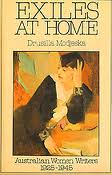
‘Exiles at Home: Australian Women Writers 1925-1945’ by Drusilla Modjeska

1991, 258 p

I feel as if I am reading this book at several steps removed. My copy of this book is the 1991 reprint of the original 1981 version which itself was taken from Modjeska’s PhD thesis.  So they do exist-those mythical creatures who actually get a book out of their PhD!  In the introduction to the 1991 edition  she describes the intellectual milieu in which she wrote her original thesis.  It was written in the early 1980s when she could not foresee the dominance of women in Australian writing and publishing in the upcoming decade, and under the influence of the Women’s Liberation Movement as it was known at the time.   There’s a rather rueful admission at the end of Chapter 2 that perhaps she had mis-attributed a publication to a particular author (and unfortunately, she does make rather a lot of this publication), but she allows the original text to stand.  I assume that many academics have similar infelicities which they know about in their own work, but can allow them to go through to the keeper because the work is not reprinted.  I found it interesting to read the rather earnest 1981 acknowledgments page, followed by the 1991 introduction which reflects an older, more relaxed narrative voice, more similar to that found in her other, later writings.

Modjeska points out

The 1930s were remarkable years in Australian cultural history.  Women were producing the best fiction of the period and they were, for the first and indeed only time, a dominant influence in Australian literature… They were politically active, they were often angry and they made sure their presence was felt as writers and as women.  Their remarkable history and the broader tradition that stretches beyond them has been undervalued and obscured.  This book is a history of these women writers, tracing the interconnections between their lives, their work, their politics and their fiction.  It is a book not only about social history but about writing, about cultural and ideological struggle, about feminism and fiction, about the contradictions of class and gender. (p. 1-2)

Her book ranges around a number of women novelists of the 1920s and 30s- Miles Franklin,  Marjorie Barnard, Flora Eldershaw, Eleanor Dark, Jean Devanny, Dymphna Cusack and Katharine Susannah Prichard (my impetus for reading the book).   Many of these women were linked through their contact with Nettie Palmer, whom I had only ever encountered as part of the Vance-and-Nettie-Palmer team.  Miles Franklin gets a chapter to herself, while the others are woven together by their letters and communications to and through Nettie Palmer and amongst themselves.

Much of the book discusses the role of politics on these women’s writings and identities as public intellectuals during a decade of the Depression, the rise of Fascism, Stalinism, the Spanish Civil War and World War II.   Some of them, like Prichard and Devanny became overtly identified with the Communist Party, to the detriment of their writing;  while others distanced themselves from or resisted such clear allegiance, even though Modjeska portrayed most of them as leftist in their politics. They all had to face and somehow accommodate the demands of being wife, mother and daughter.

For me, the least successful chapter came near the end of the book where she discusses a string of books, many of which I have not even heard of, let alone read.   Modjeska’s analysis is heavily influenced by the Marxist Feminism of the 1970s and 80s , something her subjects lacked:

One of the problems for the writer-women of the thirties was that their anger, their feminist protest was backed by very little theory. In consequence their political anxieties deflected from the early feminist impulse in their fiction while forcing them back on a commonsense faith  in what they knew was important in their experience as women and which they expressed as a female humanism… In the absence of theory they had to rely on those old female virtues of commonsense and intuition (p.256)

I’m not convinced that it was such a deficiency as Modjeska felt it to be, or whether she would feel that way today.

I admit to being out of my depth in much of the subject matter and I ‘m not sure whether I picked up on the overarching argument of the book.  The chapters were self contained and read almost as essays in their own right, but I wasn’t able to pull them together into a structured argument.   I have seen this book cited several times, and it obviously broke new ground when it was published.   I also sense that in many ways, the deficiencies that Modjeska identifies in terms, say, of a strong critical biography of Miles Franklin have been taken up in recent scholarship. What I did detect, however, was the complementarity between this book and Modjeska’s later work Stravinsky’s Lunch, which I class amongst the best Australian non-fiction books I have read.  And I find myself wondering, if Modjeska were to write this book today 30 years on, what sort of book it would be.
My top 7 for 2010

Why Top Seven? Well, largely because I’ve let this blog take over my reading journal where I used to score out of 10.  I haven’t made a practice of doing this here, and so it’s not quite so easy to sort out the ‘very good’ s from the ‘bloody brilliant’ s.  Also, I now no longer draw a distinction between the reading I’m doing for my thesis and my leisure reading, and that makes it harder to decide a ‘best’ compared with a ‘very useful to me in my thinking at this stage’ book.  So, subject to all these caveats,  seven it is- with links to my reviews.

1. Richard Holmes Footsteps: Adventures of a Romantic Biographer

2. Hilary Mantel Wolf Hall

3. Anne Fadiman Ex Libris

4. Edward P Jones The Known World

5. Richard Yates Revolutionary Road

6. Tom Griffiths Hunters and Collectors

7. Ruth Park The Harp in the South Trilogy


‘The Pioneers’ by Kathleen Susannah Prichard

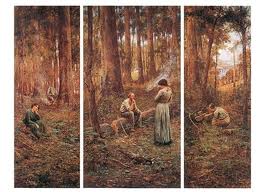
I hadn’t realised during reading this book that I was actually reading a painting.  Here it is- McCubbin’s triptych “The Pioneers”- how could I have possibly missed the allusion?

The book opens with Mary Cameron, standing in the bush beside their wagon, desultorily feeding a smouldering campfire with sticks of eucalyptus that she breaks in her hands or across her knees.  She goes to a fallen trunk, sits down and gazes into the shadows.  The book closes with her grandson pushing the bush away from a “lichen-grown wooden cross”, dropping on one knee to read the inscription.  Ah- I thought- “The Pioneers”- of course!

The Pioneers won the Hodder and Stoughton All Empire Literature Prize for Australia in 1915.   It is not hard to imagine why: for a British publisher the book is steeped in eucalypts, pioneer spirit and optimism exemplified by the young colonial  soldiers of the Australian Imperial Force in WWI.   Although its author became (in)famous for her heavy Communist Party involvement in later decades,  there’s a nationalistic pride here that I, at least, find difficult to reconcile with the internationalism of her later politics.  Perhaps it was prompted by the circumstances in which it was written- by a young Australian journalist based in England, drawing on the notebooks she had penned recording the old-timers’ stories during her own time in Gippsland several years earlier.

It’s all there- the silence and forbidding beauty of the bush, the old convicts, the cattle-duffers and the bushfires- but there’s also a defiant pride in the generation that followed the pioneers, who threw off the shame of convictism that haunted their parents and grabbed the opportunities open to them.  There’s a White Australian debt to be acknowledged to the pioneers on the frontier, and a  romance and optimism about the “currency” lads and lasses growing up tall, proud and resourceful – who wouldn’t want to embrace that?

I often find it hard to talk about “old”  Australian books and authors.  There’s often a mawkishness and blatant nationalism that I’m not comfortable with as a reader.  I find myself wondering if the incorporation of such books  into the “Australian Classics” canon subjects them to a critical scrutiny that their targeted audience of the time might not have shared.  For example, a review of The Pioneers at the time noted that “the setting of romance is said to be very attractive to readers who are only incidentally interested in history”  and then as now, books were written and published with a contemporary audience in mind- an audience with different expectations and tastes to what we might have today.  For myself,  I find myself being dragged back to my 21st century reader mindset because the sentimentality and melodrama of these late19th/early 20th century books overwhelms me (two exceptions: Ruth Park’s Harp in the South and Henry Handel Richardson’s The Fortunes of Richard Mahony).  I then find myself reading such texts as a historian, because I’m rather discomfited by them as a fiction-reader. I’m aware that this is probably not fair on the book, or the author, or my own experience as reader.

I’m particularly conscious of this because I’ve just finished reading Sarah Water’s The Night Watch (glowing review to come!) which I found much more satisfying than, say, Dymphna Cusack and Florence James’  Come In Spinner.  Surely the 1950s book written from experience would have an inherent fidelity, but in terms of my emotional response, I found the more recent text,  aimed no doubt at a different audience segment, and stripped of the popular melodrama and skittishness, more satisfying.  Perhaps it’s the different mindset that a reader brings to reading historical fiction as a genre, as distinct from popular contemporary fiction from an era that is now historical itself?

You might want to read Whispering Gums’ review of the book too.

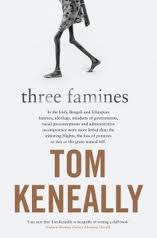
‘Three Famines’ by Tom Keneally

2010, 320 p.

The three famines of this book are the Irish potato famine of the 1840s, the Bengal famine during WWII and the Ethiopian famine of the 1970s and 80s.  Keneally has written about two of these famines previously- the Irish famine in The Great Shame, and through his fictional work Towards Asmara– and so, in one regard, this is a well-tilled field for him.  This book, however, is a comparative text and  he draws out commonalities between the three famines- the role of the evil figurehead who comes to personify the famine; the whistleblowers who make the famine known to the wider world and the ideologies and administrative incompetence that lie behind the political acts that so often exacerbate the famine.  Indeed, instead of famine being the failure of crops or rain, it is the result of egotism, politicking, ideology and willful blindness, often during a time of war.  Plenty and famine perversely seem to be able to exist simultaneously.  He writes of the physical effects of famine and poverty, and the paradox by  which nutritional alternatives are spurned in the yearning for familiar food. He highlights the restlessness that drives the migration patterns of starving people – a timely reminder in the face of such anxiety over ‘illegal’ refugees and people movement.

I have a few quibbles over the book, however.  It is clearly written as a layman’s guide, rather than an academic text, and  even this is marred by several editorial mistakes including dates. At times chapters cover all three famines, while other chapters are devoted specifically to one famine alone.   I wish that he had written a final chapter, drawing the three famines together, but instead the book splintered off into a string of other smaller famines that blunted the impact of the book somewhat.  Keneally is a prolific writer on a wide range of topics and a much-loved public personality, but I just wish that this was a tighter book than it is.

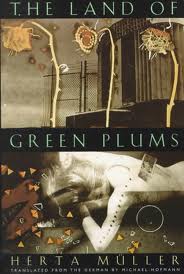
‘The Land of Green Plums’ by Herta Muller

242 p. 1998

This was my selection for CAE bookgroup (aka “The Ladies Who Say Ooooh”) and within about three pages of opening it, I thought to myself: oh dear, The Ladies are not going to enjoy this book.  It is a book of unrelieved bleakness.

The unnamed narrator is one of a small group of student dissidents in Ceausescu’s Romania.  There is a nightmare-like dissonance and bestiality about this semi-autobiographical telling of their lives: people barter sex for offal; abattoir workers jostle to drink the animals’ blood; factory workers labour making tin cows.  The title of the book alludes to the childhood warning  given to the narrator that eating green plums would kill you, and yet the swaggering soldiers of Ceausescu’s regime stuff their pockets and saunter around with bulging cheeks full of green plums with impunity.

The friends write to each other in coded letters where certain phrases convey whether they are being interrogated or watched and each letter is sealed with a hair to alert that the letter may have been tampered with.  As a reader, I found myself hyper-alert to these words- so much so that much later in the book when one of the code  words was uttered just in passing, that I turned quite cold.  Running through the book is the narrator’s constant surveillance and inquisition by the chilling Captain Pjele of the Securitate.  Even when three of the four friends escape to Germany, they are aware of the tentacles of the Securitate and the impossibility of freedom.

The book won the International  IMPAC Dublin Literary Award in 1996 and the author was awarded the Nobel Prize for Literature in 2009.  The language of the book is dense and throbbing, and reads more as poetry than plot.  In fact, the book itself is quite hard to follow during the act of reading, although you discern the plot almost without realizing it.  As a book in translation, the deeply political act of writing a book about Romania in German escapes us, as do the nuances of being part of a German-speaking minority in Romania in post-war Europe.

I can’t say that I enjoyed reading this book.  I found it oppressive and disturbing and rather unfortunately- very memorable.

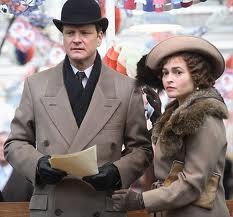
‘The King’s Speech’

It had been a sad, strained Christmas Day for us this year, and so off to the movies we went for Boxing Day, along with many other burghers of the leafy suburbs over the Yarra.  We were sitting in probably the closest seats to the screen, and  who should be sitting behind us in the second closest seats to the screen but my good friend M.

The movie featured bravura performances from both Colin Firth and Geoffrey Rush.  The embarrassment of the then-Duke of York’s speech at Wembley Stadium is still excruciating, and the movie succeeds brilliantly in channelling your attention away from the content of what he was trying to convey to a minute, breath-holding fixation on how he was saying it.  The casting was inspired  all round: you could see flashes of our present Queen in the young girl cast as the Princess Elizabeth, and Helen Bonham-Carter captures the vivacity of the woman we came to know as the Queen Mother before she became embalmed in dress coats and ostrich feathers.

It strikes me that poor Bertie was more exposed by live radio technology then than he would be today with almost effortless sound editing.  Unfortunate, really.

Still, I can’t help wondering if “the firm” is not doing a job on us all through cinema- first Helen Mirren in The Queen, and now this movie.  How cynical I am.

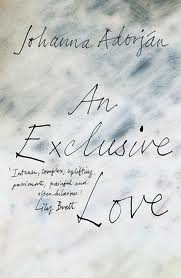
‘An Exclusive Love’ by Johanna Adorjan

2010, 185 p

At first blush, this might seem a rather inappropriate book to be reading just as Mum died, but I found it oddly soothing.  In the opening lines of the book we learn that the author’s grandparents committed suicide together in 1991, and the preparations for this suicide run throughout the text, written in the present tense, minutely hypothesizing about their movements on that final day.   It is a day of banalities: picking flowers from the garden and placing them in vases,  taking the dog to a neighbour who is oblivious to their plans, prising open the capsules containing the drugs that will kill them, and ignoring the phone call that they suspect is a family member.  There’s a calmness and purposefulness that I, at least, found reassuring- quite apart from the ethical questions that their actions raise.  As the title suggests, this was an excluding love as well as an exclusive one.

Interwoven with the present-tense rundown of their last day is a Who-Do-You-Think- You-Are type reconstruction of her grandparents’ lives, stitched together  from the accounts of relatives and her grandparents’ surviving friends.  Her Hungarian Jewish grandparents themselves had said little of their wartime experiences – “we don’t talk about that”.   Her grandfather had survived the concentration camps; her grandmother had spent the war in hiding.  Following the Russian re-occupation of Hungary in 1956 her grandparents fled to Denmark as refugees, where they spent the rest of their years, grateful to Denmark for the sanctuary, but steadfastly Hungarian.

This is only a short book, which is perhaps a good thing as the tension in waiting for the suicide is rather drawn out.  The book is beautifully written and I suspect, beautifully translated with a warm, loving narrative voice that is quietly accepting of her grandparents’ decision.  There is no fear of death here,  and this is a good thing for me to read just at the moment.

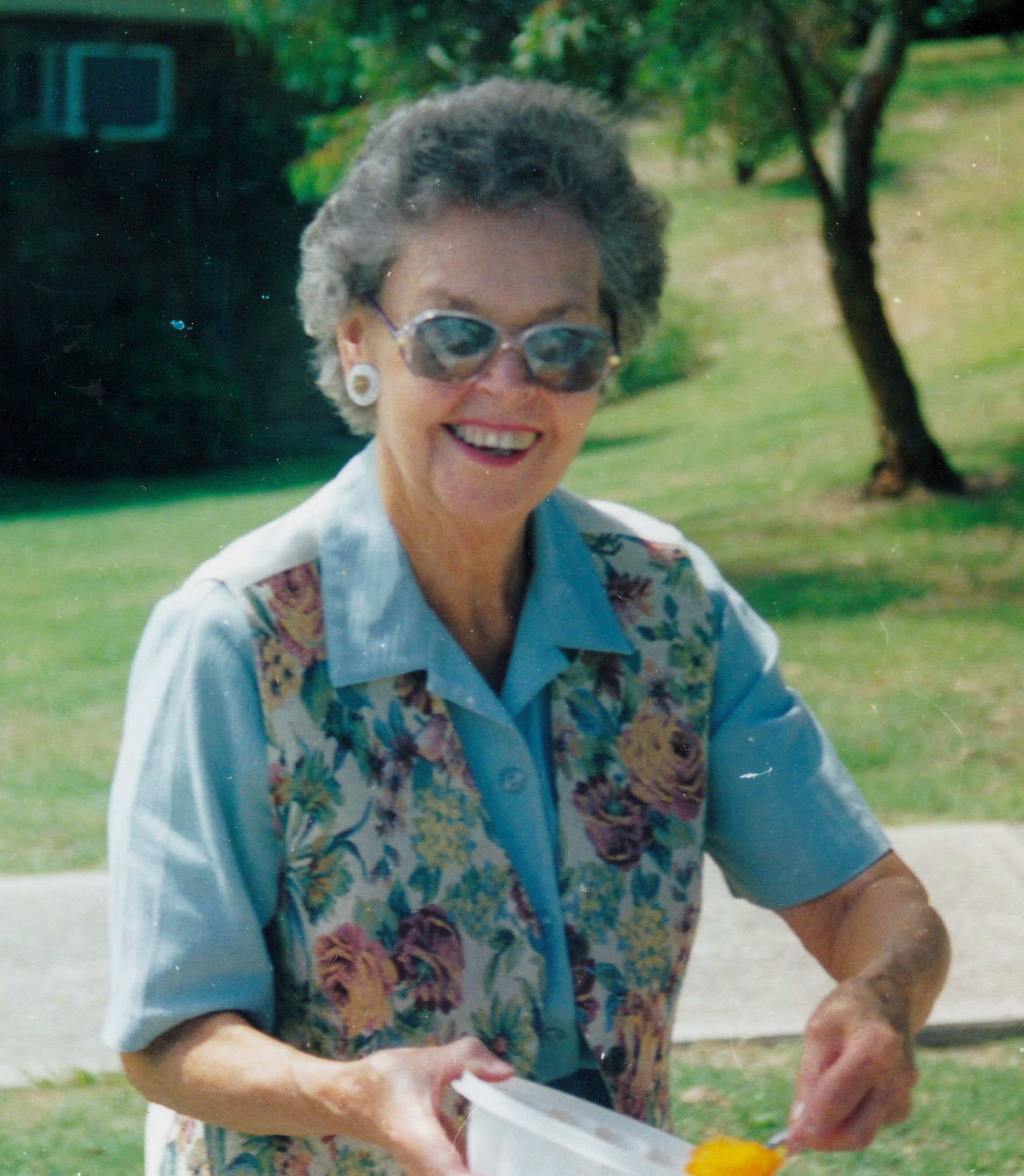
Betty Lumley 8.9.1925 – 17.12.2010

My beautiful Mum passed away last Friday.

Missing in action

The “Resident Judge of Port Phillip” has been missing in action recently, engulfed in the minutia of organizing the upcoming  Law and History Conference.   Never again will I take for granted the abundance of material in a conference pack, the elegance of the design of the conference theme,  or the elegant logic of the conference program (until late withdrawals bring it down like a pack of cards!).  I’ll see you, no doubt, on the other side of all this.

Now that you mention it…

I was reading a fairly old book of collected essays on Upper Canada the other night.  It was the 1975 edition of Historical Essays on Upper Canada edited by J. K. Johnson.  There has been a second collection of essays  released in 1989, again edited by J. K. Johnson but  joined by Bruce Wilson this time.

It interested me that in the introduction to the 1975 book, Johnson noted that one of the themes of the essays was a preoccupation with economic affairs.  He wrote:

It is probably no accident that the preoccupation of historians of Upper Canada has often been with economic affairs- with the study of growth, of the metropolitan dominance of Toronto, of agriculture, of business firms, of lumbering or public works. It is true that Upper Canadian society showed a propensity to produce or adopt contentious public figures who have attracted the attention of historians, but the great majority of Upper Canadians were from the very beginning engaged in the more mundane business of developing the resources which the province had to offer- engaged in other words in the business of making a living, and wherever possible, in making a profit, a fact of Upper Canadian life which has been rightly stressed in historical writing.  If historians of Upper Canada can be said to have created an overall view of any kind it is of a society generally concerned with its own (mainly economic) betterment but in some dispute about the best ways of achieving that goal  (p. ix)

Now actually that he mentions it, I had noticed that much of the history I’ve read of Upper Canada has a strong economic history focus.   I don’t really think that Australian history has the same emphasis.  There’s Shann’s old Economic History of Australia written in 1948, and the Butlins whom I’ve written about here who also write economic histories.  Blainey’s work, especially The Tyranny of Distance makes an argument with strong economic strands, but it doesn’t have the tables and figures that mark so much of the Upper Canadian material I have read (which is, to be fair, often chapters and articles).  Nonetheless  I’d be hard pressed to think of a recent general book about Australian history that has a really strong economic focus.

Johnson’s justification for the emphasis on economic history among Ontarian historians would hold just as true for Port Phillip which was likewise established by people wanting to make money.  But again, I don’t think that this is the case. A.G.L. Shaw’s  A History of the Port Phillip District is a narrative history that includes a strong economic analysis, but it is just one strand among several.  Likewise the three volume Priestley/Broome/Dingle series published for Victoria’s 150th anniversary- the economic story is there, running steadily underneath, but not the main focus.

I can really only think of one academic on staff whom I would characterize as an “economic historian” and only one of my fellow postgraduates has written an overtly economic thesis.  Several of my colleagues are writing environmental histories, but they are of a different hue.

I’m aware that historical specialisations wax and wane, and that some institutions attract particular schools of historians.  But I’m wondering if there’s some cultural influence at play here too- a variation of the ‘tall poppy syndrome’ perhaps?