First Footprints

Did you catch First Footprints on television on Sunday night?  If not, hie thee hence to i-view and catch it there.

I think that many of us of a certain age can recall sitting  cross-legged on the floor of the school hall, watching black and white film reels of traditional Aboriginal people in the desert (possibly the Desert People film, produced in 1966?) It may well have been shown by the Religious Education teachers who were often retired missionaries, and in my mind the film is linked with the “mission boxes”, little cardboard money boxes that were distributed during Lent “for the missions” among Aboriginal people.  Ah-so many questions now, but not at the time.  Watching in the half-light of a school hall in the 1960s, smirking and tittering over the bare breasts, what was reinforced was the utter strangeness and primitiveness of a lifestyle so thoroughly ‘other’ than ours.

When I think about it, I haven’t seen such films for several decades.  I’d like to think that it was because we have become increasingly aware of sensitivities over images of people who have died, but I can’t imagine that this was the case in the 1970s and 1980s.

Seeing the footage again on Sunday night, though, I was overwhelmed by awe at the sheer age of the aboriginal peoples as survivors and vicariously proud of their deep connection with the land. No primitiveness now: instead resourcefulness, adaptability, grit, spirituality.

I found myself holding my breath at the footage of Narwala Gabarnmang.

Image

I remembered reading about this discovery but I hadn’t realized the depth of colour and the intricacy and density of the artwork.  The rock shelter looked like a cathedral, with a similar sense of the spiritual mixed with the very human striving for beauty and expression.  I found myself sitting very still, utterly transfixed. I didn’t expect this to have such an effect on me.

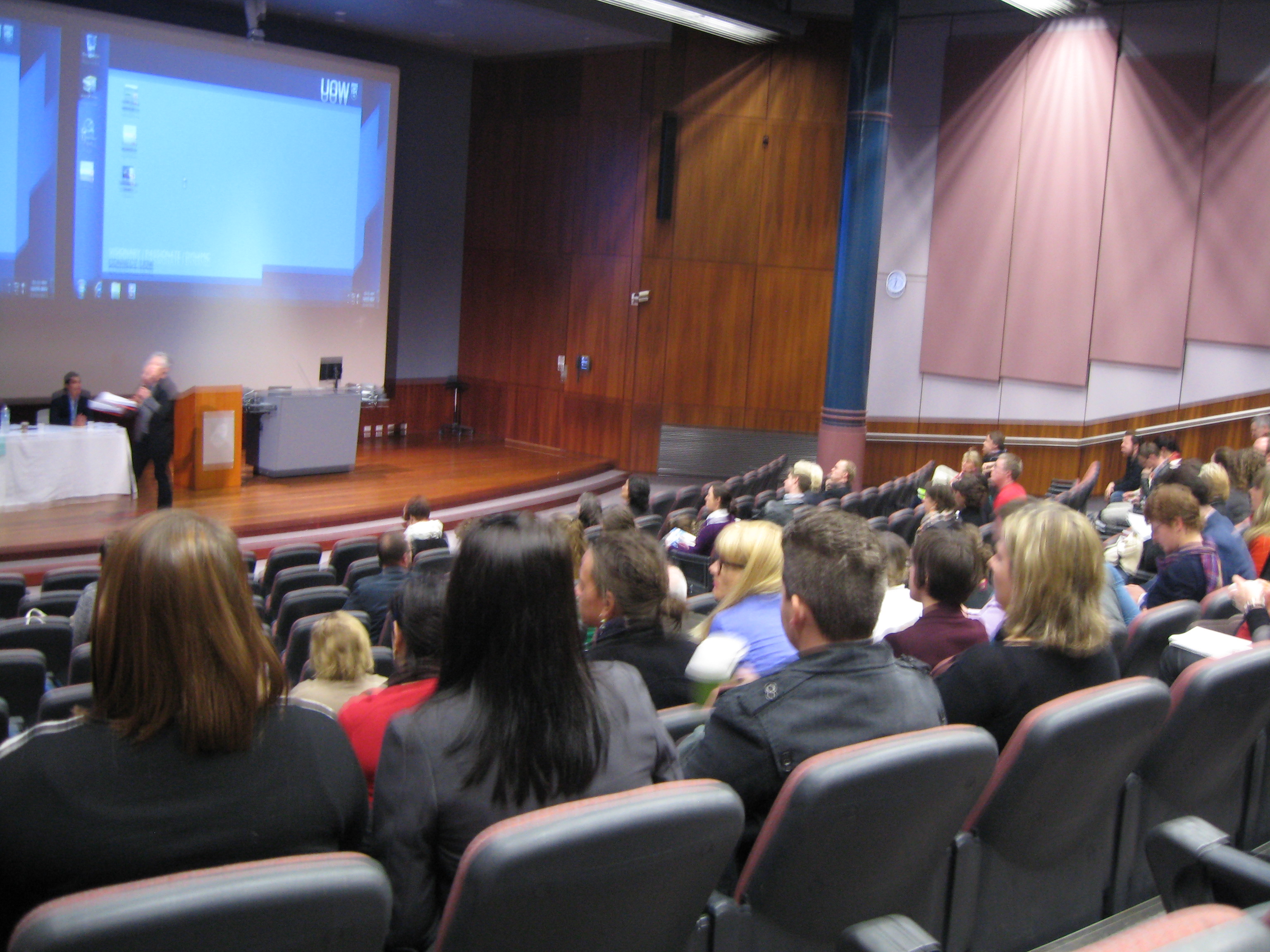
A conference-eye view of Wollongong

Well, a conference-eye view of any place is going to be a very short-sighted one because most of the time is spent at the venue, or travelling to or from it.   I must admit that I didn’t really get to see much of Wollongong at all.

It was only when I thought about it that I realized that I have never been to Wollongong.  No- wait- I spent exactly one day there as part of the field work on a Work Integrated Learning research project that I worked on in my Other Life as an Educational Designer about -eek!- thirteen years ago.  But I have never spent an extended time there. Continue reading →

AHA Conference 12 July

Trains and planes wait for no-one (even though we certainly wait for THEM!) so I attended only one session of the Conference today and had to leave before the final plenary.  Yvonne Perkins at Stumbling Through the Past may write about it, as she has also been blogging the conference.

IMG_4909

The theme of the conference was “Mobilities and Mobilisations in History”.  Many of the papers addressed the first theme, but the final session that I attended was focussed on the second: ‘Mobilising Australia in World War II’. Some late arrivals and car breakdowns meant the presentations did not follow the order in the program, so I’ll report them in a more logical progression than I heard them. Continue reading →

Australian Historical Association Conference 11 July 2013

Day Three opened with a plenary panel ‘Rethinking Indigenous Histories’, featuring Marcia Langton (University of Melbourne), Tim Rowse (UWS) and John Maynard (University of Newcastle). Both Langton and Maynard are Indigenous scholars.  The aim of the session was to consider recent developments in the writing of Indigenous histories, although the presentations and the questions that followed ranged further than that. Continue reading →

AHA Conference 10th July 2013

The morning started with the Keynote address by Matt Matsuda from Rutgers University. His paper was titled  ‘New Pacific Histories: Ocean, Motion, Emotion: Mobilities and mobilizations in History’. What a beautifully crafted, lyrical performance this was!  Continue reading →

AHA conference Tuesday 9th July 2013

I’m up at Wollongong for the next few days for the Australian Historical Association Conference. Yvonne Perkins, who blogs at Stumbling Through the Past is here as well and assiduous networker that she is,  encouraged me to blog the conference as she did last year (and is doing again this year).  One of the frustrations of a streamed conference is that you often find yourself wishing that you could be in two places at once, so I guess that reading someone’s impressions of what they have heard is a rather distant next best thing. However,  I’m very conscious that I may misrepresent what I thought I heard- so this is my best shot and apologies if I have misunderstood.

You can download the full version of the abstracts (PDF) AHA_Program_FullAbstracts28June in order to read the speakers’ intentions for their presentations.

Continue reading →

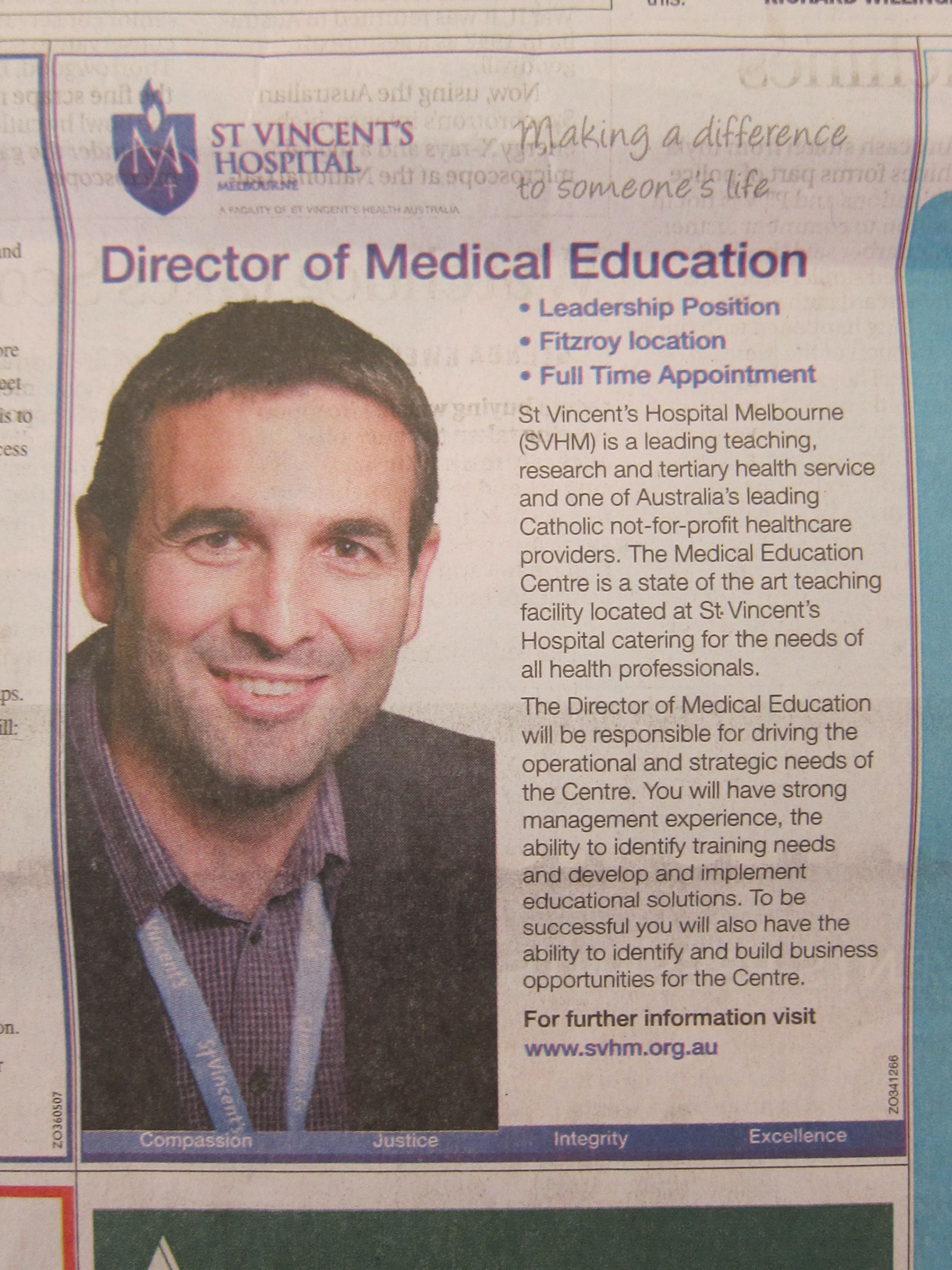
Can women apply?

I can’t quite believe that I’ve seen this.

StVincents

Can women apply or only young men with sexy five o’clock shadows? The St Vincent’s Medical Education webpage is no better.

Hell, why not go back to the ‘Men’s’ and ‘Womens’ Positions Vacant columns and be done with it?

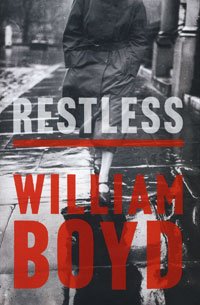
‘Restless’ by William Boyd

RestlessNovel

2007, 336 p.

Last month I was rather embarrassed that the bookgroup ladies disliked my book group choice, Brooklyn, so vehemently. So it was with relief that I was able to march in this month, book under my arm, and proudly announce that “I chose this book!”

I must admit, though,  that when I read the blurb on the back I wondered if I really had chosen this book.  I’m not really into spy novels at all- so why had I nominated this one?  I could only think that I was aware of his book Any Human Heart and must have been swayed by the comments about the book in the catalogue (which does beg the question ‘why didn’t I go for Any Human Heart then?)  Oh well- no matter.  This is a very good book for readers who don’t like spy novels.

There are two alternating narratives.  The first, told in the first person, is that of Ruth in the 1970s whose mother Sally begins acting very strangely.  Her mother hands over to her, chapter-by-chapter, her autobiography that reveals that her mother is not, as Ruth believes, an English-bred housewife and mother but instead, a spy for the British recruited during WWII.  The second narrative is the third-person autobiography itself, which tells of Eva (Ruth’s mother) and her recruitment and life as as a British agent, working to influence America to join the war effort during WWII.  This part of the book is quite factual, based on British Security Coordination, an espionage unit based in the Rockefeller Centre.

The descriptions in the book are very carefully written, with the eye of one trained to notice small details, as Eva was. Increasingly her daughter Ruth, and eventually you, too, as reader begin to scan the settings he describes with a  heightened awareness as well.  He brings the two narratives together carefully, leaving you quite unsettled about the ending.  Normally I don’t particularly like alternating narratives because I come to favour one over the other and resent being tossed between them, but I didn’t feel that way with this book: I enjoyed each narrative equally.

There’s not a lot of violence in this book (some, but not excessively) and it has much to do with identity, manipulation and distrust- all very human emotions  at the intersection of relationships and this other, weirder world of espionage.

I enjoyed it. There’s a 2 part BBC series that aired in England in December 2012. (Fantastic cast- Charlotte Rampling, Rufus Sewell, Michael Gambon…..)

My rating: 8.5/10

Sourced from: CAE book groups

Read because: Book group selection

‘Eugenia: A Man’ by Suzanne Falkiner

I recently read Mark Tedeschi’s book Eugenia.  It raised quite a few methodological and narrative questions for me, and so I was interested to see how other writers dealt with the same material.  You might  want to read my review of Tedeschi’s book too, because my response to this book was formed after reading it.

eugenia_falkiner

1988, 243 p.

The blurb on the back of this book reads:

In the spring of 1917 an apprentice from the Cumberland Paper Mills, just outside Sydney, was walking along a bush track beside the Lane Cover River when he discovered the partially burnt body of an unidentified woman.  The arrest three years later of a 45 year old Italian woman, Eugenia Falleni, for murder, led to an investigation that fascinated the people of Australia.

Known in the newspapers as the ‘Man-Woman Case’, the trial revealed that from the time she had left New Zealand and gone to sea as a cabin boy, Eugenia had lived at least 20 years of her life in the guise of a man.

There is a entry on Eugenia Falleni in the Australian Dictionary of Biography if you’re not already familiar with her story.

The title of the book is quite definitive- “Eugenia- a Man.”  The image Falkiner has used for the front cover shows Harry Crawford as a young man and is taken from a photographic postcard created between 1900 and 1917 in Sydney.  On the back of the postcard are the words “I am sending you my photo for (a) keepsake, with love from H. Crawford”.  We do not know who wrote these words, as Harry Crawford himself was illiterate; nor do we know to whom they were written.

This book is written is two parts.  Part I, comprising twenty one chapters,traverses Eugenia’s life: her early life, his marriage, the crime and the trials.  It doesn’t take long to get to the death: just 25 pages. Unlike the Tedeschi book, Falkiner is careful to note the source of her information in the text itself (without footnotes), and I must admit that I felt more comfortable with such an approach.  I knew who said what, and when.  Also, this book differs from the Tedeschi book in that it is absolutely silent about what happened on Eight Hours Day when the death of Annie Birkett occurred.

Much of Part I is taken from the trial transcripts, especially those printed in the newspapers.  The press took a close and rather prurient interest in the trial: you only need do a Trove search to find the many print columns devoted to the trial. Falkiner goes through each of the witnesses in turn, and spends almost as much time on the magistrate’s court hearing as the Supreme Court trial.  Like Tedeschi, she is critical of Eugenia’s defence lawyer McDonnell, but it is the appraisal of an onlooker rather than the critique of an insider, as Tedeschi Q. C.  is.

There are occasional chapters during Part I where the author herself comes onto centre stage.  She explains at the outset how she came to be interested in Eugenia; she visits the locations where the death occurred; she traces the houses where various characters lived.  The ‘quest’ narrative is quite a common framing narrative for us now, both in fiction and through shows like ‘Who Do You Think You Are?’ and I must admit that it’s becoming a little hackneyed- but perhaps less so in 1988 when this book was written.

In Part II, the author shares the limelight with Falleni as she tries to get behind the trial to find some sense of Falleni as a person.  She tracks down relatives,  visits them in New Zealand, she even visits Eugenia’s birthplace in Italy.

Histories always exist within an historiographical context, and this is true of Falkiner’s book as well.  You can sense the presence of the 1980s in her interest in the migrant experience and the gender roles of  men and women in the early twentieth century.  She does address the issue of trans-sexuality, but in nowhere near the depth that it might be explored today (and in Tedeschi’s book)  and not at all from the perspective of lesbian history or queer theory.  A recent review written as background material for the play ‘Passing’  tackled the author for her sentimentalized view of Eugenia:

Falkiner’s book is perhaps the most detailed study of Eugenia Falleni’s life but its insight value is diluted by Falkiner’s sentimentality and subjectivity. Falkiner projects unabashed sympathy and no small amount of pop-psychology about gender and sexuality towards her subject – she frames Eugenia as a misunderstood gentle soul suffering from a vague kind of gender identity crisis to such a point that Annie Birkett’s murder, which Eugenia was tried and convicted for and later admitted guilt to, is relegated as a footnote.  (From Passing Research Notes: ‘Trans theory- a brief guide)

I’m not sure that in 1988 there was the  interest or theoretical frameworks at the popular level for queer theory analysis.  If there is sentimentality, I think that it springs from the emotional investment that any biographer makes in her subject, especially where the research springs bottom-up from interest in the individual and their story rather than from a top-down interest in a theoretical phenomenon.  I’ve been aware recently of research into European migrants to Australia at the turn of the century from the perspective of whiteness studies, which is a 21st century twist on the 1980s’-era multiculturalism that Falkiner explores in her book.  One thing that came through very clearly was the marginality and fluidity of a working class existence where housing, jobs and, in Eugenia’s case, identities were temporary and rootless.  I was surprised, in both this book and in Tedeschi’s, about the silence about World War I and its effect on working-class communities and men.  Perhaps the silence is in the documents, but it did strike me as strange.

The book itself is a very easy read, not dissimilar in tone and approach to a Good Weekend article in the weekend’s newspaper.  Perhaps it doesn’t have the little stabs of insight of a Helen Garner (e.g. Joe Cinque’s Consolation) or Chloe Hooper’s The Tall Man, but it is similar to both of them in that the book deals with a crime and the consequences in court and afterward, and the observer’s response.

Should you read this book, or Tedeschi’s?  I’d say “read them both”- perhaps reading this one first.

awwbadge_2013

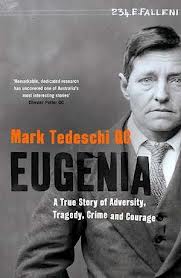
‘Eugenia’ by Mark Tedeschi Q. C.

eugenia_tedeschi

2012, 236 p & notes

I must admit that I don’t very often come away from the ANZLHS Law and History Conference rushing  to my library website to look up a book.  I did, however,  with this book last December only to find that it already had multiple reservations.  I put a hold on it in December and finally received it in May.  Perhaps they should buy another copy….

You’ve probably seen or hear of Mark Tedeschi  QC, even if you don’t know you have.  He’s the NSW Senior Crown Prosecutor, and he has been involved in a slew of important and famous criminal trials: Ivan Milat’s Backpacker Murder; the trial of the men who murdered the heart surgeon Victor Chang;  the trial following the assassination of politician John Newman; the Gordon Wood case over the death of Caroline Byrne at The Gap; and Counsel assisting the Coroner in the 2007 trial into the killing of the Balibo Five.  It was in his role as Senior Crown Prosecutor that he addressed a gathering of former and present Crown Prosecutors gathered at NSW Parliament House in 2005 to celebrate the 175th anniversary of the appointment of the first Crown Prosecutor,  Frederick Garling, in 1830.At that presentation he listed a number of extraordinary, complex and bizarre trials, and first on his list was that of Eugenia Falleni. In the introduction to this book he writes:

In the intervening years, I have come to consider that the trial of Eugenia Falleni in 1920 should be viewed as the single most important criminal trial of those 175 years.  Its prominence is not because of any  lasting effect that the trial had on the law or the administration of criminal justice, but rather because of the multitude of legal and social issues that Eugenia’s life and trial throw up for us to consider, so that we can use them as a yardstick to ask ourselves what we have learned and how far we have progressed since then.” P. 228

So who was Eugenia Falleni?  I’m wary of spoilers, so I’ll cite from the publicity on the back cover.

Eugenia Falleni was a woman, who in the 1920s was charged with the murder of her wife.  She had lived in Australia for twenty two years as a man and during that time married twice.  Three years after the mysterious disappearance of Annie, her first wife, Eugenia was arrested and charged with her murder.  This is the story of one of the most extraordinary criminal trials in legal history anywhere in the world.  The book traces Eugenia’s history: from her early years in New Zealand, to her brutal treatment aboard a merchant ship and then her life in Sydney, living as Harry Crawford- exploring how Harry managed to convince two wives that he was a man, culminating with Annie’s death, the police investigation, Harry’s second marriage to Lizzie, and then arrest for Annie’s murder three years after she had disappeared.

The book is written in three parts.  The first, ‘The Search for Love’ takes us up to the trial.  Many chapters start with a paragraph identifying the year and listing a number of events that occurred that year.  It reminded me a bit of the technique in the film Same Time Next Year where each new encounter was separated from the last by a film clip of significant events.  So, in this book Chapter 5 is set in 1913, marked by Roland Garros’s flight from France to Tunisia, Emily Pankhurst’s jail sentence and the commencement of work on Canberra.  It’s rather repetitive and overt, but on the other hand I could actually name the years in which events took place instead of just having a vague idea after a single date is given at the start of the book , then not mentioned again.

The book is written using fictional techniques, but it is not fiction.  There are conversations in the book, and frequent internal dialogues where the author suggests the thoughts of various characters.  Despite the spoiler on the back cover, there is little foreshadowing of events that will unfurl during the story.

In his introduction, Tedeschi  signals how he is going to deal with his sources.  He writes:

The historical facts of Eugenia Fallini’s story that I have related in this book, including quotations from newspaper reports and evidence from her trial, are based upon contemporary public records, press reports, court transcripts and other written accounts, as well as subsequent recollections of people who had direct contact with the main personalities.  I could have provided footnotes or endnotes for the historical facts, but I believe that including numbered notes in a text creates a visual and psychological hurdle for the reader to overcome.  For this reason, I have instead included a bibliography at the end of the book and I have only inserted numbered endnotes in the text  where they are essential for an explanation.  Where I have referred to personal thoughts and emotions, these are generally inferred by me from the background factual circumstances in which they occurred.  Most conversations are taken from police statements or evidence given in the committal proceedings and the trial.  In those two instances (in chapters 1 and 8) where, in the absence of established facts, I have engaged in conjecture about significant events, I have clearly indicated that this is the case and stated the basis for my supposition. P. xiv.

I didn’t find this particularly satisfactory.  The bibliography at the end of the book is divided into legal documents, newspaper articles, obituaries and family histories, and secondary sources.  The legal documents, which are probably the most important, include the transcript of the trial, the judge’s trial notes, the register of post mortem examinations , NSW female penitentiary records and a police statement.  Yet in the text itself, there is no indication which document a particular fact draws upon and thus no way of the reader weighing the authority and interests that the statement reflected.  The footnotes are more like explanatory notes e.g. conversion of imperial measures into decimal, biographical details of minor characters, or references to tangential legal cases.  Occasionally, though, there are footnotes directly related to the narrative.

He makes many assumptions about his characters’ state of mind without indicating the basis for his reconstruction .  For example:

 Over the long weekend, Harry languished in his kitchen over a bottle of whisky, agonising about what would become of Annie’s fourteen-year old son, and indeed himself, without Annie.  When the boy returned from his long-weekend holiday at Collaroy with the Bone family, how was he to break the terrible news to him that his mother had gone off without telling him or even leaving a note, leaving him with his stepfather? He felt great sorrow for this boy who had lost his father when he was very young and who now faced being informed that his mother was gone.  P 66

There is no indication of the evidence he used for deducing Harry’s feelings about his stepson, or whether this ‘terrible news’ of Annie’s desertion  was clearly thought through rather than an excuse conjured up on the spot. We do not know whether this reflects Eugenia (Harry’s) own confession, the step-son’s testimony, or Tedeschi’s assumptions- and surely that matters.

In his introduction, he particularly signposted Chapter 8 as a section where he was creating his own explanation.  I cannot fault the care with which he does so in the opening paragraphs of that chapter:

There were only two people who knew exactly what happened next in the clearing at the Lane Cover River Park: Harry Crawford and his wife, Annie.  Neither of them was in a position afterwards to give an account, for reasons that will become apparent.  What follows is therefore a possible version of events, re-created by the author, that is entirely consistent with all the known facts that later emerged, but interpreted with the benefit of today’s superior knowledge in the forensic sciences and unimpeded by the considerable prejudice that existed at the time for someone in Harry Crawford’s predicament  (p.55)

What follows is a narrative that is highly sympathetic to Harry Crawford (Eugenia).  It is very much the sort of legal narrative that a defence counsel could create, but it is oddly placed in Part I, which is a straight chronological account.  The author gives no indication of the evidence from which he has drawn up the scenario, and once created, it skews the rest of the narrative.    What would I have done, were I writing this book?  I think I might have created this narrative, and then immediately created a counter-narrative.  Perhaps I would have put it in Part II where Tedeschi writes as a lawyer, or perhaps at the end of the book.  I would certainly, at least identified the sources for my explanation here, if not elsewhere.  This chapter has no notes at all.

It is in Part II of the book  (“Legal  Proceedings”) that Tedeschi really hits his straps.  Using his legal knowledge, he examines the investigation and trial from beginning to end, noting discrepancies and anomalies and distinguishing changes in the law from the early 20th century to today. He notes flaws in the Crown’s case and is particularly scathing of Harry’s defence lawyer.  You’re very much aware of the lawyer at work here.  He creates a long list of fifteen alternative questions that the defence layer could have but did not ask, and embroiders the narrative with the rhetorical flourishes that a lawyer in full flight might use: for example,  a succession of paragraphs that each end with the sentence “it has not always been so” or in another section listing things that the defence lawyer could have done “but would he do so?”  Whatever my misgivings about the first part of the book, only a barrister could write this second section.

Part III, “Incarceration and Release” examines Eugenia’s life after she has been released from prison. Here he quotes more directly from medical reports, oral histories and newspaper articles, and I felt as if I was on surer evidentiary ground.  It is only a short section and rather sad.  He concludes with a retrospective that reviews the trial from a 21st century perspective.  It’s an interesting chapter.  Finally, there is an appendix that follows up on the main characters and what happened to them later, and the places and institutions in which events occurred.  I’m not really sure that it was necessary as an appendix because the story stood well on its own two feet.

The book addresses the issue of sex and gender directly.  It’s a fairly human response, I suppose, for us to wonder “But surely his wives would have known that she wasn’t a man?!” and Tedeschi goes into quite a bit of detail about the object coyly referred to in the court cases as “the article”.
eugenia_246x550

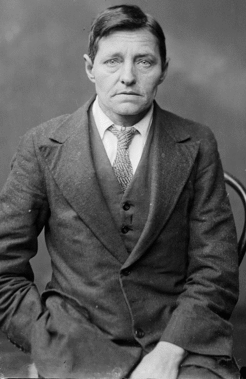
I found myself returning again and again to the police photograph of Harry on the front cover.  It was taken immediately after his arrest.  Not only had he been charged with the murder of his first wife, but his second wife now knew about his false identity.  He was afraid that he would be placed in a male prison with his identity as man/woman common knowledge.  There’s cockiness and yet sorrow in his face, and he had every reason to be fearful.

It’s a compelling story and, quite apart from the narrative itself, this book has raised so many methodological questions for me that I want to read more. How would a journalist deal with the story, or an historian?  Tedeschi acknowledges his debt to Suzanne Falkiner’s book, and I know that the historian Ruth Ford has written about her as well.  I haven’t finished with this story yet.