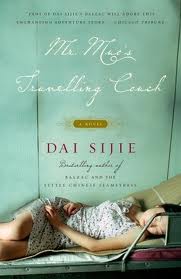
Mr Muo’s Travelling Couch

drmuostravellingcouch

2003 (2005 translation from French), 264p.

Well, that’s 264-pages-reading-time that I’m not going to get back again.

Dai Sijie is the author of Balzac and the Little Chinese Seamstress, and there are similarities between the two books.  Both books revolve around the power of European literature (Balzac in the earlier book; Freud in this book); both refer to the ‘re-education’ policies of the Cultural Revolution; both books involve journeys.  But where there was the theme of innocence and awakening in his first book, the major plotline of this novel is that Mr Muo, recently returned from France where he qualified as a psychoanalyst, needs to find a virgin to offer as a bribe so that his girlfriend can be released from prison.  All rather grubby really.

He speaks (albeit almost casually) of post-Cultural Revolution and post-Tienanmen Square China, and I did find that interesting.  I was wondering when it was going to expand into a full-blown critique, but it remained very subtle- unless it passed completely over my head.  I know very little about Freudianism but the author’s use of it all seemed rather obvious and simplistic.  I am, however, very ready to concede that there might be nuances and critiques of Freud here that may have also passed completely over my head.  (I’m wondering if Freud in Oceania has read it?)   I kept waiting for this book to DO something, but alas it never did.  In fact, I don’t know if anything happened at all or whether it was all a dream after all.

Even more disconcerting were the blurbs front and back that described it as ‘hilarious’ and  ‘amusing charming read with a sharp, satirical edge’ and ‘allusive, intelligent and very funny’.   I obviously have a different sense of humour from such readers.

My rating: 3/10

Read because: it was a bookgroup choice for February (even though I won’t be there for the meeting).  Boy, I’m glad I didn’t choose THIS book!

Sourced from: CAE

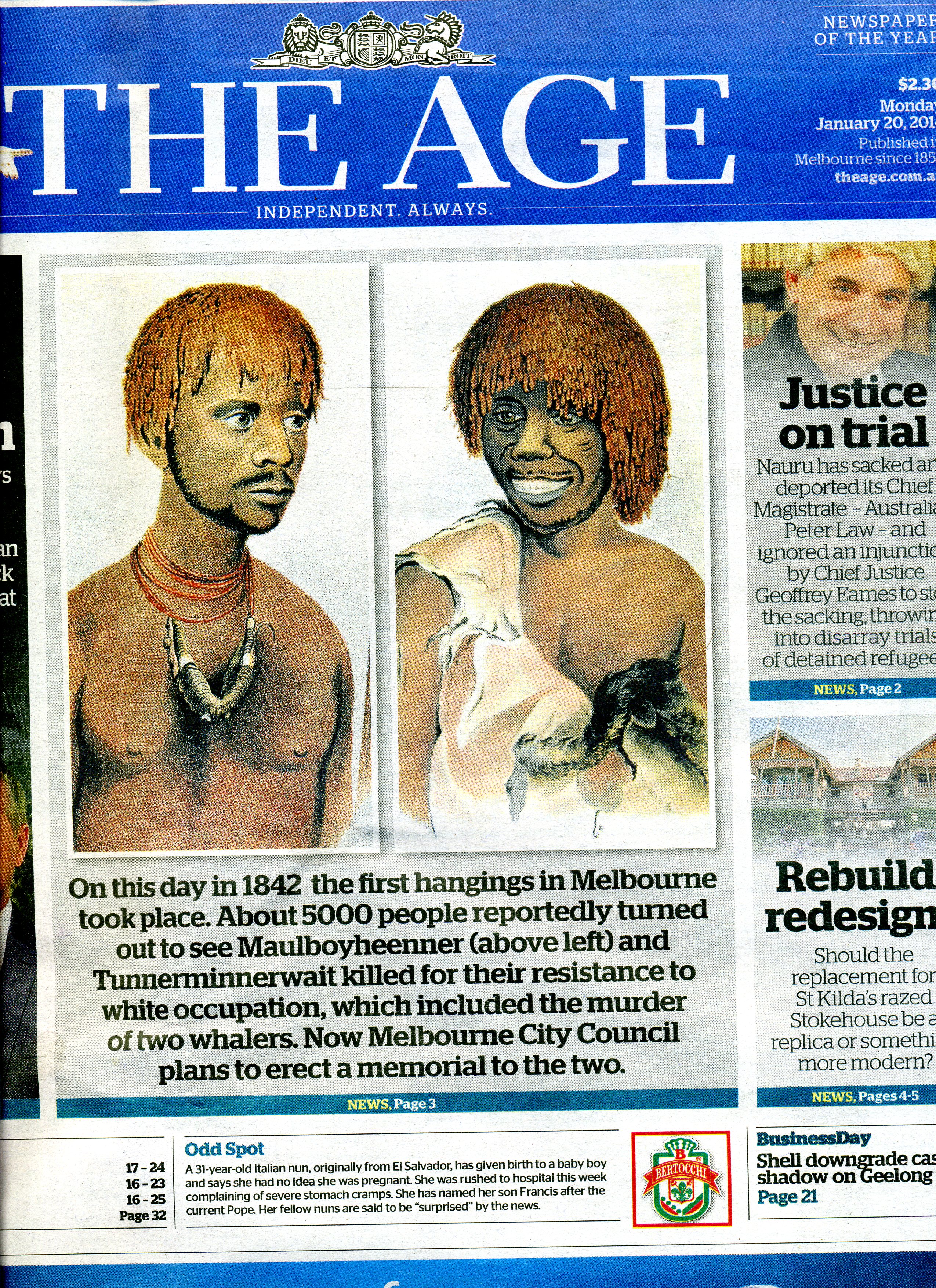
Judge Willis on the front page of today’s Age? Not quite….

img100

It’s the 20th January and so it is the 172th anniversary of the hanging of Maulboyheenner and Tunnerminnerwait.  Each year this anniversary receives more prominence, and I see from today’s article that Melbourne City Council plans to erect a memorial, probably outside the Old Melbourne Gaol.  Details of location, cost, size and nature have not yet been decided. You can read the research paper by Monash University academic Clare Land supporting the proposal here.

I thought that Judge Willis was about to get his 15 seconds of 21st century fame in this article, but he’s not mentioned at all.  So, you’ll just have to read my earlier posts about Judge Willis’ part in these hangings, which were the first official hangings that occurred the Port Phillip district.  You can read them here and here.

Again, I’d strongly encourage you to read Leonie Steven’s article ‘The Phenomenal Coolness of Tunnerminnerwait’ published in the Victorian Historical Journal, Vol 81, Number 1, June 2010.  If you’re a member of the State Library of Victoria, then you’ll be able to get access to it (likewise with the other state libraries in Australia.  It’s really worth joining your state library: you get so much access to databases and journals from home).  Alternatively, there’s an online version here.   It’s a beautifully written article that has the humility to admit that sometimes motives for action are ultimately unknowable and that it is important to go back to the primary sources again and again.  Good advice.

Hot, wot?

We Melburnians can think of little else but the weather at the moment as we are enduring a hot spell of four consecutive days with temperatures over 40 degrees. But then again, we’re always a bit weather-obsessed, as our temperatures often fluctuate wildly.  In summer,  over two or three days we build up to a hot (usually mid-low thirties) day, then have a cool change that plunges us back to 20 degrees before gradually building up to the mid-thirties again.

Now, as many of you will know, I am very fond of my newspaper. A friend asked me recently “what makes you get out of bed?” and my answer then and now is “getting the paper”. I am distraught when it’s late: going out every five minutes, checking under all the plants in my increasingly bushy cottage garden, checking again…and again…and again. Even when I already know most of what appears in it through the internet or BBC World Radio overnight, I still like opening up new pages and reading the paper cover to cover. It takes hours on the weekend (and yes, I am very tempted by Morry’s Schwartz’s  forthcoming Saturday Paper as well)!

When I settle down every morning to read the paper, I always read the death notices.  I always read the Odd Spot.  And I always read the weather pages.  I look at the international weather reports and I mentally transport myself to each of the places I’ve been and try to imagine them under the current weather conditions.  I look at Kenya because my boy’s there, where there is either “increasing sunshine” or “showers”; I look at Paris and think of myself sitting on a bench at Versailles; I look at London and think of myself standing opposite the Tower of London; I look at New York and think of Central Park; I look at Toronto and think of the streetcar running past our college at the University;  I look at Wellington and think of standing at the harbourside; I look at Christchurch and I grieve for its cathedral in the city square.  I have all these pictures in my mind like a series of mental postcards and I riffle through them in my imagination, superimposing that day’s weather report onto them.

Then there are those weather graphs for our own weather in Melbourne for that day. Every day I sigh and say “I don’t GET this graph”.  I know that they’re working on probabilities and scales. I’m certain that there’s some mathematical and scientific rationale to this display that my very unmathematical brain cannot understand, and has no interest in trying to do (so explaining it to me in words of one syllable probably won’t help.)

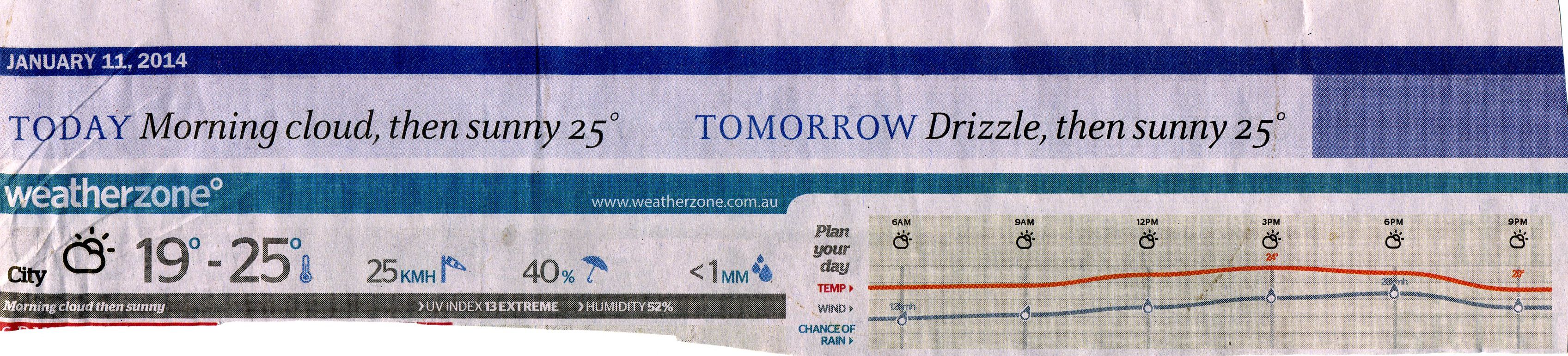
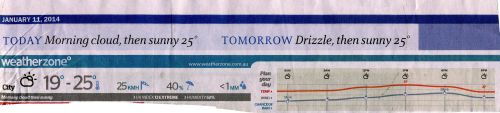
Here’s one for a pleasant summer’s day, (Saturday Jan 11)  with little variation between the minimum and maximum.

GRAPH 1 SATURDAY JAN 11
img094

My first problem is that even though the prediction shows 19 – 25, the graph  shows a high of 24 (the highest part of the graph) and a low of 20.  In every graphic, every day, the temperatures shown never match what is predicted on the left hand side of the page.

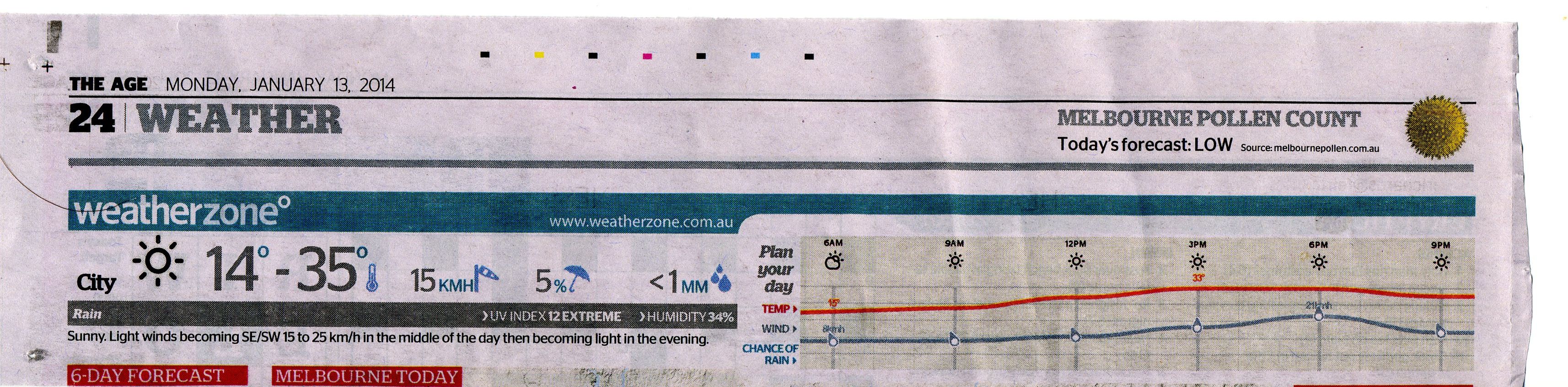
GRAPH 2 MONDAY JANUARY 13

img098

But here we are on Monday Jan 13 where the temperature more than doubles- from 14 to 35 degrees (or as the graph depicts, from 15 to 33). Here’s my second problem- wouldn’t you think that this graph with a vast range between minimum and maximum would look very different from the day where the temperature barely moves?

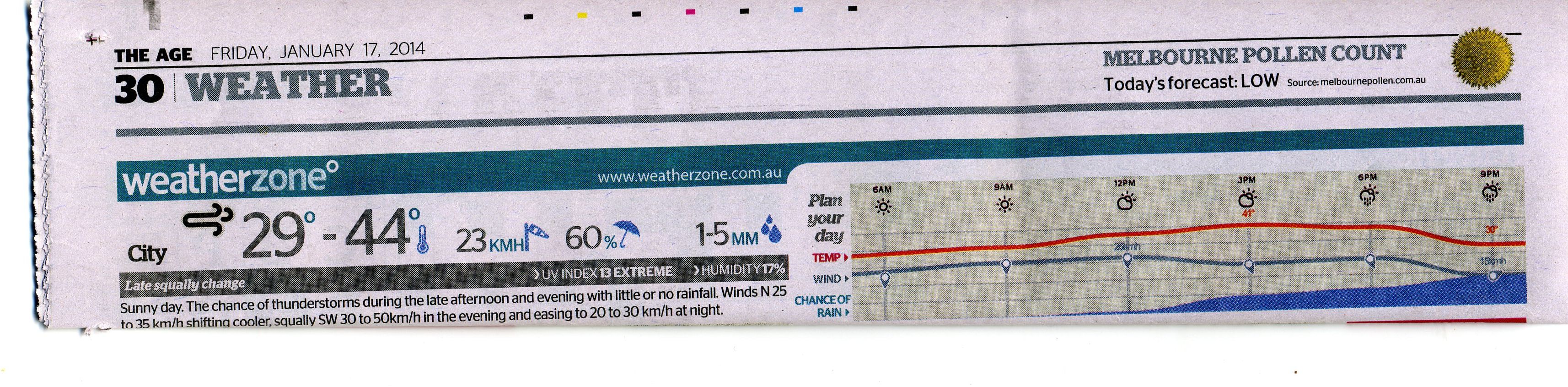
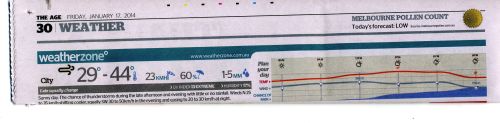
And here we are for today (Friday Jan 17) , when there’s a sharp cool change predicted tonight (alleluia!)

GRAPH 3 FRIDAY JANUARY 17
img096

To be sure, it does show a dip between 6.oo p.m. and 9.00 p.m. but it doesn’t reflect the prediction that the temperature will fall 10 degrees within an hour.  It shows a high of 41 at 3.00 pm but doesn’t indicate when it’s going to go even higher to reach 44 (and believe me, once you’re over 40, the single degrees DO matter!)

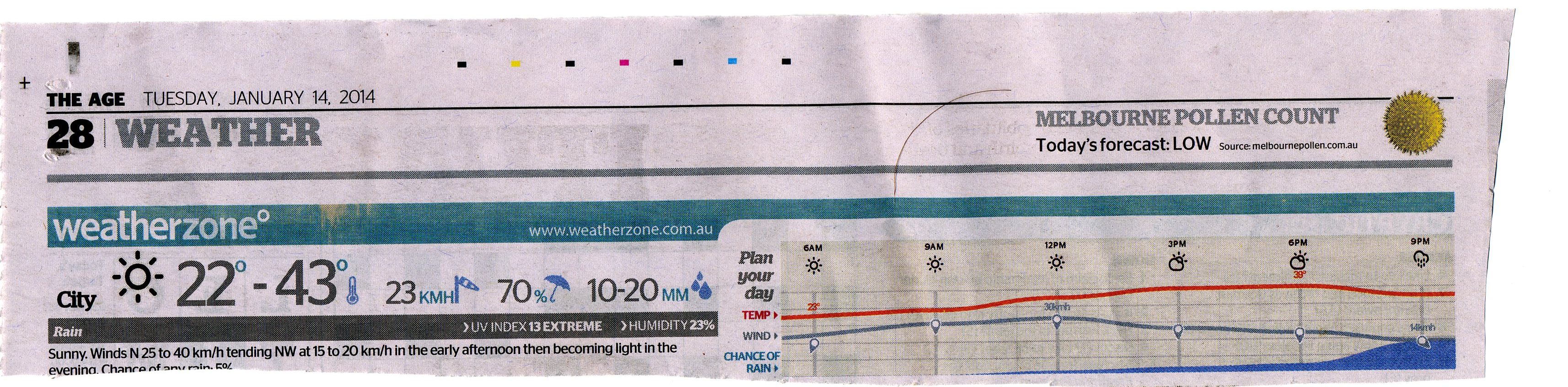
Moreover, the rain predictions confuse me. Here’s a graph from Tuesday 14th where the temperature almost doubled (which is not immediately obvious) with rain forecast in the evening with a 70% likelihood of between 10-20 mm.

GRAPH 4 TUESDAY JANUARY 14

img099

Yet if you compare the appearance of the rain prediction for the January 14th graph with today’s ( Graph 3 January 17th), it looks as if we’re due to get more rain today, yet it’s a 60% likelihood of between  1-5 mm.  If it’s only 1 mm, then it barely counts.

While I do appreciate information about the predicted time of a cool change (so that you know whether to take a cardi or not), I am bemused, confused and amused by these graphs every single morning. Gives me something to get out of bed and grumble about every day.

P.S. I wrote about the last heatwave in 2009 here, with a backward glance toward early-Melbourne commentaries on the weather.

The ‘fairytale’ is over

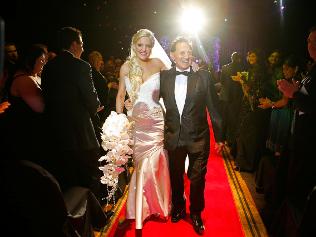
Well, who would have thunk it? Geoffrey and Brynne Edelsten’s marriage is over.

geoffrey-edelsten-brynne-gordon

Here are the wedding celebrations described with breathless enthusiasm in 2009, and here’s a rather sad analysis of the same celebration written by a guest some four years later now that it’s over.

Celebrity gossip is my rather grubby secret vice- indulged mainly at the check-out, the hairdressers and doctors with the odd furtive glance at internet links on The Age website-  and I don’t normally write about it here.  But bad hair transplant, curious suntan and Brynne notwithstanding, I do have rather a soft spot for Geoffrey Edelsten.

It was a couple of days before Christmas in 1988 (I think- might have been 1989) and I developed the mother of all sore throats.  Ye Gods- each swallow felt like a knife and I felt absolutely terrible.  I could barely open my mouth; the taste was terrible; as soon as I lay down I felt as if I was going to suffocate…. oh, it was dreadful.   In desperation I went to the walk-up 24 hour clinic in Kingsbury that was owned by none other than the famous Dr Edelsten.  I think that it must have been at the nadir of his fortunes: it was a very humble grey brick surgery in two old houses on a busy corner.  It had the chandelier, but that was about all, with threadbare carpet, hard chairs and the ubiquitous doctor’s-surgery magazines. There were no other patients, and the whole place looked rather tired and crumpled- as did the doctor himself.

It was quinsy, which sounds all very Victorian and old-fashioned.  People used to die of it- in fact, I read a description of Queen Elizabeth I’s death and even though I know that she was supposed to have died of poisoning (perhaps from her face powder), I reckon it was quinsy.  Alison Weir (Elizabeth the Queen, 1998 p.481-4) says that her final illness began with “slight swellings- probably ulcers- in the throat” and she complained to Nottingham “My Lord, I am tied with a chain of iron around my neck. I am tied, and the case is altered with me”. Apparently she just lay on cushions on the floor, “holding her finger continually in her mouth, with her eyes open and fixed to the ground”.  Well, that sounds like me Christmas 1988. Eventually Queen Elizabeth’s ulcer burst and she felt much better (although went on to die a few days later), just as mine burst on Boxing Day (and I lived to tell the tale, obviously).  Instant relief.

The good doctor made his diagnosis and gave me a hefty injection of antibiotics (there was no way that I could swallow a tablet).  And another the next morning and evening, and the morning and evening after that.  By now it was Christmas Day and there he was, alone in that surgery at 8.00 in the morning and there he was still alone in that surgery at 7.00 p.m. that night.  Not once did I see another patient there.

I’ve had quinsy a couple of times since, although never as bad as that first time- touch wood I haven’t had it for the last ten years or so.  I still get nervous at the sign of a sore throat.  I haven’t forgotten that kind doctor in his empty surgery and in spite of all that has happened to him, I feel rather sad for him.

Trains and skeins

I don’t like tagging.

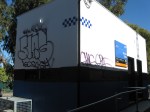
But I don’t like the PSO (Protective Services Officer) hutch at my railway station either.  It sits up against the entrance, so that everyone has to squeeze past it.  These dongas are part of a state government law-and-order policy to put armed security guards on every station after dark.  No staff, mind you, to sell you a ticket or tell you when the next train’s coming.  Just two goons with guns.  Of course, there’s nothing to do on these very quiet, deserted stations between the trains, so they need a shed. And the powers that be have decided that at Macleod, it has to be right in the doorway.  That’s nice, isn’t it?
As I said, I don’t like tagging.  It’s ugly. It’s offensive.  It’s rude.

But so is that PSO hut.

And so, with great pleasure, I see that it has been tagged.  It’s the only one on the Hurstbridge line that has been so ‘adorned’.  I hope they do it again and again and again.  And I hope that they take this ugly, offensive and rude building away.

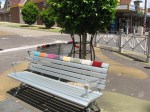
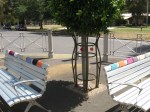
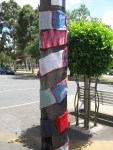
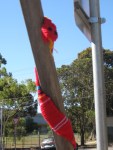
On a happier note, I see that someone who loves Macleod is yarn-bombing it.  How appropriate for Macleod- the home of the nannas.  It’s good to think that young ones are knitting away, with a sense of humour, with a light touch that harms no-one and brings only pleasure. Thank you.

The Ghost of Job Warehouse

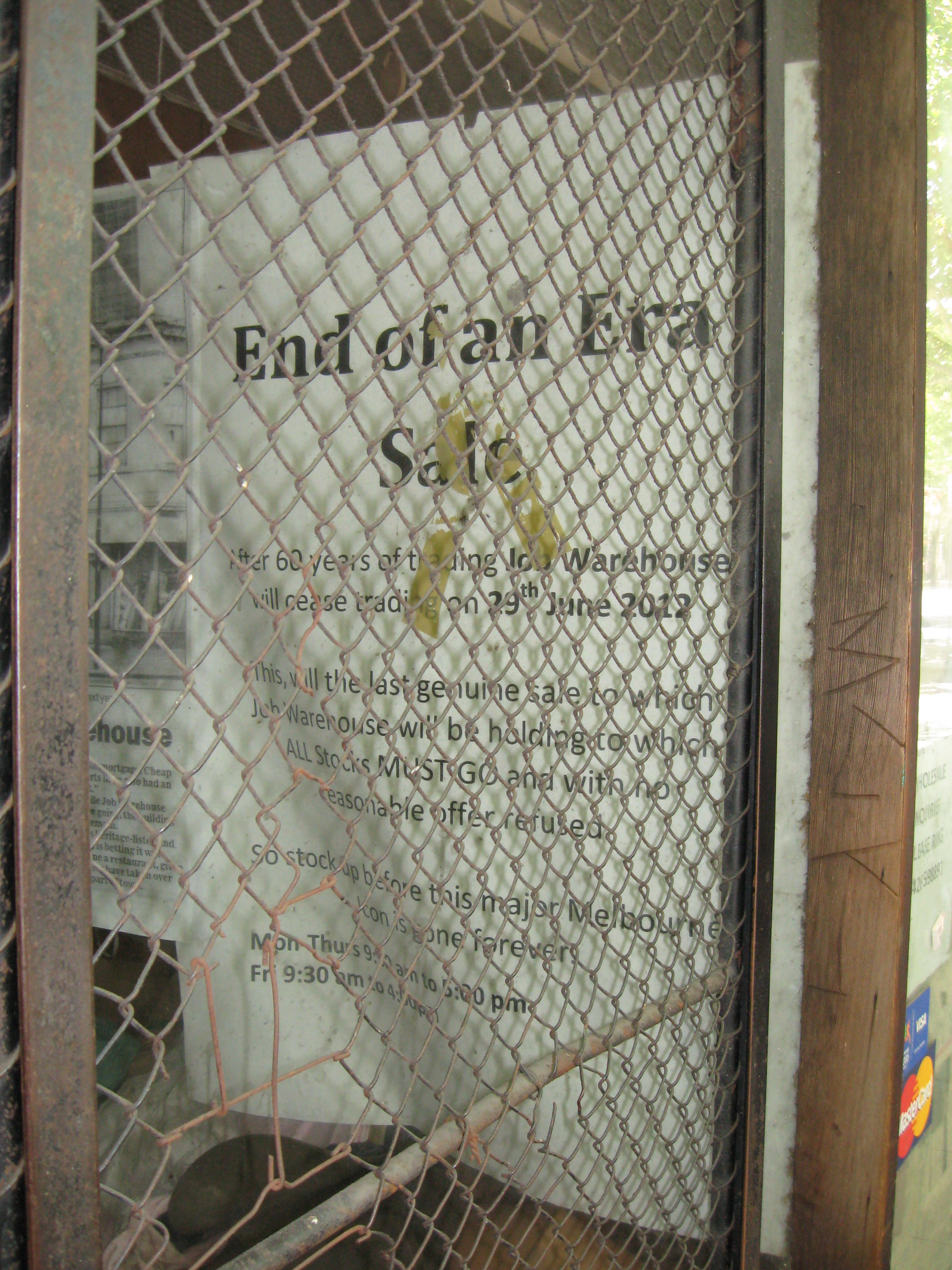
I was saddened to read some time ago that Job Warehouse was closing down.  Melburnians will know what I’m talking about: a grubby, shambolic fabric shop up the Parliament House end of Bourke Street that seems have been been there forever.

For those who have never been inside Job Warehouse, think wall to wall fabric, double the amount you were just thinking of, double it again, then arrange the bolts from floor to ceiling, from back wall to shopfront display window, with the haphazard flair of a kid playing pick-up-sticks. Think rich fabrics. Think poor fabrics. … Think the finest and the rarest. Think dead flies and the odd stray sandwich.  Think bridal, suits, opera, army. Think every type of material you’ve ever heard of then double that too… Think of a leaking masonite-patched roof.  Think colour as far as the eye can see- which in the dimly-lit clothy claustrophobia of Job Warehouse isn’t very far. [ Tony Wilson ‘No looking with the hands’ The Monthly, August 2005]

Job Warehouse (54-62 Bourke St) was spread over several shops in a double storey row that was constructed in 1848-9.  As such, it is one of a handful of pre-gold rush buildings still standing in Melbourne.  It is constructed of rendered stucco on a basalt plinth.  The western part of the building, nos. 60-62 Bourke Street, was built by a well-known butcher William Crossley as a shop, slaughter yard and residence, and the landscape artist Eugene von Guerard lived in number 56. It is registered on the Victorian Heritage Database. [Check out the pictures on the database entry]. I should feel reassured by that, but after my Banyule Homestead adventures,  I don’t.

[Click to enlarge the pictures]

I must confess that I never stepped foot inside Job Warehouse while it was open.  Two reasons: first, it was very rarely open and second, I’d heard terrifying tales about the owners.  They were two brothers, Jacob and Max Zeimer, who arrived in Melbourne in 1948 as penniless Polish refugees. All their family had perished in the Holocaust.  Their salesmanship was idiosyncratic:

“He [Mr Zeimer” took one look at me,” recalls Erin, a disgrunted shopper, “and yelled ‘Out! No browsing, just buying!” Another short-lived customer claims that in trying to access a particular material she once had to move an errant banana that had been left lying on a bolt of cloth.  She was spotted with the banana and shown the door: ‘No food in shop! You will have to leave’…..’You had to know what you wanted’ says Gaby, another regular ‘but if you were looking for individual, vintage and unusual fabrics it was the place to go.  Some of the stuff was water-damaged and rotting. Some was just beautiful’  [Tony Wilson, ‘No Looking with the Hands’ The Monthly August 2005]

There’s even a video from the Late Show where Tony Martin and Mick Molloy get kicked out and try to re-enter in typical Chaser fashion.  It starts at 3.00 minutes in and goes to 4.30.

When Max died in 1988,  Jacob continued on in the business, closing the haberdashery section that Max had run as a mark of respect.  Jacob died in 2005 aged 91.  His sons decided to close the business in 2012 and lease the building, possibly for restaurants.

IMG_5043

Well, that hasn’t happened yet.  Job Warehouse is closed but not gone completely.  Walking up Bourke Street, I was surprised that it still looked much the same, and if I pressed my face up against the grimy windows (that, to be honest, were not much grimier than when the shop was in full operation), I could see that it looks much as it always did.  There are still bolts of material, great snarls of lace, yellowing papers and dust.

Just for now, I can imagine that it’s still operational.  After all, it was always shut when I saw it, and a new owner could step right in and take over where the Zeimer brothers left off- if he or she had a mind to.

‘Streets of Melbourne’ at the Old Treasury Building

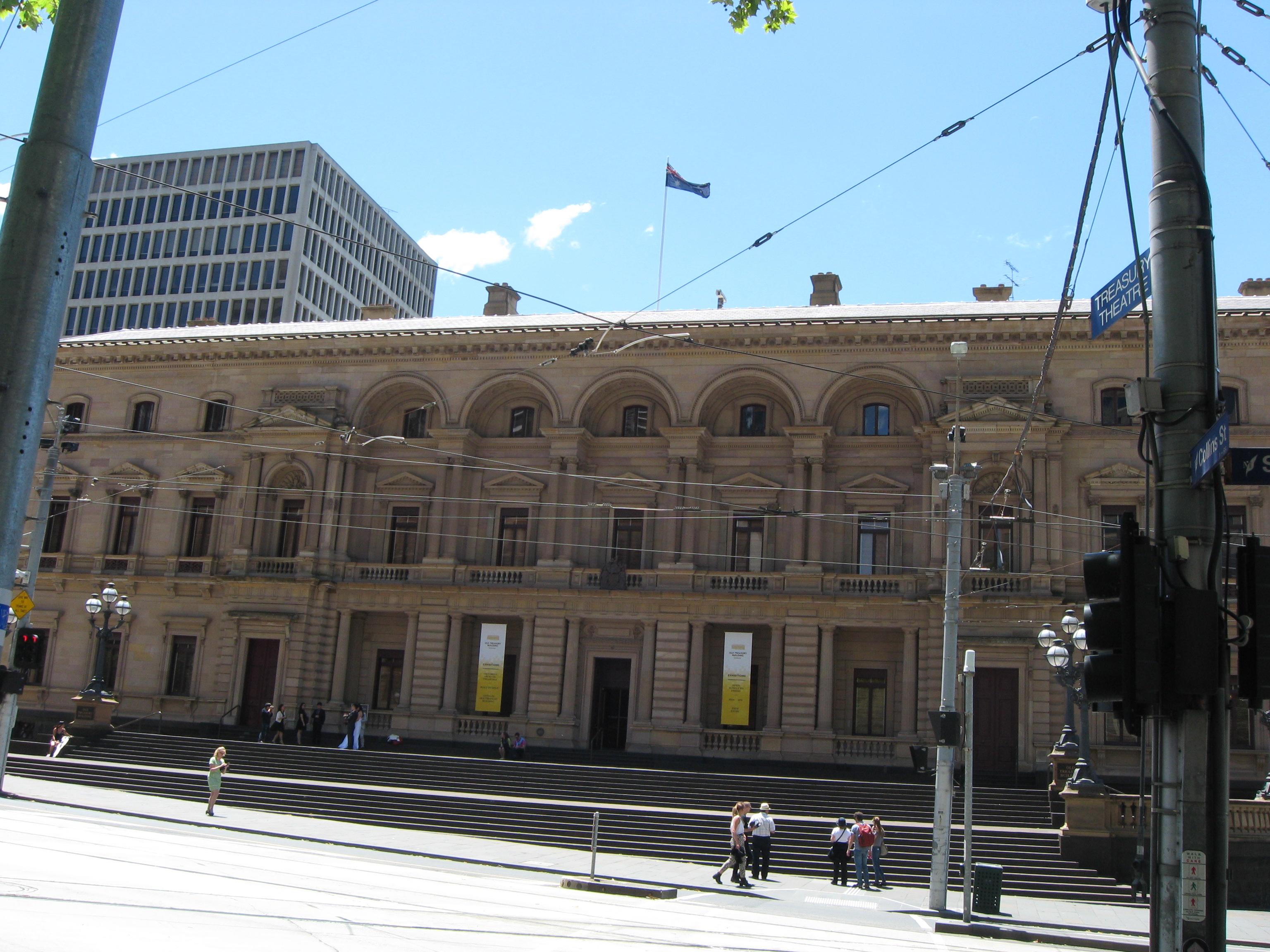
While I sometimes feel as if I am the only person who’s not away at the beach, the mountains or where-ever everyone else goes, there are some advantages in being home during the close-down around Christmas and New Year.  Off into town we went yesterday, feeling like tourists in our own town, to see the ‘Streets of Melbourne’ exhibition at the Old Treasury Building.  It’s on until May 2014, so there’s plenty of time to catch it!

IMG_5042

If you haven’t been to the museum in the Old Treasury, I strongly suggest that you pop in.  It’s FREE, it’s grown-up and it gives a much better narrative of the history of Victoria than the House of Fun that pretends to be the Museum of Victoria.  It’s open every day except Saturday between 10.00 – 4.00 each day, and its website is here.

The building itself was designed by J. J. Clark, who was only 19 when he started work on it.  It is a three-story Rennaisance Revival- style building, constructed between 1858 and 1862 at the cost of approximately 75,000 pounds.  It’s a proud building that boasts of the wealth that gold bequeathed to Victoria.  It was built to store gold in the vaults below (which you can access) and originally provided office facilities for the Governor, the Premier (then called the Chief Secretary), the Treasurer and the Auditor General.   It is still used today for Executive Council meetings.  The left hand side of the building usually has a bride or two hovering around it because it’s the home of the Victorian Marriage Registry (as you can see if you click to enlarge the image above).

We were fortunate to see the Executive Council rooms upstairs because they’re not always open. I’ve obviously been dwelling in pre-Responsible Government days for too long, because I’m rather ashamed to admit that it hadn’t occurred to me that there even IS an Executive Council any more.   In Port Phillip during Judge Willis’ time (i.e. prior to Separation), the executive council of New South Wales consisted of about 5-7 men, all appointed by the Crown and on the Executive Council by virtue of their substantive positions i.e. the Governor himself, the Commander-in-Chief of the Forces, the Lord Bishop of Australia, the Colonial Secretary, the Colonial Treasurer, the Chief Justice and the Attorney General.   You don’t tend to hear much about it, because the Legislative Council was much more significant in the granting of Responsible Government.   But here we are, 170 years on in the separate state of Victoria, and the Executive Council, which meets in this room,now  consists of the governor and the senior ministry (although I do wonder how they all crowd around the table).  It was pleasing to see photographs of the current-day Executive Council with both men and women, compared with the rather dour and serious men-in-suits in some of the older pictures in the corridor outside.

The exhibition of early Melbourne paintings is also on the first floor.  You can only see them through a tour (Mondays 2.00pm. from Jan 20th or other times by appointment $8.00). I purchased the catalogue because there’s images there that I have never seen before.  Many of them are from the Roy Morgan Research Centre collection.

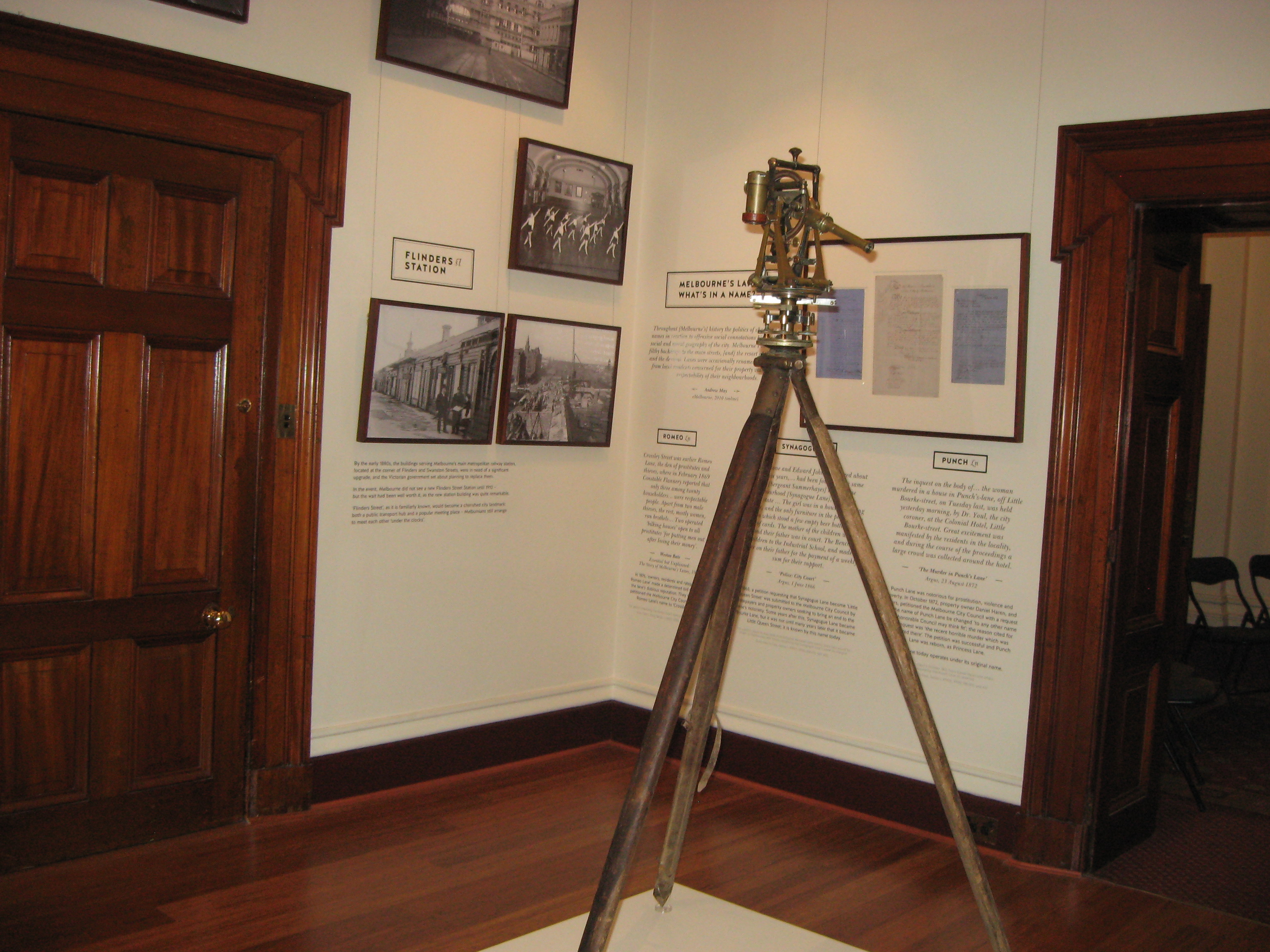
The museum downstairs has a large permanent display, but the first two rooms have special displays, and at the moment it’s of the streets of Melbourne, with an emphasis on the Hoddle Grid.  There are some fascinating maps there, and various surveying instruments and artefacts.

IMG_5040

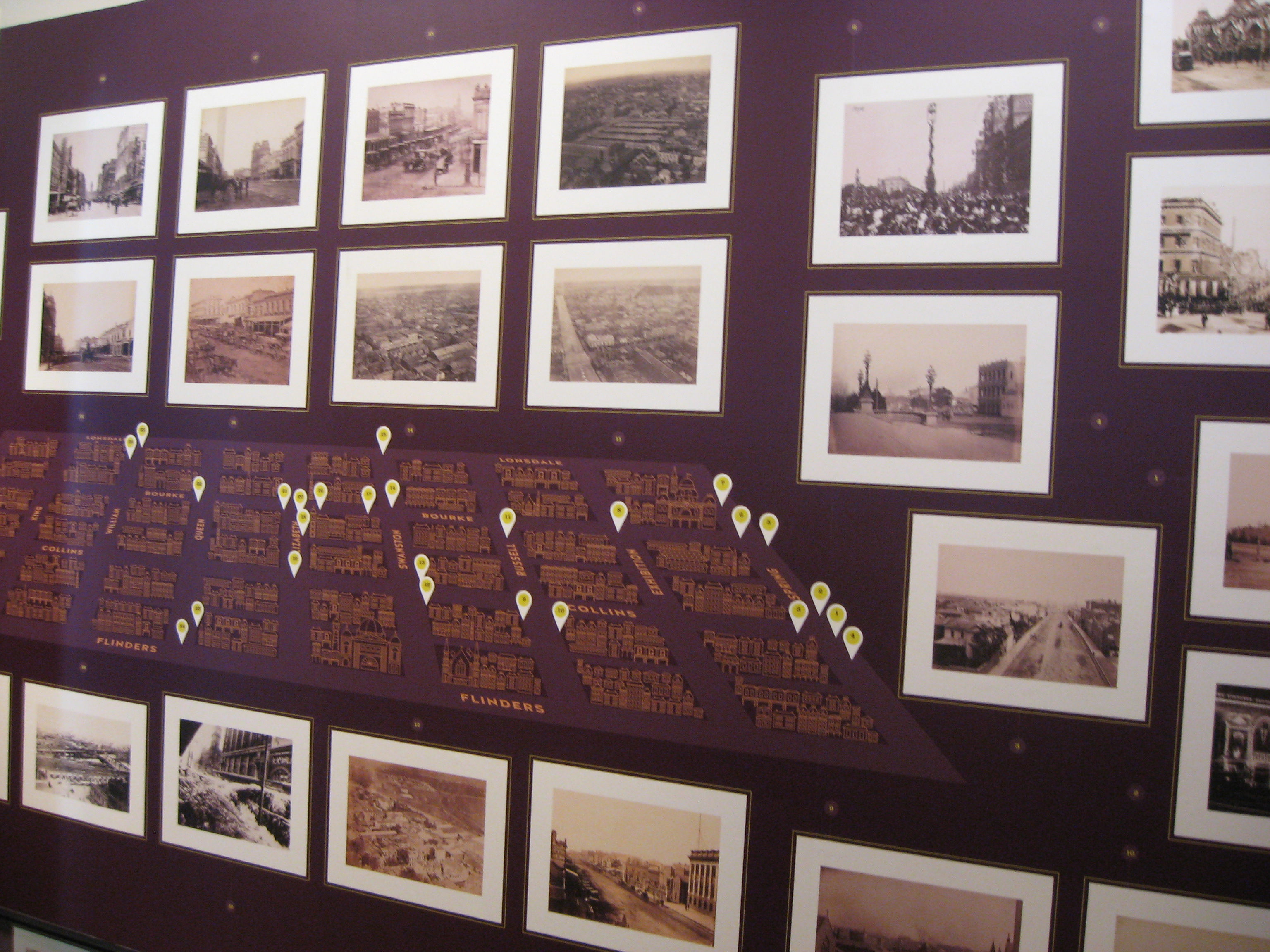
We probably spent 90 minutes poring over a large map of the grid on the wall that has numbered street scape photos surrounding it.  There were photographs that I hadn’t seen before here as well, and we spent much time picking out buildings and arguing about which direction the photograph was taken from  (a compass and directional arrows on the map, which we suggested, would resolve such disputes!)

IMG_5041

This is a fantastic museum and I’m pleased that it has survived and is still free after the earlier City Museum closed there.  You can see (and purchase) a terrific video of a trip on a cable car just before it closed during WWII, the exhibitions change frequently, and there’s actually something real in the museum to see,  as distinct from a series of ‘experiences’ and ‘immersions’ that we seem to be fobbed off with in museums these days.

New Year spiel on e-reading

It must be part of the New Year dearth of news, but I seem to have read a couple of articles recently about e-reading.  No, not the flogged-horse “Is Print Dead?” article.  The ones I’m thinking about are not so much about the effect of screen reading on the reader,  but more about the way that screen reading has  changed the writing itself, and may continue to do so in the future.

Off on a bit of a tangent was an article from The Conversation website called Will TV series go the way of Charles Dickens?  Michelle Smith from Deakin University turns back to the serialized form of nineteenth century British fiction which was published chapter by chapter, with a cliff-hanger at the end of each instalment to ensure that the reader purchased the next issue.  Television series used to be like this, too, she argues – until boxed sets and internet streaming means that viewers can gorge on  a whole season (and even multiple seasons) at one or more (lengthy) sessions.  She wonders if, just as the serialized periodical-versions of 19th century books were condensed and the cliff-hangers removed once they were published in one volume:

We can only speculate on the future of television now that traditional methods of broadcast have shifted so dramatically. Yet it is likely that these changes in how we consume television will have some effect on the content we watch in the same way as shifting patterns of print publication altered the very nature of popular fiction in the 19th century.

Related to this, on the same Conversation website, is another article entitled A good year for screen readers: notable ebooks of 2013.  Zoe Sadokierski from UTS nominated three ebooks that have used the digital format to do something that print could not.  The first, The Silent History was first published in serialized form, one chapter a day, just as the 19th century novels above were. Now that the whole book has been released, it can be purchased as a complete work.  The chapters are supplemented with video content and user-generated reports.  The second, Gimbal is a short story anthology where you can select the story you want according to the amount of time you have to read it, by genre, or by setting. Maps and pictures support the stories set in a particular city.  Finally, she nominated Interaction of Colour, which was originally written in 1960 and has been re-released in hardcover version (at a rather eyewatering price!) You can tap on hotspots for definitions; there are video and audio commentaries; and there are interactive activities to complete.  It does sound a bit textbook-y to me, but obviously the images are beautiful and the crystal-clear screen of an ipad would do them justice.  We heard a lot about ‘convergence’ a few years ago, but these three examples all affirm for me the blend of ‘reading’ and ‘viewing’ that was predicted with e-readers and screen-based reading technology.

Finally, and rather depressingly, is a short segment from an ABC radio program called Who’s reading the reader? which can be streamed or read from the transcript.  Apparently digital libraries can track your reading behaviour and the data can be used to provide feedback to authors.  The information could show the point at which readers abandon a story, or jump ahead, or go back a few pages to re-read.  If readers return to favourite characters or scenes, they could be brought into a spin-off story.   Ah, it’s all about the ‘product’ and ‘delighting the consumer’, isn’t it?

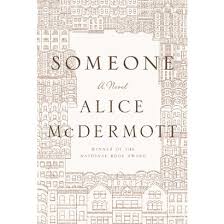
‘Someone’ by Alice McDermott

someone

2013, 232 p.

I hadn’t heard of the book; hadn’t heard of the writer. Don’t know why I picked it up from the library shelf, but I’m really glad that I did.  It’s a very auspicious way to start my reading year.

‘Someone’ is such an ordinary, anodyne term. “Who’s going to love me?” asks the main character, Marie, after she has been dumped by her boyfriend. “Someone,” says her brother “Someone will.” 

‘Someone’ sounds interchangeable and generic, but what we have been given in this book is a very particular consciousness within an otherwise ordinary, unremarkable person.  We first glimpse Marie as a child, in thick glasses, sitting on the stoop of her Brooklyn home in the 1930s, waiting for her father to emerge from the subway on the way home from work.  We see her life in shards, rather than one continuous narrative.  We see her as an old woman, new mother, worker in her first job, middle aged sister.  She is utterly, lovingly human.

Such beautiful writing.  Here she is, frantic with grief as her first boyfriend breaks up with her:

I sat on the edge of the bed.  I wanted to take my glasses off, fling them across the room.  To tear the new hat from my head and fling it, too.  Put my hands to my scalp and peel off the homely face.  Unbutton the dress, unbuckle the belt, remove the frail slip.  I wanted to reach behind my neck and unhook the flesh from the bone, open it along the zipper of my spine, step out of my skin and fling it to the floor.  Back shoulder stomach and breast.  Trample it.  Raise a fist to God for how He had shaped me in that first darkness: unlovely and unloved. (p. 79)

Darkness and light are motifs that are touched on in several places in the book.  Blind Bill Corrigan sits on a chair out in the street as the children play around him, and Marie herself suffers from poor eyesight and nearly goes blind herself.  Afraid of the dark as a child, the light is left on while she falls asleep and she wakes to “the soft-edged geometric patches of streetlight on the ceiling, across one wall.”  Woken by a bad dream as an adult, “the walls of the room were lit with lozenges of streetlight, long rectangles and a thin cross”.

Marie does not travel far in her life: from Brooklyn to Long Island.  Place has bound her to people forever as they move in and out of her life.  When blind Bill Corrigan dies, a childhood friend- more than a childhood friend really,- reappears at the wake and recalls Bill Corrigan sitting on the chair:

“Remember that chair he sat in every day?”

I nodded. “I was just thinking about it” It might have been the first time in my life I understood what an easy bond it was, to share a neighbourhood as we had done, to share a time past. “It’s still there, ” I added, as if this should amaze him. “At least it was there this morning.  No one’s had the heart to take it in.”  (p 140)

In some ways the book reminded me of A Tree Grows in Brooklyn with the Irish-American family in the same neighbourhood.  However, this book shucks off any attempt to be chronological as it jumps from childhood to old age, back and forth.  Events occur, sometimes foreshadowed and other times echoing on. McDermott’s control of the narrative is masterful- there’s not a word wasted, and connections emerge as discoveries, unforced and unlaboured.

It’s only a short book- just over 200 pages.   It says much, but it is stripped down and pure.  Beautiful.

My rating: Is it too early on 1 January to give a 10?

Sourced from: Yarra Plenty Regional Library

Read because: it was just there on the ‘new books’ shelf.  What a find!

Australian Women Writers Challenge 2013 completed!

awwbadge_2013

Well, as the year draws to a close I learn that the Australian Women Writers Challenge is gearing up again for 2014.  Will I gird up again? Probably.

I nominated myself for the ‘Franklin’ level (read 10, review 6) and exceeded that. I also vowed to focus on female historians in particular.   Here are my reviews, and yes, this is why I haven’t finished my thesis.  “But it’s all FEEDING the thesis” I bleat in self-defence.

Fiction

Susan Johnston ‘My Hundred Lovers’

Margo Lanagan ‘Sea Hearts’

Cate Kennedy ‘Like a House on Fire’

Amy Espeseth ‘Sufficient Grace”

Kate Grenville ‘Sarah Thornhill’

Courtney Collins ‘The Burial’

Drusilla Modjeska ‘The Mountain’

Janette Turner Hospital ‘The Ivory Swing‘

Histories and Life Writing

Gillian Bouras ‘A Stranger Here‘

Kim Torney ‘Babes in the Bush: The Making of an Australian Image’

Pamela Burton ‘From Moree to Mabo: The Mary Gaudron Story’

Bev Roberts ‘Miss D and Miss N’

Janet Butler ‘Kitty’s War’

Yvonne M. Ward ‘Unsuitable for Publication: Editing Queen Victoria’

Lynette Russell ‘Roving Mariners’

Desley Deacon, Penny Russel and Angela Woollocott (eds) ‘Transnational Lives: Biographies of Global Modernity 1700-Present’

Susan Mitchell ‘All Things Bright and Beautiful’

Suzanne Falkiner ‘Eugenia: A Man’

Barbara Caine ‘Biography and History’

Christine Wright ‘Wellington’s Men in Australia’

Sheila Fitzpatrick ‘A Spy in the Archives’

Alice Pung ‘Unpolished Gem’

Judith Lucy ‘The Lucy Family Alphabet’

Kirsten McKenzie A Swindler’s Progress